Tag Archives: scent

Scent detection dogs sniffing out a critically endangered orchid

Three spaniels, an orchid in hiding, and an innovative technique that could change how Saving our Species monitors elusive species.

Trying to save a species that’s hard to find is a problem many conservationists face. Imagine the challenge when a species spends most of its time lying dormant beneath the earth’s surface.

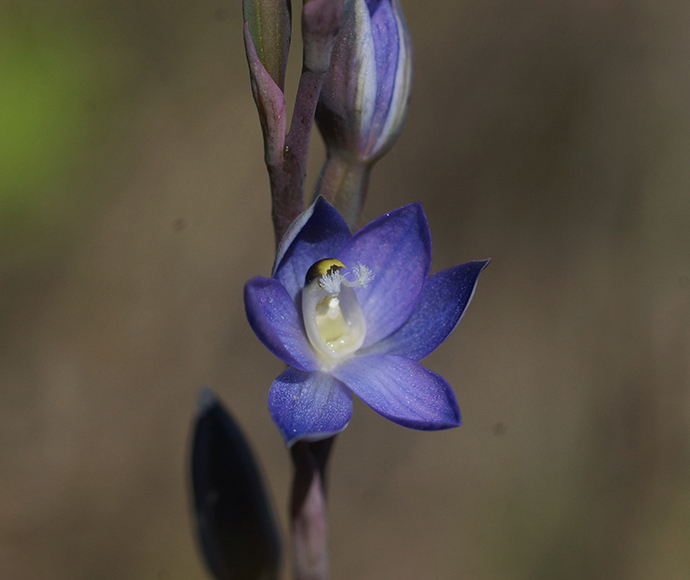
The critically endangered Wyong sun orchid (Thelymitra adorata) is one of these hidden species. It is hard to see unless it’s flowering, which makes monitoring a difficult task.

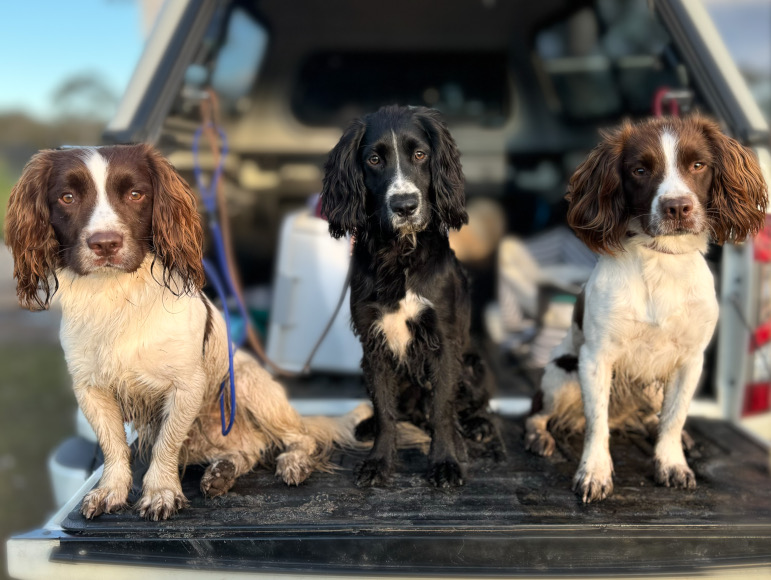
Three clever canines (Paddy, Sully and Vera) are being trained to use their strong sense of smell to help find this orchid. While the use of scent detection dogs is not new to conservation, this is the first time they have been used for Wyong sun orchid monitoring. It’s a trial that could mark the start of a game-changing method.
Hard-to-detect tubers

A tuber is a specialised plant stem that occurs underground, storing a lot of a plant’s nutrients. It exists in a type of hibernation mode. During this ‘resting’ phase, you could walk right over a tuber and never know it. When conditions above ground are favourable, a tuber will sprout and push through the soil, producing a plant that conservationists can finally see.

However, for the Wyong sun orchid’s tubers, the right conditions for emerging include the presence of fire (much like humans in winter). Imagine how much easier monitoring would be if conservationists could detect this plant without having to wait for these conditions.

A less invasive, innovative method

Thanks to a partnership between Saving our Species and dog training organisations On the Scent and The Good Dog, the team are one ‘sniff’ closer to detecting this species while it is sleeping.

‘If successful, this method may enable a year-round survey window, give greater certainty of survey results and assist in planning conservation actions, such as targeting areas for controlled burns’, said Paul Hillier, a senior regional conservation officer for Saving our Species.

‘Until now, the only way to find the Wyong sun orchid is by identifying the flower or leaf, whereas the dogs will attempt to find the plant by scenting the tubers under the ground in a minimally invasive way’, said Mel, owner and dog trainer, The Good Dog.

This unique partnership is expanding opportunities to conserve this critically endangered species, and if successful, may provide the basis for detecting other cryptic species in the future.

‘Both The Good Dog and On the Scent believe that supporting threatened species conservation is important to ensure they remain and repopulate in their habitat for years to come and don’t become just another item added to the extinction list’, said Philly, owner and dog trainer, On the Scent Canine Detection.
The project is also in collaboration with Australian Botanic Garden Mount Annan and Central Coast Council.

Source: NSW Environment and Heritage

How dogs see with their noses

This post isn’t some reference to a scientific journal – it’s a YouTube video.

I hope you enjoy it and learn a little something about your dog’s gift of smell…

Kathleen Crisley, specialist in dog massage, rehabilitation and nutrition/food therapy, Canine Catering Ltd, Christchurch, New Zealand

Scent of my human

The functional MRI research team led by Gregory Berns have done it again.  In research published in the journal Behavioural Processes, they show that an area of the canine brain associated with reward responds more strongly to the scents of familiar humans than it does to the scents of other humans, or even to those of familiar dogs.

Kady, a lab involved in the study, shown training for the experiment in a mock-up fMRI scanner.  Photo by Helen Berns

Kady, a lab involved in the study, shown training for the experiment in a mock-up fMRI scanner. Photo by Helen Berns

“In our experiment, the scent donors were not physically present. That means the canine brain responses were being triggered by something distant in space and time. It shows that dogs’ brains have these mental representations of us that persist when we’re not there.”

When humans smell the perfume or cologne of someone they love, they may have an immediate, emotional reaction that’s not necessarily cognitive, Berns notes. “Our experiment may be showing the same process in dogs. But since dogs are so much more olfactory than humans, their responses would likely be even more powerful than the ones we might have.”

The experiment involved 12 dogs of various breeds. The animals had all undergone training to hold perfectly still while undergoing an fMRI scan. As they were being scanned, the subjects were presented with five different scents that had been collected on sterile gauze pads that morning and sealed in Mylar envelopes. The scent samples came from the subject itself, a dog the subject had never met, a dog that lived in the subject’s household, a human the dog had never met, and a human that lived in the subject’s household.

The familiar human scent samples were taken from someone else from the house other than the handlers during the experiment, so that none of the scent donors were physically present.

The dog scents were swabbed from the rear/genital area and the human scents were taken from armpits.

The results showed that all five scents elicited a similar response in parts of the dogs’ brains involved in detecting smells, the olfactory bulb and peduncle. The caudate responses, however, were significantly stronger for the scents of familiar humans, followed by that of familiar dogs.

“The stronger caudate activation suggested that not only did the dogs discriminate the familiar human scent from the others, they had a positive association with it,” Berns says. “While we might expect that dogs should be highly tuned to the smell of other dogs, it seems that the ‘reward response’ is reserved for their humans. Whether this is based on food, play, innate genetic predisposition or something else remains an area for future investigation.”

An interesting twist: The dogs in the experiment that had received training as service/therapy dogs showed greater caudate activation for the scent of a familiar human compared with the other dogs. It is unclear whether this difference was due to genetics or had simply been fostered through the service/therapy training.

“We plan to do further research to determine whether we can use brain-imaging techniques to better identify dogs that are optimal to serve as companion animals for the disabled,” Berns says.

The training of service dogs is time-consuming and expensive, he says, and only about one-third of the animals that begin the process successfully complete it. Meanwhile, the waiting list for service dogs is long, and includes many wounded veterans.

“In addition to serving as companion animals for wounded veterans, dogs play many important roles in military operations,” Berns says. “By understanding how dogs’ brains work, we hope to find better methods to select and train them for these roles.”

Source:  Emory University media release

Read my other blogs about functional MRI research: