Tag Archives: science

Do sterilized dogs live longer?

New research from the University of Georgia suggests that neutering procedures could add to the length of a dog’s life and alter the risk of specific causes of death.

Looking at a sample of 40,139 death records from the Veterinary Medical Database from 1984-2004, researchers determined the average age at death for intact dogs—dogs that had not been spayed or neutered—was 7.9 years versus 9.4 years for sterilized dogs.

These figures may seem low considering how many pets live much longer, but the researchers noted that the life spans would be lower than those seen more widely because their sample was taken from dogs seen at teaching hospitals (so other things would have been going on and the study population would have had more sick animals).

The researchers stand behind their results – that the difference between neutered and intact is real.

Dr. Kate Creevy, an assistant professor of internal medicine at the College of Veterinary Medicine. “The question that raises is why would you die younger if you have offspring?”

For the first time, researchers have been able to measure costs of reproduction in terms of the actual causes of death, finding that the causes of death differed between sterilized and intact dogs. Dogs who had undergone a gonadectomy (a spay or castration) were more likely to die from cancer or autoimmune diseases. Those in the sample who still had functional reproduction systems at death were more likely to die from infectious disease and trauma.

“Intact dogs are still dying from cancer; it is just a more common cause of death for those that are sterilized,” said Jessica Hoffman, a UGA doctoral candidate in the Franklin College of Arts of Sciences who co-authored the study.

Some of the reproductive hormones, particularly progesterone and testosterone, she said, could suppress the immune system, explaining why there is an increased risk of infection among dogs that have been sterilized.

The full journal article, published in PLoS One, can be viewed here.

Source:  University of Georgia media statement

Pet obesity at the molecular level

A University of Illinois research team led by Professor Kelly Swanson has published research which describes how nutrients and biological compounds in foods can affect gene expression in animals.

The research will help to understand the underlying reasons for obesity in pets.  Professor Swanson explains that obesity has its roots in the domestication of dogs.  Because dogs no longer hunt or compete for their food and are speyed or neutered (so not having to mate),  the typical dog has much smaller energy requirements than its forefathers.

The research team explains that when more energy (food) is consumed than is required, it is stored as fat in the adipose tissue (fat tissue).  Adipose tissue secretes more than 50 substances known as adipokines, which are cell-signaling molecules that are involved in metabolism, immunity and inflammation.

In obese dogs, levels of the adipokine leptin increases while the levels of the  adipokine adiponectin decreases.

The researchers aim to study obesity at the molecular level, so they can help to prevent it happening.

Source:  University of Illinois media statement

Understanding your dog’s fear of noise

Researchers from the University of Bristol School of Veterinary Sciences have investigated the occurrence of anxiety from exposure to noise and the risk factors for these behaviours.

Almost half of the owners who were interviewed reported that their dog showed at least one behavioural sign typical of fear when exposed to noises such as fireworks, thunder and gunshots, even though only a quarter had reported their dog as ‘fearful’ of noises.

scared dog of fire works

This suggests that while owners are aware of their pet’s behavioural response when exposed to a loud noise, they do not necessarily recognise this as being indicative of fear or anxiety.

And when owners don’t recognise anxiety, they don’t seek help for it.  Less than one-third of dog owners sought help for their dog’s anxiety.

The most commonly reported behavioural signs were vocalising, trembling/shaking, hiding, and seeking the comfort of people.  Since trembling and shaking are human responses to fear and anxiety, it seems like these behaviours were recognised more easily.

Other behavioural signs, such as decreased activity or salivation, did not appear to be recognised as often (possibly resulting in under-reporting). Also, signs of urination, salivation and destruction may make owners disappointed or angry, and this may over-ride the association with anxiety.

Risk of anxiety induced by noise increased with age and origin.  If dogs lived with the owner who bred them, they had a reduced risk compared to dogs purchased from the breeder by a second owner.  The researchers suggest a dog’s early life experience is an important factor in the development of fear response.

The researchers recommend there is a need for veterinarians to increase awareness among the general dog owning public about anxiety induced by loud noises and to direct them towards appropriate sources of help.  (By the way, I’ve worked with dogs using a programme of de-sensitization and relaxation techniques to help treat anxiety).

Source:  University of Bristol media statement

I know you!

Research published in the journal of Animal Cognition shows that dogs pick out faces of other dogs, irrespective of breeds, among other faces.   They can group them into a category of their own and do so using only visual cues.

The authors of the study have concluded “The fact that dogs are able to recognize their own species visually, and that they have great olfactory discriminative capacities, insures that social behavior and mating between different breeds is still potentially possible. Although humans have stretched the Canis familiaris species to its morphological limits, its biological entity has been preserved.”

Apparatus. a, b The dog sits in front of the experimenter, on a line between the 2 screens. c When hearing an order, the dog expressed his choice by going to a given screen and putting his paw in front of the chosen image. (Credit: Image courtesy of Springer Science+Business Media)

Apparatus. a, b The dog sits in front of the experimenter, on a line between the 2 screens. c When hearing an order, the dog expressed his choice by going to a given screen and putting his paw in front of the chosen image. (Credit: Image courtesy of Springer Science+Business Media)

The authors of the research explored whether the large range of diversity in the size and shape of dogs presented a ‘cognitive challenge’ to dogs trying to recognize their species, when confronted with other species.

On a computer screen, the researchers showed nine pet dogs pictures of faces from various dog breeds and cross-breeds, and simultaneously faces of other animal species, including human faces. They exposed the dogs to diverse stimuli: images of dog faces; images of non-dog species from 40 different species, including domestic and wild animals; and humans. Overall, the dogs were shown more than 144 pairs of pictures to select from. The authors observed whether the nine dogs could discriminate any type of dog from other species, and could group all dogs together, whatever their breed, into a single category.

They did.

Source:  Springer.com

Dogs and history: blood transfusions

A little bit of history in this post.  Did you know that the dog had a key role in the development of blood transfusion technology in humans?

Unfortunately, this is a story of animal experimentation.

blood tranfusion bag

In the early 1600s, an English physician named William Harvey explored the circulatory system and declared that ‘blood must continuously circulate.’  For the next 50 years, more work was done to understand the circulatory system.  Dogs were unfortunately chosen for animal experimentation and they were injected intravenously with a range of fluids including opium, wine and ale.

In 1665, English physician Richard Lower drained the blood out of a dog almost to the point where it had no blood volume left and was on the verge of death.  He then took a larger dog and replaced the blood supply.  (Poor dogs)

If you are really interested in the topic of human blood donation, this Science Show video on YouTube explains the whole history of human blood donation…

Researcher calls for monitoring of diseases in dogs and cats

Professor Michael Day of the School of Veterinary Sciences in Bristol, UK,  is the lead author in an article that recommends global monitoring of diseases in dogs and cats.  While it is known that many human diseases originate in animals, only diseases in livestock are currently monitored.

Professor Day makes the case that because cats and dogs are integrated into our lives and share our households, the potential for introduction of new zoonotic diseases exists.  He says:

‘The number of small companion animals is significant.  For example there are an estimated eight to ten million dogs living in up to 31 per cent of UK homes and in the USA, 72 million dogs in 37 per cent of homes. 

In developed countries the relationship between man and dogs and cats has deepened, with these animals now closely sharing the human indoor environment.  The benefits of pet ownership on human health, well-being and development are unquestionable, but as dogs and cats have moved from the barn, to the house, to the bedroom, the potential for disease spread to humans increases.’

Any new monitoring system will require resources and funding and the political will to see it established.  At a time when the global economy is struggling, one can be skeptical about whether there is a chance of seeing this recommendation become a reality.

You can read the article in the Emerging Infections Diseases journal  here.

Source:  University of Bristol media release

Photos to warm your heart

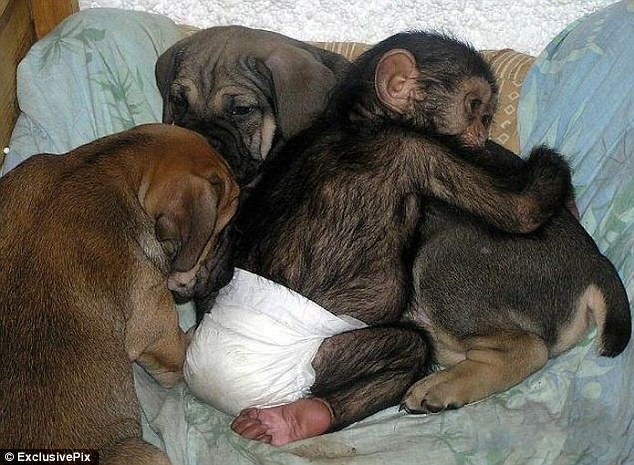
As we start the Labour Day weekend here in New Zealand, I thought I’d share these photos of a Mastiff who is helping to raise a chimpanzee in Russia.

The chimp didn’t bond with its mother and so a zookeeper took it home because her Mastiff had just given birth to pups.  As you can see from the photos, the chimp settled right in and mimics the puppies’ behaviour.

Enjoy your weekend whether it’s a long one or not!

Can you give your dog the flu?

The answer is ‘yes’ but the risk and mode of transmission is poorly understood.

Researchers at Oregon State University and Iowa State University are studying reverse zoonosis.  This is where disease goes from human to animal (rather than animal to human).  There are documented cases of H1N1 being transmitted to 13 cats and 1 dog in the 2011-2012 period.

The research team is looking for more cases of human to animal transmission so they can better understand the risks to public health.  “It’s reasonable to assume there are many more cases of this than we know about, and we want to learn more,” researcher Christiane Loehr said.   “Any time you have infection of a virus into a new species, it’s a concern, a black box of uncertainty. We don’t know for sure what the implications might be, but we do think this deserves more attention.”

Any new movement of a virus from one species to another is a concern because viruses mutate and they can mutate into more virulent or easily transmittable forms.

If you think you have the flu, it’s probably a good idea to respect good hygiene practices with everyone in the household and that means keeping your distance from your dog as well.  And if someone in your household has been unwell with influenza and your dog is experiencing respiratory symptoms, a visit to your vet is recommended.

Source:  Oregon State University press release

Laika the space dog

Sky TV (our cable channel) has been airing the film Apollo 13 for the millionth time and so, as my mind wanders, I started thinking about the first dog in space.

Her name was Laika, which means Barker in the Russian language.  She was found as a stray dog but ultimately was sent into orbit on Sputnik 2 on November 3, 1957.

A photo of Laika in her specially designed space capsule

Her successful launch into space was the subject of a lot of fanfare and heralded as an achievement by the Russian space programme.  Over the years, her launch into space was celebrated in a range of postage stamps from around the world.

This slideshow requires JavaScript.

Back in 1957, people were told that Laika lived almost a week in space before dying a painless death.  In 2002, those facts were disputed at the World Space Congress in Houston, Texas, by Dimitri Malashenkov of the Institute for Biological Problems in Moscow.

He reported that Laika died from overheating and panic just a few hours after the mission started.

Dr Malashenkov  revealed several new details about Laika’s mission at the conference, including that the dog was chained to prevent her turning around and that her food was prepared in a jelly format for space travel.  There was a carbon dioxide absorbing device in the cabin to prevent the accumulation of this toxic gas as well as an oxygen generator (similar to what was used in Apollo 13).

Medical sensors attached to Laika showed that her heart rate increased by to 3 times its resting rate during the launch.   Other sensors showed that temperature and humidity increased as the space ship attained orbit.  Within five to seven hours of flight, mission control in the Soviet Union stopped receiving life signs from Laika.

Laika achieved a place in history for her flight into space, which proved that life forms could survive (with support) in orbit.  Unfortunately for Laika, she lived in a time when animal experimentation was an accepted norm.
Source:  BBC News

Dog intelligence

Most dog owners have an opinion about their dog’s intelligence.  I regularly hear comments like, “He’s so smart, he’s ahead of the rest of his obedience class” or “He’s not very bright, but we love him.”

 When I was working on my management qualification years ago, we were told to go home and ask our partner/flatmate about how they solved problems.  Ebony, my Labrador flatmate at the time, came up with these tips, which I thought were very intelligent:

  1. Remember that chasing your tail does not get you anywhere.  It also makes you dizzy and less able to focus on the task at hand.
  2. Eat regularly and often.  Problem solving is hard work and requires energy.
  3. Don’t underestimate the value of a nap.  A problem looks different after you’ve had a good sleep.
  4. If you stare at a problem long enough, it might move on its own.
  5. Don’t be afraid to ask for help.  Try looking cute.
  6. If looking cute doesn’t work, try whining.
  7. If whining fails, loud retching noises are guaranteed to get the attention of those around you.
  8. Some problems soften over time.  Burying them in the garden hastens this process.
  9. Some problems require more immediate attention.  An immediate problem, if left unattended, is likely to result in a much more smelly mess to be cleaned up later.

There are many published works on the subject of dog intelligence.  Over the years, I’ve read countless research studies into this subject.  There are many institutions involved in the research.  All projects have the goal of understanding how dogs think.

Professor Stanley Coren of the University of British Columbia has authored several books about dog intelligence.  He states that dogs have the intellectual capacity of a two-year old and can understand more than 150 words.[1]

Researchers at the Max Planck Institute for Evolutionary Anthropology have studied the ability of dogs to interpret human gestures.  When researchers hid food beneath one container in a group and pointed to the ‘right’ container, dogs consistently picked up on those cues better than even chimpanzees (a species widely studied because of the evolutionary link between apes and humans).

Earlier this year, a research team at the University of Otago reported on their study that showed that dogs could readily distinguish happy human sounds from sad or angry ones, suggesting an ability to understand human emotions.

Even the dog toy market has recognised that dogs need mental stimulation.  The Nina Ottosson range, for example, offers a range of skill level toys designed to make your dog think about how to reveal their food reward.

Daisy demonstrates her intelligence with a Nina Ottosson toy

Despite all of this evidence, including videos of my Daisy using her interactive toys, many of the non-dog people in my life remain unconvinced about the intelligence of dogs.  I believe that persistence will pay off.  Over time we will see more and more research about the intellectual capacity of our dogs.  The non-believers will become believers.


[1] Science Daily, 10 August 2009