Tag Archives: service dog

With a nuzzle, paw and kiss, dogs offer a potent antidote to human loneliness

Loneliness has become an increased concern nationally since the pandemic. However, studies have shown companionship with dogs can greatly reduce the effects. (VCU Center of Human-Animal Interaction)

By Mia Stephens

Framed by the isolation of the pandemic, loneliness has become a huge concern across the world in recent years. Loneliness is considered as harmful as smoking 15 cigarettes a day and may be a greater public health threat than obesity

Long known as man’s best friend, dogs are being embraced even more now as a means of combatting loneliness. In one study, frequent interactions with dogs, either through ownerships or through long-term interventions, have been associated with positive psychological outcomes across the human lifespan.  

“They are skilled at socializing with humans, sensitive to our emotional states and gestures – they can communicate using complex cues and form complex attachment relationships with humans,” said Nancy Gee, Ph.D., C-AISS, professor of psychiatry and the director of Virginia Commonwealth University’s Center for Human-Animal Interaction and Bill Balaban Chair in Human-Animal Interaction. “Their attachment to their human owners mirrors that of human babies to their mothers.”  

Gee, whose been studying the relationship between therapy dogs and humans for more than two decades, spoke with VCU Health News about how interactions with dogs can relieve loneliness and increase connection with others.   

How can dogs combat human loneliness?  

Dogs are thought to fulfill the four roles of an attachment figure: They are enjoyable, comforting, missed when absent and sought in times of distress. Adults and children alike confide in their pets because they relieve us from the worry of confidentiality, judgments, or meeting expectations.  

Dogs are known as wonderful “social icebreakers” and referred to as the “great leveler” – people will risk directly engaging with unfamiliar people when there is a dog present. Additionally, research shows that pet owners have made friends through their companion animals, which have helped them engage more in the community.  

When humans interact with a dog in a calm way – where they are stroking the dog and making eye contact, or even talking to the dog – we see that both species release oxytocin (bonding/feel-good hormone), and their cortisol (stress hormone) levels drop. Additionally, their blood pressure and muscle tension lower, and their mood elevates.  

When you combine these responses together, it indicates the interactions are relaxing and enjoyable, which helps to reduce a person’s overall experience of loneliness. 

Is there a difference from other animals?  

Probably, yes, but there is not enough research on the subject to know for certain. We do know that dogs are unique in the animal kingdom. Through domestication and selection, dogs emerged from the grey wolf over a period of at least 35,000 years, and there is probably no other species on the planet as well-matched to human social needs as dogs.  

What are common types of service dogs, and do they differ in addressing human loneliness?  

There are three prominent classifications: 

  • A Service Dog (also called an Assistance Dog) has one handler who has a medically recognized disability. The dog is specially trained to assist that one person (their handler) with some aspect of that disability. For example, some dogs are trained to alert a person with a seizure disorder that a seizure is about to occur. This will allow the person to take medicine, call for assistance and/or get into a safe place/position so that they are not harmed during the actual seizure.  Service Dogs are covered under the American’s with Disabilities Act and are granted access to public facilities and housing that otherwise excludes pets. 
  • An Emotional Support Animal can be any animal species and requires no specific training. An ESA supports one person with a mental disability by comforting that person in a way that reduces symptoms. ESA status is determined by a mental health professional who writes a letter attesting to the animal’s role and housing status if pets are otherwise not allowed. However, ESAs are not permitted any other public access. 
  • A Therapy Dog is handled by one person, but the dog’s job is to interact with many people who may benefit from the interaction. Therapy dogs, like those in our center’s Dogs on Call program, are granted access to facilities and transportation based on the permission of the administration of the facility or transportation provider, and the requirements of the program in which the dogs participate. 

Currently, there is very little research that compares the three classifications of animals and the effects of SDs or ESAs in reducing loneliness. However, Dogs on Call specifically, and other therapy dogs in general, have been found to significantly reduce loneliness in the people they visit. 

Does human age matter in regard to loneliness and the benefits of interacting with dogs?  

We have results back from our own randomized clinical trials showing that for older adults and for adults with mental illness, interacting with Dogs on Call dogs and handlers is effective at reducing loneliness.  

We’ve just completed data collection on our pediatric study, so we don’t know the answer just yet, but we have reason to believe that across the human lifespan, interacting with a therapy dog can reduce loneliness. Additionally, one study showed that adolescents derive more satisfaction from, and engage in less conflict with, their pets than with their human siblings.

Source: VCU Health (Virginia Commonwealth University)
A special yearbook photo

Yearbooks are a tradition.  They provide the chance to capture a moment in time which is usually a milestone in a young person’s education.

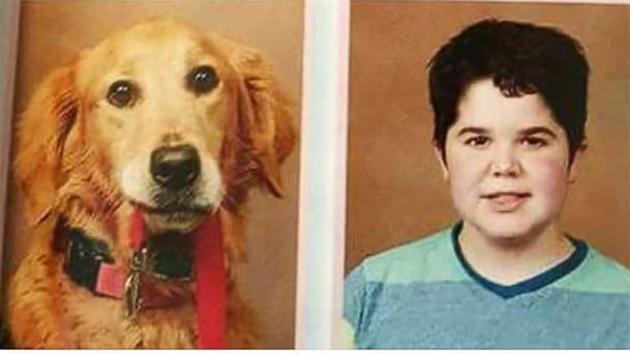
In West Monroe, Louisiana, a special yearbook photo was taken this year, of Presley who is Seph Ware’s service dog.

yearbook

Presley and Seph Ware are featured side by side in the class yearbook at Good Hope Middle School. (Holtzclaw Photography)

Seph, age 14, has Duchenne Muscular Dystrophy which is  a progressive genetic muscle disorder that causes a loss of muscle function.  Presley’s job is to help help him with daily activities at school like picking things up off the floor, opening and closing doors and turning the lights on and off.

The Good Hope Middle School felt it was only right to have Presley featured in the yearbook since she has been at school every day.

Special dog!

Source:  ABC 13

Service dog fraud

There’s a worrying and growing trend in the United States.  It’s Service Dog Fraud – when dog owners purchase fake service dog vests and then take their dogs into public places.

Under the provisions of the Americans with Disabilities Act, people with service animals must be allowed access to public places.  This is the Department of Justice’s definition of a service animal:

“Service animals are defined as dogs that are individually trained to do work or perform tasks for people with disabilities. Examples of such work or tasks include guiding people who are blind, alerting people who are deaf, pulling a wheelchair, alerting and protecting a person who is having a seizure, reminding a person with mental illness to take prescribed medications, calming a person with Post Traumatic Stress Disorder (PTSD) during an anxiety attack, or performing other duties. Service animals are working animals, not pets. The work or task a dog has been trained to provide must be directly related to the person’s disability.”

Yet, the sale of fake service dog products is unregulated.  On a recent flight through Los Angeles International Airport, the volunteers in their PUPs programme told me that they regularly see fake service dogs at the airport.  They can be spotted a mile away – dogs that are clearly pets with behaviors that are not characteristic of true service dogs doing things like jumping on people or stealing food.

CBS News has covered this type of fraud, which is causing people with genuine disabilities to be questioned about their right to enter establishments with their service dog:

Canine Companions for Independence is asking dog owners to take a pledge to stop service dog fraud.  You can take this pledge by clicking here. 

I encourage you to sign the pledge and circulate it to your friends and relatives.  If you know of someone who is illegally passing their dog off as a service dog, please ask them to stop and help them to understand what problems they are causing.

See also my earlier post on the sale of fake service dog products

Kathleen Crisley, specialist in dog massage, rehabilitation and nutrition/food therapy, Canine Catering Ltd, Christchurch, New Zealand

Comet’s Tale – book review

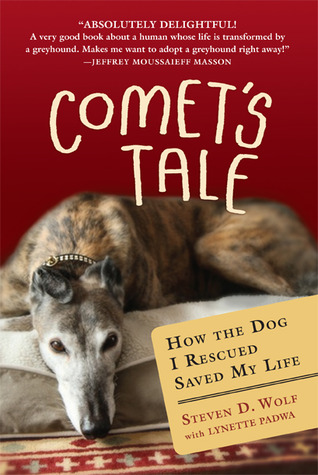
Comet's TaleThis book will make you want to go out and adopt a Greyhound!  Mr Wolf tells the story of Comet, a Greyhound who comes into his life as his health and well-being are seriously under threat.

The author never had any experience with Greyhounds until he is drawn to a charitable group promoting Greyhound adoption at his local supermarket.

A Greyhound who suffered abuse at the track, Comet is withdrawn around most people but decides that Mr Wolf (affectionately called “Wolfie” by his wife) is for her.  She literally sits down next to him and lets him know – take me home.

As Steven’s health deteriorates, he lives on pain killers and can barely walk or do simple household tasks.  This is when he decides that Comet has all of the qualities of a service dog and only needs training.  He looks for trainers to assist him and all scoff at the suggestion that a Greyhound could be a service dog.  So, he trains her himself.

I particularly liked the stories of Comet as she learns to pull Steven’s wheelchair through the airport.  Aided by the photo on the cover of the book (the only photo in this book, which perhaps is its only shortcoming), you can understand when Steven describes Comet’s doe eyes and the looks she would give him to communicate her very articulate thoughts!

I recommend this book for summer reading (if you are currently in the Northern Hemisphere) or curl up with it in front of the fire for winter entertainment (if you are in the Southern Hemisphere).

Happy reading!

Kathleen Crisley, specialist in dog massage, rehabilitation and nutrition/food therapy, Canine Catering Ltd, Christchurch, New Zealand


The British Medical Journal’s Shaggy Dog Story

Two Belgian researchers have published their Shaggy Dog Story in the British Medical Journal this month.

They tell of a 35-year old patient with a severe sleep disorder that made traveling on public transport a problem because she would fall asleep and miss her stop, often becoming disoriented.

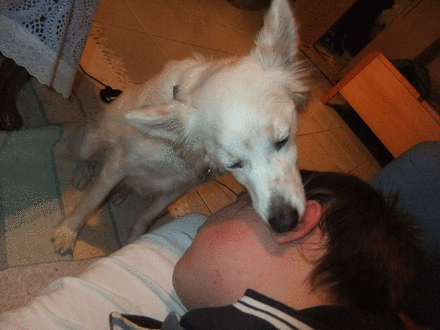
Dog waking patient

She was paired with a service dog that was trained to wake her for important noises and on public transport.   This type of success story points to even more roles for service dogs.

Wake me up, Shaggy!