A new study suggests that dogs may have first successfully migrated to the Americas only about 10,000 years ago, thousands of years after the first human migrants crossed a land bridge from Siberia to North America.
Photo by Angus McNab
The study, which looked at the genetic characteristics of 84 individual dogs from more than a dozen sites in North and South America, is the largest analysis so far of ancient dogs in the Americas. The findings appear in the Journal of Human Evolution.
Unlike their wild wolf predecessors, ancient dogs learned to tolerate human company and generally benefitted from the association: they gained access to new food sources, enjoyed the safety of human encampments and, eventually, traveled the world with their two-legged masters. Dogs also were pressed into service as beasts of burden, and sometimes were served as food, particularly on special occasions.
Their 11,000- to 16,000-year association with humans makes dogs a promising subject for the study of ancient human behavior, including migratory behavior, said University of Illinois graduate student Kelsey Witt, who led the new analysis.
“Dogs are one of the earliest organisms to have migrated with humans to every continent, and I think that says a lot about the relationship dogs have had with humans,” Witt said. “They can be a powerful tool when you’re looking at how human populations have moved around over time.”
Human remains are not always available for study “because living populations who are very connected to their ancestors in some cases may be opposed to the destructive nature of genetic analysis,” Witt said. Analysis of ancient dog remains is often permitted when analysis of human remains is not, she said.
Previous studies of ancient dogs in the Americas focused on the dogs’ mitochondrial DNA, which is easier to obtain from ancient remains than nuclear DNA and, unlike nuclear DNA, is inherited only from the mother. This means mitochondrial DNA offers researchers “an unbroken line of inheritance back to the past,” Witt said.
The new study also focused on mitochondrial DNA, but included a much larger sample of dogs than had been analyzed before.
Motorola has unveiled the Scout 5000, a smartphone for dogs
The device, which is WiFi and Bluetooth enabled, will monitor a dog’s health, track their location with GPS and allow owners, when they are not home, to speak to their dogs using 3G. A microphone will allow the dog to be heard, too.
There is also a built-in camera so owners can check on what their dogs are up to.
Motorola says the Scout 5000 will be available in the USA in June and carry a $199 price tag; a version for small dogs will be $91. The device will come with a year of 3G service, after which owners will need to purchase a data plan.
Technology has, again, gone to the dogs!
Kathleen Crisley, specialist in dog massage, rehabilitation and nutrition/food therapy, Canine Catering Ltd, Christchurch, New Zealand
Kenny is a Blue Heeler/Bull Terrier cross. Now 12, he’s survived a car accident when a puppy and then a stroke in 2011.
Not surprisingly, Kenny has a few mobility issues. His back gets sore and his left side is weaker. He gets regular massage and laser treatments from me which help to keep him more comfortable and mobile.
Like many other senior dogs with a few aches and pains, Kenny still wants to join his family when they go out. Sometimes he makes it into his favourite park but then struggles on the way back to the car.
The solution, when Kenny gets tired, is to put him in a stroller.
Kenny with dad, Jason (photo by Elesha Ennis)
Many men seem reluctant to be seen walking their dog in a stroller. I say “Real men are happy to show that they care and love their dog”. All credit to Jason, Kenny’s dogfather.
Dogs with mobility issues can live full and active lives with a little help. Kenny is far better off getting the mental stimulation of family outings than he is being left at home. Senior dog care requires management techniques; strollers and carts can play their part.
It’s a long way back to the car…thanks Dad! (Photo courtesy of Elesha Ennis)
Kathleen Crisley, specialist in dog massage, rehabilitation and nutrition/food therapy, Canine Catering Ltd, Christchurch, New Zealand
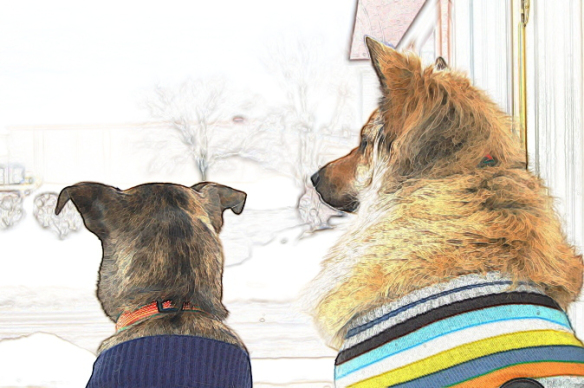
I love our dogs! There is nothing that I would not do for them. I will never get tired of seeing them sit in the front door together, side by side, watching the cars, deer (aka “Big Doggies”), an occasional kitty, and the police cars that patrol the area.
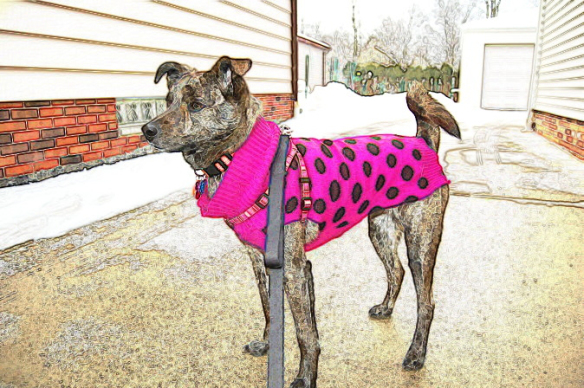
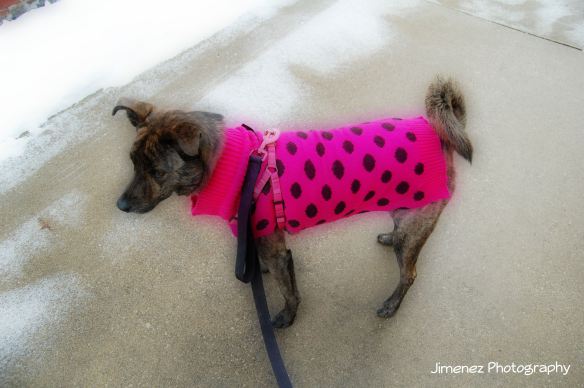
This is Bella’s other new sweater! She looks like a little lady bug in her new pink sweater with black polka dots! I used a neat photo effect on this photo called colored pencil. I love how it brought out Bella’s coloring and defined the bricks on the house.
Bella loves her new sweaters because she is now nice and warm and her butt is now covered well too!
What is the funnest thing to do when it snows? Build Snow Doggies! Here is my rendition of Nikita and Bella as Snow Doggies! I can’t even tell you how…
Eclipse, a Black Labrador living in Seattle, has made the local news… She’s so enthusiastic about going to the dog park, she often takes herself there – on the bus!
Enjoy this story about a special black Lab!
Kathleen Crisley, specialist in dog massage, rehabilitation and nutrition/food therapy, Canine Catering Ltd, Christchurch, New Zealand
I am conscientious and reliable. From an early age, I also had a strong sense of self-preservation when it came to putting myself in potentially dangerous situations. To some, that makes me neurotic. However, that’s not such a bad thing, according to new research out of the University of California at Berkeley and California State University.
Helicopter parenting may not be the best strategy for raising independent kids. But a healthy measure of clinginess and overprotectiveness could actually be advantageous when rearing dogs and cats, according to new research from UC Berkeley and California State University, East Bay.
A Web-based survey of more than 1,000 pet owners nationwide analyzed the key personality traits and nurturing styles of people who identified as a “cat person,” a “dog person,” “both” or “neither.”
Surprisingly perhaps, those who expressed the greatest affection for their pets also rated among the most conscientious and neurotic, suggesting that the qualities that make for overbearing parents might work better for our domesticated canine and feline companions, who tend to require lifelong parenting.
“The fact that higher levels of neuroticism are associated with affection and anxious attachment suggests that people who score higher on that dimension may have high levels of affection and dependence on their pets, which may be a good thing for pets,” said Mikel Delgado, a doctoral student in psychology at UC Berkeley and co-author of the study, recently published in the Journal of Applied Animal Welfare Science.
The results echo those of a 2010 study by University of Texas psychologist Sam Gosling, a UC Berkeley graduate, which showed dog owners to be more extroverted, but less open to new experiences, and cat owners to be more neurotic, but also more creative and adventurous.
While previous studies have focused on people’s attachment to their pets, this is the first U.S. study to incorporate the principles of human attachment theory – which assesses the bond between parents and children or between romantic partners — with pet owners’ personality types, including whether they identify as a “dog person” or “cat person.”
It is also the first to find a positive correlation between neuroticism, anxious attachment and the care of and affection for pets, said CSU-East Bay psychologist Gretchen Reevy, co-author of the paper and a graduate of UC Berkeley.
Delgado and Reevy recruited male and female pet owners of all ages through the Craigslist classified advertising website, their personal Facebook pages and pet-related pages on the Reddit news and social networking site. Nearly 40 percent of those surveyed said they liked dogs and cats equally, while 38 percent identified as dog people and 19 percent as cat people. A mere 3 percent favored neither.
The online questionnaire was based on both human and animal attachment assessments, including one that measures the “Big Five” overarching human characteristics (openness, conscientiousness, extraversion, agreeableness and neuroticism). Pet owners were also rated according to the Lexington Attachment to Pets Scale, which measures affection for pets, and the Pet Attachment Questionnaire, which gauges “anxious attachment” and “avoidant attachment.”
People who score high on anxious attachment tend to need more reassurance from the objects of their affection, and in the survey those tended to be younger people who chose a cat as a favorite pet.
Conversely, people who rate highly on avoidant attachment, which refers to a less affectionate and more withdrawn temperament – and can inspire such rejoinders as “commitment-phobe” in romantic relationships – are much less needy. Both dog and cat lovers scored low on avoidant attachment, suggesting both personality types enjoy close relationships with their pets.
“We hypothesized that more attentive and affectionate pet owners would receive higher affection scores and lower avoidant attachment scores, as higher levels of avoidant attachment would suggest distancing behaviors between the individual and their pet,” Delgado said.
Delgado and Reevy plan to dig more deeply into the link between neuroticism and affection for and dependence on one’s pet.
“We will investigate further whether greater affection for and greater anxious attachment to one’s pet, and neuroticism, are associated with better care and understanding of the pet’s needs,” Reevy said.
The value of dogs in advertising cannot be underestimated. Just ask the Target Corporation, a chain of discount stores in the United States.
Their mascot is Bullseye, a bull terrier.
Photo by Target Corporation
Bullseye features in print media and television campaigns and appears ‘in person’ at corporate events including store openings. In October 2014, for example, Target opened a CityTarget store in Boston, not far from famed Fenway Park.
Bullseye apparently lives on a ranch just north of Los Angeles with her trainers. Over the years, there have been many Bullseyes (just like there were successive Lassies over the years). The company has also proudly reported that the makeup used on Bullseye is non-toxic and natural.
Bulleye is so popular that Target offers a range of products featuring Bullseye in its Bullseye Shop.
Kathleen Crisley, specialist in dog massage, rehabilitation and nutrition/food therapy, Canine Catering Ltd, Christchurch, New Zealand
Yet another piece of research that points to the value of dogs and other animals. This time the research was done at the University of Missouri and focused on the social skills of autistic children.
You guessed it – the children who lived with pets developed better social skills including assertiveness. “When I compared the social skills of children with autism who lived with dogs to those who did not, the children with dogs appeared to have greater social skills,” said Gretchen Carlisle, Research Fellow.
The ASB Classic tennis tournament finished yesterday with Venus Williams winning the title. But the real high point of the tournament was the advertising…
Meet the Best Ball Boys in the World: Oscar the Mastiff cross, Ted the Border Colies, and Teddy, the Jack Russell cross…
If dogs were allowed in ‘real’ tennis matches, I think I could become a fan!
Kathleen Crisley, specialist in dog massage, rehabilitation and nutrition/food therapy, Canine Catering Ltd, Christchurch, New Zealand
The role of pets has changed a lot in the last 20 or so years. This change is also reflected in how people mourn when a pet dies. This column, by Monica Collins of The Boston Globe, discusses how mourning for a lost pet is recognized as genuine grief. Well worth reading (just click on the link below)










 DoggyMom.com