Author Archives: DoggyMom.com

Dentistry without anesthesia?

I had a phone call yesterday from an older gentleman who wanted to know if I cleaned dogs’ teeth without anesthetic.  (I do not)  I told him that I do sell dog toothbrushes and toothpaste and he wasn’t aware that these things existed!  And then he said that he would never be able to brush his dog’s teeth because he wouldn’t cooperate.

This made me wonder why he thought a dental procedure without sedating his dog was going to be effective.  But I try to be positive when engaging with new clientele; it seems that he was after a procedure that would cost him less money – not necessarily what was appropriate (or comfortable) for his dog.

I explained that I thought he would be better served by having a proper dental cleaning which is a veterinary procedure and then focusing on prevention.  This would include things like teeth-brushing by getting his dog accustomed to the taste of the paste, then gradually introducing the brush with praise and treats (positive reinforcement) throughout.

He thanked me for my advice.

I’ve done a little homework about this practice, because I have concerns whether an animal could truly be treated thoroughly without sedation.  I’ve just been to the dentist myself for a cleaning this week and it isn’t always a comfortable procedure!  Imagine a dog being restrained for it…

The American Veterinary Dental College refers to Anesthesia-Free Dentistry as Non-Professional Dental Scaling (NPDS) and cautions owners against the procedure for the following reasons:

1. Dental tartar is firmly adhered to the surface of the teeth. Scaling to remove tartar is accomplished using ultrasonic and sonic power scalers, plus hand instruments that must have a sharp working edge to be used effectively. Even slight head movement by the patient could result in injury to the oral tissues of the patient, and the operator may be bitten when the patient reacts.
2. Professional dental scaling includes scaling the surfaces of the teeth both above and below the gingival margin (gum line), followed by dental polishing. The most critical part of a dental scaling procedure is scaling the tooth surfaces that are within the gingival pocket (the subgingival space between the gum and the root), where periodontal disease is active. Because the patient cooperates, dental scaling of human teeth performed by a professional trained in the procedures can be completed successfully without anesthesia. However, access to the subgingival area of every tooth is impossible in an unanesthetized canine or feline patient. Removal of dental tartar on the visible surfaces of the teeth has little effect on a pet’s health, and provides a false sense of accomplishment. The effect is purely cosmetic.

3. Inhalation anesthesia using a cuffed endotracheal tube provides three important advantages… the cooperation of the patient with a procedure it does not understand, elimination of pain resulting from examination and treatment of affected dental tissues during the procedure, and protection of the airway and lungs from accidental aspiration.

4. A complete oral examination, which is an important part of a professional dental scaling procedure, is not possible in an unanesthetized patient. The surfaces of the teeth facing the tongue cannot be examined, and areas of disease and discomfort are likely to be missed.

In my blog on Managing Dental Health, I explain the things I do for Daisy to keep her teeth in good condition.  I recommend professional veterinary care to ensure your dog’s oral health, followed by a preventative regime that minimizes the need for future cleanings and anesthesia.

A new dog massage service?

Thought for Friday…

Should I start offering couples massage?

A new way to look at dog massage

Blessed bonds between dogs and humans

This is going to come as no surprise to many of you – but research has confirmed that the owner-dog bond is similar to that of parent-child.Paw in handScientists at the University of Veterinary Medicine in Vienna (known as Vetmeduni Vienna) have studied the phenomenon known as the ‘secure base effect’ between dogs and their owners.

Human infants use their caregivers as a secure base when it comes to interacting with the environment and the researchers wanted to know if dogs found the same security with their owners.

The research team, led by Lisa Horn, examined the dogs’ reactions under three different conditions: “absent owner”, “silent owner” and “encouraging owner”. The dogs could earn a food reward by manipulating interactive dog toys.

The dogs were much less keen on working for food when their caregivers were not there than when they were. Whether an owner additionally encouraged the dog during the task or remained silent, had little influence on the dog’s level of motivation.

In a follow-up experiment, the research team replaced the owner with an unfamiliar person. The scientists observed that dogs hardly interacted with the strangers and were not much more interested in trying to get the food reward than when the stranger was not there. The dogs were much more motivated only when their owner was present. The researchers concluded that the owner’s presence is important for the animal to behave in a confident manner.

Horn said, “One of the things that really surprised us is  that adult dogs behave towards their caregivers like human children do.”

Am I surprised? Not really.  (This blog ain’t named Doggy Mom for nothing!)

You can read the journal article “The Importance of the Secure Base Effect for Domestic Dogs – Evidence from a Manipulative Problem-Solving Task” online here.

Proud to be Daisy's doggy mom

Proud to be Daisy’s mom

Visual identification of breed – one reason why BSL doesn’t work

I’m ‘on the record’ that I don’t support breed specific legislation (BSL) and I consider it one of New Zealand’s great shames that it has adopted such laws  (just one of the issues I raised when I submitted to the review of the Animal Welfare Act).

Breed specific legislation doesn’t work because, in part, these laws rely on visual identification of breeds.  If a dog is identified as one of the banned or dangerous breeds, it can (literally) be ‘all over, Rover.’

There’s scientific research that shows why visual identification is a fatal flaw in BSL.  Some of this research has been conducted by Dr Victoria Lea Voith who is based at the Western University of Health Sciences, College of Veterinary Medicine.

In 2009, Voith and her colleagues published results of a study comparing visual identification of dog breed with DNA results.   They showed that there was a very low accuracy rate when visual identifications were verified with DNA.  The research team concluded:

  • There is little correlation between dog adoption agencies’ identification of probable breed composition with the identification of breeds by DNA analysis
  • Further evaluation of the reliability and validity of visual dog breed identification is warranted
  • Justification of current public and private policies pertaining to breed specific regulations should be reviewed

This year (2013), Voith and her colleagues published another paper entitled “Comparison of Visual and DNA Breed Identification of Dogs and Inter-Observer Reliability”   Since their previous paper was based on the identification of breed by a single person, the research team wanted to see if the success rate of breed identification improved when multiple people were involved.  The research team presented one-minute video clips of the same 20 dogs to over 900 people who were engaged in dog-related professions or services.

For 14 of the dogs, fewer than 50% of the respondents visually identified breeds of dogs that matched DNA identification. For only 7 of the dogs was there agreement among more than 50% of the respondents regarding the most predominant breed of a mixed breed.  In 3 of those 7 cases, the visual identification did not match the DNA analysis.

This time, the research team concluded:

This study reveals large disparities between visual and DNA breed identification as well as differences among peoples’ visual identifications of dogs. These discrepancies raise questions concerning the accuracy of databases which supply demographic data on dog breeds for publications such as public health reports, articles on canine behavior, and the rationale for public and private restrictions pertaining to dog breeds.

Dr Voith explains her research in this YouTube video:

If you still want to know more about this issue, you can visit the Breed Identification page of the National Canine Research Council.  On this page, you can download color posters that further explain the problems associated with visual identification of breeds.

Dogs help to improve moods of teens in treatment

Lindsay Ellsworth, a doctoral candidate at Washington State University,  has a new, mood-boosting therapy for teenagers in drug and alcohol treatment.

The treatment is shelter dogs!

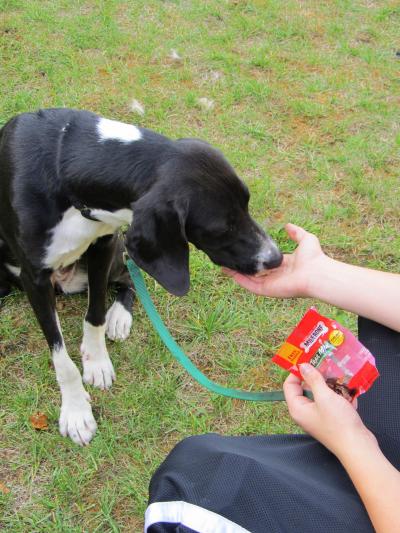
A participant at Excelsior Youth Center in Spokane, Wash., gives treats to a shelter dog from the Spokane Humane Society. A first-of-its-kind study demonstrates how dog-interaction activities improve the mood of teenagers living in residential treatment centers.  Photo courtesy of Washington State University

A participant at Excelsior Youth Center in Spokane, Wash., gives treats to a shelter dog from the Spokane Humane Society. A first-of-its-kind study demonstrates how dog-interaction activities improve the mood of teenagers living in residential treatment centers. Photo courtesy of Washington State University

On Friday afternoons, a group of approximately four dogs from the Spokane Humane Society visit the Excelsior Youth Center, where teenagers in treatment there can help brush, feed and play with the dogs.

“We found one of the most robust effects of interacting with the dogs was increased joviality,” she said. “Some of the words the boys used to describe their moods after working with the dogs were ‘excited,’ ‘energetic’ ‘and happy.'”

Ellsworth’s study is the first of its kind to demonstrate how dog-interaction activities improve mood among teenagers living in residential treatment centers.

Ellsworth’s methodology is fairly standard to research projects, involving a test group and a control group.  Once a week, during the daily recreation time at the Center, Ellsworth breaks about eight participants into two groups. One group plays pool, video games or basketball provided in the treatment center. The other group interacts with the shelter dogs for about an hour.

Before the activity period, participants identify 60 mood descriptors on a scale of one to five on what is known as the PANAS-X, a self-reporting method organizational psychologists use to scale and study emotion. After the activity, the participants fill out the same scale.

Robert Faltermeyer, executive director of the youth center, and the staff are hopeful this kind of science-based program could be established as part of treatment centers’ structured activities.

“It’s an opportunity for kids in a real chaotic life, making unhealthy choices, to focus in on a specific task with an animal,” he said. “It empowers them to make positive changes even on the simplest scale of correcting the animal’s behavior.”

Source: Washington State University media release

The canine ambassador at the Fairmont Hotel

At the Fairmont Hotel MacDonald in Edmonton (Canada), you will be greeted by a very special staff member – Smudge the Yellow Labrador!

SmudgeSmudge is a failed guide dog (due to her enthusiastic/over-friendly nature) and so thanks to a working arrangement with the Canadian National Institute for the Blind, Smudge came to work at the hotel.

Guests can book to take Smudge out for a walk and she will visit meetings on request.  Look for her (on her bed, by the concierge desk) when you are visiting.

Smudge also has her own Facebook page and you can follow her activities there.

Here’s a bit more about Smudge:

A farewell service for Oklahoma pets

Last weekend, a memorial service was held for the Oklahoma pets who perished in last month’s tornadoes.  The service was conducted at the Orr Family Farm which is located next door to the Celestial Acres Training Center, a training facility for horses where many died.

Perhaps one of the most touching stories of the losses suffered was that of Fred, a black Labrador.  He survived the storm buried beneath debris that was subsequently bulldozed over several times.  He was rescued but passed away five days later.  His veterinarian said, ‘It doesn’t seem fair.’

Full story available at The Oklahoman

Canine cancer: the warning signs and the way to a cure?

According to the Animal Cancer Foundation, one in four dogs will develop cancer in their lifetime.  That’s a pretty scary statistic.  A diagnosis of a malignant cancer for one’s dog is just as traumatic and worrying as a diagnosis of the disease in any member of the family.

Experts in both human and canine cancers agree that we still have much to learn about the types of these diseases and how to treat them.

The National Veterinary Cancer Registry has been launched recently to identify and register pets diagnosed with cancer.  The Registry’s goal is to facilitate and promote medical treatments that lead to advances, higher success rates and eventual cures for cancer in pets and people by matching animals with cancer to clinical trials for new cancer treatments.

NVCR logo

The Registry is a joint venture between the CARE Foundation, Baylor University Medical Center (BUMC) at Dallas and the Texas Veterinary Oncology Group.

Dr Gerald S Post, Founder and President of the Animal Cancer Foundation says there are 10 warning signs of cancer in both dogs and cats.  They are:

1. Swollen lymph nodes: These “glands” are located all throughout the body but are most easily detected behind the jaw or behind the knee. When these lymph nodes are enlarged they can suggest a common form of cancer called lymphoma. A biopsy or cytology of these enlarged lymph nodes can aid in the diagnosis.

2. An enlarging or changing lump: Any lump on a pet that is rapidly growing or changing in texture or shape should have a biopsy. Lumps belong in biopsy jars, not on pets.

3. Abdominal distension: When the “stomach” or belly becomes rapidly enlarged, this may suggest a mass or tumor in the abdomen or it may indicate some bleeding that is occurring in this area. A radiograph or an ultrasound of the abdomen can be very useful.

4. Chronic weight loss: When a pet is losing weight and you have not put your pet on a diet, you should have your pet checked. This sign is not diagnostic for cancer, but can indicate that something is wrong. Many cancer patients have weight loss.

5. Chronic vomiting or diarrhea: Unexplained vomiting or diarrhea should prompt further investigation. Often tumors of the gastrointestinal tract can cause chronic vomiting and/or diarrhea. Radiographs, ultrasound examinations and endoscopy are useful diagnostic tools when this occurs.

6. Unexplained bleeding: Bleeding from the mouth, nose, penis, vagina or gums that is not due to trauma should be examined. Although bleeding disorders do occur in pets, they usually are discovered while pets are young. If unexplained bleeding starts when a pet is old, a thorough search should be undertaken.

7. Cough: A dry, non-productive cough in an older pet should prompt chest radiographs to be taken. This type of cough is the most common sign of lung cancer. Please remember there are many causes of cough in dogs and cats.

8. Lameness: Unexplained lameness especially in large or giant breed dogs is a very common sign of bone cancer. Radiographs of the affected area are useful for detecting cancer of the bone.

9. Straining to urinate: Straining to urinate and blood in the urine usually indicate a common urinary tract infection; if the straining and bleeding are not rapidly controlled with antibiotics or are recurrent, cancer of the bladder may be the underlying cause. Cystoscopy or other techniques that allow a veterinarian to take a biopsy of the bladder are useful and sometimes necessary to establish a definitive diagnosis in these cases.

10. Oral odor: Oral tumors do occur in pets and can cause a pet to change its food preference (i.e. from hard to soft foods) or cause a pet to change the manner in which it chews its food. Many times a foul odor can be detected in pets with oral tumors. A thorough oral examination with radiographs or CT scan, necessitating sedation, is often necessary to determine the cause of the problem.

Helping pet owners make tough choices

When your dog becomes seriously ill, it’s your job as the owner to make decisions about quality of life.  And it’s one of the toughest decisions we face during our lives.

Researchers at Michigan State University  are developing a new tool to help people assess their pet’s quality of life, a key factor in decisions about when to order life-prolonging procedures and when an animal’s suffering means it’s time to put them to sleep.

The research team, led by veterinarian Maria Iliopoulou, created a survey to help dog owners monitor the quality of life of 29 dogs undergoing chemotherapy treatment for cancer.   The owners completed the questionnaire when they received their dog’s cancer diagnosis and answered questions about how their dog was behaving then and how they behaved six months prior to the diagnosis.

Similar questions were asked in questionnaires administered at three and six weeks into chemotherapy. Meanwhile, the veterinarians treating the dogs filled out shorter surveys based on their observations.   The research team wanted to see if owners and clinicians agreed.

The research found that there was a close match between owners and vets, particularly in questions involving play behaviour, the dog’s happiness as perceived by the owner and clinical signs of disease.  These areas of commonality create the basis for a tool that will help to facilitate client and vet communication.  If there’s agreement about what constitutes quality of life, then it is these criteria that owners and vets should use to help agree on next steps for the dog’s care.

For the study, dog owners completed a questionnaire at the time of diagnosis about how the animal was behaving then and how they typically behaved six months prior. Follow-up questionnaires filled out three and six weeks later documented changes in behavior as the dogs underwent chemo. Meanwhile, the veterinarians filled out shorter surveys based on their observations. – See more at: http://msutoday.msu.edu/news/2013/helping-pet-owners-make-tough-choices/#sthash.aUqdUd6n.dpuf
Dr Iliopoulou and her dog Rocky (photo by G L Kohuth)

Dr Iliopoulou and her dog Rocky (photo by G L Kohuth)

The research team has published their results in the Journal of the American Veterinary Medical Association.  All dogs were patients at the Michigan State University Animal Cancer Care Clinic.  The plan is to expand the work using a much larger sample size of patients and Iliopoulou hopes to develop questionnaires for dogs suffering from other diseases as well.

Source:  Michigan State University media statement

ichigan State University researchers are developing a new tool to help people assess their ailing pets’ quality of life, a key factor in decisions about when to order life-prolonging procedures and when an animal’s suffering means it’s time to let go. – See more at: http://msutoday.msu.edu/news/2013/helping-pet-owners-make-tough-choices/#sthash.aUqdUd6n.dpuf

Kabang, the snoutless dog

Kabang wasn’t always snoutless; she was just a family dog in the Philippines.  And then one day in December 2011, she leaped in front of a motorcycle to save the lives of the family’s daughter and niece.

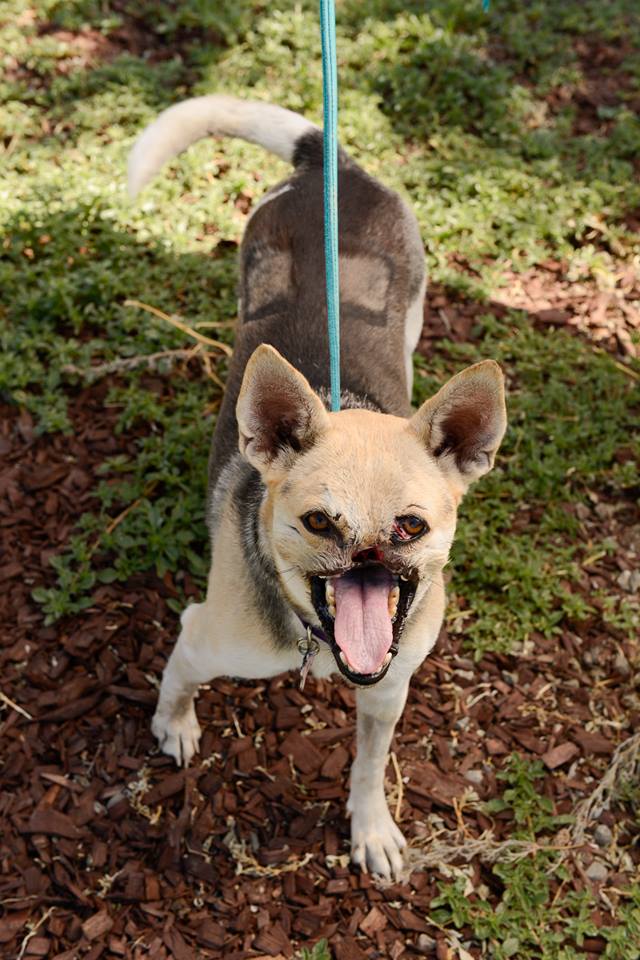
In the process, her snout and upper jaw were ripped off by the motorcycle’s wheel.  With devastating injuries and limited veterinary care locally, a Care for Kabang fundraising campaign  gathered enough funds to get her to California for surgery in late 2012.

Kabang, ready to go home (Photo by UC Davis)

Kabang, ready to go home (Photo by UC Davis)

Once there, doctors discovered that the dog also had a life-threatening cancer and gave her chemotherapy.  The chemotherapy meant  that surgeons had to delay any plans for surgery on her face.  She also had to be treated for heartworm before that surgery could proceed.

In the end, veterinarians couldn’t reconstruct Kabang’s jaw, but they did heal her wounds during her seven-month stay.   Her surgeries included dental work and teeth extractions followed by closing of opened wounds and the restoration of her nasal function.

Earlier this week, Kabang returned home to a hero’s welcome, as noted by this BBC report:

Kabang is now considered an ambassador of ‘dogwill’ to show the power of the unconditional love and devotion our dogs show us each day.  Zamboanga City Mayor Celso Lobregat signed Executive Order 503-2013, making Kabang the official symbol of responsible pet ownership and advocacy against animal cruelty.

Her owner, Rudy Bunggal, has been struggling with financial and personal demons associated with alcohol.  He’s now been given a new home by the local government, which will pay for the house to be prepared for their arrival by the end of this month.  The new house is larger, made of concrete, has a stable roof and is located in a more pleasant environment than Rudy’s shanty house behind a petrol station.