Author Archives: DoggyMom.com

Doggy quote of the month for October

I have sometimes thought of the final cause of dogs having such short lives and I am quite satisfied it is in compassion to the human race; for if we suffer so much in losing a dog after an acquaintance of ten to twelve years, what would it be if they were to double?

–  Sir Walter Scott

Developing methods in pain management and osteoarthritis

Researchers at Kansas State University are devoting their time to the study of improvements in pain management and the treatment of osteoarthritis in dogs.   (For more information on pain management, see my June 2012 blog)

The projects are led by James Roush, a professor of clinical sciences.

In one study, the research team determined that the maximum effective time for using hot and cold packs for pain management is 10 minutes.   The researchers studied how packing affects tissue temperature in beagles and beagle-sized dogs after surgery because hot and cold packing is a common technique for reducing swelling.   After 10 minutes, the maximum change in tissue temperature has been reached.

In another study, a special mat is being used to study lameness in dogs suffering from osteoarthritis.  When dogs step on the mat, it measures the pressure in their step and the study team can determine in which leg the lameness is worse.

“We’ve designed the study to help improve osteoarthritis treatment,” Roush said. “We will also use it to measure clinical patients when they come in for regular checkups. We can measure their recovery and a variety of other aspects: how they respond to nonsteroidal anti-inflammatories, how they respond to narcotics or how they respond to a surgical procedure that is designed to take that pressure off the joint.”

And in a third study,  Roush is collaborating with researchers to study the effectiveness of a painkiller used to treat dogs to identify potential alternatives.

“To achieve the drug’s effect, the dosage in dogs is much higher than in people,” Roush said. “It also may not be a very good analgesic in dogs. We want to see if there is an alternative that requires smaller doses and does not have not as much of a discrepancy for patients.”

Source:  Kansas State University media release

Deaf pet awareness week

The week of 23 – 29 September is Deaf Pet Awareness Week.

In many cases, when a dog is found to be deaf, it is put to sleep.   However, more frequently there are pet owners willing to take on these special needs animals.  These dogs can be trained using sign language and are just as intelligent as ‘normal’ dogs.

Deafness in animals can be inherited or acquired through trauma, drug reactions, or simply old age.   Dalmatians and Boxers are more prone to deafness than others. Thirty percent of all Dalmatians born are either deaf in one ear or  bilaterally deaf.   Some deaf dogs also have albinism, meaning that they lack normal melanin pigment in their eyes, nose, or skin.  Owners of these dogs have to pay special attention to sun protection.

The Deaf Dog Education Action Fund has a wonderful website with answers to questions involving the ownership and care of deaf dogs.

Use this special week to contact animal shelters in your area to find out if there is a special deaf dog waiting for you!

Extended beach ban in Auckland

The Auckland (New Zealand) Council is proposing to further restrict the ability of dog owners to exercise their dogs at the beach.  This is a sad day for New Zealand and for New Zealand dog owners.

The bylaw will  prohibit dogs on beaches from the Saturday of Labour Weekend (October) to March 31 during the hours of 10am till 6.30pm.

The Hibiscus and Bays local boards want the ban to end on March 1, which would allow dog owners 30 more days of usage of the beaches.  As part of their submission, they showed the Council representatives a host of pictures of empty beaches during the month of March – challenging the notion that allowing dogs on the beaches would restrict the enjoyment and rights of other beach users.

Responsible dog owners of New Zealand – fight for your rights – otherwise, there are many people very willing to take those rights away from you!

Alma mater dogs – The Yale University Bulldog

Yale University in New Haven, Connecticut is reportedly the first university in the United States to adopt a mascot, dating back to the 1890’s when a student from England started the tradition.

The official bulldog is named ‘Handsome Dan’ and the university’s current Handsome Dan is Number 17!  (You can read about all of the Handsome Dans on this website.)

Handsome Dan will appear at games of the university’s football team – you guessed it – The Bulldogs.

Cole Porter (class of 1913) wrote the Bulldog Song, which is the Yale fight song.  It’s played by the band whenever a touchdown is scored.  The song goes like this:

Bulldog!  Bulldog!
Bow, wow, wow
Eli Yale
Bulldog!  Bulldog!
Bow, wow, wow
Our team can never fail

When the sons of Eli
Break through the line
That is the sign we hail
Bulldog!  Bulldog!
Bow, wow, wow
Eli Yale!

Official merchandise of the Yale athletics teams is known as Bulldog Blue.

And like most university mascots, the image of Handsome Dan is replicated throughout merchandise, events and student life on the Yale campus.

A university where your dog can come too

It’s autumn in the northern hemisphere and the time of year when students are going to colleges and universities for the first time.   If they are enrolled at Stephens College in Columbia, Missouri – there’s a high chance that their dog can come too!

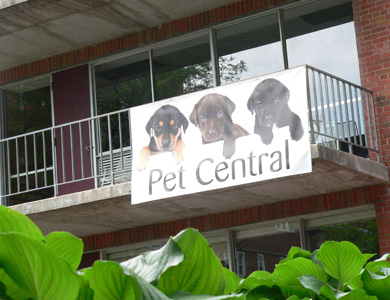
Searcy Hall at the college is better known as Pet Central and houses 40 students and their pets.  Pets have been accepted at the college since 2004.  The college also has a pet fostering program.  They’ve partnered with a local no-kill shelter and students can foster a dog during their time at college and train and socialise them in preparation for adoption.

A scholarship, room discount, paid food and medications, and pet deposit waiver are just a few of the benefits available to freshmen and transfer students who apply to participate in the pet fostering program.

Sadly,  the college’s insurance policy excludes these breeds from staying at Pet Central:  Pit Bull, Rottweiler, Chow, Akita and German Shepherd.  I’m not a supporter of breed-specific legislation and so it’s hard to accept these types of restrictions but that’s the influence of the underwriters, unfortunately.

New kennel cough vaccine offers dog owners and vets a choice

The US Food and Drug Administration has approved a new kennel cough (bordetella) vaccine made by pharmaceutical company Boehringer Ingelheim that is administered orally.

Branded as Bronchi-Shield® ORAL, the vaccine is mixed in the vet’s office and placed in the dog’s mouth  between the dog’s cheek and gum, an area known as the buccal cavity.

For dogs that don’t tolerate the intra-nasal form of vaccination, this form is likely to be an improvement.

Kennel cough has many strains and not all are considered bordetella.   As with other kennel cough vaccinations, the vaccine does not prevent your dog from coming down with bordetella or any of the many infectious respiratory diseases.   However, vaccination may help to reduce the severity of the illness if your dog does contract it and that allows for faster recovery.

Kennels in the United States report that the cost for this form of the vaccine is currently three times the cost of the traditional vaccine.  That’s because the product is new and only one pharmaceutical company is manufacturing it.  The price is likely to reduce over time as the vaccine becomes more widely used.

For more information about Bronchi-Shield® ORAL, visit the product website.

How Chinese medicine may help dogs with cancer

Research from the University of Pennsylvania School of Veterinary Medicine has been published which shows promise in treating dogs with a specific type of cancer.

Hemangiosarcoma is a type of cancer that can occur in any dog, but German Shepherds and Golden Retrievers seem to be the most prone to developing it.  The cancer is an aggressive and malignant tumor of blood vessel cells.   The most common area it affects is the spleen but can appear in the skin, other soft tissues and the liver.  This is a type of cancer that is metastatic and it will frequently spread to other parts of the body.

In the study, 15 dogs were divided into three groups of 5 and given a different dose of a product called I’m-Yunity, which contains polysaccharopeptide or PSP.  PSP is derived from Yunzhi mushrooms and appears to have an immune-boosting effect – it’s been used in traditional Chinese medicine for more than 2,000 years.

The findings?

‘We were shocked,’ says Professor Dorothy Cimino-Brown.  ‘Prior to this, the longest reported median survival time of dogs with hemangiosarcoma of the spleen that underwent no further treatment was 86 days.  We had dogs that lived beyond a year with nothing other than this mushroom as treatment.’

The treatment may offer a way for owners to extend the life of their pet and there were no adverse effects reported.

The researchers plan to study the effect of the compound further, using groups of candidates that are given a placebo, others which undergo chemotherapy, and other groups given the mushroom-based treatment.

Source:  University of Pennsylvania media statement

Animal welfare in New Zealand – have your say

Time is running out to have your say on Government’s animal welfare proposals.  Submissions close on 28 September 2012.

Visit this site to download the discussion document containing proposals.

Changes are being proposed to standards of care and conduct towards animals and the role of the National Animal Welfare Advisory Committee.

Is there a role for a Commissioner for Animals?  How do you feel about breed specific legislation?   These are just some of the issues relating to animal welfare and your dog that you might like to consider in making a submission.

Instead of picking up the newspaper this weekend, how about reading the discussion document and working on your submission first?

Oogy – the dog only a family could love

I’ve just finished reading Oogy:  the dog only a family could love by Larry Levin.  This New York Times bestseller tells the story of Oogy, a puppy that had been used for bait in dog fighting, and the Levin family who adopted him.

In many ways, this is a story about fate.  Fate in how a badly injured Oogy was brought to an animal hospital offering after-hours treatment.  Fate because a woman who worked at the hospital (later called ‘Saint Diane’)  recognised Oogy’s special character and intervened to ensure Oogy got life-saving treatment and care.     Fate because the Levin family met him when they had brought their sick cat to be put to sleep and decided to adopt him.

Oogy lost his left ear and and a good portion of his jaw and face to dog fighting.  It appears that he was used as bait because he wasn’t a good fighter and then left in an abandoned house to die without care or attention.

The Levins named him Oogy because it was a derivation of ‘Ugly.’  Mr Levin is the first to admit that when he first met Oogy, his appearance was grotesque.  (The dog had a lot of scar tissue which was operated on later.)  In fact, Oogy was so disfigured that, because of the connection to dog fighting, everyone assumed Oogy was a pit bull.

As he matured, it was agreed that Oogy was a Dogo Argentino, one of the breeds that is often discriminated against and termed ‘dangerous.’

Read this book and enjoy the Levin’s journey with Oogy.  Read about how his charm wins over residents who were scared of him; read about the care the Levins provided for Oogy, seeing him through corrective surgeries as well as rehabilitation from cruciate ligament ruptures.

Finally, I think one of the best parts of this book is how Levin describes the responsibility of the pet owner:

‘It has always been my belief that a pet owner has a special responsibility to do everything that can be done to make the pet’s life as fulfilling and peaceful as possible.  That responsibility is yours the moment you make the choice to take an animal into your life.’