Author Archives: DoggyMom.com

Alma mater dogs – The Northeastern Husky

Many institutes of higher learning have adopted a dog as their official mascot.  In this, what I hope will be my first profile of such dogs, I’d like to introduce you to the Northeastern University Husky.

In a prominent foyer of the main campus, a bronze sculpture of the Husky has been on display for decades in homage of the dog’s role as the official mascot.

It’s a common meeting place for students and faculty, particularly as the foyer provides a haven from what can be rainy or snowy weather in Boston.

The statue’s muzzle has been worn smooth from the amount of petting it has had over the years.

In addition, the sports teams of Northeastern are referred to as the Huskies, the newsletter of the university is The Husky Nation, and the on-campus card for purchasing is The Husky Card.

Visit the official university bookstore and you can buy t-shirts, sweatshirts and other items bearing the Husky image.  If you are lucky, a real Husky will attend a special sport or other event being held at the University!

This slideshow requires JavaScript.

International Homeless Animals’ Day

Today (18th August) is International Homeless Animals’ Day.

On the third Saturday of August each year, organisations band together to raise awareness about pet overpopulation.  This year is the 21st year of the initiative!

If you are thinking of adding a dog to your household (or another dog), please adopt from a shelter or rescue organisation.  And spay/neuter your pet to avoid adding to the pet population in your area.

The cost of veterinary care

Last night on consumer television programme Fair Go, there was an item about the high cost of veterinary care in New Zealand.

The makers of the programme compared costs for common veterinary procedures in cats and dogs – thinks like dental cleanings and microchipping.  And for those of us working in the companion animal field, it came as no surprise that there can be a huge variability in costs.

I remember when I was studying pet nutrition, our first assignment included a question about the cost of the first year of a dog’s care.    We had to itemise all costs for  everything from food to flea treatments to veterinary care.  And like so many other living costs in New Zealand, our prices were higher.  That’s what happens when you live on comparatively small islands in the middle of the Pacific!  In fact, my tutor said that our costs were the highest of all others in the class from around the world.

However, the Fair Go programme basically advised viewers that the way to control their costs was to shop around.  While I agree with this point – to a point, there’s a lot more that you can do to keep the costs of your veterinary care –  and your dog’s overall care – reasonable.

And I’m also a big supporter of the adage – YOU GET WHAT YOU PAY FOR.  In every aspect of my dog’s care, I aim to purchase quality products and services. They may not be the cheapest – but I’m satisfied that they are the best.

In my opinion, you should:

  • Adopt a preventive healthcare approach first

As soon as your dog comes into your life, vow that you will do the best you can for them.  This means choosing high quality, nutritious foods (‘you are what you eat’) and giving your dog the right amount of exercise.  Ensure your dog doesn’t become overweight and clean their teeth.

For teeth cleaning, there’s the old-fashioned approach which includes giving dogs raw meaty bones.  There are also good dental chews on the market and toys like rope chews act as dental floss.  There’s also some very good toothbrushes and toothpaste you can buy because not all dogs get enough cleaning from the items that they chew.

  • Build a relationship with a vet

If you go all over town chasing the best price, no single veterinary practice will have a full picture of your dog’s health history.  Shop around and then try to stick with the same vet.  Be honest about your ability to pay and if the practice knows you, they will be in a better position to offer you a payment plan or a reduction in price. You probably won’t have that as an option if the veterinary practice has never seen you before!

If you are unhappy with any service that a veterinarian provides you (including cost) you should raise your concerns with the practice first to see what solutions are available.  Then, if you’re still not happy, go out and find yourself another vet that you can work with.

  • Complementary therapies for longevity and quality of life

Complementary therapies like my massage, acupressure and laser therapy practice have a role in keeping your dog healthy (and the vet bills down).   I  offer advice on rehabilitation and exercise programmes that can help reduce your dog’s dependence on pain medication, for example.  I’m an advocate for therapies such as hydrotherapy and acupuncture, both of which I use for my own, aging dog.

  • Shop online

There are many outlets where you can find pet products at a more reasonable price than a traditional pet store or veterinary practice.  These include sites like Trade Me, but also online pet pharmacy My VetI also source and sell products online through my company – Canine Catering and, because I’m a smaller operation with lower overheads, you will pay a lower price.

(In general, retail costs are higher because there are more costs for doing business.  They have shop assistants to pay, rent, and bills for heating, maintenance and electricity. )

I hope these tips give you a broader perspective on the costs of caring for your dog.  If we save money, we have more money to spend on our families which includes our pets!

Suryia and Roscoe – a special friendship

This story came to me a few weeks ago via a friend’s email.  So I did a bit of digging to get the full story.

Suryia is an Orangutan and Roscoe is a a Blue Tick Hound.  They live together at The Institute of Greatly Endangered and Rare Species (TIGERS) in South Carolina, where they met in 2008 when a thin Roscoe followed caregivers back to the reserve.

The two became fast friends and now have a book about their story.

When you purchase it from their website, proceeds go to support wild orangutan conservation in Borneo.

Ordinarily, dogs and primates don’t mix but this pair proves an exception to that rule!

This slideshow requires JavaScript.

Cruelty-free shopping guide

Many of us are ‘animal people’ who are concerned about animal welfare in general and not just the health and well-being of our dogs.  When it comes to the products we buy, we’d like to choose ethical products – products that haven’t been tested on animals.

Here in New Zealand, you can download a copy of the SAFE Shopping Guide to help you make the right purchasing decisions.

SAFE is a non-profit charitable organisation financed solely through donations.  It is dedicated to changing attitudes and nurturing compassionate values by educating the public about the inherent value of animals.

SAFE has been working in New Zealand for 75 years and so they know their stuff.  Visit the SAFE website here.

It’s raining cats and dogs

It’s been raining since last night here and the long-range forecast is that it will continue for the next few days.  And so that has gotten me thinking – what is the origin of the saying It’s raining cats and dogs?

On the face of it, this phrase just doesn’t make sense.  Some say that it comes from the days when all the animals in the household were kept in the rafters of the thatch-roofed cottages.  When it really rained heavily, the animals would fall out…

What does the Library of Congress say about this phrase (including de-bunking of the thatched roof theory)?

Read here for a well-referenced look at the origin of It’s raining cats and dogs

The Throver – the throw made with dogs in mind

I don’t give product recommendations very often but I have to say that the Crypton® Throver is  made with the dog owner in mind.  These all-purpose throws come in various designs, some including dog motifs.  I purchased the Dogland pattern when I purchased my new settee.  Now both Daisy and I enjoy our new furniture.  Here she is.  She’s comfortable and happy and the settee isn’t covered in dog hair.

Throvers are made from Crypton® super fabric that is permanently stain, moisture, mildew, bacteria and odor-resistant.   Made in the U.S.A., this fabric is perfect for the dog-owning household.  We’ve had our Throver for several months, it’s in constant use and it still looks new.  Pet beds and mess mats are also available in this durable fabric.

The Throver is more expensive than other throws on the market (currently retailing for $99.00 for a throw measuring 48″ x 54″) but it’s worth it.

Purchase your throver online from Crypton®.

Congratulations, Massachusetts – a job well done

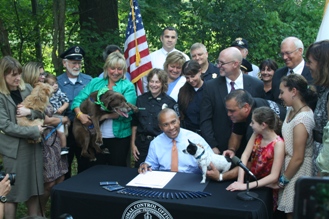
I’m very proud of my home state of Massachusetts.   Last week, Governor Patrick signed bill  S. 2192 “An Act Further Regulating Animal Control” into law.

The new law:

  • Creates a statewide spay/neuter program to reduce the number of homeless animals and will, in turn, also reduce the cost to cities and towns for housing and sheltering these animals. This is funded by a voluntary tax check off.
  • Adds enforcement provisions to section 139A (the spay/neuter deposit law for animals adopted from shelters and animal control facilities) to ensure homeless animals can’t reproduce.
  • Requires animal control officers to receive training.  This is funded by the tax check off.
  • Prohibits carbon monoxide and carbon dioxide gas as a means to “euthanize” dogs and cats.  (Anyone who saw the HBO documentary One Nation Under Dog knows why this important)
  • Improves the dangerous dog law in a breed neutral manner
  • Allows pets to be included in domestic violence protection orders

The law will also create some statewide oversight for animal control, which previously did not exist in the state; creates categories for kennel licensing; creates consistency in the holding time for stray dogs and provide other meaningful updates to the state’s antiquated animal control laws.  An amendment to the bill also added some restrictions on the tethering of dogs.

This new law will not cost money, it will actually minimize costs to cities and towns by reducing the number of homeless animals and the associated cost to house and take care of them. In addition, ensuring that animal control officers are trained, and improving the dangerous dog law to protect public safety, will provide indirect cost savings.

Best of all, this bill proves that animal welfare agencies can work together.  The bill was drafted as a collaboration between the Animal Control Officers Association of Massachusetts (ACOAM), the Massachusetts Society for the Prevention of Cruelty to Animals (MSPCA), the Animal Rescue League of Boston, the state’s Bureau of Animal Health within the Department of Agricultural Resources and the Massachusetts Veterinary Medical Association (MVMA).

Myths about dogs

Some information that circulates about dogs just isn’t true.  Here are some examples:

Mutts (mixed breeds) are healthier

Actually, any dog can have health problems but pure bred dogs commonly have more genetic disorders.  Mixed breeds, according to many vets, have hybrid vigor.  This term refers to superior qualities that appear when genetically different animals are crossbred.   The technical term for hybrid vigor is heterosis.

Licking helps to heal a wound

This is not necessarily the case.  Some dogs obsessively lick a wound and this does more damage than good.  You should consult your veterinarian if your dog is worrying a sore or wound.

Puppies and dogs don’t need house training because they naturally know where to go (wolfs, from where dogs descended,  won’t soil their den)

Nice try but most dogs and puppies need to be trained to do their business outside.  Some dogs (like children) are easier to train.

If a dog wags its tail, its friendly and happy

This isn’t always the case.  A wagging tail can mean a dog is excited or agitated.  Unless you know a dog, the best precaution is to ask its owner before you pet it.

Only male dogs ‘hump’ or raise their leg to pee

Female dogs will also do this,  particularly if they are dominant. Spaying does not affect this behavior.

International Assistance Dog Week

International Assistance Dog Week runs from 5-11 August this year.

The week is all about the dogs who  help people manage life with disability.  The goals of the week are:

  • Recognize and honor assistance dogs
  • Raise awareness and educate the public about assistance dogs
  • Honor puppy raisers and trainers
  • Recognize heroic deeds performed by assistance dogs in our communities

The IADW website contains information on events near you (primarily in the USA) but hopefully my home country of New Zealand will join in next year.

By the way, I support:

What dog assistance charities do you support?