Author Archives: DoggyMom.com

Caring for Nunavik’s sled dogs

Andréanne Cléroux, a veterinary student at the University of Montreal International Veterinary Group, is conducting a project to design and deliver a first aid guide for dogs in northern Quebec.

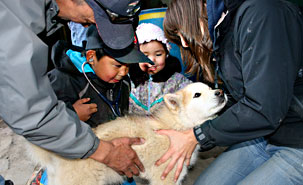
A family with their dog in Nunavik. (Credit: Sylvie Ricard)

“The problem relates mainly to animal health care, immunization, and dog population control,” Cléroux explains. “We wanted to create a guide that would provide basic tools for pet owners so they can provide care to their animal while waiting to contact the remote veterinary consultation service to get advice from a veterinarian at the CHUV (University of Montreal Veterinary Hospital).” 

Cléroux spent time developing the guide before travelling to northern Quebec to work on the draft with residents.  One of the challenges has been to develop a product that was good for those unfamiliar with dog care and still make it useful to mushers, who tend to know more about their dogs.

Cléroux has also created a first aid kit that includes all the necessary material to provide the care described in the manual and delivered it to several villages, with a goal to make it more widely available to all 14 communities in Nunavik.

Source:  University of Montreal press release


Things I must remember as a dog

  • When in the car, I will not insist on having the window rolled down when it’s raining.
  • We do not have a doorbell.  I will not bark each time I hear one on the television.
  • The sofa is not a face towel.  Neither are mum’s and dad’s laps.
  • My head does not belong in the refrigerator.
  • I will not bite the officer’s hand when he reaches in for dad’s drivers license.
  • I will not use ‘roll around in the dirt’ as an option after just getting a bath.
  • The cat is not a squeaky toy so when I play with him and he makes that noise, it’s usually not a good thing.

US stamps in honour of working dogs

The US Postal Service has a set of four stamps honouring service dogs.

The Dogs at Work set shows a guide dog assisting a blind woman, a tracking dog that is following a scent, a therapy dog visiting with an elderly woman and a search and rescue dog standing in a field.

In releasing the stamps for sale, the USPS said “Dogs have become more than just best friends — they’ve also become our coworkers. From guide dogs to therapy dogs to search and rescue dogs, these stamps from the U.S. Postal Service® honor the enduring partnership between dogs and people.”

“Currently, some 10,000 guide dogs in the U.S. and Canada serve as an extra set of eyes for people who are blind. Therapy dogs, chosen for their friendly dispositions, bring comfort and joy to the elderly and the ill. Dogs that work with police and military personnel are trained to detect drugs, guns, and explosives. Search and rescue dogs speed up search efforts, increasing the odds of survival for disaster victims.

Artist John M. Thompson created original paintings for the stamps, which were designed by art director Howard E. Paine. The Dogs At Work stamps are being issued at a 65-cent denomination, which is the price for single-piece retail First-Class Mail weighing more than one ounce and up to and including two ounces.”


Doggy quote of the month for June

“Until one has loved an animal, a part of one’s soul remains unawakened”

– Anatole France

Community, officials at odds over free-roaming dog

Blue the dog doesn’t have a home. And he apparently doesn’t want one. But the blue-eyed Australian cattle dog has $1,800 in savings, a Facebook page and an air-conditioned dog house.

He also has a lawyer, who is working to get him an exemption from local leash laws so he can continue his free-wheeling lifestyle in southern New Mexico’s lakeside community of Elephant Butte, where he was abandoned as a puppy a decade ago.

Read the full story in The Daily Times.

A Dog’s Soul

Every dog must have a soul, somewhere deep inside

Where all his hurts and grievances are buried with his pride.

Where he decides the good and bad, the wrong way from the right,

And where his judgment carefully is hidden from our sight.

A dog must have a secret place, where every thought abides,

A sort of close acquaintance that he trusts in and confides.

And when accused unjustly for himself.   He cannot speak,

Rebuked.  He finds within his soul, the comfort he must seek.

He’ll love, tho’ he is unloved, and he’ll serve tho’ badly used,

And one kind word will wipe away the times he’s been abused.

Altho’ his heart may break in two, his love will still be whole,

Because God gave to every dog an understanding Soul!

–  Author Unknown

Canine heartworm disease

In my recent visit to the Best Friends Animal Society sanctuary, I fell in love with a little dog that I would have loved to adopt.   I learned that she had heartworm disease and was scheduled to undergo further treatment.

I’m not familiar with this disease because I live in New Zealand, where the disease doesn’t exist (and so our authorities would not allow her into the country, which was news I was not prepared to hear).  Here’s some information on the condition:

Heartworm disease is widespread in the United States but particularly prevalent in the southern states around the Gulf of Mexico (including Texas, where my little dog was picked up).  

Mosquitoes help to transmit the infection.  The mosquito ingests microfilariae that circulate in the blood of an infected animal and then these microfilariae develop inside the mosquito.  When the mosquito bites another dog, the larvae are transferred to the new host and travel through the connective tissues into veins and then travel to the heart where they attach themselves in the arteries and pulmonary blood vessels to feed off the nutrient-rich blood.

Within 3-4 months, the heartworms begin reproducing, releasing microfilariae into the bloodstream, where again they can be picked up by mosquitoes to infect other dogs or re-infect the same dog that is bitten again.

Heartworms can grow up to a foot in length and damage the blood vessels as well as inhibiting the flow of blood.   Many dogs with heartworm will not show symptoms but in more serious cases the dogs may have a mild, persistent cough, be reluctant to exercise, show fatigue after only moderate exercise, or have reduced appetite and weight loss.  Dogs can die from the effects of a severe heartworm infestation.

There is a drug that can be injected into a dog for treatment of heartworm, but administration of drugs to prevent heartworm is essential in all dogs.  Dogs are tested for an antigen to confirm presence of heartworms. 

Dogs that are treated for heartworm are injected with a special drug under close veterinary supervision.  Dogs must be kept quiet because as the worms die off, their bodies can become lodged in the lungs causing pulmonary embolism.  This condition can also kill the dog.   Treatment for heartworm is not a full-proof process and comes with risks.

Heartworm disease can affect animals other than dogs.  It has been found in coyotes, wolves, cats, foxes and ferrets – but is the dog that is considered the definitive and ideal host.

Dog owners in the US should ensure that they are giving their dog an approved heartworm prevention drug. 

You can learn more about canine heartworm disease by visiting the American Heartworm Society website.

A canine heart showing severe heartworm infestation

No-Kill Los Angeles (NKLA)

Last month, a very special initiative was launched in Los Angeles – NKLA (No-Kill Los Angeles)

This initiative is another to help achieve the goal of the Best Friends Animal Society: No More Homeless Pets. 

NKLA’s website says “We are a coalition of animal welfare organizations, city shelters and passionate individuals. Led by Best Friends Animal Society, we’re dedicated to ending the killing of healthy and treatable pets in L.A. shelters. Our plan is straightforward. Provide spay/neuter services where they are needed most so fewer animals go into shelters, and increase adoptions through the combined efforts of the NKLA coalition so more animals come out of the shelters and go into new homes.”

In 2011, over 17,000  adoptable animals were euthanised in the Los Angeles area – so the need is great.

If you live in the Los Angeles area and are an animal lover, perhaps you should consider assisting the NKLA movement by donating money, fostering, or adopting.

What is a no kill shelter?

As the name suggests, a no kill animal shelter is one where all adoptable animals are allowed to live until they are found a forever, loving home.  Only severely ill animals, or those that are truly determined to be dangerous and unadoptable, are euthanised. 

The concept of ‘no kill’ has challenged the animal welfare sector as far back as the 1970s.  An article by Ed Duvin in 1989 in a publication called animalines is reputed to have been a major turning point.  The article characterised the animal welfare sector as a ‘slumbering giant’ and pointed to the need for a coordinated national effort with a greater focus on education and the valuing of each animal’s life.  It challenged the sector to stop killing animals in the name of mercy.

You can read a reprint of that article here.

I have just had the pleasure of working at the Best Friends Animal Society sanctuary in Kanab, Utah.  This is an inspiring leader in the no kill movement and I look forward to bringing you more news about Best Friends and animal welfare in future blog postings.

Re-thinking dog domestication

A research team led by the University of Durham has published a study in the Proceedings of the National Academy of Sciences (USA).  This study shows that today’s modern breeds of dog have little in common genetically with their ancient ancestors. 

Dog domestication occurred over 15,000 years ago – and there is still much to learn!

Years of cross-breeding are the major influence on the genetic differences, although the researchers are quick to add that other effects on genetic diversity will include patterns of human movement and the impact on dog population sizes caused by major events such as World War I and World War II.

The research team analysed genetic data from 1,375 dogs representing 35 breeds. They also looked at data showing genetic samples of wolves because other research studies have concluded that the dog descended directly from the gray wolf.

Lead author Dr Greger Larson, an evolutionary biologist, says the study demonstrated just how much there is still to understand about the early history of dog domestication.  “We really love our dogs and they have accompanied us across every continent.  Ironically, the ubiquity of dogs combined with their deep history has obscured their origins and made it difficult for us to know how dogs became man’s best friend.”

The study also refutes claims of previous researchers that genetic differences in breeds such as the Basenji, Saluki and Dingo were evidence of an ancient heritage.  The Durham team’s study shows that these dogs are genetically different because they were geographically isolated and were not part of the 19th Century Victorian-initiated kennel clubs that blended lineages to create most of today’s breeds.

A Saluki (copyright Keith Dobney)

Source:  University of Durham press release