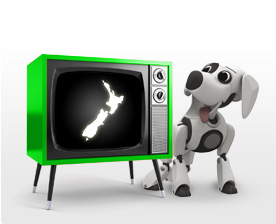
The New Zealand Government has chosen a digital cartoon dog, Seymour, as its mascot in the Going Digital campaign.
Seymour of the Going Digital campaign
Like many other countries, New Zealand will transition to only digital television starting next year. This change affects many people who have older style televisions and who do not currently use digital reception devices such as those provided by Freeview and Sky TV.
Seymour is a cute little black and white dog. You can view his commercials on the Going Digital website.
Kathleen Crisley, Fear-Free certified professional and specialist in dog massage, rehabilitation and nutrition/food therapy, The Balanced Dog, Christchurch, New Zealand
The Foundation for Biomedical Research, located in Washington DC, estimates that there are 60,000 dogs in research facilities in the United States. (The Foundation advocates for ethical treatment of animals used in research.)
The beagle is commonly chosen as a research subject because of its size and temperament.
Unfortunately for the dogs involved in research, most facilities do not re-home the dogs after their ‘useful’ period has passed. Most are euthanised. One reason for this is that the facilities who conduct research involving dogs do not wish to be identified, for fear that they are targeted by activists who publicise their use of the dogs. In extreme cases, activists have been known to break into the facilities to release the dogs.
Some animal welfare agencies work behind the scenes to find ways to receive these dogs and find them new homes, also protecting the anonymity of the laboratories so they are encouraged to re-home more dogs in the future. The San Francisco Chronicle ran a story last week of one such re-homing effort involving nine beagles.
Re-homing an ex-laboratory dog is not always easy. Most of these dogs have never been outside and have never been housebroken because they spend their lives in a crate or cage. In the cases of these beagles, they were also de-barked (vocal chords were intentionally cut) to reduce noise in the laboratory.
The June re-homing exercise was the second for the Beagle Freedom Project, which mounted this wonderful video on YouTube of the rescue:
In future blog postings, I will provide some more information about dogs used in research and the points of view about whether or not the experimentation on them is essential. This is a major animal welfare issue and one that will not go away quickly as the world seeks to develop new treatments for human diseases and disorders.
Kathleen Crisley, Fear-Free certified professional and specialist in dog massage, rehabilitation and nutrition/food therapy, The Balanced Dog, Christchurch, New Zealand
Carrie is a Golden Retriever from Chile. Her owner, Jose Fuentes, has taught her to merengue with him. Thanks to the Internet, the pair has developed a reputation, appearing on television shows like The Late Show with David Letterman.
There has even been a petition, of sorts, to get Carrie and Jose onto Dancing with the Stars as a guest act!
Here are a few videos of Carrie, thanks to the power of You Tube.
Kathleen Crisley, Fear-Free certified professional and specialist in dog massage, rehabilitation and nutrition/food therapy, The Balanced Dog, Christchurch, New Zealand
The Peach Theatre Company in cooperation with radio station More FM and Purina are looking for a dog to play Toto in the upcoming production of the Wizard of Oz which will be performed in Auckland this September.
The producers are open-minded and will consider dogs other than the Cairn Terrier, who featured as the original Toto in the film. If you think your dog has star quality, then fill out the entry form here.
Kathleen Crisley, Fear-Free certified professional and specialist in dog massage, rehabilitation and nutrition/food therapy, The Balanced Dog, Christchurch, New Zealand
News has broken this week that Trouble, the Maltese previously owned by Leona Helmsley (‘The Queen of Mean’), died in December. Helmsley left a US$12 million trust fund when she died in 2007 for the care of Trouble. This amount was later reduced to US$2 million when relatives challenged the will.
If you are thinking about providing for your dog in your will – there is a right way and wrong way to do it.
Right way: Check into the regulations in your area about establishing trust funds for the benefit of your pet’s care and open the trust fund now, making regular contributions. Make sure you nominate someone to care for your dog after you have died, using the funds in the trust.
If pet trusts are not allowed in your area, you need to nominate a carer for your dog and then leave them money to support your dog’s care.
Wrong way: Don’t leave money to your dog in your will. Whether we like it or not, dogs are considered property and this status means that they cannot inherit money. The money you leave to your dog will likely be re-distributed to other beneficiaries.
Kathleen Crisley, Fear-Free certified professional and specialist in dog massage, rehabilitation and nutrition/food therapy, The Balanced Dog, Christchurch, New Zealand
With the advancement of DNA technology, more people want to know what their mixed breed dog is made up of. More than half of all dogs in the USA are mixed breeds, making The Mutt the most popular dog!
Mars Veterinary, which has its own veterinarians and genetics research unit, decided to conduct the first-ever Mutt Census last year, inviting owners of mutts to complete an on-line questionnaire and requiring them to use a DNA test kit called the Wisdom Panel ™.
It is now official that the German Shepherd Dog is the breed most commonly found in mixed breed dogs. The Top 10 Mutt Breeds are:
The Top 10 Mutt Breeds
1. German Shepherd Dog
2. Chow Chow
3. Labrador Retriever
4. Boxer
5. Rottweiler
6. American Staffordshire Terrier
7. Miniature Poodle
8. Golden Retriever
9. Siberian Husky
10. Cocker Spaniel
To find out more about the Mutt Census, click on the logo below. This will take you directly to the Mutt Census website.
Kathleen Crisley, Fear-Free certified professional and specialist in dog massage, rehabilitation and nutrition/food therapy, The Balanced Dog, Christchurch, New Zealand
Take Your Dog to Work Day is Friday, 24th June this year.
This day is used to help raise funds for animal care organisations around the world as employers sponsor special events for employees and their dogs. It has also become an opportunity to introduce employers to the benefits of a dog-friendly workplace.
The folks at Pet Sitters International started this event back in 1999 and their website gives you lots of useful information about how to get your employer on board, tips for success, and event ideas.
Their tips for Dog Day Success include:
designating some areas as off-limits to cater to employees who do not want to participate
having regular breaks for dog walks, possibly offering the services of a dog walker
ensuring all dogs are kept on leash
making sure employees have alternative arrangements if their dogs get sick or are unhappy in the office
There’s still time to organise your own Take Your Dog to Work Day for this year!
Kathleen Crisley, Fear-Free certified professional and specialist in dog massage, rehabilitation and nutrition/food therapy,The Balanced Dog, Christchurch, New Zealand
The 1st of July will mark the start of a new financial year for many towns and here in Christchurch it means that dog registrations must be paid for another year.
Christchurch encourages responsible dog ownership by offering certified responsible dog owners a dramatically reduced registration fee. For a spayed or neutered dog, the fee drops from $76.00 to $53.00. Second and subsequent dogs at the same residence can be registered for only $37.00 each.
What does it mean to be a responsible dog owner?
Dog owners must apply to the council to be granted responsible dog owner status.
Applicants for Responsible Dog Ownership status sign an application form stating that they have and will continue to meet all the following conditions and requirements listed below:
(a) No dog owned by the applicant in the last two years has:
(i) Been impounded, chased or returned home by Council Dog Control staff.
(ii) Been the subject of any bona-fide complaint.
(iii) Been issued with an infringement notice for any dog related offence.
(b) All dog registration fees have been paid for the past two years by the due date.
(c) The applicant has not been prosecuted, nor issued with an infringement notice, for any dog related offences.
(d) Any information regarding the purchase of, death, sale or transfer of dogs to and from the applicant’s property, including movement of any pups born on the premises, shall continue to be promptly notified in writing to the Council.
(e) The applicant’s property is suitably fenced and gated to ensure it is dog-proof.
Dog free access to a door of the dwelling is provided for authorised callers.
(The Council reserves the right to carry out random property inspections to ensure compliance.)
(f) All dog(s) owned or kept by the applicant will be controlled in accordance with the Dog Control Act 1996 and with current Council Dog Control Bylaws.
(g) The applicant has been a recorded dog owner and resided within the Christchurch City Council area for at least 12 months. If an owner has not been a recorded dog owner and resided in Christchurch City for at least one year but can produce written evidence that they have had a classification with criteria similar in most respects to those included here in another territorial authority they may be considered to have fulfilled this condition.
(h) Any faecal matter (droppings) deposited by the applicant’s dog(s) in any public place or on any land other than that occupied by the applicant will be removed forthwith and deposited in a suitable receptacle.
(i) Any change of residential address within the city shall be notified in writing to the Council within 14 days.
(j) The applicant understands that any breach of the above conditions will lead to the immediate cancellation of privileges under this policy.
(k) The applicant is aware that the granting of this application does not relieve the applicant from payment of the full dog control fee.
If the dog owner breaches the rules in any way, they can lose their Responsible Dog Owner status for a period of two years.
What does your town do to encourage responsible dog ownership?
Kathleen Crisley, Fear-Free certified professional and specialist in dog massage, rehabilitation and nutrition/food therapy,The Balanced Dog, Christchurch, New Zealand
New Zealand’s Ministry of Civil Defence has launched a new DVD aimed at teaching young children how to drop and cover during an earthquake and Stan the Dog is the lead character.
Stan tells kids how to get under furniture or crouch with their hands protecting their heads.
Called Turtle Safe, you can download the resources here.