
“He’s a hard dog to keep on the porch”
– Presidential candidate Hillary Clinton, on her husband Bill

“He’s a hard dog to keep on the porch”
– Presidential candidate Hillary Clinton, on her husband Bill
Yearbooks are a tradition. They provide the chance to capture a moment in time which is usually a milestone in a young person’s education.
In West Monroe, Louisiana, a special yearbook photo was taken this year, of Presley who is Seph Ware’s service dog.
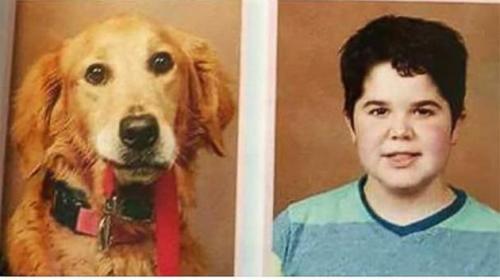
Presley and Seph Ware are featured side by side in the class yearbook at Good Hope Middle School. (Holtzclaw Photography)
Seph, age 14, has Duchenne Muscular Dystrophy which is a progressive genetic muscle disorder that causes a loss of muscle function. Presley’s job is to help help him with daily activities at school like picking things up off the floor, opening and closing doors and turning the lights on and off.
The Good Hope Middle School felt it was only right to have Presley featured in the yearbook since she has been at school every day.
Special dog!
Source: ABC 13
Posted in Dogs, special dogs and awards
Tagged Good Hope Middle School, Louisiana, Presley, service dog, yearbook photo
All airports in the United States that service over 10,000 passengers per year must have a pet relief area in every terminal by this August, according to federal regulation.
This is great news for the traveling public.
Initially, pet relief areas were focused on providing areas for service animals. But interest and need has grown particularly in providing pet relief areas after passengers pass through airport security (not just in an outdoor area).

An outdoor pet relief area at LAX
I’ve blogged about pet relief areas before. Here are the links.
Kathleen Crisley, specialist in dog massage, rehabilitation and nutrition/food therapy, The Balanced Dog, Christchurch, New Zealand
Tagged airports, dog loo, federal regulation, pet relief areas, toilets
Firefighter William Linder was washing his car last year when he smelled smoke. A neighbor’s shed was on fire and when he entered, he found a little pit bull puppy cowering in the corner.

He revived the puppy with mouth-to-snoot resuscitation and the puppy was admitted to a veterinary hospital with burns over 75% over his body.
The puppy endured six weeks of antibiotics and morphine to survive his injuries. His owners abandoned him because they couldn’t pay for his care. So Linder, who works in Hanahan, South Carolina, adopted him.
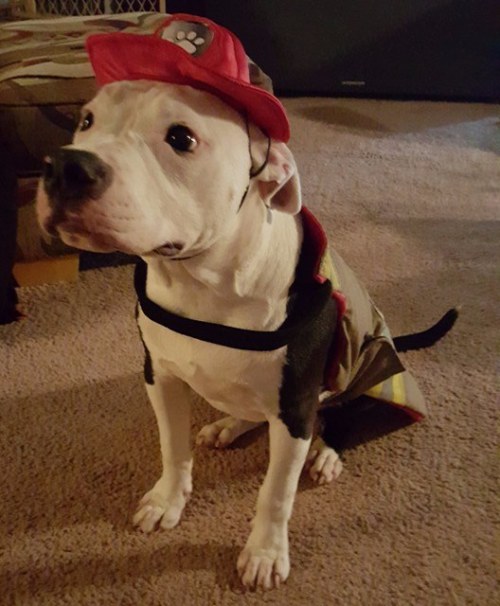
Although Jake has bald spots from the burns where fur will never grow, he’s become a station mascot and Linder takes him to elementary schools to teach fire prevention.
Another pit bull showing the world that, just like other dogs, they only want be loved.
Kathleen Crisley, specialist in dog massage, rehabilitation and nutrition/food therapy, The Balanced Dog, Christchurch, New Zealand
Posted in Dogs, special dogs and awards
Tagged firefighter, Hanahan South Carolina, Jake, station mascot, William Linder

I often get asked ‘what type of dog benefits most from massage and laser?’
People think that a certain breed or size of dog has the most problems. While it is true that some breeds have a higher likelihood of problems due to genetics – obesity or hip dysplasia in Labradors, for example – the reality is that all dogs benefit from touch therapies. That’s purebreds and mixed breeds, toy dogs, medium and large dogs and extra-large dogs.
People also think that you only massage a dog once they are elderly and showing signs of discomfort. While of course you should seek help in these instances, you can keep your dog more flexible in the joints and with good blood flow to the muscles by instituting a regular wellness program that includes massage.
And by regular, I only see some of my clients six- or eight-weekly, because we have their dog responding well to their treatments. They move more freely and comfortably now and only need a ‘top up’ to keep in good shape.
So the other message I have in this post is that your dog’s massage therapy doesn’t have to break your budget. If you get your dog into a regular massage program, you can easily plan for this expense and accommodate it. This is so much better than trying to fund the ‘ambulance at the bottom of the cliff’ approach.
I practice on a mobile basis, and so with lower overheads (no clinic to rent, heat and insure), I pass on these savings to my customers.
Kathleen Crisley, specialist in dog massage, rehabilitation and nutrition/food therapy, The Balanced Dog, Christchurch, New Zealand

A fossil found in Maryland was identified by a University of Pennsylvania doctoral student as belonging to a new species of ancient dog. The hyena-like canine, with massive jaws capable of crushing bone, would have lived approximately 12 million years ago, at a time when massive sharks like megalodon swam in the oceans. Credit: Illustration of Cynarctus from “Dogs, Their Fossil Relatives and Evolutionary History.” Reprinted and used with permission of the publisher and Mauricio Antón, author of the illustration and copyright owner [2008]; Courtesy of University of Pennsylvania
The newly named species is Cynarctus wangi, named for Xiaoming Wang, curator at the Natural History Museum of Los Angeles County and a renowned expert on mammalian carnivores. This coyote-sized dog was a member of the extinct subfamily Borophaginae, commonly known as bone-crushing dogs because of their powerful jaws and broad teeth.
“In this respect they are believed to have behaved in a similar way to hyenas today,” said the study’s lead author, Steven E. Jasinski, a student in the Department of Earth and Environmental Science in Penn’s School of Arts & Sciences and acting curator of paleontology and geology at the State Museum of Pennsylvania in Harrisburg.
Fossils from terrestrial species from this region and time period are relatively rare, thus the find helps paleontologists fill in important missing pieces about what prehistoric life was like on North American’s East Coast.
“Most fossils known from this time period represent marine animals, who become fossilized more easily than animals on land,” Jasinski said. “It is quite rare we find fossils from land animals in this region during this time, but each one provides important information for what life was like then.”
Whenco-researchers Jasinski and Wallace first began their investigation of the specimen, which had been found by an amateur collector along the beach under the Choptank Formation in Maryland’s Calvert Cliffs region and was then held by the Smithsonian Institution, they presumed it was a known species of borophagine dog, a species called marylandica that was questionably referred to as Cynarctus, a fossil of which had been found in older sediment in the same area. But when they compared features of the occlusal surfaces, where the top and bottom teeth meet, of the previously known and the new specimens, they found notable differences. They concluded that the specimen represented a distinct species new to science.
“It looks like it might be a distant relative descended from the previously known borophagine,” Jasinski said.
Borophagine dogs were widespread and diverse in North America from around 30 million to about 10 million years ago. The last members went extinct around 2 millions of years ago during the late Pliocene. C. wangi represents one of the last surviving borophagines and was likely outcompeted by ancestors of some of the canines living today: wolves, coyotes and foxes.
Despite its strong jaws, the researchers believe C. wangi wouldn’t have been wholly reliant on meat to sustain itself.
“Based on its teeth, probably only about a third of its diet would have been meat,” Jasinski said. “It would have supplemented that by eating plants or insects, living more like a mini-bear than like a dog.”
“This new dog gives us useful insight into the ecosystem of eastern North America between 12 and 13 million years ago,” Jasinski said.
Source: PennNews media release
The DeLuca family of Tampa, Florida are very happy they chose to adopt Haus, a German Shepherd two months ago.
Last week, Haus stepped in to keep their 7-year old daughter from being attacked by a rattlesnake, an Eastern Diamondback to be precise.
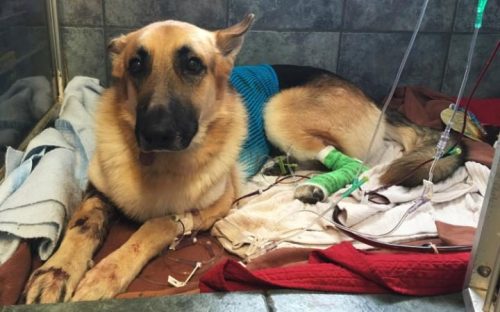
Haus suffered several snake bites and it was touch-and-go for a while when he was admitted to the local veterinary hospital and put on an anti-venom drip and given pain relief.
The family appealed for funds for his care and were amazed at how quickly the funds added up to over $50,000. They then issued a statement “PLEASE — we feel we have plenty to care for Haus’ needs” and encouraged people to donate to other worthwhile charities – where the excess funds will also be donated.
At last report, Haus’ condition is improving.
And it makes me very glad that New Zealand is a land without snakes!
Kathleen Crisley, specialist in dog massage, rehabilitation and nutrition/food therapy, The Balanced Dog, Christchurch, New Zealand
Posted in Dogs, special dogs and awards
Tagged Florida, german shepherd, Haus, rattlesnake, snake

There’s an old saying: you reap what you sow
In all my work with special needs dogs, I think this holds true. If our starting point is muzzling a dog because of their breed, and they are unable to express their natural behaviors or experience the joy of freedom, then we sow the seeds of aggression.
If we aim to make all dogs companions and we work towards socializing and training them, we get the opposite.
Simple, isn’t it?
Kathleen Crisley, specialist in dog massage, rehabilitation and nutrition/food therapy, The Balanced Dog, Christchurch, New Zealand
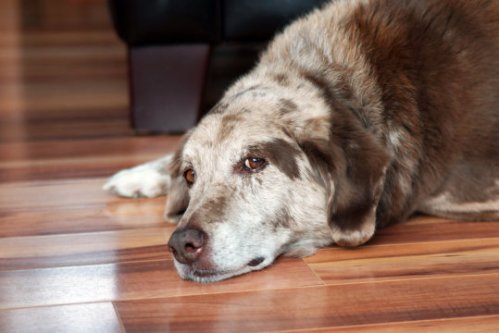
A rare, severe form of pulmonary hypertension, which up until now, has only been classified as a human lung disease, has also been discovered in dogs according to a Michigan State University study. (Stock image) Credit: © Sylvie Bouchard / Fotolia
A rare, severe form of pulmonary hypertension, which up until now, has only been classified as a human lung disease, has also been discovered in dogs according to a Michigan State University study.
“Our research is the first to document the existence of pulmonary veno-occlusive disease, or PVOD, in dogs,” said Kurt Williams, the lead author of the study and an expert in respiratory pathology in MSU’s College of Veterinary Medicine. “PVOD is considered one of the most severe forms of pulmonary hypertension.”
The study is published in the journal Veterinary Pathology.
The number of pulmonary hypertension, or PH, cases reported in the United States is low, affecting 15 to 50 people per million each year. PVOD is diagnosed in only about 10 percent of PH cases where no other cause of the disease has been determined. Unfortunately, there are very few effective treatment options for PVOD and a lung transplant often becomes the best choice.
“PVOD might be more common in dogs than in people, but this has yet to be determined and needs to be looked at further,” Williams said.
Pulmonary hypertension develops because of abnormal blood vessels in the lungs, which makes it harder for the heart to push blood through and provide oxygen to the rest of the body. In cases of PVOD, the small veins in the lungs become blocked, increasing pressure in these blood vessels, and ultimately causing heart failure.
“The same process happens in canines,” Williams said. “These dogs also come in with similar symptoms as humans, yet because subtle changes in health may not be recognized as quickly in dogs, death can occur quickly once the animal is seen by a veterinarian.”
Symptoms include cough, increased rate of breathing, respiratory distress, loss of appetite and chronic fatigue. Fatal progression of the disease in humans can last up to two years.
“PVOD is a poorly understood disease not just because it’s so rare, but also because there’ve been no other animals known to have the disease,” Williams said. “Our finding changes things.”
Williams said that the discovery could be important for human medicine because the canine disease may serve as a model for human PVOD.
“It’s cases like this that help to remind us how important veterinary medicine is to medicine in general,” he said. “Our colleagues in the human medical community are becoming much more aware of the many diseases shared by our respective patients and how together we can learn from each other.”






 DoggyMom.com