Author Archives: DoggyMom.com

Eyesight in the older dog

The eyesight in our dogs changes with age.
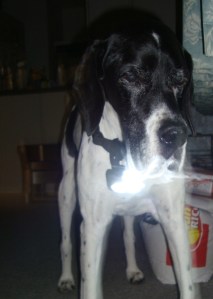
English Pointer with Puplight

Researchers based at the Nestlé Purina Research Center in Missouri have discovered that our dogs become more near-sighted as they age.  Their results were published in the journal PLoS One.

This investigation used an instrument called an autorefractor to measure the dogs’ eyesight in indirect and direct lighting conditions. The study involved nine Beagles ranging in age from 1 to 14 years.   Before entering the study, the dogs were examined to confirm that none of them had cataracts.

Measurements were taken on three different days of the week for a period of six weeks.

The researchers found a remarkable difference between the younger and older dogs.  The older dogs had a much-reduced ability to see at longer distances (far-sightedness) compared to the younger dogs.  Younger dogs were also able to make larger accommodation changes from indirect light to direct light conditions, indicating a more flexible lens.

Humans are the opposite in terms of length of sight.  As we age it can become more difficult to read and see things at shorter distances whereas our ability to see at distances is often not affected (although some older people do have difficulties adjusting to night and low-light conditions, just as the dogs in this study did).

So if your dog is getting older and you notice that they can’t pick up on your body language and signals, there’s a physical reason for it.

Through my own experience working with older dogs, I recommend using a light that helps your senior dog adjust to low-lighting conditions.  See my post on the PupLight, for example.

Kathleen Crisley, specialist in dog massage, rehabilitation and nutrition/food therapy, The Balanced Dog, Christchurch, New Zealand


 

The dog friendly Italian supermarket

Unes grocery shop owner Gianfranco Galantini noticed how many small dogs were being left outside his shop in the city of Liano, Italy as their owners dashed inside to do their shopping.

He decided to welcome the dogs inside by designing pet-friendly shopping trolleys.

Dog friendly shopping trolley

(Picture: Lucia Landoni/ La Repubblica)

The front section of each trolley has a solid bottom, allowing the dogs to sit or stand inside.  It’s legal to bring the dogs inside the store, so long as they are under control.  The store also cleans the trolley after each use.

Word gets around dog owners pretty quickly when a shop is welcoming to dogs; owners have responded by shopping there and by all accounts, the dogs have been well behaved and there haven’t been any problems.

The trolleys have proved so popular that the Unes grocery chain is considering rolling them out in its other stores.

Wouldn’t you like to see this type of pet-friendly shopping in your community?

103603255-ffc26775-ac4e-427c-b763-4a958ae4bcee.jpg

(Picture: Lucia Landoni/ La Repubblica)

Kathleen Crisley, specialist in dog massage, rehabilitation and nutrition/food therapy, The Balanced Dog, Christchurch, New Zealand

Words we say to our dogs and other things

Yet more research on the human-animal bond.  This time the research was based at Barnard College’s Dog Cognition Lab.

Researchers Alexandra Horowitz and Julie Hecht asked members of the public to send them videos of playtime with their dogs.

Dog with frisbee

They received 187 videos from dog owners in 19 different countries and watched them all, looking for patterns in human behaviour and the dog’s responses.

For example, they created a list of the top 35 words owners used with their dogs:

List of words dog owners use

The research team also noticed gender differences.  Female owners touch their dogs more when at play; half of male owners didn’t touch their dogs at all.

There is a practical application for this research (although I do agree that it sounds like a fun job).  There is a growing interest in helping to train dogs as assistance dogs and understanding how humans and dog interact may help to refine training techniques.

The research has been published in the journal Animal Cognition.

Source:  Discover magazine

Pet friendly senior living

TigerPlace is a retirement community that helps residents care for their pets as both age.

Located in Colombia, Missouri, this retirement community offers one-floor living to make it easy for owners and pets to enjoy the outdoors.  And there’s on-site veterinary care!Senior gentleman and dog sitting on ground and posing in a park

Described as “pet encouraging” as opposed to “pet tolerating”, this facility even offers dog walkers for older residents who are finding it difficult to give their dog the exercise it needs.

This article in the Missourian gives greater insight into the facility and its value to its residents.  This includes following 90-year old Elizabeth Kennedy who lives at TigerPlace with her 12-year old Boston Terrier, Dolly.

The article mentions a growing trend for retirement communities to offer pet care and the  recognition and evidence that pets keep us living longer, more active, and happier lives.

Kathleen Crisley, specialist in dog massage, rehabilitation and nutrition/food therapy, The Balanced Dog, Christchurch, New Zealand


Sofa sitting

Coach sitting

Dogs are interesting and entertaining creatures.  Most love to play and rest on our sofas and furniture (if they are allowed).

And they also adopt some funny positions when doing this.

What’s your dog’s funny furniture position?

Kathleen Crisley, specialist in dog massage, rehabilitation and nutrition/food therapy, The Balanced Dog, Christchurch, New Zealand

Shopping At Home Depot With Abby

Home Depot allows dogs. What a great learning and socializing experience. Where else do you go with your dog?

Marcela's avatarAllMyCanineCompanions

HD1 Abby, “Excuse me. Could someone help us find some tools?”

Moving is always hectic and time consuming and we’ve been busy unpacking, cleaning, buying things for our new place and much more.  Home Depot is one of the places we’ve been going to lately a lot so we take Abby with us to expose her to new people, environment, sounds, etc.

HD2 Abby, “Moms, someone is coming to help us in a minute.”

Abby got to work that day by trying to get someone to come and help us find a few items we needed to buy.  It was Saturday, so everybody was busy trying to help customers.  We had a secret weapon, Abby.  They all wanted to pet her.

HD3 Abby, “Ok moms, tell me what you need so I can grab it for you.”

Abby is a pretty young pup, but I always tell pet parents that regardless of their…

View original post 160 more words

Exploring the impact of pets in the workplace

Banfield Pet Hospital has published the results of its first-ever study of pet-friendly workplaces in the United States…

Banfield Infographic on Pet Friendly Workplaces

Obituary: Fidele of Bruges


Fidele of Bruges

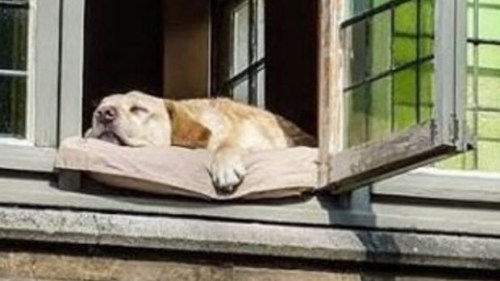
Fidele, the Golden Labrador who lived at the Bed and Breakfast Coté Canal and made a small appearance in the film In Bruges, passed away in early February at the age of 12.

His owner, Caroline Van Langeraert, has said that Fidele became an icon, with tourist boats along the canals stopping so tourists could take photos of him in his regular resting space at the window of the bed and breakfast.  He is irreplaceable.

Many tourists will have photos and videos of Fidele in his spot at the window, as seen here in YouTube.

It is always sad to see our dog friends leave; particularly so when they share our businesses and our customers know them well.  (Apparently, one US tourist asked to book into the bed and breakfast specifically because she had heard about Fidele.)


Kathleen Crisley, specialist in dog massage, rehabilitation and nutrition/food therapy, The Balanced Dog, Christchurch, New Zealand


Cross-breeding to eradicate Chiari syndrome

In a new study published in the journal PLOS ONE, scientists from the University of Surrey, working with an experienced breeder in the Netherlands, examined how the skull and brain of toy dogs change when a Brussels Griffon with Chiari-like malformation is crossed with an Australian Terrier.  The succeeding hybrid puppy is then back crossed to a Brussels Griffon to give some of the features of the Brussels Griffon, but keeping the longer skull of the Australian Terrier.

Griffon and cross breed

Second-generation backcross and purebred Brussel Griffon Sire Photo credit: Henny van der Berg

The results from the study showed it is possible to breed a dog which had the external features of a short-nosed Brussels Griffon and reduce the risk of Chiari malformation, a debilitating condition found in toy dogs and affecting 1 in 1,280 humans.  The disease is characterised by premature fusion of skull bones forcing parts of the brain to push through the opening in the back of the skull causing fluid filled cavities to develop in the spinal cord. Chiari malformation causes headaches, problems with walking or even paralysis and has become prevalent in some toy breed dogs as a result of selective breeding.

The breeder, Henny van der Berg proposed the project idea after an accidental mating between two of her dogs.  The four-year study analysed five traits on magnetic resonance images (MRI) scans and how they changed generation by generation in the family of 29 dogs.  Using a careful selection of head shape and MRI scans over two generations, the findings revealed it was possible to breed a dog which had the external features of a Brussels Griffon, but is less susceptible to Chiari malformation.

“This is a true collaboration with breeders and researchers working together and using their expertise to improve the health of dogs,” said Dr Clare Rusbridge from the University of Surrey.

“Our study investigated how the characteristics of this disease is inherited in the family.  Such knowledge could help in tackling this debilitating disease in toy dog breeds.  We hope our research will help develop more sophisticated ways of screening and improve breeding guidelines by creating robust breeding values.”

The team at the University of Surrey is now collaborating with geneticists at the University of Montreal, and correlating the skull and brain traits visualised on magnetic resonance images with the dog genome. This information will then be translated to humans.

Source:  University of Surrey media release

My other posts about Chiari malformation include:

New Florida law protects dog rescuers

Republican Governor Rick Scott has signed House Bill 131 into law.  This law will allow people to break into locked vehicles to rescue animals or people who are “in imminent danger of suffering harm.”

Dog in car

In Florida, children and pets have regularly suffered by being left in overheated cars.  Many have died.

Rightfully so, there are guidelines for the law to apply.

  1.  You must check that the vehicle is locked.
  2. After doing so, call 911 or law enforcement before entering the vehicle or immediately after rescuing the child or pet.
  3. Use no more force than is necessary to break in — and remain with the person or animal until first-responders arrive.

All of these guidelines seem very reasonable to me.

Well done to the State of Florida!

Kathleen Crisley, specialist in dog massage, rehabilitation and nutrition/food therapy, The Balanced Dog, Christchurch, New Zealand