Author Archives: DoggyMom.com

The benefits of stretching

Dog doing morning stretches

Vera does her morning yoga (photo by Jenny Hamilton)

I remember watching a yoga video years ago where the instructor described the act of stretching as ‘making space in the joints.’

As a canine massage therapist, I think stretching is essential.  It lengthens muscles in a controlled and safe way to ensure good range of motion in the limbs and it helps to maintain blood flow to essential soft tissues.

As our dogs age, or when they are injured, then often need help with stretching (the same is true of people).  That’s where professional massage comes in – someone to help warm and stretch the muscles, tendons and ligaments.

Owners can also learn to stretch their dogs; it’s something I include in special massage workshops for greyhound owners.  I’ve found that greyhounds, with their sleek builds and racing instinct, often tighten up when in a pet home or when they don’t get regular off-lead exercise.

Kathleen Crisley, specialist in dog massage, rehabilitation and nutrition/food therapy, The Balanced Dog, Christchurch, New Zealand


Inhibitory control in dogs

Inhibitory control may be an indicator of a dog’s ability to solve a problem, according to a study published February 10, 2016 in the open-access journal PLOS ONE.

Playing with objects may help dogs learn about their environment, similar to how it helps human infants. Scientists think dogs’ inhibitory control, or the ability to inhibit or regulate attentional or emotional responses, may play a role in their individual differences in physical problem-solving task performance.

Wait for it border collie

A Border Collie during the wait-for-treat task.Credit Clever Dog Lab/Vetmeduni Vienna

The authors of this study investigated the effects of pet dogs’ experiences interacting with the physical environment and their individual differences in inhibitory control on their physical problem-solving ability. A cohort of ~40 pet Border Collie dogs were assigned to three different conditions, and tested in an intensive series of inhibitory control tasks, such as wait-for-treat, and cognitive measures, such as size constancy over a period of 18 months.

The authors found that differences in previous object-related experiences do not explain variability in performance in problem solving tasks. Depending on the cognitive task, inhibitory control had a positive or a negative effect on performance and turned out to be the best predictors of individual performance in the different tasks.

The authors think that dogs likely do not transfer knowledge about physical rules from one physical problem-solving task to another, but rather approach each task as a novel problem. In addition, individual performance in these tasks may be influenced by the subject’s level of inhibitory control. The authors suggest that studying the interplay between inhibitory control and problem-solving performance may make an important contribution to our understanding of individual and species differences in physical problem-solving performance.

Journal article may be found here.

Source:  EurekAlert! media release

Priceless

Just a brief post and thought of the day.

Getting your dog food delivered….convenient

Having fun with the box afterwards….PRICELESS

Kathleen Crisley, specialist in dog massage, rehabilitation and nutrition/food therapy, The Balanced Dog, Christchurch, New Zealand

The mis-labelling of pit bulls

DNA results show that shelter workers are often mistaken when they label a dog as a pit bull, with potentially devastating consequences for the dogs, a new University of Florida study has found.
DNA pit bull study

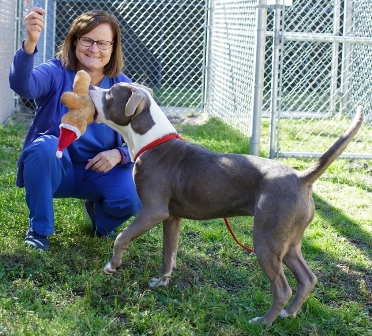
Dr. Julie Levy holds a dog currently up for adoption at the Alachua County Animal Services facility in Gainesville, Florida

“Animal shelter staff and veterinarians are frequently expected to guess the breed of dogs based on appearance alone,” said Julie Levy, D.V.M., Ph.D., a professor of shelter medicine at the UF College of Veterinary Medicine and the lead author of a study published recently in The Veterinary Journal.

“Unlike many other things people can’t quite define but ‘know when they see it,’ identification of dogs as pit bulls can trigger an array of negative consequences, from the loss of housing, to being seized by animal control, to the taking of the dog’s life,” she said. “In the high-stakes world of animal shelters, a dog’s life might depend on a potential adopter’s momentary glimpse and assumptions about its suitability as a pet. If the shelter staff has labeled the dog as a pit bull, its chances for adoption automatically go down in many shelters.”

The past few decades have brought an increase in ownership restrictions on breeds including pit bulls and dogs that resemble them. The restrictions are based on assumptions that certain breeds are inherently dangerous, that such dogs can be reliably identified and that the restrictions will improve public safety, the study states.

The study focused on how accurately shelter staff identified dogs believed to be pit bulls. ‘Pit bull’ is not a recognized breed, but a term applied to dogs derived from the heritage breeds American Staffordshire terrier or Staffordshire bull terrier. The purebred American pit bull terrier is also derived from these breeds and is often included in the loose definition of ‘pit bull.’

The research team evaluated breed assessments of 120 dogs made by 16 shelter staff members, including four veterinarians, at four shelters. These staff members all had at least three years of experience working in a shelter environment. The researchers then took blood samples from the dogs, developed DNA profiles for each animal and compared the DNA findings against the staff’s initial assessments.

“We found that different shelter staffers who evaluated the same dogs at the same time had only a moderate level of agreement among themselves,” Levy said. Results of the study also showed that while limitations in available DNA profiles make absolute breed identification problematic, when visual identification was compared with DNA test results, the assessors in the study fared even worse.

Dogs with pit bull heritage breed DNA were identified only 33 to 75 percent of the time, depending on which of the staff members was judging them. Conversely, dogs lacking any genetic evidence of relevant breeds were labeled as pit bull-type dogs from 0 to 48 percent of the time, the researchers reported.

“Essentially we found that the marked lack of agreement observed among shelter staff members in categorizing the breeds of shelter dogs illustrates that reliable inclusion or exclusion of dogs as ‘pit bulls’ is not possible, even by experts,” Levy said. “These results raise difficult questions because shelter workers and veterinarians are expected to determine the breeds of dogs in their facilities on a daily basis.

Additionally, they are often called on as experts as to whether a dog’s breed will trigger confiscation or regulatory action. The stakes for these dogs and their owners are in many cases very high.”

Dog breeds contain many genetic traits and variants, and the behavior of any individual dog is impossible to predict based on possible combinations.

“A dog’s physical appearance cannot tell observers anything about its behavior. Even dogs of similar appearance and the same breed often have diverse behavioral traits in the same way that human siblings often have very different personalities,”Levy said.

Even though most pet dogs are of unknown mixed breeds, there is a natural inclination among pet owners to speculate on what their dog’s breed heritage might be, the authors said.

“This has fueled an entire industry of pet dog DNA analysis,” Levy said. “These tests are fun, but they won’t help predict behavior or health traits. Shelters and veterinary clinics are better off entering ‘mixed breed’ or ‘unknown’ in their records unless the actual pedigrees are available.”

As for legal restrictions on dogs based on their appearance, Levy said public safety would be better served by reducing risk factors for dog bites, such as supervising children, recognizing canine body language, avoiding an unfamiliar dog in its territory, neutering dogs and raising puppies to be social companions.

Source:  University of Florida media release

See also my 2013 post on Visual identification of breed – one reason why BSL doesn’t work

Patience

Patience

Some people find it hard to believe that a dog professional like myself has never raised a dog from a puppy.  That’s because my family raised me with the idea that you adopt, rather than buy, a dog.  And by default that has steered me into a life with re-homed dogs – both mixed breeds and purebreds – who have entered my life at different ages.

My first dog came from a shelter; my second came from a supermarket ‘free to a good home’ ad; my third was a private adoption facilitated by a local rescue group (but she had never lived in their shelter); my fourth was a word-of-mouth adoption of Daisy, a purebred Pointer, who had bounced back to her breeder through no fault of her own.  And now, I have Izzy who is a retired racing greyhound.

It’s a myth that ‘rescue’ dogs are all mixed breeds; many pure bred dogs also find themselves in need of re-homing.  Responsible breeders will take back a dog for any reason during the lifetime of the dog.  So, for example, in cases of divorce or an owner’s death, these dogs come up for adoption – and that’s only a couple of examples.  There are also breed specific rescue groups who are passionate supporters of a breed and work to re-home dogs who have fallen on bad times.

What my life of adopting dogs has taught me is patience.  It’s great to go out and buy the dog a bed, food and toys and envisage a perfect life together.  And it will be good- but there are usually teething problems.

For example, when I adopted Izzy , she was suffering from re-homing stress.  She was overwhelmed by her surroundings in my home – it was totally foreign territory.  She was off her food and made herself a bed on a blanket by the front door.  She remained there for almost 2 weeks (only moving to eat or drink or go out for walks) until she got her confidence to explore more of the house.

It took her 2 months to venture confidently into my bedroom (where large windows looking out onto the garden seemed to overwhelm her).  She did not get on my bed for almost 4 months.

We had a few toileting incidents but that was also because she was getting used to new food and was already stressed from her change of circumstances.  Whose tummy wouldn’t cause them problems?

But we got there and that takes patience.  When I do home-checking for Greyhounds as Pets, I get an idea about how well the family is prepared to be patient with their new dog.

A prospective owner with a very strict timeline for getting their dog settled is unlikely to be successful – the dog doesn’t know about the timeline.

The best advice I can give is – be patient.  If anything, give your new dog some space.  Let them decide when they are comfortable in trying new things and don’t overwhelm them with affection too soon.

It’s worth the wait.

Kathleen Crisley, specialist in dog massage, rehabilitation and nutrition/food therapy, The Balanced Dog, Christchurch, New Zealand


Mensa dogs

Dogs have measurable IQs, like people, suggests new research from the London School of Economics and Political Science (LSE) and the University of Edinburgh.

The research, published in the journal Intelligence, looked at whether dog intelligence is structured in a similar way as in humans. When IQ, or ‘general intelligence’, is tested in people, individuals tend to perform comparably across different types of cognitive tasks –  those who do well in one type of task, tend to do well in others.

Dog intelligence test

The researchers created a proto-type dog ‘IQ test’ which they used to assess the intelligence of 68 working border collies. These tests included: navigation, tested by timing how long it took the dogs to get food that was behind different types of barriers; assessing whether they could tell the difference between quantities of food and; their ability to follow a human pointing gesture to an object.

The researchers found that dogs that did well on one test tended be better at the other tests. Furthermore, dogs that did tests faster were likely to do them more accurately.

Dr Rosalind Arden, a Research Associate at LSE, said: “Just as people vary in their problem solving abilities, so do dogs, even within one breed. This is significant because in humans there is a small but measurable tendency for people who are brighter to be healthier and live longer.  So if, as our research suggests, dog intelligence is structured similarly to ours, studying a species that doesn’t smoke, drink, use recreational drugs and does not have large differences in education and income, may help us understand this link between intelligence and health better.

“In addition, dogs are one of the few animals that reproduce many of the key features of dementia, so understanding their cognitive abilities could be valuable in helping us to understand the causes this disorder in humans and possibly test treatments for it.”

The suite of tests was conducted in under an hour per dog, which is comparable with the time it takes a person to do an IQ-type test.  Previous research on canine cognitive abilities has taken much longer to administer.

Dr Mark Adams, Research Fellow at the University of Edinburgh, said: “This is only a first step, but we are aiming to create a dog IQ test that is reliable, valid and can be administered quickly.  Such a test could rapidly improve our understanding of the connection between dog intelligence, health, even lifespan, and be the foundation of ‘dognitive epidemiology’

“Dogs are excellent for this kind of work because they are willing to participate and seem to enjoy taking part.”

In order to get a large sample of dogs from similar backgrounds the researchers recruited working border collies, which meant that there weren’t big differences in how they were raised.

Source:  London School of Economics and Political Science media release

Personal comment:  Dogs must be a popular research topic if even the London School of Economics is getting into the act!

Firefighters rescue dog from burning home

A Sacramento homeowner’s smoke alarms did their job this week by waking the family so they could evacuate and raise the alarm with fire crews.

Unfortunately, it looks like their dog was left inside (dogs may run and hide during these situations; there is commotion and stress and people do not always think clearly – in terms of being able to get their dog out of the house with them).

Fire video screen shot

The Sacramento Fire Department did a great job in finding the dog, and his rescue was caught on ‘helmet cam’

You can view the video by following this link to a CBS news report.  The video is also available on the Fire Department’s Facebook page.

Smoke alarms save lives.  Tomorrow is Valentine’s Day – show your dog that you love them by checking that your smoke alarms are working.

Kathleen Crisley, specialist in dog massage, rehabilitation and nutrition/food therapy, The Balanced Dog, Christchurch, New Zealand

Dogs – part of the coping for kids of military families

Janelle Casson says it never gets any easier when her husband deploys as a U.S. Army combat engineer. But after four tours of duty in the last 12 years—assignments ranging from a year to 15 months each in Iraq—she and her four children eventually fall into a well-learned routine. “You have a muscle memory of how it feels to be without him and what we all need to do to keep moving forward,” she says.

Even Ebony, the family’s 9-year-old Scottish terrier-schnauzer mix, takes the deployments hard, moping about the house and keeping to herself. “It takes a couple of weeks for her to come to terms with the fact that dad is not here,” says Casson, of Killeen, Texas. Ebony inevitably forgoes her normal bed in the master bedroom to seek comfort sleeping alongside one of the children.

Terrier Schnauzer mix

This article didn’t come with a photograph of Ebony, but I imagine she looks something like this.

Fourteen-year-old Elijah, the oldest, is the main support for the dog, which joined the family when the boy was 5. “He’s been Ebony’s primary caretaker” whenever his father is away, says Casson. “He feeds her and takes her on walks. He just fell into the role of taking care of her, much the way [many military] kids fall into other typically dad roles when they’re gone.”

Ebony is probably helping Elijah, too. Recent Tufts University research finds that a strong relationship with a pet is associated with better coping skills in children who are managing the stress of having a parent deployed. The study came out of the new Tufts Institute for Human-Animal Interaction (TIHAI), which seeks to discover exactly how animals help us better handle physical and emotional stress, commit to fitness and educational goals, overcome physical disabilities and recover from psychological trauma.

Animals have been a part of our lives for thousands of years. We started keeping company with them as soon as we realized that dogs could help us hunt, cats would exterminate the rodents pilfering our grain stores and horses offered transportation.

But that’s not the whole story. Why do we continue to embrace these domesticated animals like members of our family, even though they no longer fulfill our pragmatic needs? The new Tufts institute, launched in 2015, is examining the importance of our relationships with other species. But instead of working in the traditional silos of fields such as veterinary medicine, human medicine and psychology, TIHAI draws on faculty, staff and students from myriad areas of expertise.

“We bring together all these different disciplines to put some sound evidence behind what we intuitively know is true: animals can enhance our lives in so many ways,” says Lisa Freeman, J86, V91, N96, a professor at Cummings School of Veterinary Medicine who directs the Institute.

Source:  TuftsNow

Emotions matter: a dog’s view of facial expressions

A recent study from the University of Helsinki shows that the social gazing behavior of domestic dogs resembles that of humans: dogs view facial expressions systematically, preferring eyes. In addition, the facial expression alters their viewing behavior, especially in the face of threat. The study was published in the science journal PLOS ONE.

The study uused eye gaze tracking to demonstrate how dogs view the emotional expressions of dog and human faces. Dogs looked first at the eye region and generally examined eyes longer than nose or mouth areas. Species-specific characteristics of certain expressions attracted their attention, for example the mouths of threatening dogs. However, dogs appeared to base their perception of facial expressions on the whole face.

Threatening faces evoked attentional bias, which may be based on an evolutionary adaptive mechanism: the sensitivity to detect and avoid threats represents a survival advantage.

“The tolerant behavior strategy of dogs toward humans may partially explain the results. Domestication may have equipped dogs with a sensitivity to detect the threat signals of humans and respond them with pronounced appeasement signals”, says researcher Sanni Somppi from the University of Helsinki.

This is the first evidence of emotion-related gaze patterns in non-primates. Already 150 years ago Charles Darwin proposed that the analogies in the form and function of human and non-human animal emotional expressions suggest shared evolutionary roots.  Recent findings provide modern scientific support for Darwin’s old argument.

Facial expressions research

Dogs view facial expressions on a monitor

A total of 31 dogs of 13 different breeds attended the study. Prior to the experiment the dogs were clicker-trained to stay still in front of a monitor without being cued or restrained.

Source:  AlphaGalileo media release

I have previously blogged about other University of Helsinki research.  These posts include:


Image

A dog’s prayer

A dog's prayer