Author Archives: DoggyMom.com

Jingle and Bell for the holidays

Jingle and Bell are plush/soft toys sold by Hallmark.  This year, Hallmark is donating the sum of $100,000 to Best Friends Animal Society to support animal adoption.

Jingle and Bell

When these toys are purchased from a Hallmark Gold Crown store, Hallmark will include information about Best Friends to help spread the word about the no-kill movement and the benefits of adoption.

Corporate sponsorship in the right direction, I say.

Kathleen Crisley, specialist in dog massage, rehabilitation and nutrition/food therapy, Canine Catering Ltd, Christchurch, New Zealand

The great escape – an example of dog intelligence

Any reader of my blog knows that I enjoy following research topics, and I’ve written a number of posts about dog cognition.

This video, of a German Short Haired Pointer, shows that dogs are smart and can work things out.

She’s working on her great escape…watch her as she works it out (don’t just jump to the end)

Kathleen Crisley, specialist in dog massage, rehabilitation and nutrition/food therapy, Canine Catering Ltd, Christchurch, New Zealand

Personality match

When I heard about Paws Like Me, a site with a personality quiz for matching prospective adopters with dogs up for adoption, I had to go look.

This site provides people who must re-home their dogs with a place to list them as available for adoption.  The site encourages shelters, through its partner program, to refer people to list their dog with them directly so that shelters have more room for other needy animals.

Sorry, this site is only for USA adoptions – not available in New Zealand.

I took the personality test, which took less than 5 minutes.  It seems pretty accurate based on the types of dogs I have had during my life:

Your ideal dog!

You are a very active person, but because the dog will be home for long hours alone you need a dog with less energy. High energy dogs do not do well with long periods of down-time and are likely to find their own outlet for their mental and physical energy. You like a dog that is fairly easy to train to basic commands and a few fun tricks. The dog should be able to focus his attention on something for a decent amount of time. You don’t mind a dog that is a bit reserved in new situations or around new people. You can be patient and take the time to teach him that there is nothing to fear. You like an affectionate dog that will snuggle with you, but you don’t want him to be in your face trying to get attention constantly.
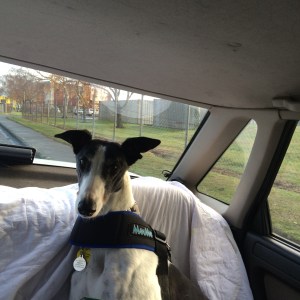
Izzy the Greyhound riding in the car

Izzy

I think Izzy would agree that we have been a good match!

Kathleen Crisley, specialist in dog massage, rehabilitation and nutrition/food therapy, Canine Catering Ltd, Christchurch, New Zealand

Grieving for a pet

Don't weep for me gravestone

Today I have been thinking a lot about pet loss and grief.

It’s just been one of those weeks – a few older dogs who are clearly reaching the end of their lives and one client in particular who seems to be on the verge of needing to make an end-of-life decision for their aging dog….

Most pet owners have experienced grief at the loss of a beloved animal.  I know I have.  And even when you know that your dog is reaching the end of its life, the loss is still shocking when the end finally arrives.

And then I read this Wall Street Journal article, decidedly focused on US employment and employers, about the decisions employees face when grieving for a lost animal.  It’s a little shocking (but not surprising) to know that employers have asked employees who are euthanising their pets to report to work before/after the event.

When I used to be employed in a large public sector organisation as a senior manager, I commented on a proposed bereavement policy.  I suggested that managers should be able to use their discretion and grant a day of bereavement leave based on the loss of a pet.  Managers would know the circumstances of their employee and the role of their pet in their lives because they were expected to know their staff well.

I also saw it as a leadership issue – large employers have the ability to support staff with benefits that smaller firms may not.

The CEO declined (actually, he never declined he just ignored the submission). I found out later from someone in HR (because I asked) that the CEO felt he ‘had to draw the line somewhere.’

Despite the growing research-based evidence of the role our dogs play in our emotional and physical health, owners are not supported through the inevitable grieving process that follows their life-long commitment.

It’s sad.

I’m very proud that I support my clients in assessing quality of life and I follow up with them after their dog passes; many have stayed in touch as colleagues and friends long after their dog has gone.

My only hope is that our workplaces and their policies catch up on what it means to be truly family-friendly.

Kathleen Crisley, specialist in dog massage, rehabilitation and nutrition/food therapy, Canine Catering Ltd, Christchurch, New Zealand

A device to help monitor guide dog health

Researchers at North Carolina State University have developed a device that allows people who are blind to monitor their guide dogs, in order to keep tabs on the health and well-being of their canine companions.

Guide dog and handler

Sean Mealin and Simba, using a traditional guide dog harness and handle. Photo credit: NC State University

“Dogs primarily communicate through their movements and posture, which makes it difficult or impossible for people who are blind to fully understand their dogs’ needs on a moment-to-moment basis,” says David Roberts, an assistant professor of computer science at NC State and co-author of a paper describing the new technology. “This challenge is particularly pronounced in guide dogs, who are bred and trained to be outwardly calm and avoid drawing attention to themselves in public.

To address this need, the researchers have developed a suite of technologies that monitor a dog’s breathing and heart rate and share the information with the dog’s handler.

“Our goal is to let guide dog handlers know when their dogs are stressed or anxious,” says Sean Mealin, a Ph.D. student at NC State and lead author of the paper. “This is important because it is widely believed that stress is a significant contributing factor to early retirement of guide dogs and other service animals. The technology may also be able to help handlers detect other health problems, such as symptoms of heat exhaustion.”

The issue is particularly important to Mealin, who is blind and works with his own guide dog, Simba.

The research team had previously developed monitoring technologies that are incorporated into a lightweight harness that can be worn by rescue or service dogs. The trick was to find a way to share that monitoring data with users who are blind – and to do so in a way that allows those users to act on the information.

So, the researchers developed a specialized handle that attaches to a guide dog’s harness.  The handle is equipped with two vibrating motors.

High tech dog harness

This guide-dog harness handle contains electronics that allow users to monitor the breathing and heart rate of their dogs. Photo credit: David Roberts

One motor is embedded in the handle by the handler’s thumb, and vibrates – or beats – in time with the dog’s heart rate. When the dog’s heart rate increases, so does the rate at which the motor beats.

The second motor is embedded in the handle near the handler’s pinky finger, and vibrates in synch with the dog’s breathing. The vibration increases and decreases in intensity, to simulate the dog breathing in and out.

“We’re refreshing the design and plan to do additional testing with guide-dog handlers,” Roberts says. “Our ultimate goal is to provide technology that can help both guide dogs and their people. That won’t be in the immediate future, but we’re optimistic that we’ll get there.”

Source:  NC State University media release

Homemade doggy ice cream

I can claim another culinary victory this week.

I truly believe that good nutrition is the basis of a long life.  As I say in my dog massage classes, “Senior dog care starts before your dog is a senior.”

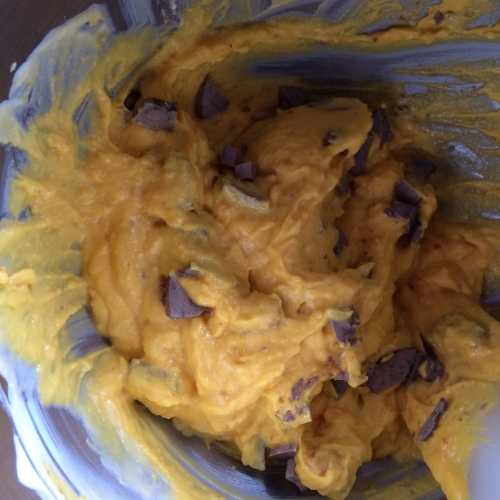
And I have successfully created some dog ice cream for Izzy that is a nutritious treat.  It uses probiotic yogurt, fresh pureed pumpkin and cooked liver (lamb’s liver in this case).

Best of all, it looks like orange/chocolate chip ice cream!

Izzy's ice cream

I’ve poured this mixture into ice cube trays and Izzy can indulge in it a few times a week.

This is a treat – not a core dog food of course.  But I’m very pleased with the result.

Kathleen Crisley, specialist in dog massage, rehabilitation and nutrition/food therapy, Canine Catering Ltd, Christchurch, New Zealand

How our dogs react to faces (vs other objects)

Dogs have a specialized region in their brains for processing faces, a new study finds. PeerJ is publishing the research, which provides the first evidence for a face-selective region in the temporal cortex of dogs.

“Our findings show that dogs have an innate way to process faces in their brains, a quality that has previously only been well-documented in humans and other primates,” says Gregory Berns, a neuroscientist at Emory University and the senior author of the study.
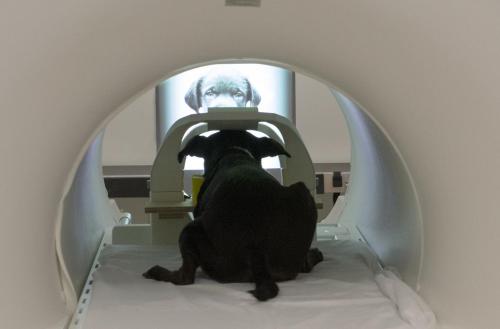
Dog in MRI machine at Emory University

The study involved dogs viewing both static images and video images on a screen while undergoing fMRI. It was a particularly challenging experiment since dogs do not normally interact with two-dimensional images, and they had to undergo training to learn to pay attention to the screen. Photo by Gregory Berns, Emory University

Having neural machinery dedicated to face processing suggests that this ability is hard-wired through cognitive evolution, Berns says, and may help explain dogs’ extreme sensitivity to human social cues.

Berns heads up the Dog Project in Emory’s Department of Psychology, which is researching evolutionary questions surrounding man’s best, and oldest, friend. The project was the first to train dogs to voluntarily enter a functional magnetic resonance imaging (fMRI) scanner and remain motionless during scanning, without restraint or sedation.

For the current study, the researchers focused on how dogs respond to faces versus everyday objects. “Dogs are obviously highly social animals,” Berns says, “so it makes sense that they would respond to faces. We wanted to know whether that response is learned or innate.”

The study involved dogs viewing both static images and video images on a screen while undergoing fMRI. It was a particularly challenging experiment since dogs do not normally interact with two-dimensional images, and they had to undergo training to learn to pay attention to the screen.

A limitation of the study was the small sample size: Only six of the eight dogs enrolled in the study were able to hold a gaze for at least 30 seconds on each of the images to meet the experimental criteria.

The results were clear, however, for the six subjects able to complete the experiment. A region in their temporal lobe responded significantly more to movies of human faces than to movies of everyday objects. This same region responded similarly to still images of human faces and dog faces, yet significantly more to both human and dog faces than to images of everyday objects.

If the dogs’ response to faces was learned – by associating a human face with food, for example – you would expect to see a response in the reward system of their brains, but that was not the case, Berns says.

The researchers have dubbed the canine face-processing region they identified the dog face area, or DFA.

One hypothesis is that distinguishing faces is important for any social creature.

Source:  EurekAlert! media statement


Professor Berns’ group at Emory University is one of the leading research teams in the field of canine cognition.  Previous blog posts about his work include:

Canine companions and the lure of inattentively pooping in public

The title of this post is unashamedly taken from an article in the journal Environmental Sociology.

Dog poop flagged for research

Photo by Matthias Gross

This article is a study, primarily focused on European nations, and the patterns of owners who do/do not clean up after their dog poops.

The author observed that people are more likely to clean up after their dog when there are people around to watch.

I’ll let you read it for yourself…

The study’s (published) conclusion is:

This exploratory study thus suggests that observing activities and strategies of defecating may provide new insight into human–animal relationships by exploring the role of droppings. An important prerequisite for successfully displaying poop and for diverting attention away from the fact that dog poop is increasingly to be seen in public is that the actors involved are skillful enough to attest to nonknowledge about the production of excrements by their best friends.

Kathleen Crisley, specialist in dog massage, rehabilitation and nutrition/food therapy, Canine Catering Ltd, Christchurch, New Zealand

Other blog posts about dog poop include:

Roller coaster anyone?

There’s a rather unique roller coast in Denmark, just 100 kilometres from Copenhagen in the Bon Bon Land amusement park.

It’s the Dog Fart Rollercoaster (Hundeprutterutchebane)!

This family-sized roller coaster is dog-themed.  In the centre there’s a dog who is in the middle of a giant poo.  And then when the coaster goes through the dog kennel, riders are greeted by a large dog fart sound.

Bon Bon land roller coaster dog Bon Bon land roller coaster dog from behind

????????????????????????????????????

Unique?  Absolutely.  A Danish sense of humour will obviously be helpful when visiting this park!

Kathleen Crisley, specialist in dog massage, rehabilitation and nutrition/food therapy, Canine Catering Ltd, Christchurch, New Zealand

Photos by Theme Park Review


Gabe, Best Man

When veteran Justin Lansford got married last month to long-time girlfriend, Carol, his best man was his support dog Gabe.

A Golden Retriever, Gabe was matched with Lansford when he returned from Afghanistan an amputee thanks to an IED explosion in 2012.

Lansford lost his left leg to that explosion and also suffered from post-traumatic stress disorder.

Justin and Gabe wait at the alter (Brad Hall Photography)

Justin and Gabe wait at the alter (Brad Hall Photography)

ABC News’ Good Morning America also covered the story:

A big shout-out to Justin, Carol and Gabe….may you have a long and happy life together!

Kathleen Crisley, specialist in dog massage, rehabilitation and nutrition/food therapy, Canine Catering Ltd, Christchurch, New Zealand