Category Archives: dog care

The importance of pain management

Whenever I take on a new client, I use a health questionnaire that covers current conditions as well as the dog’s health history.  One of the issues I address is any recent changes to the dog’s behaviour or living conditions.

What I am trying to ascertain is if a dog is in pain or having adjustment difficulties. There is a clear link between pain and aggression and this has been supported in a recent study by researchers at the Autonomous University of Barcelona in Spain.

In the Spanish study, which has been published in the Journal of Veterinary Behavior, 12 dogs that were brought in by their owners for ‘aggression problems’ were studied.  All were found to have pain-induced aggression with eight diagnosed as having hip dysplasia.

The breeds in the study were:  a Giant Schnauzer, Irish Setter, Pit Bull, Dalmatian, two German shepherds, Neapolitan Mastiff, Shih-tzu, Bobtail, Catalan Sheepdog, Chow Chow and Doberman.

The researchers concluded “if the pet is handled when in pain, it will quickly act aggressively to avoid more discomfort without the owner being able to prevent it.”

So, when a dog is behaving differently or is “out-of-sorts”, a visit to the vet is recommended.  Behaviour changes can be the first indicator that something is wrong and your vet can help to run appropriate tests to see if there is an underlying health problem.

Dogs have a way of not telling us they are in pain until a problem is more pronounced because their natural instinct is to protect themselves by not exhibiting any noticeable vulnerabilities.  Therapies such as massage and low level laser (which I employ in my canine rehabilitation practice) are useful in helping to manage pain through appropriate stimulation of acupressure points and managing muscle, tendon and ligament condition.  I’m also a strong supporter of acupuncture and refer clients to a local vet who is trained in veterinary acupuncture.

These complementary therapies can be employed alongside traditional pain medications such as NSAIDs to support your dog’s quality of life.  When pain is managed, quality of life improves for everyone in the household.

Source:  Plataforma SINC. “If your dog is aggressive, maybe it is in pain.” ScienceDaily, 13 Jun. 2012. Web. 15 Jun. 2012.
Dog dreaming

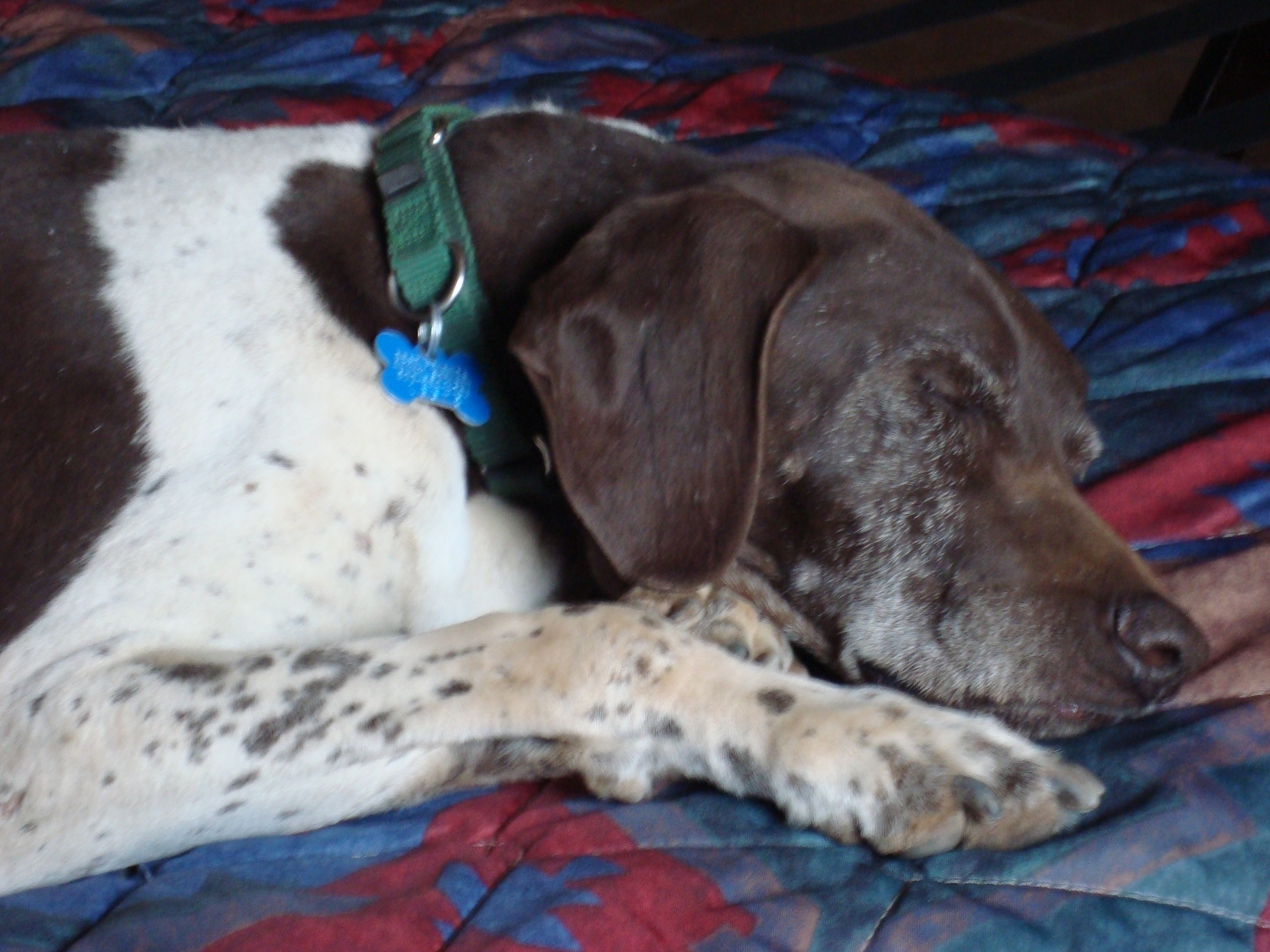
We’ve all seen our dogs deeply asleep, with paws and legs twitching.  There have even been times when my dog puts her head up while sleeping and howls like a wolf.  (She usually wakes herself up, too).

Do our dogs dream?

All evidence points to an answer of ‘yes’.

Researchers know, for example, that the EEGs (electroencephalograms) of sleeping dogs show brain wave activity similar to humans during sleep.  There is a period of sleep known as REM sleep (REM means rapid eye movement) when breathing becomes irregular and the eyes twitch.  Sound familiar?

When humans have been wakened during REM sleep, they report that they have been dreaming and so there is no reason to think that our dogs aren’t dreaming. 

Matthew Wilson, Associate Professor of Brain and Cognitive Sciences at the Massachusetts Institute of Technology says that animals have complex dreams and are able to retain and recall long sequences of events while they are asleep. 

His work involved rats and monitoring their brain wave activity when they were asleep and awake.  He also tracked the effect of sleep on learning of repetitive tasks.

Professor Wilson has said of his work “dreams are the ultimate off-line experience. This work demonstrates that animals are capable of re-evaluating their experiences when they are not in the midst of them.”

By the way, dogs, cats and rabbits are crepuscular which means that they naturally tend to be more active at dawn and at dusk.  Humans are diurnal which means they are most active during the day (which explains why night shifts are so hard on people).  Dogs seem to adjust their own sleep habits to match those of their owners.

Caring for Nunavik’s sled dogs

Andréanne Cléroux, a veterinary student at the University of Montreal International Veterinary Group, is conducting a project to design and deliver a first aid guide for dogs in northern Quebec.

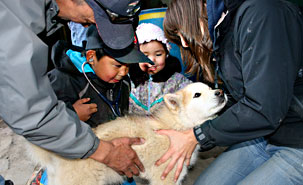
A family with their dog in Nunavik. (Credit: Sylvie Ricard)

“The problem relates mainly to animal health care, immunization, and dog population control,” Cléroux explains. “We wanted to create a guide that would provide basic tools for pet owners so they can provide care to their animal while waiting to contact the remote veterinary consultation service to get advice from a veterinarian at the CHUV (University of Montreal Veterinary Hospital).” 

Cléroux spent time developing the guide before travelling to northern Quebec to work on the draft with residents.  One of the challenges has been to develop a product that was good for those unfamiliar with dog care and still make it useful to mushers, who tend to know more about their dogs.

Cléroux has also created a first aid kit that includes all the necessary material to provide the care described in the manual and delivered it to several villages, with a goal to make it more widely available to all 14 communities in Nunavik.

Source:  University of Montreal press release


Canine heartworm disease

In my recent visit to the Best Friends Animal Society sanctuary, I fell in love with a little dog that I would have loved to adopt.   I learned that she had heartworm disease and was scheduled to undergo further treatment.

I’m not familiar with this disease because I live in New Zealand, where the disease doesn’t exist (and so our authorities would not allow her into the country, which was news I was not prepared to hear).  Here’s some information on the condition:

Heartworm disease is widespread in the United States but particularly prevalent in the southern states around the Gulf of Mexico (including Texas, where my little dog was picked up).  

Mosquitoes help to transmit the infection.  The mosquito ingests microfilariae that circulate in the blood of an infected animal and then these microfilariae develop inside the mosquito.  When the mosquito bites another dog, the larvae are transferred to the new host and travel through the connective tissues into veins and then travel to the heart where they attach themselves in the arteries and pulmonary blood vessels to feed off the nutrient-rich blood.

Within 3-4 months, the heartworms begin reproducing, releasing microfilariae into the bloodstream, where again they can be picked up by mosquitoes to infect other dogs or re-infect the same dog that is bitten again.

Heartworms can grow up to a foot in length and damage the blood vessels as well as inhibiting the flow of blood.   Many dogs with heartworm will not show symptoms but in more serious cases the dogs may have a mild, persistent cough, be reluctant to exercise, show fatigue after only moderate exercise, or have reduced appetite and weight loss.  Dogs can die from the effects of a severe heartworm infestation.

There is a drug that can be injected into a dog for treatment of heartworm, but administration of drugs to prevent heartworm is essential in all dogs.  Dogs are tested for an antigen to confirm presence of heartworms. 

Dogs that are treated for heartworm are injected with a special drug under close veterinary supervision.  Dogs must be kept quiet because as the worms die off, their bodies can become lodged in the lungs causing pulmonary embolism.  This condition can also kill the dog.   Treatment for heartworm is not a full-proof process and comes with risks.

Heartworm disease can affect animals other than dogs.  It has been found in coyotes, wolves, cats, foxes and ferrets – but is the dog that is considered the definitive and ideal host.

Dog owners in the US should ensure that they are giving their dog an approved heartworm prevention drug. 

You can learn more about canine heartworm disease by visiting the American Heartworm Society website.

A canine heart showing severe heartworm infestation

Here we go again – pet food recalls in USA

This time, the cause of concern is salmonella contamination.   Salmonella is a zoonotic infection, meaning it can be transferred to humans too.

Salmonella infection in dogs causes gastroenteritis, septicemia, and spontaneous abortions.  Humans usually experience vomiting, diarrhea and fevers.  It’s not pleasant.

The best prevention is to wash surfaces in the kitchen after feeding your dog and to ensure you wash your hands after handling pet foods.

The brands currently under recall are:

Solid Gold Health Products for Pets, Inc.

  • Solid Gold WolfCub Large Breed Puppy Food
  • Solid Gold WolfKing Large Breed Adult Dog Food

Wellpet LLC

  • Wellness Complete Health Super5mix Large Breed Puppy

Canidae Pet Foods

  • Canidae Dog, All Life Stages
  • Canidae Dog, Chicken Meal & Rice
  • Canidae Dog, Lamb Meal & Rice
  • Canidae Dog, Platinum

Apex Pet Foods

  • Apex Chicken and Rice Dog, 20lb and 40lb bags

Natural Balance Pet Foods

  • Natural Balance Sweet Potato & Venison Dog
  • Natural Balance Lamb Meal & Brown Rice Dog
  • Natural Balance Sweet Potato & Bison Dog
  • Natural Balance Vegetarian Dog
  • Natural Balance Lamb Meal & Brown Rice Dog Large Breed Bites
  • Natural Balance Lamb Meal & Brown Rice Dog Small Breed Bites
  • Chicken Soup for the Pet Lover’s Soul
  • Country Value
  • Diamond
  • Diamond Naturals
  • Premium Edge
  • Professional
  • 4Health
  • Taste of the Wild

The Kirkland Signature products included in the recall are:

  • Kirkland Signature Super Premium Adult Dog Lamb, Rice & Vegetable Formula
  • Kirkland Signature Super Premium Adult Dog Chicken, Rice & Vegetable Formula
  • Kirkland Signature Super Premium Mature Dog Chicken, Rice & Egg Formula
  • Kirkland Signature Super Premium Healthy Weight Dog Formulated with Chicken & Vegetables
  • Kirkland Signature Super Premium Maintenance Cat Chicken & Rice Formula
  • Kirkland Signature Super Premium Healthy Weight Cat Formula
  • Kirkland Signature Nature’s Domain Salmon Meal & Sweet Potato Formula for Dogs

It’s hard to know if some of these foods are available in New Zealand (Canidae definitely is) because some foods are imported in smaller quantities.  If you are feeding one of these foods, stop immediately and check with your supplier for more details on the recall.

This website from the FDA gives all the latest information on pet food recalls.

Protecting K-9 cops

The Vest-A-Dog Network is actively working to outfit police dogs with protective vests.  Started in 1999, with funds were raised by a local girl for Tiko who was a replacement dog for another who was killed in action, the movement has grown.

You can donate directly  via the Vest-A-Dog website to support the featured canine protector or you can read about how to start your own local network on the site.

The program funds a K-9 One™ vest to sponsored police dog units.  These vests are made with Dupont Kevlar, the same material found in protective vests for human police officers.  The vests are designed to be bulletproof, stabproof and to protect against blunt force trauma.

A vest for protection against stabbing and bullets currently costs US$825 which is why many local units have difficulty finding the funds to protect their canine officers.

The New Zealand Police have stated (on their website) that they looked at an Australian vest in 2008/09 and decided that the vest would not have protected dogs that were previously injured on the line of duty.

However, I wonder that if with shootings like that of police dog Gage in Christchurch in July 2010, if the NZ Police should look at alternatives.  I’ve emailed them with details of the Vest-A-Dog project.

Kathleen Crisley, specialist in dog massage, rehabilitation and nutrition/food therapy, The Balanced Dog, Christchurch, New Zealand

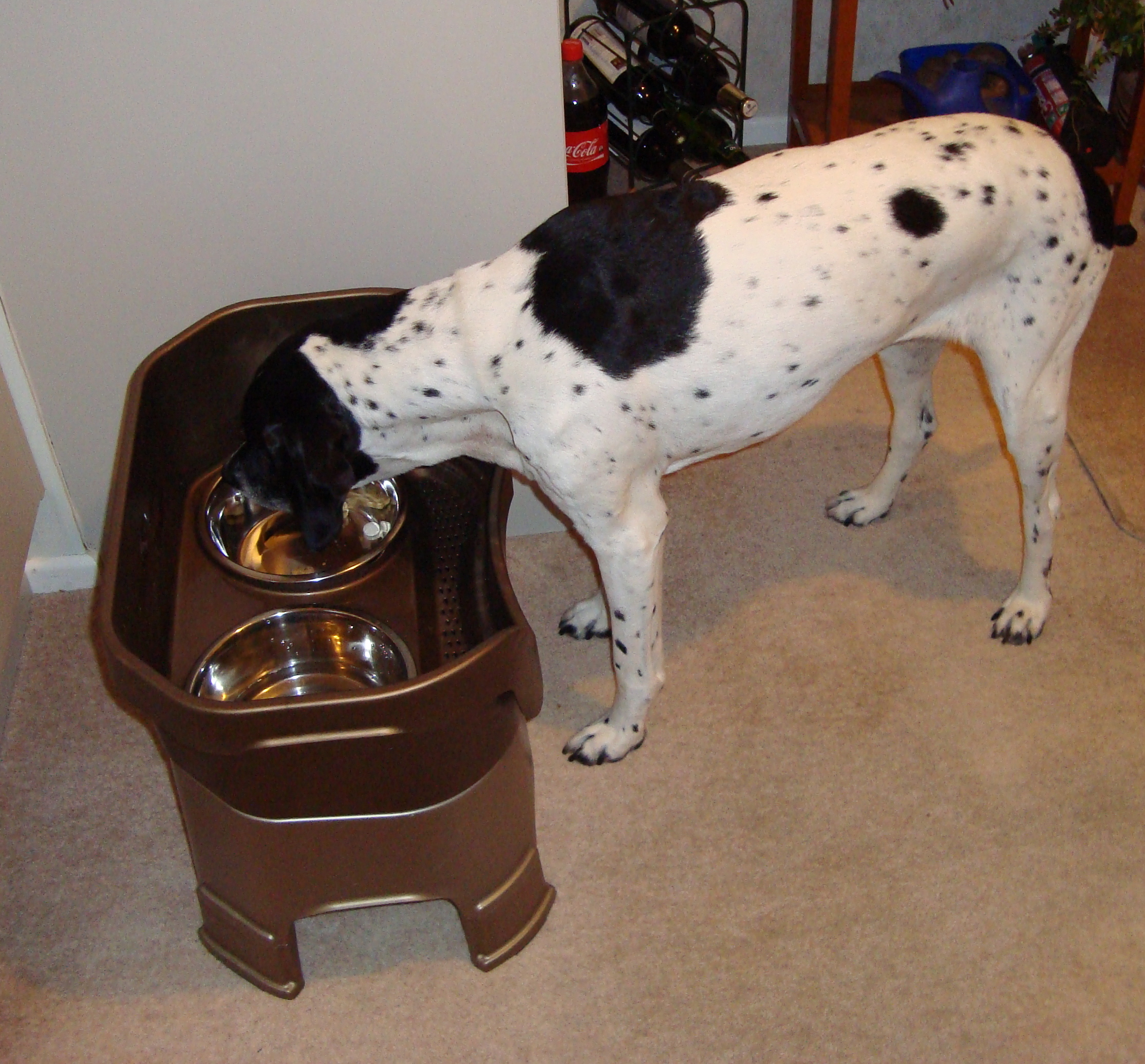
Would a raised dog feeder help my dog?

A massage client asked me this question earlier this week.   The dog in question is a Boxer (beautiful boy) who happens to be suffering from degeneration in his spine.

Although he is doing well with regular swimming, acupuncture and massage therapy, his owner knows that he is comparatively young (8) and she wants him to have a good quality of life for a long time.  So that’s when we started talking about changes she could make to his physical environment to make things less stressful for him (ramps, steps, etc.)

Would a raised feeder help my dog?

Raised feeders can be a real advantage for a dog with orthopaedic problems or arthritis.  Eating from a raised feeder helps to relieve strain on the neck and back, allowing the dog to eat without dramatically altering their posture and helping them to retain balance.

But – some studies have shown that dogs who are susceptible to bloat have an increased risk from eating from a raised feeder.  The most notable reference for this link is an article by Dr Larry Glickman in Journal of the American Veterinary Medical Association, Vol. 17, No. 10.

Gastric dilation-volvulus (GDV) is known by the common term ‘bloat’  and other terms such as ‘stomach torsion’ or ‘twisted stomach.’  Regardless of what name you use, the condition is life-threatening.  Dogs can die of bloat within several hours.   Even with treatment, as many as 25-33% of dogs who develop bloat will die.

In bloat, the stomach fills up with air and puts pressure on the other organs and the diaphragm. The pressure on the diaphragm makes it difficult for the dog to breathe. The air-filled stomach also compresses large veins in the abdomen, preventing blood from returning to the heart.

Filled with air, the stomach can easily rotate on itself, pinching off its blood supply. This rotation is known as volvulus.  The stomach begins to die and the entire blood supply is disrupted.  A dog with this condition can deteriorate very rapidly – meaning a trip to the vet as an emergency.

Purdue University ranks Boxers as the 16th breed most susceptible to bloat (Great Danes are the highest).  So, in this case, the owner decided not to opt for a raised feeder.  Not only is her Boxer on the higher risk list, but he also is a gobbler – making quick work of his food!

This is just one example where it pays to do a little research.  An idea that seems like a good one may not be so.

Epilepsy gene discovery in dogs

The journal PLoS ONE has published research this week by Professor Hannes Lohi of the University of Helsinki.  Professor Lohi and his research team have isolated a gene linked to epilepsy in Belgian Shepherds.

The gene is found on canine chromosome 37.  The research team isolated the gene by comparing the genome of dogs with epilepsy against those of dogs that were in a healthy control group.  The gene could increase the risk of epilepsy by a factor of 7.

Genetic epilepsy is also referred to as ‘idiopathic epilepsy.’  A co-author on the article has said that as many as 20% of the Belgian Shepherd breed is estimated to have epilepsy and so the research could underpin the development of a genetic test for the disease.

Seizures can result in abnormal movements, usually on one side of the body, followed by cramping in the limbs.  Drooling and vomiting are other symptoms.

This research group is responsible for other genetic discoveries in dogs.  Through their research, the group has developed a canine DNA bank in Finland containing 40,000 samples from 250 different breeds of dogs.  They have previously identified the epilepsy gene EPM2B in Miniature Wirehaired Dachshunds and a gene LGI2 in Lagotto Romagnolos and collaborated with other researchers in the discovery of an epilepsy gene in Tibetan Terriers.

Source:  Helsingin yliopisto (University of Helsinki) (2012, March 23).   New epilepsy gene located in dogs. ScienceDaily. Retrieved March 25, 2012, from http://www.sciencedaily.com­ /releases/2012/03/120323205337.htm?utm_source=feedburner&utm_medium=email&utm_campaign=Feed%3A+sciencedaily%2Fplants_animals%2Fdogs
+%28ScienceDaily%3A+Plants+%26+Animals+News+–+Dogs%29

The sale of Ellenco to Southern Cross – a positive for pet owners

Southern Cross Benefits Ltd announced this week that it has purchased Ellenco Pet Insurance.  Although some may lament the loss of a ‘mom and pop’ operation that has operated for 22 years, I think the ownership transfer is a good thing for New Zealand dog (and other pet) owners.  Why?

  • Only 8% of dog owners in NZ currently have pet insurance (according to the NZ Companion Animal Council’s Companion Animals in NZ survey, July 2011)
  • The Southern Cross Healthcare Group, of which Southern Cross Benefits Limited is one company,  is the largest healthcare insurance provider in NZ
  • Ellenco’s owners could not afford to put up the $3 million bond required by new legislation and its previous bond of only $500,000 was a potential risk to policy holders
  • In my opinion, Southern Cross is a trusted brand in NZ and should encourage more pet owners to seriously consider the purchase of insurance
  • Southern Cross has acknowledged that surveys of its clients have shown that there is interest in pet insurance – so an audience that hasn’t been reached so far by  insurance providers is aware of the benefits of pet insurance –  but hasn’t had the confidence yet to buy a policy
  • Southern Cross Benefits Limited has an A+ (Strong) financial strength rating from Standard & Poor’s, is a Registered Financial Service Provider, and is a member of the Insurance & Savings Ombudsman’s Disputes Resolution Scheme

Insurance, like other business markets, matures over time.  This is a huge step for NZ in its recognition of the importance of pets and the associated costs of their healthcare.

Another big step in the pet insurance market here was when The Warehouse started offering Petplan insurance, furthering the marketing of pet insurance generally through a very popular retail outlet.

In the words of Ian MacPherson, CEO of Southern Cross Healthcare Group, “Pet insurance is a natural extension for Southern Cross. Many New Zealanders count their pets as part of the family. However, currently very few owners have pet insurance, meaning they are exposed to what can be very high bills should their pet be affected by an unexpected illness or injury.”

It is important to note that the policies of all pet insurance providers in NZ have coverage of some sort for complementary therapies.  Read my pet insurance fact sheet for more details.

Footnote:  Credit must be given to the founders of Ellenco, Rodger Cox and Jenny Ellenbroek.  Ellenco was the first firm to offer pet insurance in New Zealand, others have followed.  Many policy holders have benefited from the coverage of their company’s policies.  Alas, time has caught up with the small Christchurch-based operation.

The Insurance (Prudential Supervision) Act 2010 required insurers to put up higher bonds and the small firm could not afford this change.  Policy holders are lucky that the owners negotiated with Southern Cross for the purchase of the firm’s policies.  Until operations are transferred to Hamilton in 2013, there will be no change to Ellenco’s policy provisions.

Kathleen Crisley, specialist in dog massage, rehabilitation and nutrition/food therapy, The Balanced Dog, Christchurch, New Zealand

Quality of life improves when obese dogs shed excess weight

Researchers at the University of Liverpool have published the results of a study into the quality of life of obese dogs in The Veterinary Journal.

The researchers tracked various quality of life indicators with the owners of 50 dogs who were classified as obese.  These dogs were of various breeds and a mixture of males and females.   The same questionnaire was repeated once the dogs went through a weight loss programme (for the dogs that were successful in losing weight, and those that were not).

Photo courtesy of University of Liverpool

The vitality scores for the dogs that lost weight increased and their scores for emotional disturbance and pain decreased. The more body fat that the dogs lost, the greater their improvement in vitality.

Some people may think ‘these results are a no-brainer’ but in veterinary and other clinical medicine fields, the norm is ‘evidence-based medicine.’  That is, practitioners like veterinarians want results from research that is measurable and defensible when applying or recommending treatments.

Since obesity is linked to problems with the heart, arthritis and other conditions, research likes this helps to underpin the importance of the healthy weight message.

The same basic principles for weight loss in dogs apply to humans:  use portion control, increase exercise and activity, and eat healthy foods.