Category Archives: Dogs

Love your dog? Restrain it when riding in the car!

This week has been a very rainy one in Christchurch.  Since I am a mobile practitioner, I spend a fair amount of time in the car.  When stopped at a traffic light, I snapped this photo with my phone:

Dog in car on rainy day

You can clearly see this little white dog sitting on the ledge at the rear window of the car.  I watched while the dog moved around on the ledge and onto the back seat of the car, then back again.

If this vehicle had to stop suddenly for any reason, this dog would go flying!  Just as the driving safely videos show things like drink bottles flying after a crash, so too would this little dog.  If it survived, it would likely need intensive medical care that would be both painful and expensive.

I don’t see enough dogs in Christchurch that are restrained properly using a car harness.  It’s very concerning.

I’ve even met and talked with vets about this subject, and many have admitted that although they know they should restrain their own dogs, they don’t!   Most vets don’t even ask as part of the annual check-up with their clients whether or not their dog travels in a vehicle and, if so, whether it is properly restrained.

We need more people leading from example….

…like the lovely lady who came yesterday to fit her Labrador puppy, Harley, with an auto harness.  She’s training him at a young age to accept being restrained in the car.

Please let me know if your vet encourages you to restrain your dog when traveling in the car.  I’d like to promote them via my Facebook page.  And send me photos of your dog safely restrained in the car!

Kathleen Crisley, specialist in dog massage, rehabilitation and nutrition/food therapy, Canine Catering Ltd, Christchurch, New Zealand

Barking characterizes dogs like voices characterize people

An international group of researchers has conducted a study on canine behavior showing that gender, age, context and individual recognition can be identified with a high percentage of success through statistical and computational methods of pattern recognition applied to their barking.

The results of the study have been published in the journal Animal Cognition.

This research aimed to understand the acoustic signals obtained from dog barking when the dog subjects are subjected to certain situations. The research was conducted through the development of a computational system based on statistic modeling that is able to recognize diverse characteristics of the dog (gender, age, individual, situation).

This diagram has been used to help ‘map’ the computing system behind the research:

Photo credit:   Universidad Politécnica de Madrid (UPM)

Photo credit:
Universidad Politécnica de Madrid (UPM)

The experiments were carried out in Budapest with eight Mudi breed dogs from Hungary, usually used as sheep-dogs—three males and five females. Each dog (aged between one and 10) registered 100 barks. A total of 800 barks was obtained by placing the dogs in seven different situations: (a) alone, after the owner tied the dog to a tree; (b) playing with a ball; (c) fighting, when a human pretended to attack the dog’s owner; (d) receiving their food ration; (f) in the company of a person who was foreign to the dog; and (g) preparing to go out with the owner. Each one of the 800 barks was characterized from 29 acoustic measurements.

By using the diverse computational models obtained from the collected data during the experiment, researchers successfully recognized the dog’s gender 85.13% of the time, while the age of the dog (recoded as young, adult and old) was classified without mistakes 80.25% of the time. The task of identifying the situation in which the dog was engaged was successful 55.50% of the time, while the recognition (among the eight dogs participating in the study) of the Mudi breed was successful the 67.63% of the time.

Whilst a highly technical bit of research, particularly for those of us who are challenged by computer programming and mathematics, there are applied uses for this research such as in assessing dog behavior.  Software programs using these models could help to identify fear, anxiety and levels of aggressiveness in a dog.

Source:  Phys.org

Chance gets a second chance

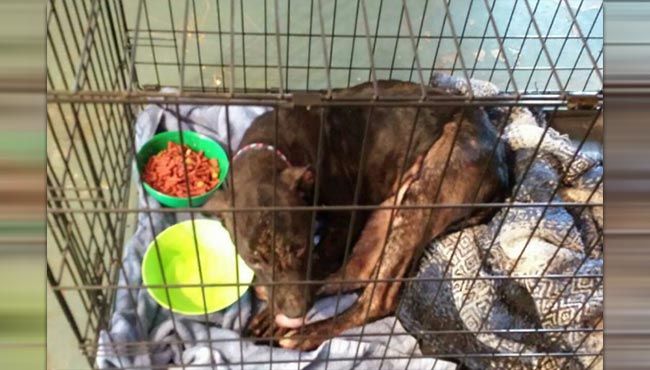
Who would have thought that a self-professed ‘every day working man employed at a scrap metal yard’ would be an animal adoption spokesman?  But that’s what’s happened in Alabama after a 5-month old puppy was found alive in a crushed batch of scrap metal.

Chance rests in a crate after his rescue

Chance rests in a crate after his rescue

“I couldn’t believe he was alive at first, then I couldn’t believe that someone would be that cruel,” Anthony Nicholson said.

Now named Chance, a veterinary check has revealed that the puppy has either a displaced or cracked hip.  Nicholson will pay the money for Chance’s surgery if he can’t raise it through fundraising.  His funding campaign is currently half-way to reaching its target.  Interested readers can donate to help Chance by going to Nicholson’s Go Fund Me site here.

“There are too many rescues and other foundations that will help re-home an animal. Don’t throw one away, and that’s basically what this is about,” Nicholson said.

Be sure to watch the interview about Chance on the Channel 12 website.

Source:  Channel 12, WSFA

Doggy quote of the month for June

‘Dogs are better than human beings because they know but do not tell.’

– Emily Dickinson, poet, 1830 – 1886

Punishment for owners who leave their pets outside in extreme weather

Illinois lawmakers have endorsed legislation that, if signed, would see owners who leave their pets outside in extreme weather sentenced to up to a year in jail and a fine of up to $2,500.

The bill has been sent to Gov. Bruce Rauner to sign into law.

A dog being watched by walker Natalia Straley plays in the snow Feb. 26, 2015, at the Montrose dog beach in Chicago.  (Anthony Souffle, Chicago Tribune)

A dog being watched by walker Natalia Straley plays in the snow Feb. 26, 2015, at the Montrose dog beach in Chicago. (Anthony Souffle, Chicago Tribune)

Sponsoring Rep. Sara Feigenholtz, D-Chicago, said the bill was inspired by recent cases of dogs during the last Northern Hemisphere winter season; the dogs froze to death.

Although the legislation has passed both the State House and Senate, it needs the Governor to make it a law.  The bill has been opposed by the farming lobby, which fears it will interfere in their businesses.

It’s a progressive piece of legislation in my opinion because animals need our protection and a judge can use his/her discretion in terms of sentencing.

And as for farming, this opens a larger debate about consumption, production economies, and animal welfare – all issues that impact our environment and animals here in New Zealand.

Kathleen Crisley, specialist in dog massage, rehabilitation and nutrition/food therapy, Canine Catering Ltd, Christchurch, New Zealand

Source:  Chicago Tribune

Controlling the brown dog tick

Dogs and their owners who battle the Brown Dog Tick sometimes go to desperate measures ─ including getting rid of their dogs, fumigating their homes, throwing many possessions out or even moving ─ to control the pesky bugs, which breed indoors and hide in places that are practically impossible to reach.

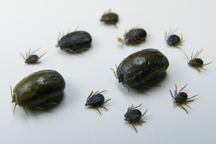
A petri dish contains several brown dog ticks, a species researchers believe has become resistant to the most commonly used pesticides.  UF/IFAS Photo by Tyler Jones.

A petri dish contains several brown dog ticks, a species researchers believe has become resistant to the most commonly used pesticides. UF/IFAS Photo by Tyler Jones.

Phil Kaufman, an associate professor of veterinary entomology at the University of Florida Institute for Food and Agricultural Sciences, is one of several investigators who have just published two studies. One shows the tick is resistant to the most commonly used chemical applied directly between the dog’s shoulder blades. The other shows the effectiveness of carbon dioxide as a lure for baiting ticks to bed bug traps.

The first finding, while not good news, is practical. Pet owners and pest control companies know pesticides with permethrin will not control the Brown Dog Tick. The chemical fipronil should work in most situations, but owners should watch for loss of activity of the chemical, such as ticks that appear to be alive and swelling within the month after treatment.

The second finding is critical as Kaufman and other scientists, such as Faith Oi, grapple with getting rid of the Brown Dog Tick.

Kaufman and Oi describe the Brown Dog Tick as “cryptobiotic,” meaning it hides in nooks and crannies of your house where you’d never find them, and they spend about 95 percent of their time away from the dog. But if experts can get the ticks to come to one spot, they can better control them, Kaufman said.

Meanwhile, homeowners can use pesticides to control the ticks, but “the vacuum is your best friend,” Oi said.

Brown Dog ticks can complete their lifecycle inside people’s homes, unlike most ticks, which spend most of their lifetime outside, Kaufman said. One female Brown Dog Tick can lay up to 5,000 eggs in its lifetime and if that is in your home, you could be in for trouble.

“They’re particularly troublesome for people who have cluttered homes, and they drive some homeowners to desperate measures in search of ways to control the tick,” Kaufman said. “Eliminating places where ticks live and breed is the one of the best practices for tick control.”

Homeowners also can help by simplifying their interiors. That allows for more thorough inspections, easier cleaning and pesticide applications, he said. It also allows for more effective evaluation of the treatment after products are applied.

In addition to being pesky, Brown Dog ticks can damage or irritate a dog’s skin. In rare cases, they can cause a fever, anorexia or anemia. If you see these signs in your dog, you should see a veterinarian as soon as possible, Kaufman said.

This research into the brown dog tick has been published in the March 2015 and May 2015 issues of the Journal of Medical Entomology.

Source:  University of Florida media release

A different way to encourage owners to scoop

Let’s make the world less crap…

That’s the opening line of a current Kickstarter campaign to obtain funding for Poopins, a biodegradable marker for piles of dog poo that haven’t been removed by unthinking dog walkers.

Scoop Ya Poop

Motivated by walks on Sumner Beach here in Christchurch, where numerous piles of dog poo have been observed, local man Stephen McCarthy came up with the idea of Poopins  (think ‘poo’ and ‘pins’ combined).

I’m not sure if this product will ultimately get funded.  But, the fact that someone is thinking of this type of open reminder to dog owners, points to the fact that we have too many irresponsible dog owners in this city.

Picking up your dog’s feces should be non-negotiable.  Today, as part of my weekly shopping, I bought a package of nappy bags (diaper bags for Northern Hemisphere readers) for picking up poop.  Bags are probably the easiest thing to get hold of; I re-use bags when I have them available, and then the nappy bags the rest of the time.

Some of the options that could be available if Poopins are able to launch onto the market

Some of the options that could be available if Poopins are able to launch onto the market

I personally would like to see the City of Christchurch become more dog-friendly with urban design that makes responsible dog ownership the norm – and apply peer pressure to those dog owners who are not responsible.  When dog owners don’t clean up, they make it harder for the rest of us to enjoy our dogs openly and with a variety of locations to choose from.

My other posts on this subject include:

Please – no matter where you live in this world – clean up after your dog.  It’s the responsible thing to do!

Kathleen Crisley, specialist in dog massage, rehabilitation and nutrition/food therapy, Canine Catering Ltd, Christchurch, New Zealand
When a military dog retires…

Photo courtesy of Best Friends Animal Society

Photo courtesy of Best Friends Animal Society

The US military trains and uses dogs for a variety of reasons – and the dogs and their handlers develop a deep bond with one another.

The 2016 fiscal year military appropriations bill recently passed the House of Representatives and included a provision that mandates that all suitable military animals be made available for adoption. It also says that each animal’s handler — the person who these veterans most trust and rely on — shall be given priority when it’s time to adopt.

The bill is making its way to the Senate and it’s time to let Washington lawmakers know that you think this special provision should stay in the final version.

The Best Friends Animal Society has started an online form that enables you to ask your U.S. senators to support section 594 of the bill.   Follow this link to the Legislative Action Center to take action.

Over the years, I have written a number of stories about dogs, military service, and the health and welfare of these special service animals.  Visit these posts:

Kathleen Crisley, specialist in dog massage, rehabilitation and nutrition/food therapy, The Balanced Dog Ltd, Christchurch, New Zealand


Dogs, biosecurity and Johnny Depp

The recent story about Johnny Depp’s Yorkshire Terriers, Pistol and Boo, and their deportation from Australia has some lessons in it that I think have been overlooked.

That’s not totally surprising when you have an Australian Minister like Barnaby Joyce fronting to the media with comments like  “It’s time that Pistol and Boo buggered off back to the United States.”

Inflammatory, yes.  Headline grabbing – yes.   But lacking in good information for people to understand the Australian position on the dogs and what the public needs to know when arriving in the country.

Happy Dogz salon's Lianne and Ellie Kent with Pistol and Boo; it was the dogs' visit to the groomers and the subsequent Facebook photos that caught the attention of the Australian authorities

Happy Dogz salon’s Lianne and Ellie Kent with Pistol and Boo; it was the dogs’ visit to the groomers and the subsequent Facebook photos that caught the attention of the Australian authorities

Australia and New Zealand have some very unique flora and fauna – thanks to their geographic isolation from other continents.  The countries are also free of diseases like rabies which are a worry in other western countries like the United States and the UK and mean that animals there must be vaccinated (whereas here, they are not).

Animals can be imported to both Australia and New Zealand, but they are subject to quarantine to ensure that they are not carrying any diseases that could run rampant in these sensitive environments.   There are also requirements when importing semen, for example, for dog breeding.

So, Pistol and Boo were a legitimate biosecurity risk and their presence in the Depp party was apparently not declared.  And I hear that the Australian authorities are now investigating this to find out if Depp, or another member of his party, knowingly broke the law.

At this point, I’m prepared to give Depp the benefit of the doubt.  He and his wife love their dogs and are in the fortunate position to be able to fly them in comfort around the world in a private plane (whereas most of us can’t afford to travel long distances with our dogs, let alone worrying about them as they are treated as luggage in the holds of commercial aircraft).

They also have an ‘entourage’ that attends to their personal needs, and so I do wonder just how switched on Depp was in terms of filling out declaration forms on his arrival in Australia.  I suspect someone in his employment took care of these minor details for him – just as someone in his employment took the dogs to the groomers which started this whole saga to begin with.

So the lessons from all of this?

  • Love your dog, travel with them if you can, but understand your destination requirements in terms of quarantine and also your dog’s health
  • Understand biosecurity risks and obey the requirements of the country you are visiting
  • Treat breaches of laws seriously, but with respect for all parties.  Innocent until proven guilty, etc.
  • And use ‘headline grabbing’ stories for educational opportunities -an opportunity that Australia seems to have missed thanks to a headline-grabbing Minister

Kathleen Crisley, specialist in dog massage, rehabilitation and nutrition/food therapy, Canine Catering Ltd, Christchurch, New Zealand

A bond that goes way back

The special relationship between humans and dogs may go back 27,000 to 40,000 years, according to genomic analysis of an ancient Taimyr wolf bone reported in the Cell Press journal Current Biology on May 21. Earlier genome-based estimates have suggested that the ancestors of modern-day dogs diverged from wolves no more than 16,000 years ago, after the last Ice Age.

The genome from this ancient specimen, which has been radiocarbon dated to 35,000 years ago, reveals that the Taimyr wolf represents the most recent common ancestor of modern wolves and dogs.

his image compares an ancient Taimyr Wolf bone from the lower jaw to a modern pipette.  Photo by Love Dalén

This image compares an ancient Taimyr Wolf bone from the lower jaw to a modern pipette. Photo by Love Dalén

“Dogs may have been domesticated much earlier than is generally believed,” says Love Dalén of the Swedish Museum of Natural History. “The only other explanation is that there was a major divergence between two wolf populations at that time, and one of these populations subsequently gave rise to all modern wolves.” Dalén considers this second explanation less likely, since it would require that the second wolf population subsequently became extinct in the wild.

“It is [still] possible that a population of wolves remained relatively untamed but tracked human groups to a large degree, for a long time,” adds first author of the study Pontus Skoglund of Harvard Medical School and the Broad Institute.

The researchers made these discoveries based on a small piece of bone picked up during an expedition to the Taimyr Peninsula in Siberia. Initially, they didn’t realize the bone fragment came from a wolf at all; this was only determined using a genetic test back in the laboratory. But wolves are common on the Taimyr Peninsula, and the bone could have easily belonged to a modern-day wolf. On a hunch, the researchers decided to radiocarbon date the bone anyway. It was only then that they realized what they had: a 35,000-year-old bone from an ancient Taimyr wolf.

The DNA evidence also shows that modern-day Siberian Huskies and Greenland sled dogs share an unusually large number of genes with the ancient Taimyr wolf.

“The power of DNA can provide direct evidence that a Siberian Husky you see walking down the street shares ancestry with a wolf that roamed Northern Siberia 35,000 years ago,” Skoglund says. To put that in perspective, “this wolf lived just a few thousand years after Neandertals disappeared from Europe and modern humans started populating Europe and Asia.”

Source:  EurekAlert! media statement


