Category Archives: Dogs

Teddy’s journey – the bandages come off

Teddy has had two consultations this week to assist his recovery.

On Monday (a day after discharge), Teddy was at home resting near the log burner and constrained in either his crate or a playpen area that Jill had set up for him.  His pack mates – sister Verdi (shown in the background) and his mother, Maggie were a little confused by the new situation.  Verdi was showing some signs of dominance – growling at Teddy.
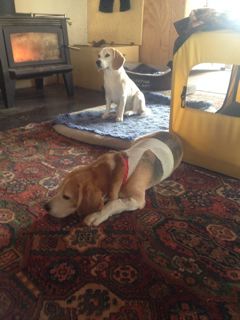
Teddy sleeping with compression bandage

Teddy’s amputation incision was covered in a compression bandage to help with swelling

Jill was using an ice pack on the incision area four times per day to help with swelling and pain relief (Teddy was also receiving pain relief through a Fentanyl patch which delivers pain medication through the skin and also Previcox, a non-steroidal anti-inflammatory drug.)

On this day, I performed an acupressure sequence on Teddy to help his body recover from the anesthesia.  We also measured Teddy for his Walkabout Harness.

Teddy received a replacement Fentanyl patch on Tuesday.

I returned on Friday to see Teddy – with his bandages removed.  This is the first time I’ve been able to view his incision up close.
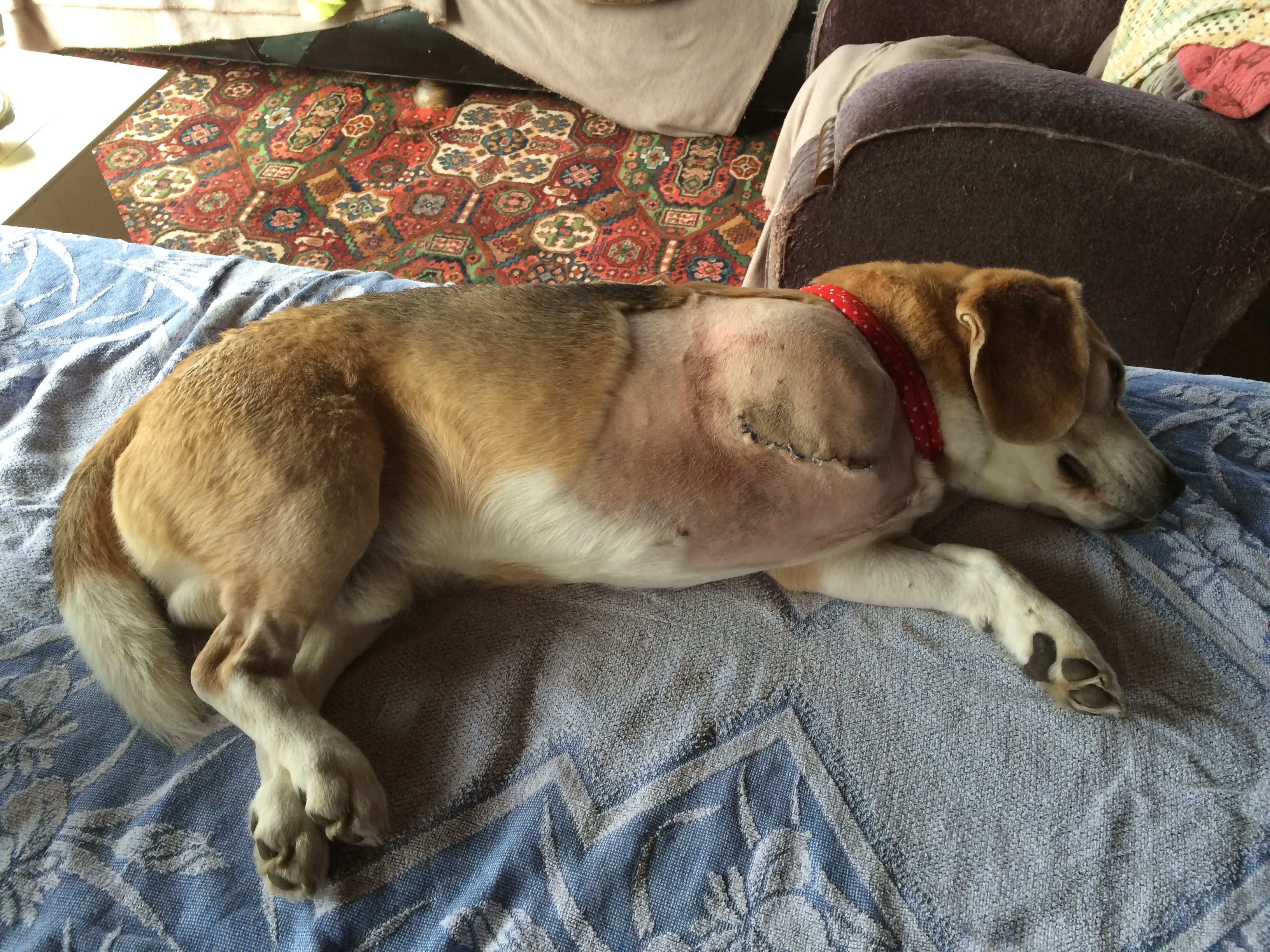
Teddy's incision

Teddy on the massage table, ready for a light treatment

Teddy was very tired on Friday and favoring his right side by sleeping mostly on his left.  This is not surprising since the comfort of the compression bandage and padding on his surgery site had been removed.

We will treat Teddy conservatively and manage his comfort in the early stages of his recovery.  Consequently, I only worked on Teddy in the above, resting position.  I gently massaged over his hips and back and he received cold laser therapy over his hips and his left forepaw (which has some arthritis).

Teddy was deeply asleep after his session – a sure sign that he needed the time out and that rest is the best thing for him.

Teddy has always been a receptive dog for massage and I expect him to be even more so post-amputation.

Kathleen Crisley, specialist in dog massage, rehabilitation and nutrition/food therapy, Canine Catering Ltd, Christchurch, New Zealand


A product for pigs proves useful for dogs

Boar MateThis is Boar Mate, a smelly spray product that helps farmers with swine breeding.

John McGlone, a professor at Texas Tech University, had some of the product at his home at a time when he was looking for ways to stop his Cairn Terrier’s problematic barking.

After a single spray of Boar Mate, Toto stopped barking.

This led the professor of animal welfare and behavior to pursue a new idea and product development.

After extensive testing and publishing of the results, and with funding help from Sergeant’s pet care products, Stop That! was developed and hit store shelves under the Sentry pet products name in 2013. It has been met with tremendous success by pet owners who were on their last legs in trying to curtail bad behavior in dogs.

Stop That!The pheromone ‘secret ingredient’ is a synthetic version of  androstenone.  This pheromone  is secreted by male pigs and is picked up by female pigs in heat. It is a foul-smelling odor for humans and also affects dogs through their olfactory system.

The testing

McGlone had four different groups of barking dogs in separate kennels. The first group of dogs simply had a person with another dog stand in front of the kennels. The second group of dogs was sprayed with a placebo that made the startling, spritz noise. The third group of dogs was sprayed with the noise and a lower concentration (.01µg/mL) of androstenone in isopropyl alcohol. The fourth group was sprayed with a higher concentration (1.0 µg/mL) of androstenone in isopropyl alcohol that also made the spritz sound.

In the first group, 25 percent (3 out of 12 dogs) stopped barking. In the second group, 44 percent (4 of 9 dogs) stopped barking. In the third group, sprayed with the lower concentration of the pheromone, 78 percent (7 of 9 dogs) stopped barking. In the fourth group, sprayed with the higher concentration of androstenone, 100 percent (6 of 6 dogs) stopped barking.

“We sprayed it in their nose or toward their head while they were barking … barking and jumping, running back and forth,” McGlone said. “This whole behavior stopped. You could almost see them thinking, ‘What was that?’”

McGlone and his group also tested the dogs to see if there were any physiological effects from the spray on the dogs, observing them for 10 minutes before and after being sprayed after outfitting the dogs with telemetry jackets and transmitters to monitor heart rate. The androstenone had no effect on the dogs’ heart rates either before or after being sprayed.

Having shown its effectiveness, McGlone was able to classify androstenone not only as a pheromone but also as an intermone, a term developed by him and his team that refers to a product that is a “pheromone in one species and has a behavioral effect in another species, but we do not know if it is a pheromone (naturally produced) in the other species.”

Source:  Newswise media release

A tribute to Gomer

I have just finished reading musician Rick Springfield’s memoir entitled Late, Late at Night.  I was a fan during my high school years, had his poster on my wall, and I believe I was even a member of his official fan club.  I also remember going to see him in concert (twice).

What I discovered in this book is that Springfield is also a dog person.  Imagine that – even when much younger – I was attracted to people who liked dogs.  There are many comments in Springfield’s memoir about the role of dogs in his early family life and through his career (you might remember that his dog Ron featured on several album covers).

Dogs acted as a source of inspiration and consistency in a life where depression was also a key player.

In January 2010, Springfield’s dog Gomer passed away.  He and his people compiled a bunch of photos of the beloved dog in this tribute on YouTube.  Dog people will ‘get’ this – the need to share and show how great our dog was and how much we miss them.

Having lost Daisy so recently, this tribute really resonated with me.  I hope you enjoy it.

Kathleen Crisley, specialist in dog massage, rehabilitation and nutrition/food therapy, The Balanced Dog Ltd, Christchurch, New Zealand

Teddy’s journey starts

Teddy is an almost 8-year old Beagle.  We’ve known each other for 4 years now because Teddy is a regular customer of my dog massage, nutrition and rehabilitation practice.

Teddy

Teddy

Teddy suffers from bilateral hip dysplasia and his owner, Jill Gordon, has been successfully managing this condition for years by giving Teddy good nutrition, massage and laser therapy, and regular osteopathic adjustments.

But Teddy wasn’t so lucky on Friday, 22nd August 2014.

On this morning, which started like so many others, Teddy was riding in his father’s van in the front seat to go to work.  When the van came to a sudden stop in traffic, Teddy slid off the front seat into the foot well.   The force of his fall and the angle in which he fell caused him to severely fracture his right front leg.

The veterinary term for Teddy’s compound fracture is a comminuted open right intracondylar elbow fracture.

Teddy’s dad rushed him to their local veterinary practice at Lincoln Village Vets where the staff there stabilised him and Alex, the vet nurse, accompanied Jill and Teddy to the local specialist surgery practice, Vet Specs.   At Vet Specs the lead surgeon, Helen Milner, assessed Teddy.  She said she might be able to save his leg through a complicated 5-hour surgery.  Jill authorised the surgery.

However, once Helen got Teddy onto the operating table, she saw in more detail than the x-rays allowed her to just how badly broken Teddy’s leg was.  It was shattered and she didn’t have enough bone fragments to successfully attempt a repair.   The only choice was amputation.

Amputation has been a devastating outcome for Jill.  We know that Teddy has a challenging journey ahead not only to recover from his amputation but also to adapt his lifestyle and surroundings so he doesn’t aggravate his hip dysplasia.

Quality of life is paramount.

Jill has chosen a healthcare team including Sarah Wisson, his osteopath, Dr Susanne Anderson, a veterinary acupuncture specialist, and me to see Teddy through this new journey.

Jill wants other owners to learn from Teddy’s experience about the need to restrain their dogs when traveling in vehicles.  And she wants owners to share in Teddy’s journey to recovery.  She has given her permission for Teddy’s story to be told here.  You will see the new category on the blog:  Teddy’s journey post-amputation.

Teddy has just been released from hospital and is recovering at home.  Jill says he’s still her handsome boy as seen here:

Teddy, before his discharge from hospital

Teddy, before his discharge from hospital

Join us for Teddy’s journey in future blog posts.

Kathleen Crisley, specialist in dog massage, rehabilitation and nutrition/food therapy, Canine Catering Ltd, Christchurch, New Zealand

Those Barking Dogs

The singing dogs

This album was released in 1957.  It was an early example of sound engineering by a sound engineer named Carl Weismann.  Weismann specialised in recording of bird song and was always frustrated when a dog’s barking could be heard in the background.

Pearl, Pussy, King, Dolly and Caesar (all pictured on the album cover) were recorded barking by Weismann and then the tapes were cut and pasted to reveal tunes like “O Susanna” and “Jingle Bells.”

During the Christmas season, it is likely you will hear the dogs’ version of Jingle Bells on radio stations.

This medley, found on YouTube, is a good example of what the full recordings sounded like:


Animal-assisted therapy: less pain medication required

Patients recovering from total joint replacement surgery who receive animal-assisted therapy (AAT) require less pain medication than those who do not experience this type of therapy.  AAT has been used in a variety of healthcare settings to improve quality of life and physical, social, emotional and/or cognitive health for patients.

Lazer, a Sheltie, is a Northwest Community Healthcare animal-assisted therapy dog.  He is shown with his handler Dr. Don Lang, DVM.

Lazer, a Sheltie, is a Northwest Community Healthcare animal-assisted therapy dog. He is shown with his handler Dr. Don Lang, DVM.

This retrospective study measured the need for oral pain medication in patients who were exposed to animal-assisted therapy and those who were not. The groups were similar in age, gender, ethnicity, length of stay and type of total joint replacement. The animal-assisted therapy consisted of daily visits from specially trained dogs for an average of five to 15 minutes. The need for oral pain medication was significantly less (28 percent less) in the animal-assisted therapy group (15.32 mg versus 21.16 mg).

This study offers interesting observations about the healing potential of animals,” said Fran Vlasses, PhD, RN, NEA-BC, ANEF, FAAN, co-author and associate professor and chair, Health Systems, Leadership and Policy Department, Loyola University Chicago Marcella Niehoff School of Nursing. “The efficacy of animal-assisted therapy in decreasing the need for pain medication and its effect on patient well-being after surgery deserves further study.”

These data were published in the August/September issue of Anthrozoos by researchers from Loyola University Chicago Marcella Niehoff School of Nursing and Loyola University Health System. Anthrozoos is the official journal of the International Society for Anthrozoology.

Source:  Loyola Medicine media release

Journal details:

Julia Havey, Frances R. Vlasses, Peter H. Vlasses, Patti Ludwig-Beymer, Diana Hackbarth. The Effect of Animal-Assisted Therapy on Pain Medication Use After Joint Replacement. Anthrozoos: A Multidisciplinary Journal of The Interactions of People & Animals, 2014; 27 (3): 361 DOI: 10.2752/175303714X13903827487962

Making cadaver dogs more efficient

A PhD student at the University of Huddersfield (UK) is conducting research to make cadaver and victim recovery (VR) dogs more efficient in their work.

These special dogs are probably not as well known as other working and assistance dogs, because the work they are associated with isn’t pleasant.  They are used to recover dead bodies (victims of suicide or murder), plus to find body parts and fluids that can help police track down the perpetrators of crime.  VR dogs were used to identify body parts from victims of the 7/7 bombings in London, for example.

Kip, a victim recovery dog from the South Yorkshire Police department, has been helping in the research (photo courtesy of University of Huddersfield)

Kip, a victim recovery dog from the South Yorkshire Police Department, has been helping in the research (photo courtesy of University of Huddersfield)

In her experiments using Kip, researcher Lorna Irish set out a sequence of vials containing different odours that she had prepared in the lab.  These chemicals are known to be produced from the body decomposition process.  Alongside these test chemicals were “positive controls” associated with human cadavers, such as human bone – from archaeological sources – and pork at various stages of decomposition.  Pork meat is used for training such dogs due to the ethical and legal problems associated with obtaining human material.  It is thought to be the closest analogue for human flesh for decomposition studies.  There were also “negative controls” – smelly chemicals not associated with decomposition, such as clove oil.

Kip correctly identified the odours derived from decomposition and was not distracted by the “negative control” smells.  It was a successful demonstration. In the field, VR dogs can sometimes be distracted by “false positives”, such as dead animals, or even mushrooms, explained Lorna.  If she can arrive at a greater understanding of the chemistry of odours from human cadavers, then VR dogs can be extra efficient.

“If you train a dog with a chemical that is specific to human decomposition, you can enhance its ability.  It is not about changing the way the dogs do it, but improving it,” she added.

Irish is approximately half-way through the research for her degree; she is traveling widely across the UK to observe dog training methods.

Source: University of Huddersfield media statement


Is a pets-at-work policy wellness’ new best friend?

The challenges for managers these days include ’employee satisfaction’  ‘reduce stress’ ’employee retention’ ‘increase productivity’ and ‘how can we get people to work longer hours?’

In this article by BenefitsPro (a resource for HR managers), you’ll discover the 2012 study which showed that employees whose dog accompanied them to work actually had lower stress at the end of the day compared to the start (the opposite was true for employees who were not accompanied by their pet).

Risdall Public Relations employee Len Mitsch takes advantage of the firm's pet-at-work policy with his dog, Rowdy. Photo courtesy of Risdall Public Relations

Risdall Public Relations employee Len Mitsch takes advantage of the firm’s pet-at-work policy with his dog, Rowdy. Photo courtesy of Risdall Public Relations

“Pet presence may serve as a low-cost, wellness intervention readily available to many organizations,” says Randolph Barker, professor of management in the Virginia Commonwealth University School of Business

For the full story, click the link below:

Is a pets-at-work policy wellness’ new best friend? | BenefitsPro.

Wordless Wednesday, part 45

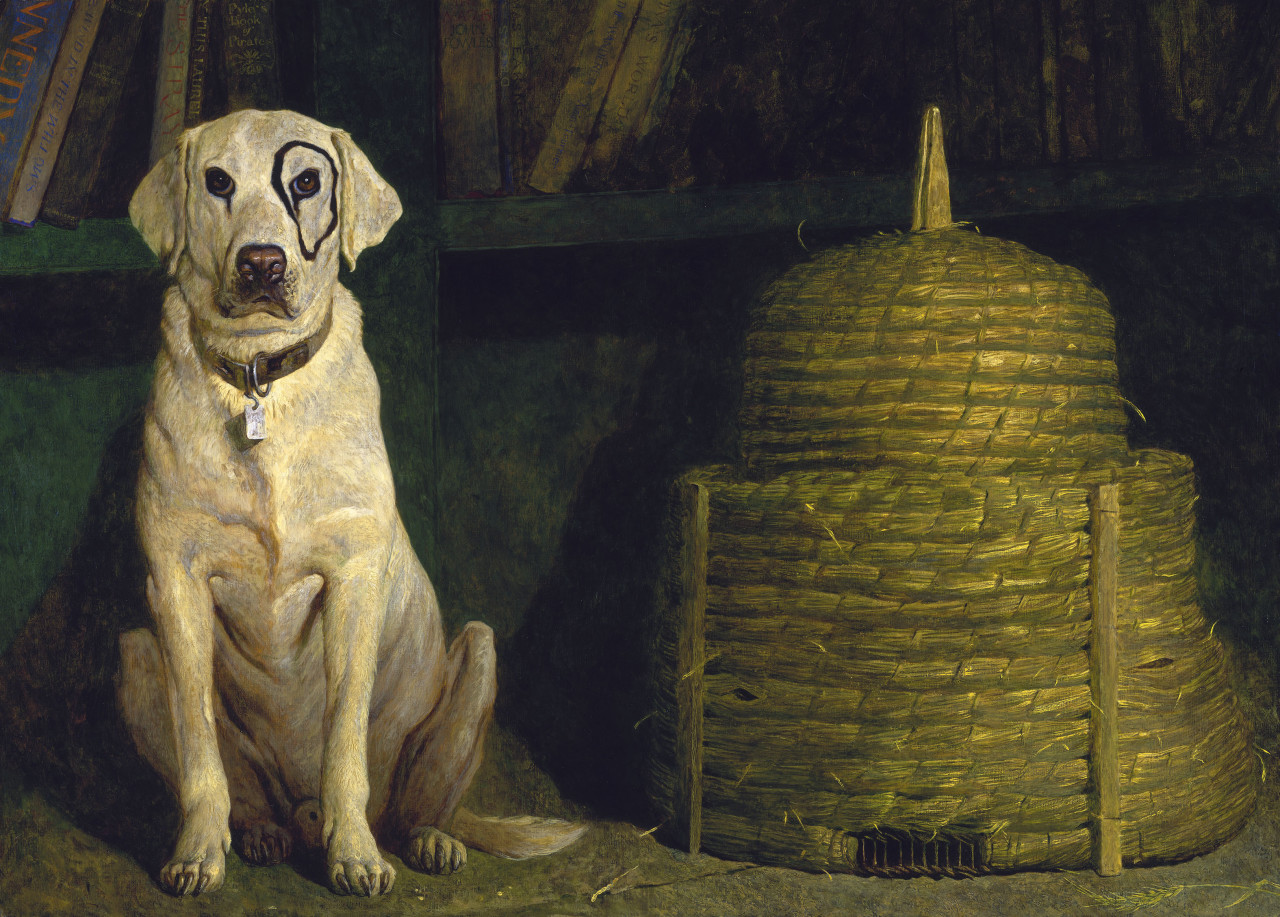
Kleberg by Jamie Wyeth oil on canvas, © Jamie Wyeth photo courtesy of Museum of Fine Arts, Boston

Kleberg by Jamie Wyeth, oil on canvas, © Jamie Wyeth photo courtesy of Museum of Fine Arts, Boston

Blog Hop

Treating canine cancer with nanotechnology

An 11-year-old Labradoodle named Grayton  is the first patient at the Virginia-Maryland College of Veterinary Medicine in a new clinical trial that is testing the use of gold nanoparticles and a targeted laser treatment for solid tumors in dogs and cats.

Grayton is suffering from a return of nasal adenocarcinoma, a cancer of the nasal passages that typically has a short life expectancy.  (Grayton’s tumor was originally treated with high dose radiation which extended his life by three years.)

Dr. Shawna Klahn, assistant professor of oncology in the Department of Small Animal Clinical Sciences, performs a checkup on Grayton four weeks after his experimental cancer treatment involving gold nanoparticles and a targeted laser therapy. (photo courtesy of Virginia Tech News)

Dr. Shawna Klahn, assistant professor of oncology in the Department of Small Animal Clinical Sciences, performs a checkup on Grayton four weeks after his experimental cancer treatment involving gold nanoparticles and a targeted laser therapy. (photo courtesy of Virginia Tech News)

“This (nanotechnology) treatment involves two phases,” Dr. Nick Dervisis, assistant professor of oncology in the Department of Small Animal Clinical Sciences, said. “First, we infuse the patient with the gold nanoparticles. Although the nanoparticles distribute throughout the body, they tend to concentrate around blood vessels associated with tumors. Within 36 hours, they have cleared the bloodstream except for tumors. The gold nanoparticles are small enough to circulate freely in the bloodstream and become temporarily captured within the incomplete blood vessel walls common in solid tumors. Then, we use a non-ablative laser on the patient.”

Dervisis explained that a non-ablative laser is not strong enough to harm the skin or normal tissue, but “it does cause the remaining nanoparticles to absorb the laser energy and convert it into heat so that they damage the tumor cells.”

Like all clinical trials, the study involves many unknowns, including the treatment’s usefulness and effectiveness. One month after the AuroLase treatment, the nosebleeds that initially brought Grayton back to the Veterinary Teaching Hospital had stopped and Grayton has no other side effects.

Grayton’s owners report that he recently enjoyed the family’s summer vacation at the beach.

Grayton may be the first companion animal in the study at the veterinary college, but he certainly won’t be the last. Dervisis is continuing to enroll patients in the study and is seeking dogs and cats of a certain size with solid tumors who have not recently received radiation therapy or chemotherapy. For more information about the trial and eligibility requirements, owners should visit the Veterinary Clinical Research Office website.

Source:  Media release, Virginia Tech News