Category Archives: Dogs

Setting the standard for pet-friendly workplaces

Trupanion pet insurance, based in Seattle, has been pet-friendly since the very beginning – when it was just the Founder and his dog, Charlie. They are currently a company of more than 300 employees and 90 pets that recognizes the benefits every day of allowing pets in the workplace.

Better still, they are happy to share their knowledge for other workplaces that may want to go pet-friendly.  For example, they have a comprehensive page on Getting Started which covers:

  • Executive buy-in
  • Templates for developing a pet policy
  • A getting started checklist
  • and more

As another example, the company made a video about their experience in developing their fire evacuation policy – since there’s a lot of dogs (and a few cats) to evacuate along with their staff:

There’s also a page on Office Petiquette!

I think I’ll be monitoring the job vacancies on Trupanion’s website…this sounds like a great place to work!

Kathleen Crisley, specialist in dog massage, rehabilitation and nutrition/food therapy, Canine Catering Ltd, Christchurch, New Zealand

Service dog fraud

There’s a worrying and growing trend in the United States.  It’s Service Dog Fraud – when dog owners purchase fake service dog vests and then take their dogs into public places.

Under the provisions of the Americans with Disabilities Act, people with service animals must be allowed access to public places.  This is the Department of Justice’s definition of a service animal:

“Service animals are defined as dogs that are individually trained to do work or perform tasks for people with disabilities. Examples of such work or tasks include guiding people who are blind, alerting people who are deaf, pulling a wheelchair, alerting and protecting a person who is having a seizure, reminding a person with mental illness to take prescribed medications, calming a person with Post Traumatic Stress Disorder (PTSD) during an anxiety attack, or performing other duties. Service animals are working animals, not pets. The work or task a dog has been trained to provide must be directly related to the person’s disability.”

Yet, the sale of fake service dog products is unregulated.  On a recent flight through Los Angeles International Airport, the volunteers in their PUPs programme told me that they regularly see fake service dogs at the airport.  They can be spotted a mile away – dogs that are clearly pets with behaviors that are not characteristic of true service dogs doing things like jumping on people or stealing food.

CBS News has covered this type of fraud, which is causing people with genuine disabilities to be questioned about their right to enter establishments with their service dog:

Canine Companions for Independence is asking dog owners to take a pledge to stop service dog fraud.  You can take this pledge by clicking here. 

I encourage you to sign the pledge and circulate it to your friends and relatives.  If you know of someone who is illegally passing their dog off as a service dog, please ask them to stop and help them to understand what problems they are causing.

See also my earlier post on the sale of fake service dog products

Kathleen Crisley, specialist in dog massage, rehabilitation and nutrition/food therapy, Canine Catering Ltd, Christchurch, New Zealand

A food dispenser for homeless dogs

It’s been estimated that almost 150,000 stray dogs and cats make the city of Istanbul, Turkey their home.  Now a company named Pugedon has designed a vending machine “A Smart Recycling Box” that dispenses dog food when an empty plastic bottle is inserted.

The machine also has a water dish so people can empty out remaining water for the animals to drink.

The idea is to support recycling and to help care for strays.  Probably the most important aspect of the machine is that it raises awareness of homeless animals.

Here’s the company’s promotional video on how the machine works.

The world’s smallest dog

Miracle Minny


This one really is for the record books – how small do you think a dog can get?

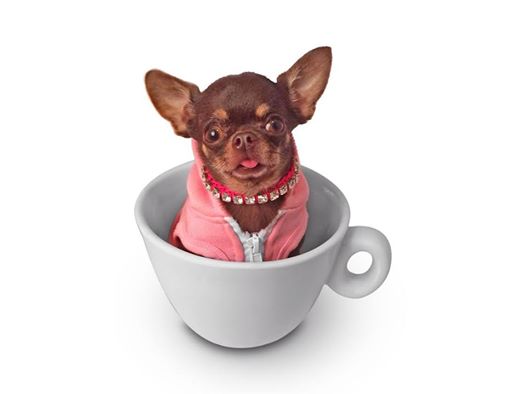
The world’s smallest dog, according to the Guinness Book of World Records, is Miracle Milly.  She’s a Chihuahua who lives in Puerto Rico.

She is only 3.8 inches tall (see photo above for scale).

Since she is a Public Figure, Milly has her own Facebook page and, like many small dogs, her owner likes to dress her up for photos.

Miracle Milly in teacup

Robin Williams leaves behind family and pug, Leonard

As the world learns more about the tragic loss of actor and comedian Robin Williams to suicide, this journalist from the Dog Channel has written about Williams and his Pug, Leonard.

I am sure that Leonard is mourning the loss of his doggy dad and owner today.

Rest easy, Mr Williams.

Robin Williams Leaves Behind Family and Pug, Leonard

I see you….no, really….I see you

If your home has WiFi and you have a tablet or smartphone to spare, you can buy an innovative product called the iCPooch.

The unit allows you to video chat with your dog and to deliver a treat through remote control.  The product is being marketed with the message ‘no more lonely days for your dog.’  Simply dial up, talk to your dog through the tablet or smartphone that you will mount on the front of the unit (the tablet/phone are not included in the purchase price of $149.99) and hit the switch on the app to have the unit deliver a treat.

IcPooch


I wonder if this product will really take off – most dogs and owners I know want to spend time together and I doubt dogs get the oxytocin boost of interacting with this unit they way the would when interacting with their owner.  The same goes for the owner…

Here’s a short video about how the iCPooch works:

The product is only available (and wired for) the United States at present.  I think this start-up will need to see how their market develops before taking the product to a wider audience.

Jealousy in dogs is real

Dogs can act jealous (is this really news to most dog owners?).  Well, researchers have taken steps to scientifically prove that jealousy exists.  They undertook this research because researchers studying emotion have argued for years whether jealousy requires complex cognition or that jealousy is a social construct not linked to physiology and psychology the way emotions like fear and anger are…

Emotion researcher Christine Harris, professor of psychology at UC San Diego, with Samwise, one of three border collies to inspire the study on dog jealousy. Photo by Steve Harris.

Emotion researcher Christine Harris, professor of psychology at UC San Diego, with Samwise, one of three border collies to inspire the study on dog jealousy. Photo by Steve Harris.

The research, published in the journal PLoS ONE, by University of California San Diego psychology professor Christine Harris and former honors student Caroline Prouvost is the first experimental test of jealous behaviors in dogs.

The findings support the view that there may be a more basic form of jealousy, which evolved to protect social bonds from interlopers.

Harris and Prouvost show that dogs exhibit more jealous behaviors, like snapping and pushing at their owner or the rival, when the owner showed affection to what appeared to be another dog (actually a stuffed dog that barked, whined and wagged its tail). Dogs exhibited these behaviors more than if the same affection was showered on a novel object and much more than when the owner’s attention was simply diverted by reading a book.

“Our study suggests not only that dogs do engage in what appear to be jealous behaviors but also that they were seeking to break up the connection between the owner and a seeming rival,” Harris said. “We can’t really speak to the dogs’ subjective experiences, of course, but it looks as though they were motivated to protect an important social relationship.”

Since there had been no prior experiments on dog jealousy, the researchers adapted a test used with 6-month-old human infants. They worked with 36 dogs in their own homes and videotaped the owners ignoring them in favor of a stuffed, animated dog or a jack-o-lantern pail. In both these conditions, the owners were instructed to treat the objects as though they were real dogs – petting them, talking to them sweetly, etc. In the third scenario, the owners were asked to read aloud a pop-up book that played melodies. Two independent raters then coded the videos for a variety of aggressive, disruptive and attention-seeking behaviors.

Dogs were about twice as likely to push or touch the owner when the owner was interacting with the faux dog (78 percent) as when the owner was attending to the pail (42 percent). Even fewer (22 percent) did this in the book condition. About 30 percent of the dogs also tried to get between their owner and the stuffed animal. And while 25 percent snapped at the “other dog,” only one did so at the pail and book.
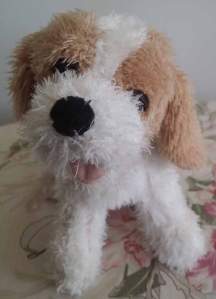
The “other dog” – the stuffed, animated pooch used in the experiment. Photo by Caroline Prouvost.

The “other dog” – the stuffed, animated pooch used in the experiment. Photo by Caroline Prouvost.

Did the dogs believe the stuffed animal was a real rival? Harris and Prouvost write that their aggression suggests they did. They also cite as additional evidence that 86 percent of the dogs sniffed the toy dog’s rear end during the experiment or post-experiment phase.

“Many people have assumed that jealousy is a social construction of human beings – or that it’s an emotion specifically tied to sexual and romantic relationships,” Harris said. “Our results challenge these ideas, showing that animals besides ourselves display strong distress whenever a rival usurps a loved one’s affection.”

Source:  UCSD media release

Space bubbles

Have you ever been to a party and someone comes in really close to you and you don’t like it?  And you step back….only to have that person step forward again?  That’s the concept of personal space and comfort.

Dogs have it too!

Here’s a great video showing dogs with different degrees of comfort and personal space.  It shows you how to train a shy dog to become more accustomed to getting close to you as the owner.

More evidence against breed specific legislation

UK legislation that targets ‘dangerous dogs’ has not been shown to reduce dog bites and policies should be based on evidence and risk assessment, suggests a new article.

Rachel Orritt, a PhD student of psychology at the University of Lincoln says that dog bites present a “public health risk of unknown magnitude but no scientific evidence upon which to base a reliable UK estimate has been obtained in the past two decades.”

She also says that discussion by medical professionals about the impact of dog-human interactions “sometimes ignores the health benefits concomitant with dog ownership” with one writer in The British Medical Journal suggesting that “the only way to stop dog bites will be to ban dogs.”

Orritt says there are several studies that show owning a dog is associated with increased physical activity, better self esteem and fewer annual visits to the doctor. She adds that “eradicating dogs would have negative consequences for human health.”

She argues that the British news media “confound the matter further through inaccurate representation of the risk posed by dogs.”

Inaccurate reporting of dog bites, coupled with public pressure “have contributed to the drafting of legislation,” she writes. The Dangerous Dog Act 1991 has been amended in an effort to improve this legislation “but has been shown to be ineffective at reducing dog bite incidence.”

Orritt says that to reduce dog bite incidence, “academics and medical and veterinary practitioners need to cooperate to develop effective, scientifically sound risk management strategies. These should be evidence based and should not depend on politically driven initiatives such as the current legislation.”

Risk assessment for human violence has proved to be accurate and reliable and Orritt says this “might be a practical preventative measure to reduce injury from dog bite” along with medical and veterinary professionals “familiarising themselves with evidence based resources.”

She says that attention must also be given to the psychological health of patients after trauma.

Orritt believes that research is needed to improve care and an “estimate of dog bite incidence” but until this is done, “the scale of the problem is entirely unknown.”

She concludes that evidence based measures to inform ongoing risk management, such as developing effective risk assessments, “should result in the reduction in dog bite injuries that punitive legislation has not achieved.”

Source:    EurekAlert! media statement

Journal Reference

R. Orritt. Dog ownership has unknown risks but known health benefits: we need evidence based policy. BMJ, 2014; 349 (jul17 7): g4081 DOI: 10.1136/bmj.g4081

Wordless Wednesday, part 44

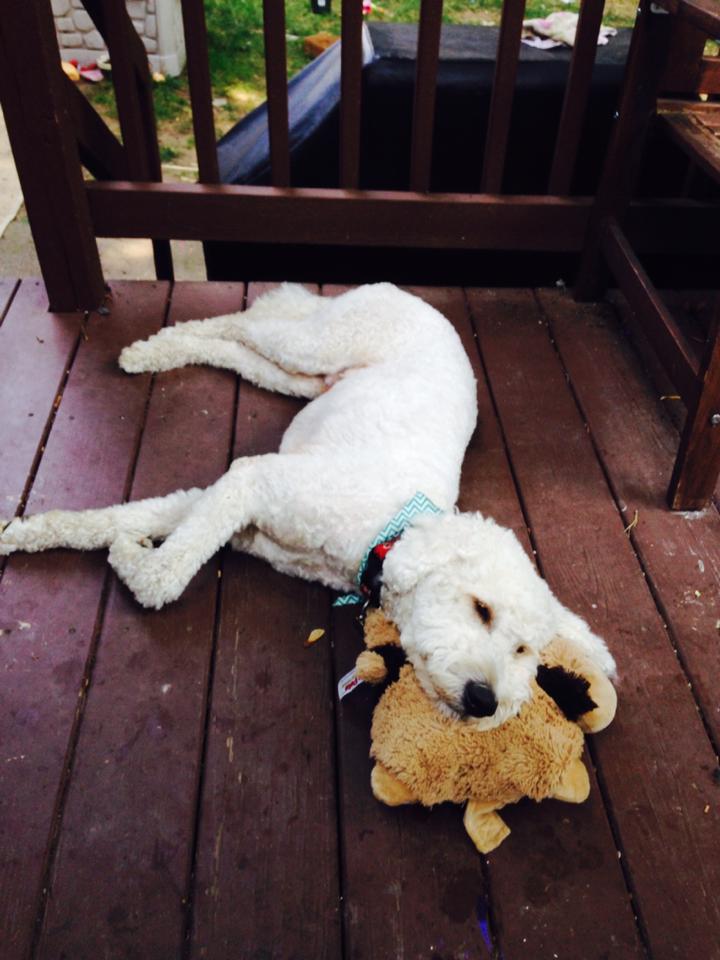
Photo courtesy of Karen Eckstein Han

Photo courtesy of Karen Eckstein Han

Blog Hop