Category Archives: Dogs

Olympian Hero Brings Home More Than a Medal

Well done to Olympic skier Gus Kenworthy for helping to save some of Sochi’s stray dogs.  Don’t forget to click through on the link in this article to the Today Show interview where Kenworthy and his friend talk about the challenges they faced in saving the dogs.

Olympian Hero Brings Home More Than a Medal.

Darla’s story – what every owner needs to understand about dog toys

http://animoto.com/play/ZuVsvhin1iovwzUg6CfpzA?utm_source=amazonaws.com&utm_medium=player&utm_campaign=player

This video comes via the Center for Pet Safety, a registered 501(c)3 research and advocacy organization dedicated to companion animal and consumer safety.

Darla was the victim of a poorly designed dog toy purchased at Walmart by her unsuspecting owner.  Darla ingested nylon fabric that wrapped around her tongue and proceeded into her digestive tract causing peritonitis.  She fought for her life for over 3 days before losing her battle.

You can read Darla’s story by clicking on this link.

Dog owners must understand that dog toys are not subject to recalls and the burden of proof and legal remedies rest with the dog owner in cases like these.

I’m sharing this story to spread the word about this dog toy and to remind everyone to be careful in their selection of toys.  Toys sold at discount retailers are particularly suspect, such as those in New Zealand that are imported from China and are not well made and use paints and dyes that clearly rub off when being chewed.

Read Darla’s  story and then give your dog a hug – and promise to keep them safe from deadly toys.

The facts about pit bulls

The facts about pit bullsSource:  National Geographic

Dogs’ brains respond to human voices

Yet more research on how dogs’ brains work.  This time from a research team at Eötvös Loránd University in Hungary and published in the journal Current Biology.

Using functional MRI, the team could see where blood flowed in the brains of a group of 11 dogs.  The dogs had been specially trained using positive reinforcement techniques to lie still in the MRI scanner for six minutes.
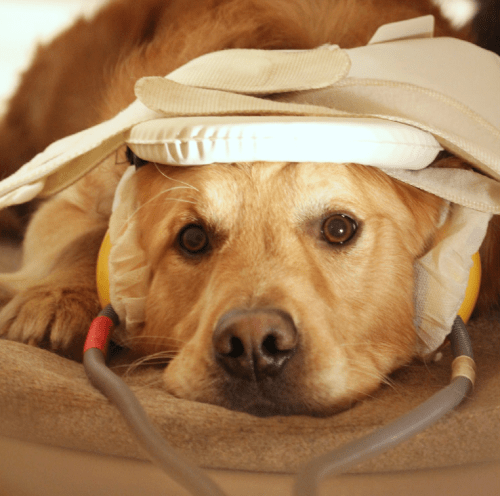
A dog lies still in the fMRI scanner, wearing earphones to pipe in sounds as part of the study. (Photo by Eniko Kubinyi)

A dog lies still in the fMRI scanner, wearing earphones to pipe in sounds as part of the study. (Photo by Eniko Kubinyi)

which tracks blood flow to various areas of the brain, a sign of increased activity—to peer inside the minds of dogs. One of a handful of labs groups worldwide that’s using the technology in this way, they’ve used positive reinforcement training to get a study group of 11 dogs to voluntarily enter the fMRI scanner and stay perfectly still for minutes at a tRead more: http://www.smithsonianmag.com/science-nature/your-dog-can-tell-from-your-voice-if-youre-happy-or-sad-180949807/#DXcpTX0jfeQGFWVY.99
Give the gift of Smithsonian magazine for only $12! http://bit.ly/1cGUiGv
Follow us: @SmithsonianMag on Twitter

The team played each dog a series of over 200 sounds across several MRI sessions.  The sounds included human voices, dog vocalizations, and meaningless noises.

When the results were compared, it showed that the dogs’ brains appear to have a dedicated area that displays more activity in response to voices (whether human speech or dogs barking) than other meaningless noises (such as glass breaking).

More importantly, that part of the brain shows more activity upon hearing an emotionally positive sound, as compared to a negative one.  This means that our dogs are able to distinguish a tone of voice that is positive from one that is negative. (Something many of us probably already knew)

The voice areas of the dogs’ brains is similar to that found in humans, suggesting that our species evolved from a common ancestor almost 100 million years ago, enabling a high degree of communication and social structure.

“We know that dogs don’t have language, per se, but we see now that dogs have very similar mechanisms to process social information as humans,” Attila Andics, lead researcher on the study says. “It makes us wonder what aspects of so-called ‘language skills’ are not so human-specific after all, but are also there in other species. That’s something we plan to look at.”

Source:  Smithsonian Magazine

Here are my earlier blogs about functional MRI studies on dogs:

they show that the dogs’ brains appear to have a dedicated area that displays more activity in response to voices (whether human speech or dogs barking) than other meaningless noises (such as glass breaking), and that part of this area shows more activity upon hearing an emotionally positive sound, as compared to a negative one.Read more: http://www.smithsonianmag.com/science-nature/your-dog-can-tell-from-your-voice-if-youre-happy-or-sad-180949807/#DXcpTX0jfeQGFWVY.99
Give the gift of Smithsonian magazine for only $12! http://bit.ly/1cGUiGv
Follow us: @SmithsonianMag on Twitter
Image

Wordless Wednesday, part 25

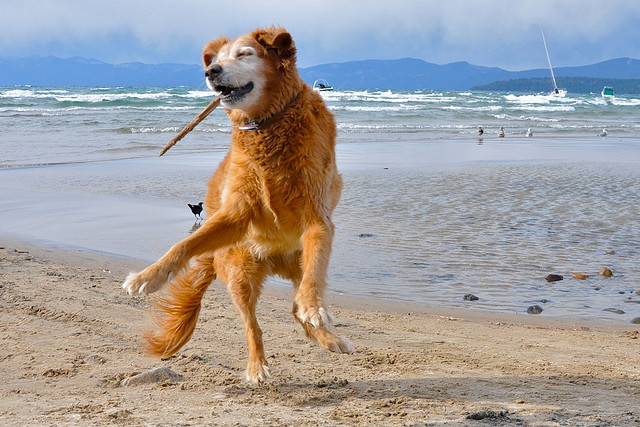
Dancing dogBP_Wordless_wed_Hop_Logo_2014

An old dog’s snores

I adore my Daisy and I’m very aware that she’s getting older.  For example, I notice that she doesn’t hear as well as she used to and she sleeps very deeply as a result.

I love watching her sleep and couldn’t resist taking this short video of her snoring.  Enjoy!

Dog agility: Do emotions get in the way of a top performance?

dog agility

Researchers have debated human right brain/left brain theory for years.  New research has looked into whether lateralisation of brain function affects dogs.

The study involved 19 dogs and trainers.  The study subjects went through a series of tests, firstly paw preference tests whilst offering food followed by agility tests, using A-frames, jumps and weave poles.  Throughout the tests, the dogs received trainer stimuli from both the right and left sides.

Trainers also completed questionnaires giving more information about the dog’s temperament.  Results showed a correlation between paw preference and agility.  Dogs with stronger paw preferences seemed more predisposed to training, less distracted and had greater agility.

When trainers presented on the left, dogs were more agitated, emotional, and performances deteriorated.  A dog’s left visual field stimulates the right brain hemisphere.

Overall the results revealed that behavioural lateralisation correlates with
performance of agility-trained dogs.  These results support previous evidence that lateralisation in dogs can directly affect visually guided motor
responses.

The results have practical implications for personnel involved in
the selection of dogs trained specifically for agility competitions and for the
development of new training techniques.

You can read the full article on this research here.

 Read my previous blogs about paw preference in dogs:

·        Behaviour in dogs depends on paw preference

·         Is your dog right-pawed or left-pawed?

Adapting to the high altitudes of Tibet

In a new study published in the journal Molecular Biology and Evolution, author Dong-Dong Wu, et. al., explored the genetic basis of high-altitude adaptation of Tibetan Mastiffs, which were originally domesticated from the Chinese native dogs of the plains.

Credit: © zuzule / Fotolia

Credit: © zuzule / Fotolia

The authors examined genome-wide mutations (called single nucleotide polymorphisms, or SNPs) of 32 Tibetan Mastiffs, and compared them to 20 Chinese native dogs and 14 grey wolves. Overall, they identified more than 120,000 SNPs, and in their analysis, narrowed these down to 16 genes that have undergone positive selection in mastiffs, with 12 of these relevant to high altitude adaption.

These candidate genes have been shown to be involved in energy production critical to high-altitude survival under low oxygen conditions.

For future studies, the authors will explore whole genome sequences from individual Tibetan Mastiffs to gain better insights into high-altitude adaptations and canine evolution.

Source:  EurekAlert! media statement

The Genius of Dogs – book review

The genius of dogsI have just finished reading The Genius of Dogs by Brian Hare and Vanessa Woods.  It’s a keeper!

I’ve always felt that many people don’t give our dogs the credit they deserve; they are not ‘dumb animals.’  This book outlines research into dog cognition and what it means for your relationship with your dog.

Hare, who is the founder of the Duke Canine Cognition Center, started his research at the young age of 7 with his dog Oreo.  He used a basic cognitive test involving two cups and a treat to test whether Oreo would respond to hand signals.  Later in life, as part of his research, he travels to places like the Congo to work with bonobos, Australia to observe dingoes on Fraser Island, and New Guinea to test a group of New Guinea Singing Dogs.

Here are a few of my favourite excerpts from this book:

  • People who own pets tend to be more extroverted, less lonely, and have higher self-esteem than people who do not own pets.
  • Breed-specific laws based on appearance as opposed to bad behavior are doomed to fail in protecting the public because it is difficult to judge a dog by her cover.
  • In return for a lifetime of loyalty, they (dogs) depend on us for food, the warmth of a loving family, and a good home.  It is up to us to uphold our end of the bargain.

This book is thoroughly referenced with 67 pages of end notes, something I believe is as an indicator of quality.

Enjoy this book, from its first page to last.  I found the book’s dedication particularly poignant…

For all dogs

Image

Wordless Wednesday, part 24

copyright Mala Frost

copyright Mala Frost

BP_Wordless_wed_Hop_Logo_2014