Category Archives: Dogs

Cranberries and urinary tract infections

Many holistic veterinarians are now recommending the use of cranberries in the long-term treatment of pets who are susceptible to urinary tract infections, or UTI.

Diabetic dogs, in particular, seem to develop UTI more regularly than the normal dog population.  Spayed females are also more susceptible to infections.

Cranberries

When a dog has a UTI, they often struggle to eliminate urine or, when they do pee, not much comes out.  Sometimes blood is seen in the urine, the urine may smell stronger, or it has a dark colour.  If your dog has a UTI, then seeing your veterinarian for antibiotics is essential.  A urinary tract infection left untreated means your dog is uncomfortable and in pain and if the infection travels to the kidneys, then your dog is in serious trouble.

Cranberries can assist when your dog is being treated for a UTI because cranberries help to acidify the urine which helps to prevent bacteria growth.

But what about prevention?  This is where the cranberries come into their own.  Not only does the cranberry acidify the urine, but studies show that they have the ability to prevent bacteria from sticking to the walls of the bladder and urinary tract and so they minimise the chance of an infection recurring.

Some owners treat their dog with cranberry powder because the juice is tart and unpalatable.  Owners must be careful because lots of cranberry juices are full of sugar (that’s a warning for humans as well as pets).

I’m working on a wheat-free cranberry biscuit recipe now that will feature as the January/February special.  I’ve just perfected my recipe and the latest batch is looking great – with the added benefit of no artificial colours!

Dog peeing

In order to prevent recurring urinary tract infections, it’s also really important to ensure your dog has lots of fresh, clean water to drink and has lots of opportunities to go outside and pee.  For diabetic dogs, care must be given to their daily diet to manage their blood sugars (another reason to watch the sugar content of any cranberry supplements).

DOGTV for the home alone dog

I wish we lived in San Diego, California where DOGTV is currently aired on cable television. There are plans for rolling it out to other cable providers but who knows if it will ever make it to New Zealand?

Since I use relaxation music in my massage practice, I know that dogs respond to certain cadences of music and it makes sense that they are visually stimulated by certain movements and shapes, too.

DOGTV offers special content for a dog’s sense of vision and hearing and aims to support a confident, happy dog, who’s less likely to develop stress, separation anxiety or other related problems.  It seems a must for the home-alone dog, particularly the younger dogs who have energy to spare when you are not able to be home with them.

DOGTV has been recognised by the Humane Society of the United States (HSUS).

If you are not in San Diego, you can subscribe to a streaming online service with prices that start at US$9.99 per month.  Make sure you understand the impact of this on any data caps you have with your internet provider.

Here’s a sample of DOGTV.  Bring your dog over to the screen to watch!

Christmas skijor anyone?

For those in the northern hemisphere, Christmas is a winter holiday and why not enjoy it with your dog?  Skijoring is a winter sport where a cross-country skier is drawn across the snow pulled by their dog.  In some cases, skiers will skijor with more than one dog.  In Norwegian, the term literally means ‘ski driving.’

Breeds like Huskies, Malamutes and Samoyeds are obvious choices for this sport, where the owner and dog get their exercise together.  However Pointers and Pointer crosses are also good sled dogs (Daisy likes that idea – although at her advanced age she will be a spectator only).

Skiing with dogs 2 Skiing with dogs 3 Skiing with dogs

In this sport, the cross-country skier provides power with skis and poles, and the dog adds additional power by running and pulling. The skier wears a skijoring harness, the dog wears a sled dog harness, and the two are connected by a length of rope. There are specialist suppliers of skijor equipment to get you started.

Of course, careful winter paw care is needed and some dogs may be fitted with protective footwear for the sport.

Christmas skijor anyone?

Watching your dog’s waistline

Body condition score

Take a look at the chart above.  It shows you how to spot ideal body condition on a dog.  Earlier this week, I was speaking with someone and she commented that she felt Daisy was too thin.  In fact, Daisy had just been to the veterinarian for her health check and was declared to be in ideal condition with an excellent body score.

The problem is that the person speaking with me owns several obese and overweight dogs.  She knows her dogs must lose weight, but she has become so accustomed to seeing an overweight dog that a dog in good condition looks too thin to her.

I work with dogs who need to lose weight by recommending exercise programmes combined with making the dog comfortable through massage, acupressure and laser therapies.  Dogs don’t get fat overnight; their weight loss programmes take a bit of time too.

Over these holidays, please don’t overfeed your dog.  And take the time to review the body conditions listed above.  If your dog isn’t in ideal condition, what do you need to do to get them there?

When your dog has the runs…

A client rang me this week to say that her dog had a major case of runny poos – the runs – or diarrhea to be exact.  She said her dog was her normal happy self but was going to the toilet regularly with fairly dramatic consequences – would I keep our massage appointment?

My answer was ‘no’ – not advisable – not because I was concerned that I’d have poo all over my massage table but because this dog’s body was telling us something.  Diarrhea is a symptom and not a disorder in itself and the dog’s body was working double-time to rid itself of an irritant.  Her system had enough to handle and a massage would only add to her metabolic load as lactic acid was released by the massage.  She didn’t need that.

My advice was to withhold food for 12 to 24 hours and to keep up the fluids.  Some people add low salt chicken or vegetable stock to the dog’s water bowl to encourage them to drink and keep hydrated, for example.  When food was again on the menu, I suggested replacing half the normal volume of food with cooked pumpkin to add fibre to the diet that the dog could easily tolerate and to keep this up for a few days until the stools returned to a normal consistency.

Other home remedies include a diet of boiled chicken with white rice, for example.

Typically, diarrhea is the result of a digestive indiscretion but it can be the result of poisoning from household or garden chemicals, a symptom of parasites such as hookworm, or a food allergy.  Some worming treatments can also stimulate a bought of diarrhea.

If a dog has additional symptoms such as lethargy, weakness, abdominal pain, blood in the diarrhea, vomiting and fever  then you need to see your veterinarian as soon as possible.   In this case, the dog seemed happy in herself and so that was a sign that she was probably not in danger.

A trip to the vet is a good idea if the diarrhea lasts for more than five days or so.

Diarrhea isn’t any fun for the dog owner or the dog.  Keeping an eye on symptoms is critically important to ensure you do the right thing when your dog has the runs…

What’s the diff, Cliff?

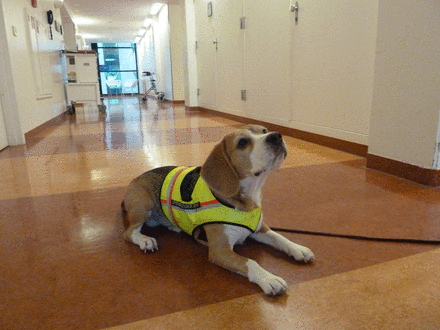
Cliff, a Beagle, is a specially trained detector dog working in two Dutch teaching hospitals.  He’s been the centre of a major study into detection of Clostridium difficile (‘C diff’ for those who are professionals in the field), an infectious bacteria that can run rampant through hospitals, rest homes and other healthcare facilities.

Detector dog on hospital ward

Symptoms range from mild diarrhoea to more severe conditions like colitis. The bacterium can be transmitted through either personal contact or the environment and the testing for the bacteria is time consuming.

The research involved 300 patients, 30 which had C diff infection.  Cliff was guided along the wards by his trainer and the trainer had no idea if the person was infected or not.  Cliff was trained to sit or lie down when C diff was detected.

The Results?  Cliff was an expert at identifying infections of C diff – with around 90% accuracy –  regardless of whether he was sniffing out stool samples or identifying infected patients in the hospital.  Cliff is only one dog, but with these results, the concept of using dogs to identify C diff infections has been proved.

This comprehensive video explains Cliff’s training and the research:

Source:  British Medical Journal

Comforting those left behind in Connecticut

Dogs have a connection to many human events.  In the case of the tragedy in Newtown, Connecticut, dogs have helped to provide comfort to the residents left traumatised by the mass shooting there last week.

Comfort dogs, typically Golden Retrievers, have been sent to the area to work with the children and adults to help them through their grief and loss.

The unconditional love and support given by dogs to humans is well documented, with physiological effects such as a lowering of blood pressure proving the impact that petting a dog can have.

Given what has happened in Newtown, any comfort that can be directed to this community will be welcomed.

The best things in life are free

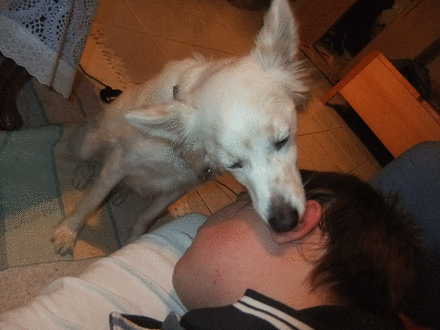
Free Kisses

In this busy holiday season, remember that the affection your dog shows you is absolutely FREE!  Don’t buy anything today – simply enjoy time with your dog.

The British Medical Journal’s Shaggy Dog Story

Two Belgian researchers have published their Shaggy Dog Story in the British Medical Journal this month.

They tell of a 35-year old patient with a severe sleep disorder that made traveling on public transport a problem because she would fall asleep and miss her stop, often becoming disoriented.

Dog waking patient

She was paired with a service dog that was trained to wake her for important noises and on public transport.   This type of success story points to even more roles for service dogs.

Wake me up, Shaggy!

Hearing Dogs NZ

Imagine being on duty 24/7 at your job and enjoying it.  Well – if you were – chances are you would be one of the 50 registered hearing dogs currently working in New Zealand.

Hearing dogs are the ‘other’ assistance dogs, less well known than their guide dog for the blind counterparts, but no less important to the lives of their human recipients.

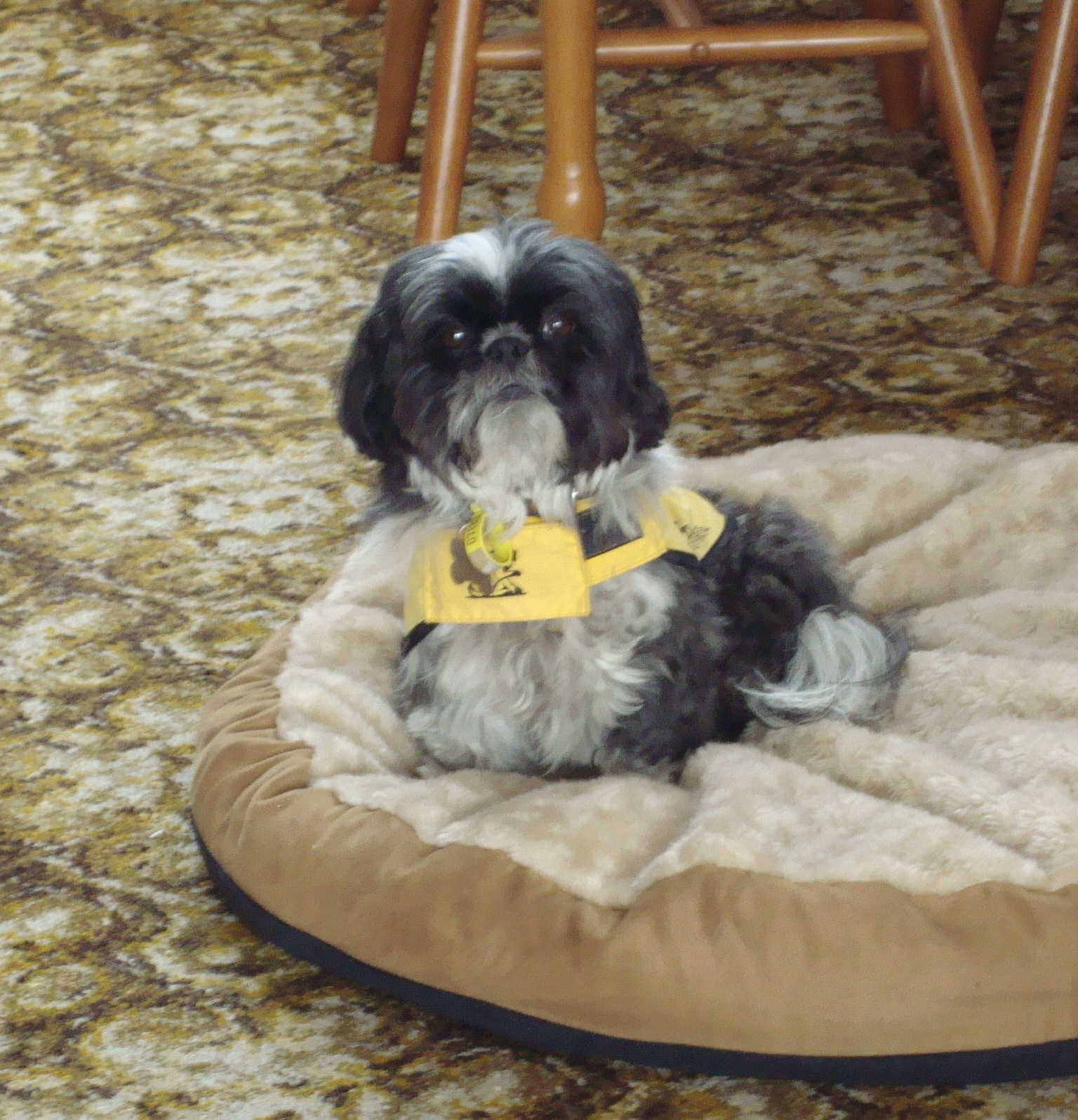
These dogs are trained to alert their deaf or severely hearing impaired owner to important sounds such as the door bell, kitchen timer, fire alarm, baby monitor, or telephone.  A hearing dog wears a distinctive yellow coat.

Tyra in her yellow Hearing Dogs coat

Tyra in her yellow Hearing Dogs coat

Hearing Dogs is an incorporated charitable trust established in 1998 that provides training for these special dogs at its National Training Centre in New Plymouth.  At any given time, there will be six dogs in training at the facility.  These dogs go to socialisers on the weekends as part of their initial training.  If you are in the New Plymouth area, this is one way of supporting the organisation.

A hearing dog may be any shape or size and most breeds are acceptable.  Training typically starts between the age of one year to 18 months.  Clare McLaughlin, General Manager, says “We look for excellent health followed by an even temperament.  The dog needs to be calm and confident and not react to sudden movements or sounds.  A well socialised dog is an advantage and one that is motivated by food makes it easier because our training is reward based.”

Another quality is willingness to learn.  Any breeder who has a dog with these qualities may want to consider offering the dog to Hearing Dogs for training.

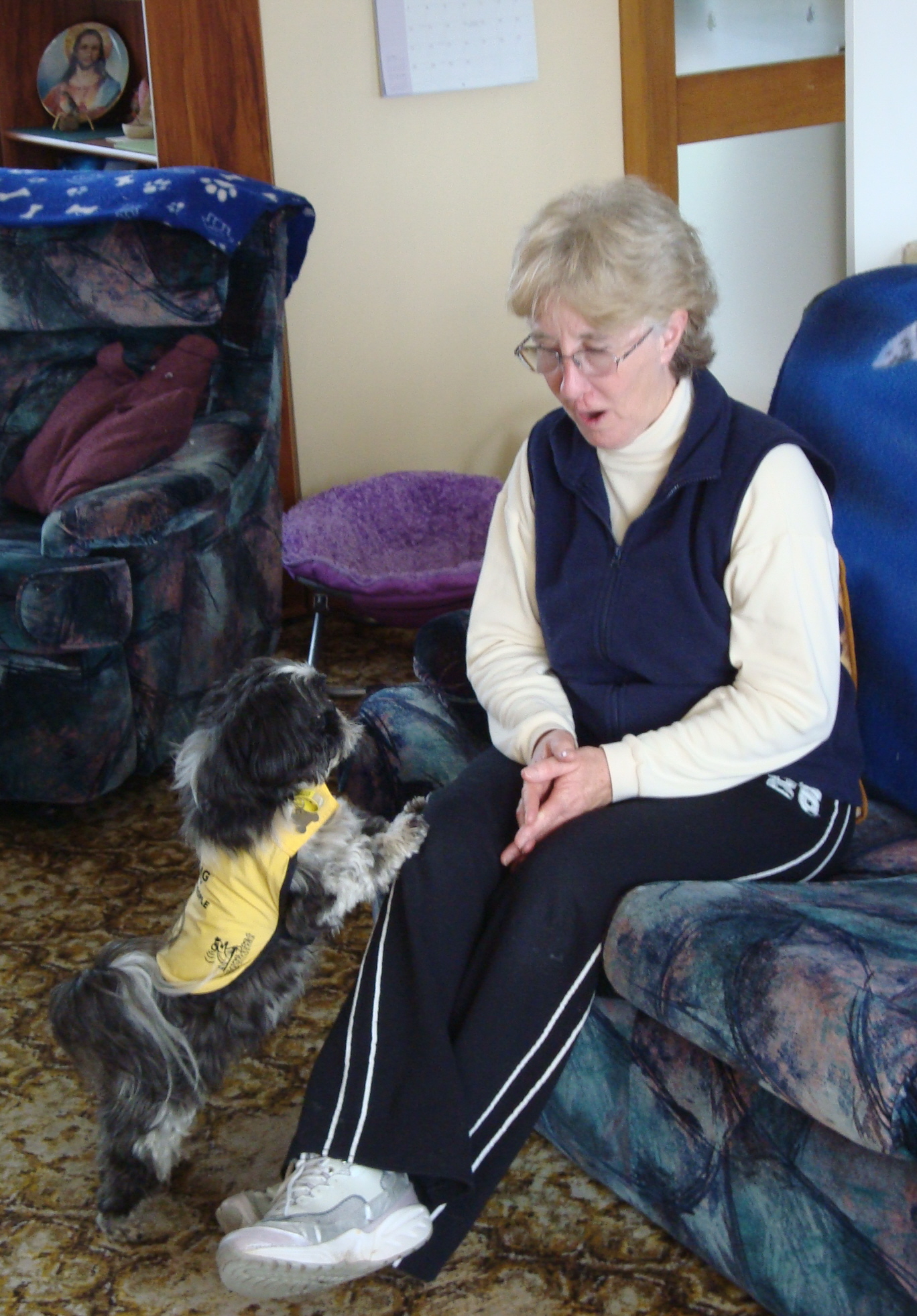
Caroline Boyce can testify to the value that a hearing dog brings to its recipient.  Caroline grew up in a hearing world, without support, and in her own words “I always felt that I wasn’t normal because there was so much going on around me.”  Despite this, she managed to travel overseas for work experience, find a loving husband, raise two children, and work.  Eight years ago she summoned the courage to go to a talk about Hearing Dogs and then put her name down to receive one.  Tyra, her second dog, has been with her for four years. Tyra demonstrated her skills for me by alerting Caroline when the kitchen timer sounded.

Tyra alerts Caroline to the timer on the kitchen oven

Tyra alerts Caroline to the timer on the kitchen oven

Hearing Dogs doesn’t have the wide corporate support or profile of some other charities, but there are many ways to help.   Dr Terryne Loney of Pet Doctors Harewood (Christchurch) has pledged two free examinations per year for all hearing dogs in Christchurch, saying “I think hearing dogs are vital for safety, wellbeing and assistance to hearing impaired people.  Hearing dogs do not get high levels of support and recognition so we wanted to help.”

 To learn more about Hearing Dogs, visit their website.