Category Archives: Dogs

Flavours Vineyard Cafe – a dog friendly cafe that’s close to home

My readers know that I am passionate about supporting dog-friendly establishments.  Dog-friendly accommodation and shopping are in short supply in New Zealand and so any establishment that embraces dogs and their owners gets my attention.

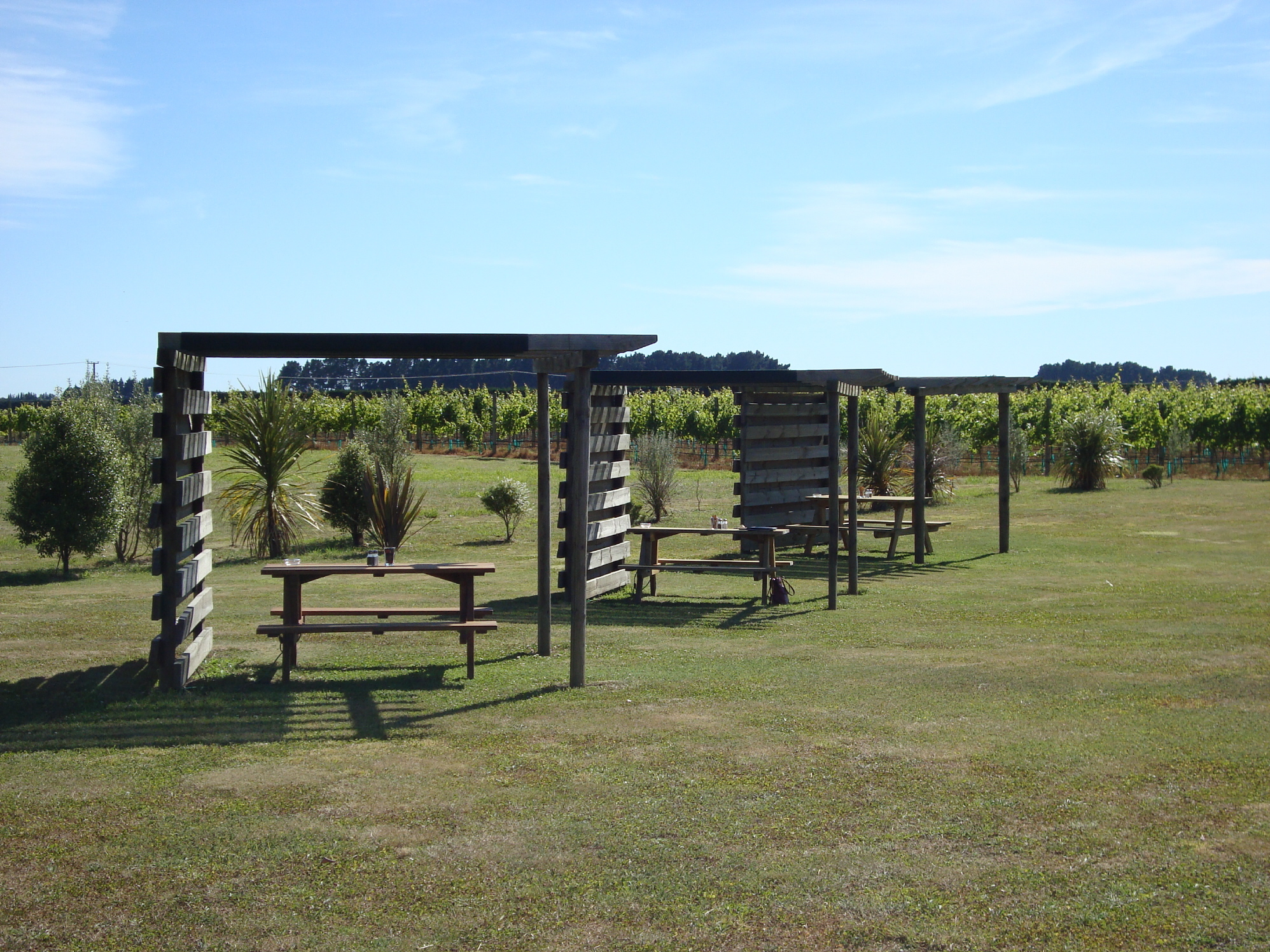
I’ve been driving by Flavours Vineyard Cafe for months but never had the opportunity to stop until we were on holiday (vacation for you overseas readers).  The cafe is located on the corner of West Coast Road (SH73) and Sandy Knolls Road, approximately 3 km from West Melton,  and has just celebrated its first anniversary.

A purpose-built American-style barn houses the cafe; the land was purchased specifically with a boutique vineyard in mind.  The cafe makes an effort to source and sell local products and best of all – it’s dog friendly!

The outdoor picnic tables have been covered with shade cloth and water is available for visiting dogs.  Horses are also welcome with room in the adjacent paddock.  Cafe manager Sam Judson says, “We get more dogs than horses, but all are welcome.”

Open every day except Wednesdays, a breakfast and daytime menu are available which include salads, pizza, fresh muffins and coffees.  On Fridays the cafe offers Pizza Night from 5:00 pm to 8:30 pm for dine-in or takeaway.

We loved it, as these photos show.  Help support local Christchurch businesses and take your dog out to Flavours Vineyard Cafe today.

This slideshow requires JavaScript.

Weight gain and obesity are not only human conditions

We live in modern times, and in western societies such as ours, obesity and weight gain are consistent problems.  And not just for people.

36 million pets in the United States are obese, according to the Association for Pet Obesity Prevention.  In dog population terms, that’s 55% of the dog population.  The Association does a pet obesity survey each year, timed with National Pet Obesity Prevention Day (in October), where it asks pet owners to fill out a survey about their pet’s size, breed and eating habits.

Veterinarian Ernie Ward is a co-founder of the Association and he says that the focus on reward-based training has helped to contribute to the obesity problem.  Simply put, owners are not adjusting their dog’s daily intake of food at mealtime to compensate for treats being given as a reward.

And once a dog is fully trained, the rewards seem to keep coming for sometimes very basic tasks.  Like pooping, for example.

(Ask yourself:  once your child is potty-trained, do you keep praising him/her each time they use the toilet? – even into their teenage and adult years?)

And I’ve found that delivering the news to a client that their dog could lose some weight can often be a reason for not being asked to return for another massage treatment.  According to a recent article in The Boston Globe, I’m not alone.  Vets that deliver the news that a pet is overweight may find that the owner becomes defensive or, worse, takes their business elsewhere!

However, when I am dealing with a dog with arthritis or other mobility disorder, I am looking for ways to relieve their pain.  If they are carrying around extra weight, their sore joints and muscles are pulling double-duty.  I remember a client with a Pug, for example, who was easily twice its normal body weight.  Sure, the dog had arthritis, but it was so fat that it didn’t want to exercise and so weight loss was going to be a challenge and something the owner had to a) recognise and b) act on.

The Globe article also discusses the wide range of calorie content amongst commercial dog foods.    People may change their dog’s food, but continue feeding the same number of cups per day.  Weight gain is insidious and many people don’t recognise that their dog has put on weight until a vet or someone else points it out to them.

I do nutritional assessments for this reason.  I ask questions about the dog’s lifestyle, exercise habits and eating.  And I can run caloric calculations based on the dog food label to give advice on how much to feed.

There are many health professionals including your vet that have your dog’s best interest at heart.  Don’t be afraid to ask if they think your dog is overweight and be humble enough to make changes.

P.S.  When I take Daisy to her acupuncture treatments, my vet asks me to weigh her prior to each consultation.  This keeps me very disciplined to ensure that Daisy remains in her ideal weight range.

Some full-service pet shops and veterinary practices are happy for you to drop in to use their scales.  Why not make it a habit of walking your dog to these places for a weigh-in?  It’s a new routine that will keep you focused on your dog’s weight in a more positive way.

More about spinal cord injury

This video, courtesy of the University of California San Francisco,  shows the gait effects of  spinal cord injury and a very good close up of the proprioception test that is used by vets.   (See my previous blog about prioprioception here.)

Spinal cord research benefits dogs

Last week, the University of California San Francisco issued a press release about the promising research of Dr Linda J Noble-Haeusslein and her collaborators at Texas A&M  University.

The US Department of Defense has granted $750,000 over three years to develop a drug that helps to mitigate the secondary damage associated with spinal cord injury.  When an injury occurs, there is a cascading chemical reaction that damages nearby cells and that means – essentially – that more damage happens than that caused by the immediate injury.

It is thought that the drug, a protein-blocking agent, will successfully interfere with that cascading process and preserve sensitive neurological pathways.

Other neurological researchers have shown that movement in the spine can be preserved if as little as 18-20 percent of nerve fibre tracts remain intact.

Dogs such as Dachshunds, Corgis and Beagles (dogs with a long torso) are known to be susceptible to disc ruptures.   When a dog presents with a disc rupture at the Small Animal Hospital at Texas A&M University, their owner will be asked to consent to the experimental treatment.

And why is the funding coming from the Department of Defence?  Well, sadly, there are many wounded soldiers returning from overseas war zones with spinal injuries.

Source:  University of California, San Francisco (UCSF) (2012, January 18). Saving dogs with spinal cord injuries. ScienceDaily. Retrieved January 25, 2012, from http://www.sciencedaily.com­ /releases/2012/01/120118155338.htm

Betty – A Special Seeing Eye Dog

This week, actress Betty White celebrated her 90th birthday.  It’s quite a milestone.   She’s received a lot of attention over the years and not just for her acting.  Ms White has a long history of animal advocacy work and many charities have benefited from her support.

The Seeing Eye, Inc., an organisation founded in 1929, has named a puppy after Betty.  Based in Morristown, New Jersey, the Seeing Eye is the oldest existing guide dog school in the world and it has trademarked the term “seeing eye” so that only dogs from its school can be called seeing eye dogs.  That’s why guide dog puppies here in New Zealand are called guide dogs whereas folks from the United States often call them seeing eye dogs.

Betty, the Seeing Eye dog named after actress Betty White

Ms White first recorded a radio public service announcement for The Seeing Eye in the 1980s in which she helped remind everyone about the requirement to allow guide dogs access to public transport.  You can listen to that announcement here.

In 1987, the American Veterinary Medical Association gave Betty its Humane Award for charity work for animals.  Ms White has a bronze plaque at the Los Angeles Zoo (near the gorilla exhibit) which also honours her work for animals.  In 2010, she was even granted the title of honorary forest ranger by the US Forest Service!

Happy birthday Betty!  And may Betty the Seeing Eye Dog have a long career!

Kathleen Crisley, specialist in dog massage, rehabilitation and nutrition/food therapy, The Balanced Dog, Christchurch, New Zealand

Digital dog success for Weta

The Wire-haired Fox Terrier is the big winner in The Adventures of Tintin film.  New Zealand’s Weta Workshop has worked its magic in creating a digital version of Snowy, Tintin’s loyal dog.

Tintin is a young reporter with a nose for news.  He was created by Georges Remi under the pen name of Hergé in 1929, appearing in a series of children’s stories/comic books that particularly appealed to young boys.  Investigating crime and finding the culprits were everyday activities for Tintin and Snowy.

It is great to see another dog take center-stage in the film world this year.  This official movie trailer, courtesy of YouTube, gives you an introduction to Snowy (and Tintin) and the wonderful work of Weta Workshop.

I love you to bits: kibbles and bits and bits and bits…

I was thinking today about how dog nutrition has changed over the years.  Today, there are more dog foods than ever before.  There are organic products and even products that aim to attain the values of the raw food diet – but offering a more prepared formulation for busy dog owners.

So now I’m going to show my age and also the power of a good jingle.  I still remember this commercial from the 1980s for Kibbles and Bits.  This was one of the first commercial dog foods to offer a hard kibble combined with softer texture pieces.  But it’s the jingle I remember and I’ve found it for you here on YouTube.  Enjoy it.

And now my friends will understand when I tell Daisy that I love her to bits…kibbles and bits and bits and bits!

We Bought a Zoo – look for the beagle!

Over the holidays, my mother and I went to see We Bought A Zoo starring Matt Damon and Scarlett Johansson.  The movie is based on the true story (and book by) Benjamin Mee, who purchased the rundown Dartmoor Wildlife  Park (now known as Dartmoor Zoo) and re-opened it in 2007.

I’m an animal lover and so movies like this appeal to me.  Even better, the family in the story owns a beagle named Leon.  He’s not a main character but as with all beagles – he’s adorable.  Behind the scenes, it sounds like the beagle playing Leon was being a true beagle – with a mind of his own despite his training.    According to Cameron Crowe, the Director of the film, “it was really the beagle who was hard to work with (laughs).”  (Interview on azcentral.com)

My advice:  go to the film and enjoy it and look for the beagle!

Loose Leashes – the photography of Ron Schmidt

As my readers know, I don’t make product endorsements very often.  But, I had to share the great dog photography of Ron Schmidt with my readers.

I discovered Ron’s work last year when I purchased a calendar, Dogma – A Dog’s Guide to Life.  I loved the combination of dog photos and dog-inspired proverbs.  I have purchased another Dogma calendar for this year!

Ron trained in photography and worked with fashion and celebrity photographers for years before branching out into commercial photography on his own in 1999.  A holiday card developed for friends and relatives that featured the family dog carrying a Christmas tree quickly morphed into a career in dog photography.  Ron and his wife launched Loose Leashes in 2005 and they donate a portion of the proceeds from sales of prints to animal welfare causes (another reason to like them!)

I won’t break any of Ron’s copyright by attempting to copy his photography on this blog – but check out Loose Leashes today!

The alpha roll myth

When scientists studied captive wolves (and I’m talking about research that dates back to the 1960s), they observed fighting for dominance within the group and extrapolated that information as relevant to domesticated dog behaviour.  Unfortunately, by studying captive wolves, the scientists were observing an artificial pack – wolves that were placed together in very unnatural circumstances.

Over the years and ‘informed’ by this research, the theory of being the Alpha Dog developed.  The alpha dog is the top dog of the pack, the dog who eats first (as an example).

Trainers who picked up on the alpha dog theory taught their clients to ‘alpha roll’ their dog.  That is when you force your dog to roll over on its back to signal your dominance.

It is true that wolves roll over as a submissive behaviour, but nothing in the record suggests that wolves force other wolves to roll over.   Wolves will roll over on their backs as a submissive gesture – they do it willingly and not by force.

This YouTube video shows a wolf rolling over as a sign of submission:

There are many trainers today who are adopting reward-based techniques, but others still adhere to a rigid interpretation of dominance theory including alpha rolls.  I’m saddened to say that when I first adopted Daisy eight years ago, I went to a local dog training club in Christchurch where the teacher believed in alpha rolls.  When Daisy didn’t go ‘down’ on my command, he took both of her legs on the right side and flipped her over.  I can still remember the frightened look in her eyes and I was almost in tears myself over the incident.

My advice is to stay away from any dog trainer that doesn’t use reward based techniques.  Make sure any trainer you use doesn’t have outdated ideas of what is true canine behaviour.