Category Archives: Dogs

Sea burials for your pet

New England Burials at Sea offers a special service for pet burials at sea along the US coastline from Maine to Miami.

The most common service is for scattering of cremation ash, although the company also offers organic cotton shrouds for full body burials by enquiry.

The company was founded by Brad White, a self-confessed dog lover and owner of Schipperkes who understands that pets are part of the family.

Ceremonies start at $95.0o.  A poem is usually read after the ashes are scattered, followed by flowers or wreaths that are placed on the water.  Owners can email a photo of their pet to Captain Brad before their charter so a photo of their pet is included on the sea burial certificate.   The burial certificate records the date, time, and latitude and longitude (location) where the ashes were scattered.  Many charters are unattended by the pet’s family, but in one case Captain Brad says that over 40 people attended a pet farewell ceremony on his boat.

Read more about the pet burial service here.

A quick Google search shows that there are several other firms offering pet burials at sea.  They are:

San Diego Burial at Sea

Newport Landing Burial at Sea (Los Angeles area)

A Burial at Sea Maritime Funeral Services (Rhode Island)

Amazing Gracie’s Pet Burials at Sea (San Diego area)
The Saving Lives campaign

The Royal NZ Society for the Prevention of Cruelty to Animals (RNZSPCA) has embraced the philosophy that ‘every life is precious’ and its Saving Lives campaign has a number of platforms to ensure that the lives of animals are saved and that they enjoy a quality of life.

When implemented, each of the platforms is aimed at supporting the goal of saving lives.  The platforms are:

  1.  Our Animals  – Every Life is Precious
  2. Pet retention
  3. Rehabilitation
  4. Desexing
  5. Maximising adoptions
  6. Rescue groups
  7. Foster homes and other volunteers
  8. Saving the strays
  9. Community involvement
  10. Can do!

The Hokitika SPCA has made headlines for achieving a no-kill shelter status, a direction that the RNZSPCA not only endorses, but says that it wants to see replicated throughout the country .  Read all about it in this article in the Greymouth Star.

Paws and Stripes helping US veterans

A man who is good enough to shed his blood for his country is good enough to be given a square deal afterwards.”
– Theodore Roosevelt

Paws and Stripes is a not-for-profit organisation working to place service dogs with US war veterans who are suffering from post traumatic stress disorder (PTSD) and traumatic brain injury.   Through their efforts dogs from shelters are trained to have a new life as a service dog – all at no cost to the veteran.

The wars in Iraq and Afghanistan has been going on for many years now, and with this the escalating numbers of returning veterans who are suffering from PTSD. Traumatic brain injury is often suffered because soldiers are injured by  ‘improvised explosive devices.’  Sadly, insurance companies will not pay to see these men and women given the use of a service dog.

Jim Stanek is the co-founder of Paws and Stripes (along with his wife).  He received injuries during his third tour of duty in Iraq and, during his nine months of treatment, he found solace in the presence of service dogs. In May of 2010, Jim and his wife unsuccessfully tried to find a trainer for their rescue dog named Sarge.  They founded Paws and Stripes in June 2010 to fill the need for these types of service dogs.

Veterans are able to choose their own dog from a shelter before entering the training programme and part of their rehabilitation is their involvement in the training.

This seems like a very special organisation combining the involvement of service dogs with shelter rescue – all whilst helping a group of people in need.   Visit the Paws and Stripes website to learn more about the programme and how to help.  While there, read stories like that of Master Sargeant Justin Jordan and his dog, Dallas (pictured below – photos copyright Paws and Stripes).

This slideshow requires JavaScript.

Kathleen Crisley, specialist in dog massage, rehabilitation and nutrition/food therapy, The Balanced Dog, Christchurch, New Zealand

PETNet – new pet food incident tracking system

This week the US Food & Drug Administration and the Partnership for Food Protection launched a new web-based system to enable real-time information sharing about pet food incidents.

‘Incidents’ are those occasions that appear to be related to defects in pet foods or illnesses brought on because of the consumption of pet foods.  The concept is that federal, state and local authorities that are responsible for regulation of the pet food industry and the tracking of outbreaks of disease in companion animals will register information on the voluntary system.  If they suspect a trend or suspicious connection with pet foods, they’ll register their information on the PETNet system.

In 2007, there was the huge recall of pet foods contaminated with melamine and when the events were debriefed, it showed that veterinarians were picking up on a trend but had no readily available platform to share their concerns.  Regulatory authorities were slow to react.  Through the internet, email systems and professional networks, veterinarians were able to get the word out that there was a problem with pet foods, but not in as quickly as they would have if there was a platform such as PETNet.

The Partnership for Food Protection was established in 2008 by the FDA bringing together federal, state, local, territorial and tribal representatives with expertise in food, feed, epidemiology, laboratory, animal health, environment and public health.

This is a list of PETNet project members.

Source:  US Food & Drug Administration media statement, 1 August 2011

Dognapping case in Sydney, Australia

The Sydney Morning Herald is reporting on a case of quadruple dognapping in Sydney.

Four of businessman Ian Lazar’s dogs were taken on July 21.  They are Goldberg, a miniature poodle, Bella and Lilly, Maltese shih-tzus and Max, a Maltese terrier.  $300,000 has been demanded as ransom.  Three other dogs were left behind.

Mr Lazar is a colourful character, but he proudly states that his dogs are his babies and that he fought for their custody when he divorced his wife.

A reward is being offered for information that will lead to the safe return of the dogs.

Read the full story here.

Dogs and grief

Dogs are emotional creatures and they often form strong bonds to their owners, extended family, and other dogs in the household.  This, of course, is one of the many benefits of having a dog (or more) as members of your pack.   Because of these emotional connections, dogs also experience grief when a loved companion dies.

Symptoms of grief can include lethargy, loss of appetite and weight loss.  With the grief comes a depression of the immune system, possibly leaving your dog vulnerable to problems like kennel cough (even if they are vaccinated).  Being aware of these symptoms is important and when a loss is experienced, extra care and attention are needed to help the dog manage their grief.  Things like extra outings to new parks can help stimulate brain activity and keep the dog happy.   Ensuring the dog has a solid routine they can rely on is also very comforting.   I have even been called in to give grieving dogs a relaxation massage to provide them extra stimulation and help them feel better.

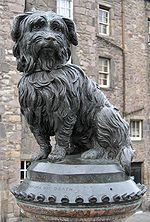
One of the most ‘celebrated’ cases of a dog’s loyalty to its dead master is the story of Greyfriars Bobby.  Bobby was a Skye Terrier owned by John Gray, who worked in Edinburgh, Scotland as a night watchman.    In February 1858, John Gray died from tuberculosis and his body was buried in the Greyfriars Kirkyard.  According to legend, for the next 14 years, Bobby spent most of his time at the grave mourning his master.  In 1872, following Bobby’s death, a statue of the dog by William Brodie was erected outside of the gates of the Kirkyard with funds from a local patron.

The Greyfriars Bobby statue located in Edinburgh, Scotland

For more recent stories about dogs who have grieved for their owners, read The phenomenon of grieving dogs.

Doggy quote of the month for August

You can run with the big dogs or sit on the porch and bark.

– Wallace Arnold


US Postal service launches new dog stamp

July 27th marked the launch of the US Postal Service’s newest stamp bearing the image of a dog.

The Owney stamp features the image of Owney, a mixed breed dog that was drawn to the US mail and followed it onto mail wagons, subsequently traveling across the United States collecting tags from each of his stops.  Owney lived at the Albany, New York, post office but would regularly sleep among empty mail bags and travel with them to locations across the United States.

Workers thought Owney was a good luck charm because, in an age of many train accidents, Owney’s trains were never involved in one.

The dog died in 1897 and his body was sent to a taxidermist for preservation.  Since 1993, Owney has been on display at the Smithsonian Institution’s National Postal Museum in Washington DC, which hosted the launch of the new stamp.  The tags Owney collected have also been preserved.

Read more about the Owney and the launch of the new stamp on this page.

The Three Bears lodge is dog friendly

The Three Bears Lodge is situated at the SW Nisqually entrance to Mt Rainier National Park amongst old growth cedar and douglas fir trees and it is dog-friendly, where two dog-friendly cabins can be booked.  If you and your family are the outdoors types, then heading to the Pacific Northwest for your vacation is a great idea.

There is a charge of $20 per dog per day and cabin amenities include:

  • a dog basket
  • temporary dog tags with the cabin’s address
  • dog towels
  • a lint roller for removal of dog hair
  • dog treats
  • plastic bags for poo removal
  • a washable dog bed and bowls
  • a large-sized dog crate

The lodge has a  large fenced area where your dog can exercise safely and the Nisqually River is about a two minute walk from the cabin, offering trails for long walks.

What a great opportunity for you and your dog to enjoy the fresh air and outdoors together.

USAR dogs and the Christchurch earthquake

The dogs of Urban Search and Rescue played a special part in the initial emergency response after Christchurch’s 6.3 magnitude earthquake on 22 February 2011.  Here is the special edition of Pawprint, the newsletter of the NZ USAR Search Dog Association.  This newsletter provides the best detail yet of how the earthquake event unfolded and the role of the dog teams in searching for survivors.

Pawprint special earthquake edition

Learn more about the NZ USAR Search Dog Association on their website.

I’m pleased to say that Canine Catering Ltd was one of the many small businesses and individuals which donated funds to the USAR Search Dog Association as part of the SBS Marathon.

Please join me in again thanking the hard work of the NZ USAR search dog teams and particularly to Cairo who is  special massage customer (funded by his handler, Janelle).


