Category Archives: Dogs

Research shows why cats are more independent than dogs

Domestic cats do not generally see their owners as a focus of safety and security in the same way that dogs do, according to new research.

Relaxed cat and dog. While it is increasingly recognized that cats are more social and more capable of shared relationships than traditionally thought, this latest research shows that adult cats appear to be more autonomous -- even in their social relationships -- and not necessarily dependent on others to provide a sense of protection. Credit: © bodza2 / Fotolia

Relaxed cat and dog. While it is increasingly recognized that cats are more social and more capable of shared relationships than traditionally thought, this latest research shows that adult cats appear to be more autonomous — even in their social relationships — and not necessarily dependent on others to provide a sense of protection.
Credit: © bodza2 / Fotolia

The study by animal behaviour specialists at the University of Lincoln, UK, shows that while dogs perceive their owners as a safe base, the relationship between people and their feline friends appears to be quite different.

While it is increasingly recognised that cats are more social and more capable of shared relationships than traditionally thought, this latest research shows that adult cats appear to be more autonomous – even in their social relationships – and not necessarily dependent on others to provide a sense of protection.

The research, published in the scientific journal PLOS ONE, was led by Professor Daniel Mills, Professor of Veterinary Behavioural Medicine at the University of Lincoln’s School of Life Sciences, along with Alice Potter – who studied as a postgraduate at Lincoln and now works with the Companion Animals Science Group at the RSPCA.

Professor Mills said: “The domestic cat has recently passed the dog as the most popular companion animal in Europe, with many seeing a cat as an ideal pet for owners who work long hours. Previous research has suggested that some cats show signs of separation anxiety when left alone by their owners, in the same way that dogs do, but the results of our study show that they are in fact much more independent than canine companions. It seems that what we interpret as separation anxiety might actually be signs of frustration.”

The Lincoln researchers carefully adapted the Ainsworth Strange Situation Test (SST), which has been widely used to demonstrate that the bond between young children or pet dogs with their primary carer can be categorised as a ‘secure attachment’ – where the carer is seen as a focus of safety and security in potentially threatening (or unfamiliar) environments.

The study observed the relationships between a number of cats and their owners, placing the pets in an unfamiliar environment together with their owner, with a stranger and also on their own. In varying scenarios, it assessed three different characteristics of attachment; the amount of contact sought by the cat, the level of passive behaviour, and signs of distress caused by the absence of the owner.

“Although our cats were more vocal when the owner rather than the stranger left them with the other individual, we didn’t see any additional evidence to suggest that the bond between a cat and its owner is one of secure attachment.”

“For pet dogs, their owners often represent a specific safe haven; however it is clear that domestic cats are much more autonomous when it comes to coping with unusual situations.”

Source:  University of Lincoln media release

Image

Doggy quote of the month for October

Samuel Butler quotation

Even a short visit can improve the day

Snowy and Mum

A dog doesn’t have to be a certified therapy dog to brighten someone’s day – it just needs to be well-trained and sociable.

Here is Snowy, a Labradoodle, with my Mum.  Snowy lives next door and makes visits for cuddles and treats (but especially treats).

If you have elderly people in your neighborhood, consider reaching out to them with your well-behaved dog.  A visit by a friendly dog can really brighten the day.

Kathleen Crisley, specialist in dog massage, rehabilitation and nutrition/food therapy, Canine Catering Ltd, Christchurch, New Zealand


Promises to my dog

DSC03008

Promises I make to my dog

  1. I promise to have realistic expectations of the role my dog will play in my life. I will remember that she is a dog, not a furry little human; she cannot satisfy all my emotional needs.
  2. I promise to protect my dog from dangers, such as traffic and other creatures who might want to hurt her.
  3. I promise to keep her well dressed with a collar containing up-to-date I.D.
  4. I promise to learn kind and gentle training methods so that she can understand what I am trying to say.
  5. I promise to be consistent with my training, since dogs feel secure when daily life is predictable, with fair rules and structure.
  6. I promise to match her loyalty and patience with my own.
  7. I promise that my dog will be part of my family. I will make a commitment to schedule time every day to interact with her so that she will feel loved and will not develop behavior problems from a lack of stimulation and socialization.
  8. I promise to seek professional help if my dog develops behavior problems that become unmanageable.
  9. I promise that my dog will have opportunities to exercise and honor some of her instincts. She’ll have walks and runs outside of her daily territory, so she can sniff and explore.
  10. I promise to provide veterinary care for her entire life. I will keep her healthy and watch her weight.
  11. I promise that if I move, marry, have a baby, or get divorced, she will continue to share my life, since she is a beloved family member.
  12. I promise that if I absolutely must give her up, I will find an appropriate home for her that is as good as or better than my home.

Source:  Best Friends Animal Society

The healthy heart: lessons from nature’s elite athletes

Kida, a 110-pound Alaskan malamute, runs on a treadmill in Terrie Williams' lab at UC Santa Cruz. Dogs are better adapted for endurance exercise than cats, and humans are more like dogs in that respect. Photo credit: Caleb Bryce, UCSC

Kida, a 110-pound Alaskan malamute, runs on a treadmill in Terrie Williams’ lab at UC Santa Cruz. Dogs are better adapted for endurance exercise than cats, and humans are more like dogs in that respect.
Photo credit: Caleb Bryce, UCSC

For over 30 years, Terrie Williams has been studying exercise physiology in wild animals: African lions and wild dogs, dolphins and whales, coyotes and mountain lions, as well as a few human athletes.

These studies have given Williams, a professor of ecology and evolutionary biology at UC  (University of California) Santa Cruz, a unique perspective on exercise and health, which she presents in an article titled “The Healthy Heart: Lessons from Nature’s Elite Athletes,” published in the September 2015 issue of the journal Physiology.

In the course of her research, Williams has found that dogs and cats are opposites in terms of aerobic capacity and maximum heart rate, and humans are more like dogs, adapted for endurance exercise (chasing down prey), while cats are built for the short bursts of speed used in stalk-and-pounce hunting. This difference is reflected in heart size relative to total body mass (larger hearts in dogs and humans, smaller hearts in cats).

Heart disease is exceedingly rare in wild animals, but it is the leading cause of death in humans worldwide. There are many plausible explanations for this, but one factor stands out above all others: the difference in daily activity levels. “We just don’t ask our hearts to do very much on a daily basis,” Williams said.

For Williams, the main reason to study exercise physiology in animals is to better understand how much energy they have to expend to live in their environments, and how they might be affected by environmental changes and human activities.

Source:  EurekAlert! media release

The underlying cause of canine diabetes

In a new effort, researchers from the University of Pennsylvania and Baylor College of Medicine have used advanced imaging technology to fill in details about the underlying cause of canine diabetes, which until now has been little understood. For the first time, they’ve precisely quantified the dramatic loss of insulin-producing beta cells in dogs with the disease and compared it to the loss observed in people with type 1 diabetes.

Diabetic dogs had a sharp loss of insulin-producing beta cells compared to non-diabetic dogs

Diabetic dogs had a sharp loss of insulin-producing beta cells compared to non-diabetic dogs

“The architecture of the canine pancreas has never been studied in the detail that we have done in this paper,” said Rebecka Hess, professor of internal medicine at Penn’s School of Veterinary Medicine and an author on the study.

Despite important differences between the disease in dogs and humans, the study also identified key similarities that suggest investigating diabetes in dogs may yield valuable insights into treating humans.

The research was led by Emily Shields, currently a graduate student in Penn’s Perelman School of Medicine, who completed much of the work as a high school and then college student in labs at Penn and Baylor.

The study was published in PLOS ONE.

Canine diabetes can be managed with insulin, similar to type 1 diabetes in humans. But, unlike the human version of the disease, dogs typically develop diabetes in middle or old age, while people with type 1 diabetes are typically diagnosed during childhood. In addition, while type 1 diabetes is known to be an autoimmune condition, researchers haven’t found conclusive evidence that the same is true in dogs.

To learn more about the factors that contribute to canine diabetes, the researchers made use of a repository of donated tissue samples from dogs — 23 with diabetes and 17 without — who had been treated at Penn Vet’s Ryan Hospital.

The team used robotic microscopes that can rapidly move around a slide taking images of pancreas tissue samples, which were analyzed by computer to determine the contents.

“In a larger view we could look at the entire cross-section of pancreas to determine how many islets there were and how big they were,” Shields said. “Then we could zoom in to differentiate beta cells, which produce insulin, from alpha cells, which produce glucagon.”

They found that beta cells dropped off in dramatic fashion in diabetic dogs, reduced 13-fold compared to non-diabetic animals. They also found that non-diabetic canine islets contained a large percentage of beta cells, comprising about 80 percent of endocrine cells. In contrast, beta cells comprise slightly more than 50 percent of endocrine cells in non-diabetic human islets. The researchers noted that this may mean that dogs need to lose more beta cells before experiencing symptoms of diabetes. The observation could explain why dogs develop a form of diabetes that is similar to type 1 diabetes, but do so later in life, compared to humans.

They also identified features of the islets and pancreatic structures that were different in dogs than in humans.

“In sharp contrast to human diabetes, in which there are a lot of islets still present but none contains insulin, we found in dogs that only a few beta cells were present and the islets were incredibly small,” Kushner said.

While the researchers had hoped to be able to visualize immune cells infiltrating the pancreas and attacking beta cells, they failed to do so.  While other signs point to canine diabetes being an autoimmune condition, this study did not find a “smoking gun.”

Though the work highlights differences between canine and human diabetes, it also points to a number of similarities that distinguish the two from diabetes in rodents, which are often used as models to study the disease.

For example, the scientists observed that dogs’ beta cells were distributed throughout the islets, as beta cells in humans are. In rodents, beta cells are concentrated in the center of the islet.

“Now that we know more about the disease in dogs and in particular how they are similar to humans in ways that rodents are not, it makes them more appealing as a model,” Kushner said.

At Penn, Hess is currently working to look for genetic markers in dogs that heighten a dog’s risk of developing diabetes.

“My hope is that with genetic screening we can eventually identify pre-clinical diabetic dogs, potentially making breeding recommendations that could decrease the incidence and prevalence of the disease in dogs,” Hess said.

Source:  Penn News media release

See something, do something

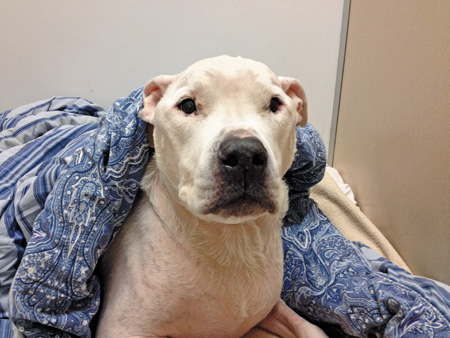
Dr Sue Ettinger is on a mission to help pet owners detect tumors early.  Her inspiration for this new program, called See Something, Do Something, was a 10-year old white pit bull named Smokey.

Smokey

Smokey

Dr Ettinger had aspirated approximately 10 masses from Smokey over the years and all came back as benign; so she wasn’t particularly worried when Smokey presented with another lump.  The clinic was so busy on the day he came in with his vet tech owner, that he never got tested that day and waited another week before returning to the clinic.

When it was aspirated, it wasn’t a lipoma and testing revealed a soft tissue sarcoma.  It hadn’t spread to other parts of the body, but a 7 cm mass with 3 cm margins was a very big surgery; they got it all and so Smokey was out of the woods.

But Dr Ettinger combed through literature to find out if there were guidelines for vets and owners about diagnosing lumps and bumps.  There weren’t and she decided to take action.

So she’s come up with:

See Something?  If a dog or cat has had a lump that is larger than a pea and has been there for more than a month…

Do Something! Go to a vet and get it aspirated or biopsied.

and even a shorter call to action:  Why Wait? Aspirate!

Simple rules that could save the life of your pet and also avoid needless pain and suffering.

Sue Ettinger is one of approximately 300 board-certified veterinary specialists in medical oncology in North America. Dr Sue is a staff oncologist and initiated the medical oncology service at the Animal Specialty Center (ASC), a private practice specialty hospital in Westchester, just north of New York City.

Sue Ettinger is one of approximately 300 board-certified veterinary specialists in medical oncology in North America. Dr Sue is a staff oncologist and initiated the medical oncology service at the Animal Specialty Center (ASC), a private practice specialty hospital in Westchester, just north of New York City

Kathleen Crisley, Fear-Free certified professional and specialist in dog massage, rehabilitation and nutrition/food therapy, The Balanced Dog, Christchurch, New Zealand

Wiggles gets his wiggle on

Wiggles, an aging Boxer, is a new admission to Best Friends Animal Sanctuary.  We didn’t know why he was surrendered, but we noticed during our assessment that he had signs of arthritis including some lameness in his left foreleg.  Wiggles would also benefit from weight loss.

Our job was to do some initial training with Wiggles, who proved to be a clever (as well as cute) boy.  I particularly found his under bite adorable.

Wiggles

Wiggles

And before I tell you more…here’s why Wiggles’ name is appropriate:

Working on 'sit'

Working on ‘sit’

Success!

Success!

Kathleen Crisley, specialist in dog massage, rehabilitation and nutrition/food therapy, Canine Catering Ltd, Christchurch, New Zealand

Hi from Kenny

I’ve been taking a break from my massage practice this week, doing some additional study (and enjoying every minute of it.)  One of the things I love about my clients is that they understand the need for me to have a break, but they also like to update me about their dogs…

Here’s one of my emails:

Just thought I would send you a quick message!

I hope all is going well on your holiday.

Kenny is doing as well as can be. He has had 2 panting episodes over the past week, one was all day Saturday and one started in the evening on Tuesday and lasted a few hours. We popped the thunder shirt on him which did seem to calm him a little.

He sends his love and wanted to tell you he is loving the sun and warm weather we have been getting here and he even had a bath the other day which felt amazing!

Kenny

Kathleen Crisley, specialist in dog massage, rehabilitation and nutrition/food therapy, Canine Catering Ltd, Christchurch, New Zealand

How to properly pet animals

Need I say more?