Category Archives: research

New type 1 diabetes therapy shows promise for long-term reversal in both humans, dogs

What if instead of daily insulin injections or wearing pumps, just getting a shot every few months could reverse Type 1 diabetes for you – or your dog?

It might take ushering in healthy pancreatic cells like a Trojan horse.

The Trojan horse, in this case, would be collagen, a protein that the body already makes for building muscles, bones, skin and blood vessels. A collagen formulation mixed with pancreatic cells, developed by Purdue University researchers in collaboration with the Indiana University School of Medicine, is the first minimally invasive therapy to successfully reverse Type 1 diabetes within 24 hours and maintain insulin independence for at least 90 days, a pre-clinical animal study shows.

For diabetic pets, the next step is a pilot clinical study in dogs with naturally occurring Type 1 diabetes, which will be conducted in collaboration with Purdue’s College of Veterinary Medicine.

“We plan to account for differences from mouse to human by helping dogs first. This way, the dogs can inform us on how well the treatment might work in humans,” said Clarissa Hernandez Stephens, first author on the work and a graduate researcher in Purdue’s Weldon School of Biomedical Engineering. Findings appear in early view for a forthcoming issue of the American Journal of Physiology – Endocrinology and Metabolism.

“With giving my dog shots twice a day, I have to constantly be thinking about where I am and when I need to be home. It greatly affects my work and my personal life,” said Jan Goetz, owner of a diabetic dog named Lexi. “Not having to give these shots would mean freedom.”

Type 1 diabetes affects about one in every 100 companion animals in the U.S., including dogs and cats, and approximately 1.25 million American children and adults.

David Taylor, an Indiana resident, has struggled with Type 1 diabetes for almost 50 years.

“A Type 1 diabetes diagnosis was my 18th birthday present, and since that first insulin injection, managing diabetes has been my ‘other’ full time job,” Taylor said. “Treatment methods have improved enormously over 50 years, but they still permit no time off for the patient. Receiving an injection every few months would restore the near-normal life to me that I haven’t had as an adult – and I could retire from that full-time diabetes management job.”

Because diabetes in dogs happens similarly in humans, treatment has so far been largely the same: Both need their glucose to be monitored throughout the day and insulin to be administered after meals.

This also means that dogs and humans could potentially benefit from the same cure: A new set of pancreatic cells to replace the clusters of cells, called islets, that aren’t releasing insulin to monitor blood glucose levels.

Still, 20 years of research and clinical trials hasn’t produced an effective islet transplantation therapy because multiple donors are needed, the current method of delivering islets through the portal vein of the liver is too invasive and the human immune system tends to destroy a large percentage of transplanted islets.

Purdue researchers simply changed how the islets were packaged – first, within a solution containing collagen, and second, as an injection through the skin instead of all the way at the liver, saving patients from a nasty procedure.

“Traditionally, we transplant islets in the liver of the animal and never do it under the skin, in large part because the skin doesn’t have the blood flow that the liver has for transporting insulin released by islets. And there are a lot of immune cells in the skin, so chances of rejection are high,” said Raghu Mirmira, professor of pediatrics and medicine and director of the Diabetes Research Center at the Indiana University School of Medicine.

The team removed the need for transplanting in the liver by thoroughly mixing mouse islets, provided by Mirmira’s lab, with the collagen solution. Upon injection just under the skin, the solution solidifies, the body recognizes the collagen and supplies it with blood flow to exchange insulin and glucose.

“It’s minimally invasive; you don’t have to go to the operating room and have this infusion into the portal vein. It’s as easy as it comes, just like getting a shot,” said Sherry Voytik Harbin, Purdue professor of biomedical engineering and basic medical sciences.

The researchers tested the effects of the solution between mouse twins and non-twins to check for discrepancies. Initial studies showed if the mouse donor were a twin to the recipient, the diabetic mouse could go at least 90 days without needing another shot. If not twins, the mouse would have normal blood sugar levels for at least 40 days. Nearly all transplanted islets survived either scenario, removing the need for multiple donors to compensate for those killed off by the immune system.

As they transition to testing the formulation in naturally diabetic dogs, the researchers will explore the feasibility of transplanting pig islets or stem cells programmed to produce insulin, in hopes that either method will further increase donor availability.

The islet transplantation therapy might also have implications for better treating severe pancreatitis.

Source:  Purdue University media statement

Dogs to benefit from test to spot liver disease

Vets have developed a blood test that quickly spots early signs of liver disease in dogs, a study suggests.

Experts say that the test – based on insights gained from human patients – could help vets identify damage and start treatment early, saving the lives of many dogs.

The test – which is to be launched worldwide – means that fewer dogs will have to undergo invasive liver biopsies, findings by the University of Edinburgh suggest.

Diagnosis challenge

Diagnosing canine liver disease is challenging and catching early signs of damage is key to its treatment, vets say.

Current diagnosis is based on biopsies, which are expensive and can lead to complications.

Joining forces

Vets based at the University’s Royal (Dick) School of Veterinary Studies teamed up with medical doctors to look at blood levels of a molecule known as miR-122 in dogs. This molecule is found in high levels in people living with liver disease.

They worked with pets and their owners to test miR-122 levels in 250 dogs, including cocker-spaniels, labradoodles and Old English sheepdogs.

Testing kits

Dogs with liver disease were found to have significantly higher levels of a miR-122 compared with healthy dogs and dogs who had a different disease that did not affect the liver.

The team now plan to launch a testing kit to help vets worldwide quickly assess if their patient pooches have liver damage.

The study is published in the Journal of Veterinary Internal Medicine.

Lead vet researcher, Professor Richard Mellanby, Head of Companion Animal Sciences at The Hospital for Small Animals at the University of Edinburgh, said: “We have found a specific, sensitive and non-invasive way to detect liver damage in dogs. We hope that our test will greatly improve outcomes by allowing vets to make rapid and accurate diagnosis.”

Dr James Dear, Reader at the University of Edinburgh’s Centre for Cardiovascular Science and NHS doctor, who co-led the study, said: “‘I am delighted that the blood test we developed to improve the diagnosis of liver disease in humans can be used to help dogs too.”

Source:  University of Edinburgh

Scientists uncover new details in how sense of smell develops

Dogs, known for their extraordinarily keen senses of smell, can be trained to use their sensitive sniffers to find drugs, bombs, bed bugs, missing hikers and even cancer. Among dogs and other animals that rely on smell, at least one factor that may give them an advantage is a sheet of tissue in the nasal cavity.

In humans, this tissue — called the olfactory epithelium — is a single flat sheet lining the roof of the nasal cavity. In dogs, however, the olfactory epithelium forms a complex maze, folding and curling over a number of bony protrusions, called turbinates, that form in the nasal cavity. The olfactory epithelium contains specialized neurons that bind to odor molecules and send signals to the brain that are interpreted as smell. Dogs have hundreds of millions more of these neurons than people do. It is assumed this added structural complexity is responsible for dogs’ superior ability to smell. But, surprisingly, that has never been shown scientifically.

Now, researchers at Washington University School of Medicine in St. Louis have uncovered new details in how the olfactory epithelium develops. The new knowledge could help scientists prove that turbinates and the resulting larger surface area of the olfactory epithelium are one definitive reason dogs smell so well.

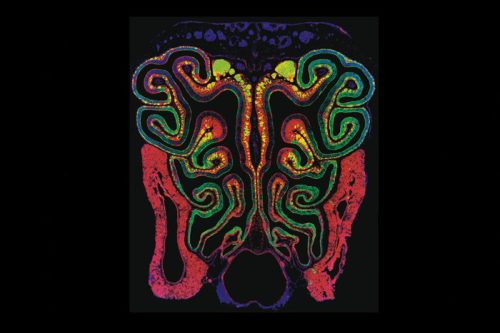
MouseOlfactoryEpithelium-700x467

The olfactory epithelium — a mouse’s is pictured in green — is a sheet of tissue that develops in the nasal cavity. Researchers at Washington University School of Medicine in St. Louis have uncovered new details on how the olfactory epithelium develops and why it is that some animals have such great senses of smell, compared with others that lack such ability.

“We think the surface area of the sheet matters in how well animals smell and in the types of smells they can detect,” said David M. Ornitz, MD, PhD, the Alumni Endowed Professor of Developmental Biology. “One reason we think this stems from differences in the complexity of these turbinates. Animals that we think of as having a great sense of smell have really complex turbinate systems.”

The study, published Aug. 9 in the journal Developmental Cell, also could help answer a longstanding evolutionary question: How did animals’ senses of smell become so enormously variable? The way these abilities came to diverge over evolutionary history remains a mystery. Understanding these signals could help scientists tease out how dogs evolved an extraordinary olfactory system and humans wound up with a comparatively stunted one.

First author Lu M. Yang, a graduate student in Ornitz’s lab, found that a newly discovered stem cell the researchers dubbed FEP cells control the size of the surface area of the olfactory epithelium. These stem cells also send a specific signaling molecule to the underlying turbinates, telling them to grow. The evidence suggests that this signaling crosstalk between the epithelium and the turbinates regulates the scale of the olfactory system that ends up developing, sometimes resulting in olfactory epithelia with larger surface areas, such as in dogs.

When the stem cells can’t signal properly, turbinate growth and olfactory epithelium surface area experience an arrested development. To study this in the lab, mice with such olfactory stunting could, in theory, be compared with typical mice to learn more about how these signals govern the final complexity of an animal’s olfactory system.

“Before our study, we didn’t know how the epithelium expands from a tiny patch of cells to a large sheet that develops in conjunction with complex turbinates,” Yang said. “We can use this to help understand why dogs, for example, have such a good sense of smell. They have extremely complex turbinate structures, and now we know some of the details about how those structures develop.”

Source:  Washington School of Medicine in St Louis

Empathetic dogs lend a helping paw

Many dogs show empathy if their owner is in distress and will also try to help rescue them. This is according to Emily M. Sanford, formerly of Macalester College and now at Johns Hopkins University in the US. She is the lead author of a study in Springer’s journal Learning and Behavior that tested whether there is truth in the notion that dogs have a prosocial and empathetic nature. Interesting to note, the study found that dogs specially trained for visitations as therapy dogs are just as likely to help as other dogs.

Helping paw

Many dogs are ready to lend a helping paw if needed. Credit: © Mat Hayward / Fotolia

In one of their experiments, Sanford and her colleagues instructed the owners of 34 dogs to either give distressed cries or to hum while sitting behind a see-through closed door. Sixteen of these dogs were registered therapy dogs. The researchers watched what the dogs did, and also measured their heart rate variability to see how they physically reacted to the situation. In another part of the experiment, the researchers examined how these same dogs gazed at their owners to measure the strength of their relationship.

Dogs that heard distress calls were no more likely to open a door than dogs that heard someone humming. However, they opened the door much faster if their owner was crying. Based on their physiological and behavioural responses, dogs who opened the door were, in fact, less stressed than they were during baseline measurements, indicating that those who could suppress their own distress were the ones who could jump into action.

The study therefore provides evidence that dogs not only feel empathy towards people, but in some cases also act on this empathy. This happens especially when they are able to suppress their own feelings of distress and can focus on those of the human involved. According to Sanford, this is similar to what is seen when children need to help others. They are only able to do so when they can suppress their own feelings of personal distress.

“It appears that adopting another’s emotional state through emotional contagion alone is not sufficient to motivate an empathetic helping response; otherwise, the most stressed dogs could have also opened the door,” explains co-author Julia Meyers-Manor of Ripon College in the US. “The extent of this empathetic response and under what conditions it can be elicited deserve further investigation, especially as it can improve our understanding of the shared evolutionary history of humans and dogs.”

Contrary to expectation, the sixteen therapy dogs in the study performed as well as the other dogs when tested on opening the door. According to Meyers-Manor this may be because registered therapy dogs, despite what people may think, do not possess traits that make them more attentive or responsive to human emotional states. She says that therapy dog certification tests involve skills based more on obedience rather than on human-animal bonding.

“It might be beneficial for therapy organizations to consider more traits important for therapeutic improvement, such as empathy, in their testing protocols,” adds Meyers-Manor. “It would also be interesting to determine whether service dogs show a different pattern of results given their extensive training in attentiveness to their human companions.”

Reference: Sanford, E.M. et al (2018). Timmy’s in the well: Empathy and prosocial helping in dogs, Learning & Behavior DOI: 10.3758/s13420-018-0332-3

Source:  Springer media release

Therapy Dogs Effective in Reducing Symptoms of ADHD

In a first of its kind randomized trial, researchers from the University of California Irvine School of Medicine found therapy dogs to be effective in reducing the symptoms of attention deficit/hyperactivity disorder (ADHD) in children.  The study’s main outcomes were recently published by the American Psychological Association in the Society of Counseling Psychology’s Human-Animal Interaction Bulletin (HAIB).  Additional new findings were presented at the International Society for Anthrozoology 2018 Conference held July 2-5 in Sydney, Australia.

Titled, “A Randomized Controlled Trial of Traditional Psychosocial and Canine-Assisted Interventions for Children with ADHD,” the research involved children aged 7 to 9 who had been diagnosed with ADHD and who had never taken medicines for their condition.  The study randomized participants to compare benefits from evidenced-based, “best practice” psychosocial interventions with the same intervention augmented by the assistance of certified therapy dogs.  The research was led by Sabrina E. B. Schuck, PhD, MA, executive director of the UCI Child Development Center and assistant professor in residence in the Department of Pediatrics at UCI School of Medicine.

UCI study

New study led by Sabrina E. B. Schuck, PhD, MA, executive director of the UCI Child Development Center and assistant professor in residence in the Department of Pediatrics at UCI School of Medicine, finds therapy dogs to be effective in reducing the symptoms of attention deficit/hyperactivity disorder (ADHD) in children. Photo by UCI

Results from Schuck’s research indicate children with ADHD who received canine assisted intervention (CAI) experienced a reduction in inattention and an improvement in social skills.  And, while both CAI and non-CAI interventions were ultimately found to be effective for reducing overall ADHD symptom severity after 12 weeks, the group assisted by therapy dogs fared significantly better with improved attention and social skills at only eight weeks and demonstrated fewer behavioral problems. No significant group differences, however, were reported for hyperactivity and impulsivity.

“Our finding that dogs can hasten the treatment response is very meaningful,” said Schuck.  “In addition, the fact that parents of the children who were in the CAI group reported significantly fewer problem behaviors over time than those treated without therapy dogs is further evidence of the importance of this research.”

Guidelines from the American Academy of Pediatrics for the management of ADHD underscore the importance of both psychopharmacological and psychosocial therapies.  Patients who receive psychosocial therapy prior to medications have shown to fare better.  Additionally, many families prefer not to use medications in young children.

“The take away from this is that families now have a viable option when seeking alternative or adjunct therapies to medication treatments for ADHD, especially when it comes to impaired attention,” said Schuck. “Inattention is perhaps the most salient problem experienced across the life span for individuals with this disorder.”

This study is the first known randomized controlled trial of CAI for children with ADHD. It illustrates that the presence of therapy dogs enhances traditional psychosocial intervention and is feasible and safe to implement.

Animal assisted intervention (AAI) has been used for decades, however, only recently has empirical evidence begun to support these practices reporting benefits including reduced stress, improved cognitive function, reduced problem behaviors and improved attention.

The study was supported by the Eunice Kennedy Shriver National Institute of Child Health and Human Development (NICHD) and Mars-WALTHAM® grant R01H066593.

Source:  University of California Irvine media release

Do grain-free diets really cause canine heart disease?

You may have heard that on July 12th, the US Food and Drug Administration issued a statement that it was investigating a potential connection between grain-free diets and canine heart disease:

The U.S. Food and Drug Administration is alerting pet owners and veterinary professionals about reports of canine dilated cardiomyopathy (DCM) in dogs eating certain pet foods containing peas, lentils, other legume seeds, or potatoes as main ingredients. These reports are unusual because DCM is occurring in breeds not typically genetically prone to the disease. The FDA’s Center for Veterinary Medicine and the Veterinary Laboratory Investigation and Response Network, a collaboration of government and veterinary diagnostic laboratories, are investigating this potential association.

Canine DCM is a disease of a dog’s heart muscle and results in an enlarged heart. As the heart and its chambers become dilated, it becomes harder for the heart to pump, and heart valves may leak, leading to a buildup of fluids in the chest and abdomen. DCM often results in congestive heart failure. Heart function may improve in cases that are not linked to genetics with appropriate veterinary treatment and dietary modification, if caught early.

The underlying cause of DCM is not truly known, but is thought to have a genetic component. Breeds that are typically more frequently affected by DCM include large and giant breed dogs, such as Great Danes, Boxers, Newfoundlands, Irish Wolfhounds, Saint Bernards and Doberman Pinschers. It is less common in small and medium breed dogs, except American and English Cocker Spaniels. However, the cases that have been reported to the FDA have included Golden and Labrador Retrievers, Whippets, a Shih Tzu, a Bulldog and Miniature Schnauzers, as well as mixed breeds.

Full text of the FDA statement here.

Investigating possible links is always a good thing; but equally concerning is understanding what data backs up any claim.

Pet Business magazine points out that the data backing up the link is very thin – at this point unlikely to pass the rigor of a peer-reviewed journal.  Obviously an industry body has concerns about the impact of consumer choices  and the impact on sales, but it is right that they point out that the data set so far is quite limited.

I follow research regularly, and I’m always open to findings that may cause us to re-think our choices of food and other healthcare strategies for our dogs.

But let’s be sure about evidence.

The availability and variety of grain-free foods has increased dramatically in recent years, as cases of itchy dogs and dietary intolerances caused by corn and wheat have been documented.  Who’s to say that grain-free carbohydrates like peas, lentils and potatoes might not also come with side effects?

And all of this debate reinforces my belief in the hybrid diet.  Sometimes raw, sometimes kibble, and sometimes homemade.  Diversification is a strength!

Kathleen Crisley, specialist in dog massage, rehabilitation and nutrition/food therapy, The Balanced Dog, Christchurch, New Zealand

Dogs prefer to eat fat…

Dogs gravitate toward high-fat food, but cats pounce on carbohydrates with even greater enthusiasm, according to research into the dietary habits of America’s two most popular pets.

Oregon research into diet

The study sheds new light on optimal nutrition for the animals and refutes a common notion that cats want and need a protein-heavy regimen.

The research, funded by The Pet Nutrition Center of Hill’s Pet Nutrition, Inc, had its findings published in the Journal of Experimental Biology in May 2018.

“The numbers were much different than what traditional thinking would have expected,” said the study’s corresponding author, Jean Hall, a professor in the Carlson College of Veterinary Medicine at Oregon State University. “Some experts have thought cats need diets that are 40 or 50 percent protein. Our findings are quite different than the numbers used in marketing and are going to really challenge the pet food industry.”

Dietary proteins contribute to a number of important physiological functions such as blood clotting, production of hormones and enzymes, vision and cell repair.

Protein also has the most power to make the eater feel satiated; carbohydrates are No. 2 in that regard, followed by fat.

Hall’s research involved monitoring 17 healthy adult dogs and 27 cats over 28 days and used four types of food that were designed to taste the same; with flavor out of the equation, the animals could make macronutrient choices based only on what their bodies were telling them they needed.

“Previous studies have shown that if you don’t balance palatability between foods, cats do in fact prefer to eat very high levels of protein and dogs want to eat a lot of fat,” Hall said. “When you balance palatability, both dogs and cats prefer significantly different macronutrient content than what they would choose based on taste.”

The animals studied by Hall and her collaborators had four food choices: high-fat, high-carbohydrate, high-protein and balanced foods. Each day, dogs had an hour to eat all they wanted up a predetermined caloric intake – that is, they could get all the calories they needed for metabolic requirements and to maintain weight, but no more.

The cats in the study were likewise not allowed to overeat, though even if given unlimited access to food that tastes how they like it, cats tend to eat in a weight-maintenance way by adjusting their intake based on the food’s energy density. In the study, cats had 24-hour food access to the point of hitting their caloric threshold.

Food container placement for both dogs and cats was changed daily to guard against “bowl position bias” affecting the results.

The researchers found the cats on average chose to get 43 percent of their calories from carbs and 30 percent from protein.

Dogs on the other hand went for 41 percent fat and 36 percent carbs.

Not a single dog or cat chose to get the highest percentage of its calories from protein.

Within the aggregate cat findings were trends correlating with age and lean body mass – how much muscle an animal has.

Younger cats with less lean body mass tended more strongly toward protein consumption than younger cats with more lean body mass; younger cats in general wanted protein more than older cats.

On the dog side of the study, high-protein foods were the least popular among younger animals with less fat body mass; dogs with greater fat body mass had the strongest preference for getting calories from protein.

“Because the choice of macronutrients was influenced in both dogs and cats by age and either lean body mass or fat body mass, that suggests a physiological basis for what they chose to eat,” Hall said.

The research also involved determining the diets’ effect on selected metabolites of each macronutrient class – what they break down into in the body. Hall found the older cats’ blood had much lower levels of DHA, a long-chain omega-3 fatty acid that’s important for the brain, heart and eyes, than the younger cats.

“None of the foods had ingredient sources of DHA or EPA, another long-chain omega-3, but cats are able to synthesize DHA by elongating and desaturating fatty acids,” Hall said. “The older cats, though, are a lot less efficient at that.”

More potential bad news for the older cats: Their concentrations of sulfated microbial catabolic products – protein-breakdown leftovers that in humans are connected to cardiovascular and kidney disease – were significantly higher.

“Just like with older people, older cats may have a different gut microbiome than younger cats, which would mean different microbial metabolic activities,” Hall said.

Basically, if a younger cat gets more protein than it can use, it can safely deal with and dispose of the excess a lot better than an older cat can.

Source:   Oregon State University

YouTube videos help researchers study dog bites

dog-biting

Researchers at the University of Liverpool have turned to the popular video-sharing site YouTube to study the complex issue of dog bites.

Preventing dog bites is an increasingly important public health and political issue with implications for both human and animal health and welfare. However, it remains difficult for researchers to understand the circumstances leading up to dog bites, with most studies relying on evidence collected after bites happen, such as hospital records and victim interviews.

In a new study published in Scientific Reports researchers have, for the first time, used YouTube videos to directly observe and analyse dog bites in situ.

Lead author Sara Owczarczak-Garstecka said: “Online videos present us with an unexplored opportunity to observe dog bites first-hand, something which is just not possible using other methods. Making more use of this type of shared content for research could help us better understand how and why bites occur and contribute to the development of bite prevention strategies.”

Using search terms such as ‘dog bite’ and ‘dog attack’ the researchers sampled 143 videos that were uploaded to YouTube between January 2016 and March 2017. For each video the context of bites, bite severity, victim and dog characteristics were recorded. For 56 of these videos they were also able to analyse the details of human and dog behaviour leading up to the bite.

The researchers acknowledge that YouTube videos of dog bites are likely subject to some bias, with, for example, bites by small dogs perhaps perceived as ‘comical’ and therefore more likely to be uploaded online.

The findings reveal that despite this potential bias, the demographic characteristics of the victims and dogs seen in YouTube bite videos, such as breed type and victims’ sex and age, are consistent with those found in previous studies. Common dog breeds observed included Chihuahuas, German Shepherds, Pit bulls and Labrador Retrievers. Around 7 in 10 of the bite victims in the videos were male, while more than half of bites observed were to children and infants.

Although this small study did not allow an exploration of the causal relationship between human behaviour and dog bites, some behaviours that have been previously observed within the context of dog bites were observed here to precede a bite. For example, the researchers observed that tactile contact with a dog increased approximately 20 seconds before a bite, as did standing or leaning over a dog.

Sara Owczarczak-Garstecka added: “These findings could offer some valuable new insight for the development of bite prevention strategies. Prevention messages could emphasise the risk of leaning over a dog and simply advise avoiding contact with a dog when possible or in doubt.”

Future research plans to better understand people’s behaviour around dogs and their perceptions of dog bites include a series of interviews with dog owners, people who work around dogs and bite recipients.

The paper ‘Online videos indicate human and dog behaviour preceding dog bites and the context in which bites occur’ is published in Scientific Reports [doi:10.1038/s41598-018-25671-7]

Source:  University of Liverpool media release

Dogs understand what’s written all over your face

Dogs can understand

Dogs can understand emotional expressions of humans. Credit: © ZoomTeam / Fotolia

Dogs are capable of understanding the emotions behind an expression on a human face. For example, if a dog turns its head to the left, it could be picking up that someone is angry, fearful or happy. If there is a look of surprise on a person’s face, dogs tend to turn their head to the right. The heart rates of dogs also go up when they see someone who is having a bad day, say Marcello Siniscalchi, Serenella d’Ingeo and Angelo Quaranta of the University of Bari Aldo Moro in Italy.

The study in Springer’s journal Learning & Behavior is the latest to reveal just how connected dogs are with people. The research also provides evidence that dogs use different parts of their brains to process human emotions.

By living in close contact with humans, dogs have developed specific skills that enable them to interact and communicate efficiently with people. Recent studies have shown that the canine brain can pick up on emotional cues contained in a person’s voice, body odour and posture, and read their faces.

In this study, the authors watched what happened when they presented photographs of the same two adults’ faces (a man and a woman) to 26 feeding dogs. The images were placed strategically to the sides of the animals’ line of sight and the photos showed a human face expressing one of the six basic human emotions: anger, fear, happiness, sadness, surprise, disgust or being neutral.

The dogs showed greater response and cardiac activity when shown photographs that expressed arousing emotional states such as anger, fear and happiness. They also took longer to resume feeding after seeing these images. The dogs’ increased heart rate indicated that in these cases they experienced higher levels of stress.

In addition, dogs tended to turn their heads to the left when they saw human faces expressing anger, fear or happiness. The reverse happened when the faces looked surprised, possibly because dogs view it as a non-threatening, relaxed expression. These findings therefore support the existence of an asymmetrical emotional modulation of dogs’ brains to process basic human emotions.

“Clearly arousing, negative emotions seem to be processed by the right hemisphere of a dog’s brain, and more positive emotions by the left side,” says Siniscalchi.

The results support that of other studies done on dogs and other mammals. These show that the right side of the brain plays a more important part in regulating the sympathetic outflow to the heart. This is a fundamental organ for the control of the ‘fight or flight’ behavioural response necessary for survival.

Source:  Springer.com

Which are smarter, cats or dogs?

This debate among pet owners can still get quite heated.

In this short video, a scientist explains why she concludes that dogs have the greater cognitive capabilities:

Kathleen Crisley, specialist in dog massage, rehabilitation and nutrition/food therapy, The Balanced Dog, Christchurch, New Zealand