Category Archives: research

Researcher calls for monitoring of diseases in dogs and cats

Professor Michael Day of the School of Veterinary Sciences in Bristol, UK,  is the lead author in an article that recommends global monitoring of diseases in dogs and cats.  While it is known that many human diseases originate in animals, only diseases in livestock are currently monitored.

Professor Day makes the case that because cats and dogs are integrated into our lives and share our households, the potential for introduction of new zoonotic diseases exists.  He says:

‘The number of small companion animals is significant.  For example there are an estimated eight to ten million dogs living in up to 31 per cent of UK homes and in the USA, 72 million dogs in 37 per cent of homes. 

In developed countries the relationship between man and dogs and cats has deepened, with these animals now closely sharing the human indoor environment.  The benefits of pet ownership on human health, well-being and development are unquestionable, but as dogs and cats have moved from the barn, to the house, to the bedroom, the potential for disease spread to humans increases.’

Any new monitoring system will require resources and funding and the political will to see it established.  At a time when the global economy is struggling, one can be skeptical about whether there is a chance of seeing this recommendation become a reality.

You can read the article in the Emerging Infections Diseases journal  here.

Source:  University of Bristol media release

Kissing your dog and the link to gum disease

My mother was never happy when our dog got too close and  managed to lick her on the mouth.   In the Snoopy cartoons, you might remember when Lucy would run around yelling ‘Get the iodine, get the hot water.  I’ve been kissed by a dog.’ 

It turns out that there is need for caution when considering the mouth-to-mouth contact with your dog.

Researchers from Japan have tracked a microbe that is very common in dogs but rare in humans.   In dog owners, 16% of them had the microbe and it appears that they share close contact with their dogs – including kissing.

The researchers also found ten human strains of periodontitis-related bacteria in the dogs’ mouths.  And they found that low levels of contact were enough to transmit mouth bacteria either way.

In considering the research, Dr Paul Maza, of the College of Veterinary Medicine at Cornell University, told America’s Fox News:  ‘Many of the different types of bacteria in dogs and cats are the same type of bacteria as in humans. If owners practice oral hygiene on their pets, such as  brushing their teeth, a pet’s mouth can actually be even cleaner than a human mouth.’

Read the full story in the Daily Mail.

Contagious yawning in dogs

Ever been at a party or in a meeting and someone yawns – and then others (including you) do the same? Have you noticed your dog yawning when you do?

Research from Lund University in Sweden published in the journal Animal Cognition proves that dogs catch yawns from humans.  But, only dogs above the age of seven months appear to be susceptible.

The syndrome of contagious yawning is an indicator of empathy, mimicking the emotional responses of others.  You can’t really measure empathy directly.

This study involved 35 dogs in Denmark between the ages of  four and 14 months.  Given that contagious yawning may be an empathetic response, the results suggest that empathy develops slowly over the first year of a dog’s life.

The researchers tested the dogs with both an unfamiliar experimenter and their owner and found no evidence that the puppies yawned more in response to their owners.

Source:  Springer publishing

Developing methods in pain management and osteoarthritis

Researchers at Kansas State University are devoting their time to the study of improvements in pain management and the treatment of osteoarthritis in dogs.   (For more information on pain management, see my June 2012 blog)

The projects are led by James Roush, a professor of clinical sciences.

In one study, the research team determined that the maximum effective time for using hot and cold packs for pain management is 10 minutes.   The researchers studied how packing affects tissue temperature in beagles and beagle-sized dogs after surgery because hot and cold packing is a common technique for reducing swelling.   After 10 minutes, the maximum change in tissue temperature has been reached.

In another study, a special mat is being used to study lameness in dogs suffering from osteoarthritis.  When dogs step on the mat, it measures the pressure in their step and the study team can determine in which leg the lameness is worse.

“We’ve designed the study to help improve osteoarthritis treatment,” Roush said. “We will also use it to measure clinical patients when they come in for regular checkups. We can measure their recovery and a variety of other aspects: how they respond to nonsteroidal anti-inflammatories, how they respond to narcotics or how they respond to a surgical procedure that is designed to take that pressure off the joint.”

And in a third study,  Roush is collaborating with researchers to study the effectiveness of a painkiller used to treat dogs to identify potential alternatives.

“To achieve the drug’s effect, the dosage in dogs is much higher than in people,” Roush said. “It also may not be a very good analgesic in dogs. We want to see if there is an alternative that requires smaller doses and does not have not as much of a discrepancy for patients.”

Source:  Kansas State University media release

How Chinese medicine may help dogs with cancer

Research from the University of Pennsylvania School of Veterinary Medicine has been published which shows promise in treating dogs with a specific type of cancer.

Hemangiosarcoma is a type of cancer that can occur in any dog, but German Shepherds and Golden Retrievers seem to be the most prone to developing it.  The cancer is an aggressive and malignant tumor of blood vessel cells.   The most common area it affects is the spleen but can appear in the skin, other soft tissues and the liver.  This is a type of cancer that is metastatic and it will frequently spread to other parts of the body.

In the study, 15 dogs were divided into three groups of 5 and given a different dose of a product called I’m-Yunity, which contains polysaccharopeptide or PSP.  PSP is derived from Yunzhi mushrooms and appears to have an immune-boosting effect – it’s been used in traditional Chinese medicine for more than 2,000 years.

The findings?

‘We were shocked,’ says Professor Dorothy Cimino-Brown.  ‘Prior to this, the longest reported median survival time of dogs with hemangiosarcoma of the spleen that underwent no further treatment was 86 days.  We had dogs that lived beyond a year with nothing other than this mushroom as treatment.’

The treatment may offer a way for owners to extend the life of their pet and there were no adverse effects reported.

The researchers plan to study the effect of the compound further, using groups of candidates that are given a placebo, others which undergo chemotherapy, and other groups given the mushroom-based treatment.

Source:  University of Pennsylvania media statement

How dogs are helping the northern spotted owl

Researchers at the University of Washington Center for Conservation Biology have found a novel use for dogs – detection of northern spotted owl pellets.  Owl pellets are regurgitated by the owls and contain fur, bones and other materials that the owl does not digest.

The traditional method of locating the owls was to undertake vocalization surveys that simulated the sounds of the northern spotted owl so that ‘real’ owls would respond.  But, as this owl has come under threat by another owl – the barred owl – researchers felt that the owls were not vocalizing out of concern that they would be found.  Barred owls are known to kill northern spotted owls.

Max, an Australian Cattle Dog, pauses after locating a northern spotted owl roosting in a tree in the Shasta-Trinity National Forest. Copyright Jennifer Hartman, University of Washington

Enter the detection dogs.  They find owl pellets at the base of trees where the owls are roosting.  By mapping these finds, the researchers can understand the habitats where each type of owl is thriving.

By using the dogs for detection, there was a 30% improvement in detection probability.

The information about barred and northern spotted owl populations will help forest managers who are making changes to protect the northern spotted owl.

Source:  University of Washington press release

Tail chasing – an obsessive compulsive disorder?

The genetics research group at the University of Helsinki has published its findings into a study of tail chasing in dogs.  The study involved 400 dogs and questionnaires to the owners about their dog’s behaviour.  Samples of each dog’s blood were also taken.

The questionnaires covered behaviours, aspects of the dog’s puppyhood and daily routines.  Owners were also asked to evaluate their dog’s personality.

Compulsive tail chasing can occur in any dog but is common in breeds such as the Bull Terrier and German Shepherd.  These breeds were included in the research, as were the Miniature Bull Terrier and the Staffordshire Bull Terrier.

The study aimed to describe the characteristics of tail chasing in dogs and to ascertain the environmental risk factors for the disorder.  The researchers also wanted to know if a previously identified gene that has been associated with obsessive compulsive disorder (OCD)  had a role to play.

What they found

  • The OCD gene that had been linked to other compulsive disorders in dogs was not associated with the tail chasing disorder
  • Dogs responded with less tail chasing when fed supplements of vitamins and minerals, although the researchers feel that more study is warranted to prove this link
  • Early separation from their mothers and/or poor care from their mother also predisposed dogs to compulsive tail chasing

Dogs may be a good model for studying OCD in humans because they are physiologically similar and share our environment.  Consequently, this research has wider implications.

The research paper is available in the 27 July 2012 edition of PloS ONE

Source:  University of Helsinki press release

Kathleen Crisley, Fear-Free certified professional and specialist in dog massage, rehabilitation and nutrition/food therapy, The Balanced Dog, Christchurch, New Zealand

Dogs respond to new skin allergy treatment

Dogs that would try to run the other way from allergy injections are finding a new oral drop to be much more palatable.  In fact, some dogs think they are a treat!

On 25th July,  at the World Congress of Veterinary Dermatology in Vancouver, British Columbia,  Dr Douglas DeBoer of the University of Wisconsin-Madison School of Veterinary Medicine presented his work which shows that placing allergy drops under a dog’s tongue can be as effective as allergy injections.

Dr DeBoer treated 217 dogs for skin allergies in his study using the drops.   Approximately 60 percent of the dogs improved significantly.  The drops require administering under the tongue twice each day.

copyright Dr Douglas DeBoer

In contrast,  allergy shots are injected approximately every 14 days.   The cost of the treatments are comparable.

Dogs can sometimes suffer a life-threatening anaphylactic reaction to allergy shots.  Even those dogs treated in the study that had previously had such a dangerous reaction did not have it when using the drops.   “Drops appear to be safer than shots in this respect,” said Dr DeBoer.

Atopic dermatitis (an itchy skin inflammation) is an allergic reaction from house dust, pollen, and mold.  Injections aim to introduce a small amount of the allergens to trigger an immune response.  The drops work on a different mechanism involved in the allergy.  Dogs that had failed to respond to allergy injections did respond to the drops.

Best of all, the drops have a sweet taste which attracted the dogs.  Some dogs came running when they heard the bottle of drops opened…

Dog hair blankets in Native America?

Mass spectrometry has been used to resolve a debate about the fibres used to weave Native American blankets.

The blankets have been known as ‘dog hair’ blankets because oral histories passed down by descendents of the Salish weavers, who were indigenous to the Pacific coast of North America, told of the blankets being woven from the hair of dogs who were specially bred for their fur.

copyright University of York Department of Archaeology

Researchers at the University of York‘s Departments of Biology, Archaeology and Chemistry analysed the protein composition of 25 textile samples from 11 different locations.  These textiles were housed in famous collections like the Smithsonian Institution and some came from the expeditions of Lewis and Clark (1803-1806) and Wilkes (1838-1842).

The researchers didn’t find any garments that were made of purely dog hair.

There was evidence of dog hair in a robe of fur and six textile samples, primarily in a blend with goat hair.  The researchers concluded that the dog fur was used to supplement goat hair as a bulking material.

They have published their findings in the journal Antiquity.

Dog intelligence

Most dog owners have an opinion about their dog’s intelligence.  I regularly hear comments like, “He’s so smart, he’s ahead of the rest of his obedience class” or “He’s not very bright, but we love him.”

 When I was working on my management qualification years ago, we were told to go home and ask our partner/flatmate about how they solved problems.  Ebony, my Labrador flatmate at the time, came up with these tips, which I thought were very intelligent:

  1. Remember that chasing your tail does not get you anywhere.  It also makes you dizzy and less able to focus on the task at hand.
  2. Eat regularly and often.  Problem solving is hard work and requires energy.
  3. Don’t underestimate the value of a nap.  A problem looks different after you’ve had a good sleep.
  4. If you stare at a problem long enough, it might move on its own.
  5. Don’t be afraid to ask for help.  Try looking cute.
  6. If looking cute doesn’t work, try whining.
  7. If whining fails, loud retching noises are guaranteed to get the attention of those around you.
  8. Some problems soften over time.  Burying them in the garden hastens this process.
  9. Some problems require more immediate attention.  An immediate problem, if left unattended, is likely to result in a much more smelly mess to be cleaned up later.

There are many published works on the subject of dog intelligence.  Over the years, I’ve read countless research studies into this subject.  There are many institutions involved in the research.  All projects have the goal of understanding how dogs think.

Professor Stanley Coren of the University of British Columbia has authored several books about dog intelligence.  He states that dogs have the intellectual capacity of a two-year old and can understand more than 150 words.[1]

Researchers at the Max Planck Institute for Evolutionary Anthropology have studied the ability of dogs to interpret human gestures.  When researchers hid food beneath one container in a group and pointed to the ‘right’ container, dogs consistently picked up on those cues better than even chimpanzees (a species widely studied because of the evolutionary link between apes and humans).

Earlier this year, a research team at the University of Otago reported on their study that showed that dogs could readily distinguish happy human sounds from sad or angry ones, suggesting an ability to understand human emotions.

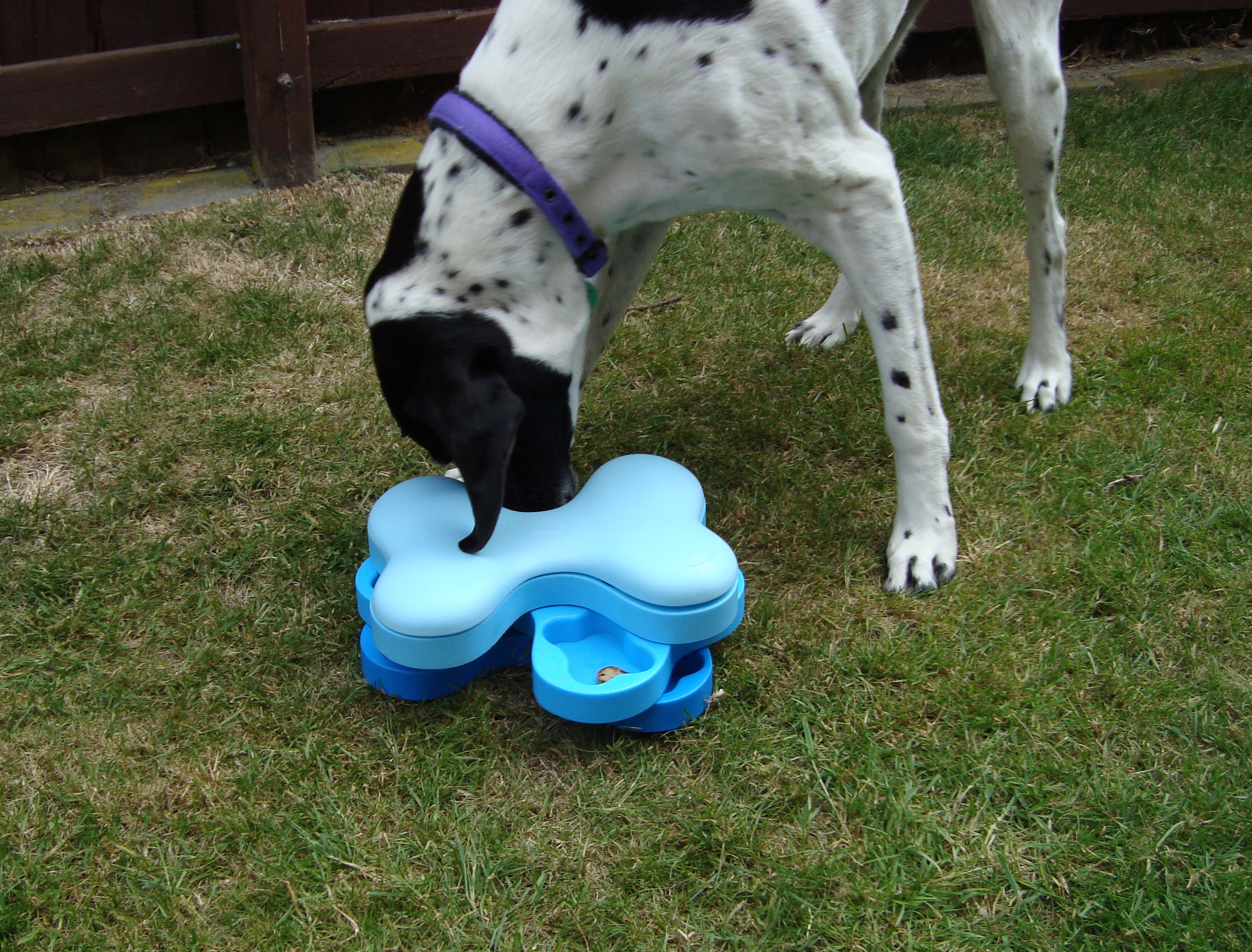
Even the dog toy market has recognised that dogs need mental stimulation.  The Nina Ottosson range, for example, offers a range of skill level toys designed to make your dog think about how to reveal their food reward.

Daisy demonstrates her intelligence with a Nina Ottosson toy

Despite all of this evidence, including videos of my Daisy using her interactive toys, many of the non-dog people in my life remain unconvinced about the intelligence of dogs.  I believe that persistence will pay off.  Over time we will see more and more research about the intellectual capacity of our dogs.  The non-believers will become believers.


[1] Science Daily, 10 August 2009