Better paws for Brutus

When Brutus was just a puppy, his breeder left the young Rottweiler outside in freezing temperatures.

The pup suffered frostbite in all four paws, and the breeder tried to salvage the puppy’s paws with an at-home amputation. But Brutus was maimed and couldn’t walk without pain.
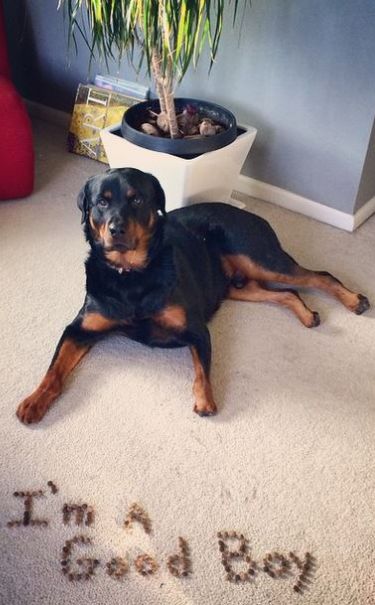
Brutus

Brutus

Now 2 years old, Brutus is living with a new and dedicated owner in Loveland, Colorado, and has become the second dog ever known to receive four prosthetic limbs. He is learning to walk again with help from OrthoPets, an animal prosthetics developer in Denver, and pet orthopedics experts at Colorado State University’s James L. Voss Veterinary Teaching Hospital.

“I believe prosthetics will play a big role in the future of veterinary orthopedics,” said Dr. Felix Duerr, an assistant professor in the Department of Clinical Sciences who practices small animal orthopedics and sports medicine at the university’s Veterinary Teaching Hospital.

“Brutus shows how we can explore new technologies to find solutions, and how our partnerships with companies like OrthoPets really help.”
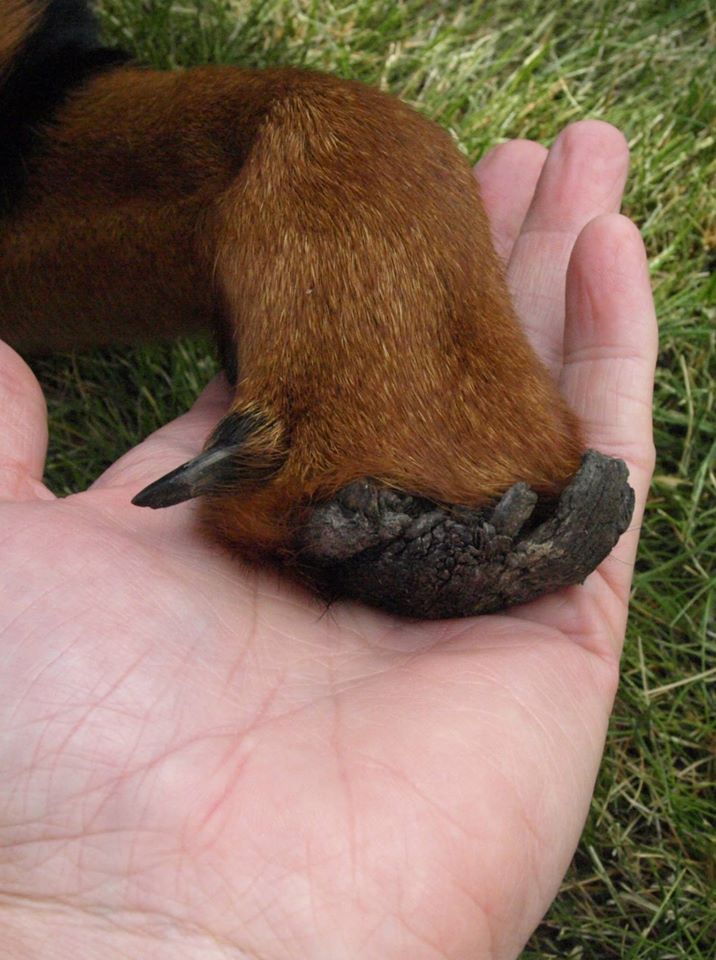
Brutus' paw

Brutus’ paw

Laura Aquilina, the dog’s owner, has provided a caring home for Brutus for seven months in an attempt to find “better paws” for the young rottie. She began fostering Brutus, and more recently adopted him, after he had trouble navigating hardwood floors and stairs in his first foster home, and the family couldn’t meet the disabled dog’s needs.

Aquilina and a pet rescuer in Canon City joined forces to raise nearly $12,500 for Brutus’ prosthetics and physical therapy through Go Fund Me, an online fundraising site. The crowdfunding project was aptly named “Better Paws for Brutus.”
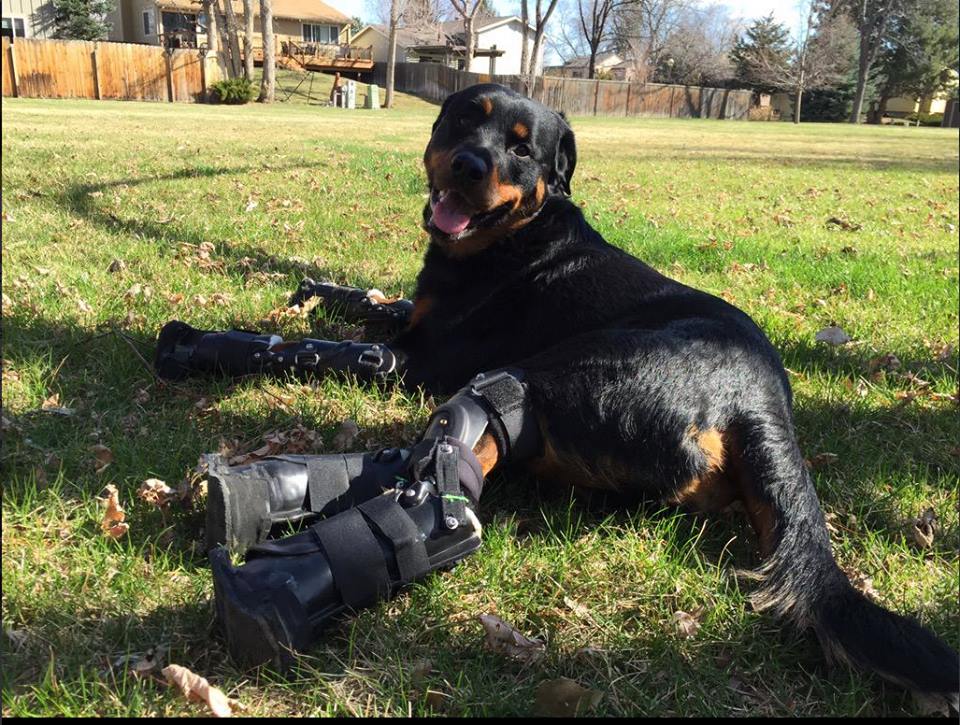
Brutus with his prosthetics

Brutus with his prosthetics

In preparation for prosthetics, Brutus underwent corrective paw surgery with Dr. Trent Gall, a CSU veterinary alumnus working in Longmont. The procedure removed bone fragments, dew claws, and two toes left from the botched amputation.

After recovery from surgery, Brutus and Aquilina worked with Denver-based OrthoPets, the world’s largest veterinary orthotic and prosthetic company, to undergo the process of prosthetics fitting. OrthoPets adapts the same technologies used in the field of human orthotics to care for animal patients.

Martin Kaufmann, company founder, partnered with Colorado State’s Veterinary Teaching Hospital for its research and rehabilitation services.

“I don’t want to be part of a world that settles for ‘fine,’ and neither does CSU,” Kaufmann said. “There’s a common mission between CSU and OrthoPets to return animals’ lives to ‘great.’”

Since the collaboration began, CSU and OrthoPets have successfully developed techniques to treat Achilles tendon injuries in dogs and are investigating how specific injuries correlate with successful orthotic techniques and long-term prosthetic use.

Kaufmann compared the Rottweiler’s story to that of Nakio, the other dog known to live with four prosthetics. “We learned a lot from Nakio’s story and were able to apply that knowledge to Brutus’ case,” he said.

OrthoPets veterinarians learned that both of Brutus’ wrist joints had collapsed. “It’s similar to a human rolling his ankle completely to the side, left grossly unstable,” Kaufmann said, noting that the dog also has a troublesome callus that makes movement difficult.

The unique prosthetics have three purposes: to protect and make Brutus’ limbs more comfortable, to support his front collapsed legs, and to realign each leg to an equal length.

As his devices are refined, Brutus has entered a new phase of rehabilitation with physical therapy guided by Sasha Foster, CSU’s certified canine rehabilitation therapist.

“We’re working with Brutus to help him adjust to wearing his new prosthetics,” Foster said. “He’s learning how to move with them on. Once he’s mastered that, we will help him achieve higher-level functioning activities, like hiking and playing with other dogs.”

In upcoming months, Foster will use underwater treadmill therapy, balance activities, exercise balls and other neuro re-education therapies to help Brutus adjust to his new limbs.

Foster said her work is motivated by helping her patient – and the animal’s family. “When you improve the quality of life for a dog, you improve the quality life for the entire family,” Foster said.

It’s likely Brutus will need physical therapy intermittently for the rest of his life. But Aquilina is hopeful.

“You need a good team behind you, and we found that at CSU,” she said.

Follow Brutus’s recovery on Facebook and Instagram at @BetterPawsForBrutus

Source:  CSU media release

Doggy quote of the month for April

“He and I are inseparable companions, and I have vowed him my perpetual society in exchange for his devotion.”

– English poet Elizabeth Barrett Browning, about her dog, Flush

Elizabeth Barrett Browning and Flush

Chaos returns…

Fairfax newspapers in New Zealand are reporting on the return of Chaos, a deaf dog who went missing on 15th March.  A great story, read it here.

Waitara man Marc Glover, partner Alicia James and their 3-year-old daughter Saphire-Rose, are over the moon that their dog, Chaos, was found after going missing for eight days.  (Photo by Sam Scannell, Fairfax NZ)

Waitara man Marc Glover, partner Alicia James and their 3-year-old daughter Saphire-Rose, are over the moon that their dog, Chaos, was found after going missing for eight days. (Photo by Sam Scannell, Fairfax NZ)

Kathleen Crisley, specialist in dog massage, rehabilitation and nutrition/food therapy, Canine Catering Ltd, Christchurch, New Zealand

Lola the therapy dog

Lola, as photographed by Nancy Rubin Stuart

Lola, as photographed by Nancy Rubin Stuart

Meet Lola, a nine-year old Golden Retriever, who accompanies her owner, Dr Bodrie of Bourne, Cape Cod, to his office and on Wednesday rounds to one of six nursing facilities.    She’s a certified therapy dog!

In this article from Cape Cod.com, you can read about the Therapy Dogs International certification process that she and Dr Bodrie underwent to make her a certified therapy dog.

Lola and Dr Bodrie

Lola and Dr Bodrie

Lola's official therapy dog badge

Lola’s official therapy dog badge


A biological trigger for canine bone cancer?

Researchers at the University of Wisconsin-Madison School of Veterinary Medicine have identified the biological mechanism that may give some cancer cells the ability to form tumors in dogs.

Yurtie, a canine cancer patient, in the UW Veterinary Care oncology ward.  Photo: Nik Hawkins

Yurtie, a canine cancer patient, in the UW Veterinary Care oncology ward.
Photo: Nik Hawkins

The recent study uncovered an association between the increased expression of a particular gene in tumor cells and more aggressive behavior in a form of canine bone cancer. It may also have implications for human cancers by detailing a new pathway for tumor formation.

The findings of the research have been published  in the journal Veterinary and Comparative Oncology and may eventually provide oncologists with another target for therapy and improve outcomes for canine patients with the disease.

The researchers examined cell lines generated from dogs with osteosarcoma, a common bone cancer that also affects people, with the intent of uncovering why only some cells generate tumors. After the dogs underwent tumor-removal surgery, cells from the tumors were grown in the lab.

This led to six different cancer cell lines, which were then transplanted into mice. The researchers then looked to see which lines developed tumors and which did not and studied the differences between them.

“We found several hundred genes that expressed differently between the tumor-forming and nontumor-forming cell lines,” said Timothy Stein, an assistant professor of oncology. However, one protein called frizzled-6 was present at levels eight times higher in cells that formed tumors.

“It’s exciting because it’s kind of uncharted territory,” says Stein “While we need more research to know for sure, it’s possible that frizzled-6 expression may be inhibiting a particular signaling pathway and contributing to the formation of tumor-initiating cells.”

The team’s genetic research will continue on dogs and be extended to humans.

Source:  University of Wisconsin-Madison media release

The Beaurepaires dog

Anyone in New Zealand notice that we have another dog-themed commercial to be proud of?

This time it is Beaurepaires, a chain of tyre (tire) retail outlets offering wheel alignments and related vehicle services.

The dog’s name is Mate and he replaces actor Vince Martin who was the face of the chain for almost 30 years.  Advertising execs felt that the marketplace is changing and they needed a hero to attract a younger audience.

Kathleen Crisley, specialist in dog massage, rehabilitation and nutrition/food therapy, Canine Catering Ltd, Christchurch, New Zealand

Ike the dog gets a new set of wheels

Ike in his new wagon (photo courtesy of ABC News)

Ike in his new wagon (photo courtesy of ABC News)

Ike is a 15-year old dog living in California.  He’s been diagnosed with bone cancer and so only has a few months to live.  His owner, Risa Feldman, wanted to give Ike as much quality of life as possible and the traditional hind end harnesses for helping him around weren’t cutting it.

So she went into Home Depot to ask for help and two employees there did even better.  They built Ike (free of charge) a new wagon complete with a little ramp so he can get in and out easily (the back end of the wagon lifts down to form the ramp).

Ike and Risa (photo courtesy of Risa Feldman)

Ike and Risa (photo courtesy of Risa Feldman)

Risa says the wagon will help Ike enjoy their walks along Manhattan Beach for a while yet.  Whilst Risa sits down at a local cafe for a coffee, Ike usually has an order of bacon…

Kathleen Crisley, specialist in dog massage, rehabilitation and nutrition/food therapy, Canine Catering Ltd, Christchurch, New Zealand

Source:  ABC News

Medical marijuana for dogs?

A bill in the legislature of the State of Nevada was introduced this week that would legalize the use of marijuana in the treatment of animals.

The bill is sponsored by Democrat Tick Segerblom.  It would let owners obtain the drug for their animals if a veterinarian confirmed it “may mitigate the symptoms or effects” of a chronic or debilitating medical condition.

The same bill has provisions for the use of medical marijuana by people.

Companion Cannabis, a product as seen in a medical marijuana dispensary in Los Angeles (Photo by Damian Dovarganes, Associated Press)

Companion Cannabis, a product as seen in a medical marijuana dispensary in Los Angeles (Photo by Damian Dovarganes, Associated Press)

There isn’t a lot of research about the use of marijuana in animals, although there are stories of owners using it to alleviate illness symptoms in their pets – usually as a last resort when traditional therapies haven’t helped.

Physiologically speaking, dogs have a high concentration of THC receptors in their brains (THC is an active ingredient in marijuana).  As a consequence, dogs are more susceptible to marijuana and this can lead to a toxic dose.  There is evidence that in states such as Colorado, which has already legalized marijuana use, more dogs are being admitted for treatment because of marijuana toxicity after they’ve eaten their owner’s supply.

The American Veterinary Medical Association, not surprisingly, does not have an official stance on the use of medical marijuana.  Since research into the topic isn’t ‘evidence based,’ the Association merely suggests that vets make treatment decisions based on sound clinical judgment that stay in compliance with the law.

The Association says that even in states where medical marijuana is legal, it is still a Class I narcotic under federal law which means vets are not legally allowed to prescribe it; meaning that in essence the Association is saying that vets shouldn’t prescribe marijuana unless federal law is changed and they are satisfied that there is a clinical reason for doing so.

Kathleen Crisley, specialist in dog massage, rehabilitation and nutrition/food therapy, Canine Catering Ltd, Christchurch, New Zealand

Winning at Crufts after a broken paw

This year’s Crufts competition was overshadowed by claims of poisoning and unethical conduct amongst competitors.  Unfortunately, this means some of the better, good-news stories have not been given the air time they normally would.

Take Kamba, for example.  A Rhodesian Ridgeback, Kamba had a piece of floating bone in his paw which was diagnosed last year after x-rays.  Kamba hadn’t been using his leg as expected and so his owner looked into the cause.

Kim Hodge and her Rhodesian Ridgeback, Kamba

Kim Hodge and her Rhodesian Ridgeback, Kamba

After the diagnosis, she pursued rehabilitation which included physical rehab and hydrotherapy which occurred from September 2014 with increasing frequency in the weeks leading up to the Crufts show.

Kamba won first prize in both the Post Graduate Class and Reserve Dog Challenge Certificate for his breed at the four-day event.  He beat more than 100 other dogs.

“Kamba loves meeting other dogs and really seems to enjoy doing shows, so it was great to see how the crowd and the judges reacted to him too. Usually, top prizes tend to go to the more seasoned dogs so it was really lovely that Kamba impressed them.”

Source:  Derby Telegraph

Kathleen Crisley, specialist in dog massage, rehabilitation and nutrition/food therapy, Canine Catering Ltd, Christchurch, New Zealand

Teddy’s journey ends

This is a blog post I didn’t think I would be writing for some years.  Unfortunately, some things are just not meant to be.

Teddy, the Beagle who so bravely came back from a front leg amputation last year, passed away on Saturday.  He was only 8 years old – gone too soon.

TeddyTeddy 10_9_14

Cancer took Teddy’s life away very quickly.  For the last 8 weeks or so, Jill had been saying things like ‘he’s not himself’ ‘he’s tired today’ or ‘he hasn’t been right since we changed his medication.’

We discussed diet, a different mixture of supplements, different medications, and different acupressure sequences…

Some days he seemed like his old self, others not.  Sometimes his liver function tests came back as abnormal, then re-tests would show an improvement after changing his core food.

But late last week, things turned quickly.

Teddy vomited up his breakfast on Tuesday and then stopped eating and drinking.  Another blood test showed highly escalated liver enzymes and Teddy was in trouble.  He was booked initially for an ultrasound on Monday but then he had to go to the vet on Friday for fluids and stayed overnight.  The ultrasound was moved up to Saturday.

And the ultrasound specialist had terrible news.  His report reads “These findings are consistent with metastatic neoplasia (likely sarcoma, adenocarcinoma, or carcinoma).  There is hepatic and splenic involvement (with likely metastases to lymph nodes and lungs).  Unfortunately Teddy’s prognosis is grave.”

Jill took a distressed Teddy home and her regular vet came to give him his final injection.  As Jill said, there was no choice.

When I saw Jill yesterday, she just said that in writing Teddy’s last story, she wanted his story to matter.

I’ve thought really hard about this.  I think everything about Teddy mattered.  He was a Beagle that was just a little too large to win in the show ring (despite winning best baby puppy several times).  Early on, Jill discovered that Teddy was born with bilateral hip dysplasia and she set about keeping him happy and healthy (I came into the picture in 2010 after an unsuccessful attempt at hydrotherapy, because Teddy also had neck problems that were aggravated by swimming).

When I lost Daisy last July, it was Teddy who would come and sit beside me in sympathy.

And then last August’s horrible accident and the amputation which was going to affect Teddy’s mobility as he aged.  And he came through it like a trooper.  When I adopted Izzy (my greyhound), I took her for a visit and a 3-legged Teddy was zooming after her as if nothing had changed.

So, what do Teddy’s last days tell us?

I think they tell us that no matter how well we take care of our dogs, and with our best intentions for seeing them to old age, we really have very little influence when the end comes.  We do our best.  And we have to make the right decisions for our dogs in the face of critical or terminal illness.

I’m glad that Teddy came through his amputation so well and that he and Jill had months together that they wouldn’t have had if she had decided to end his life then.  And I’m glad Teddy didn’t suffer for days and days like people suffering from terminal cancer do.

Teddy is one of those special clients that I will carry in my heart for the remainder of my days.  He was My Favourite Beagle.  Everything about him matters.

Kathleen Crisley, specialist in dog massage, rehabilitation and nutrition/food therapy, The Balanced Dog Ltd, Christchurch, New Zealand


