A golden retriever mom for African wild dog puppies

Hot off the press from the Oklahoma City Zoo…a litter of endangered African Wild Dogs, also known as African Painted Dogs, has been born.

The birth mother, Xena, is only three years old and inexperienced.  It became clear to the keepers that the puppies needed a surrogate mother.  Enter Lilly, a special Golden Retriever with maternal skills.

Even though Lilly’s not an African wild dog, she’s still much better suited to surrogate for our pups than humans would be,” said Zoo Veterinarian Dr. Jennifer D’Agostino. “This is a positive for both Lilly’s offspring and the African wild dogs as they will benefit from initial socialization with a canine species.”

This is an example of yet another way to use dogs for work – helping to save an endangered species.

Kathleen Crisley, specialist in dog massage, rehabilitation and nutrition/food therapy, Canine Catering Ltd, Christchurch, New Zealand


Guilty dogs

Is it true that dogs can feel and demonstrate guilt?  These videos would seem to show that a dog knows when it has been naughty!


Researchers treat canine cancer

A research team at Mississippi State’s College of Veterinary Medicine is working to better understand cancer in dogs, and the work also could advance knowledge of human cancer.

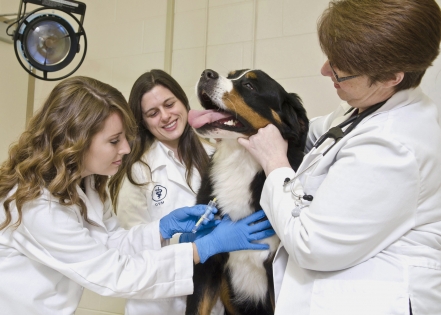
MSU veterinary medicine doctoral student Shauna Trichler (l) takes a blood sample from a patient with assistance from research resident Sandra Bulla (c) and Dr. Kari Lunsford. They are part of a College of Veterinary Medicine team studying the role of platelets in diagnosing canine cancer. Photo by: Tom Thompson

MSU veterinary medicine doctoral student Shauna Trichler (l) takes a blood sample from a patient with assistance from research resident Sandra Bulla (c) and Dr. Kari Lunsford. They are part of a College of Veterinary Medicine team studying the role of platelets in diagnosing canine cancer. Photo by: Tom Thompson

Their investigation began with only a tiny blood platelet, but quickly they discovered opportunities for growth and expanding the breadth of the research.

“We have a lot to gain by looking at platelets and how they influence cancer and healing,” said Dr. Camillo Bulla. “A part of our research is looking at the platelet. The platelet is very small, but it gives us a large picture. We hope to be able to find a tumor much sooner by taking a series of blood samples to look at platelet contents.”

Bulla is an associate professor in the college’s pathobiology and population medicine department. He and Dr. Kari Lunsford, a colleague at the college, have formed the Comparative Angiogenesis Laboratory at the university to better understand this process and treat canine patients.

As he explained, cancers need the creation of new blood vessels, called angiogenesis, to survive and grow, and tumors are able to create new blood vessels as pathways to travel and spread. They also are looking at the way platelets interact with tumor cells as they attempt to spread to the area surrounding the tumor or metastasize to distant sites in the body.

Lunsford, an associate professor in the clinical sciences department, said, “We know that metastasizing tumor cells need platelets but it is not yet known what the platelets do for the migrating (metastasizing) tumor. This is one of the questions we hope to help answer.”

“If treatments are successful and the cancer goes into remission, we would monitor the patient for a relapse of the disease by looking at its platelets,” Lunsford said. “This type of monitoring would be less invasive than taking biopsies and might also be an earlier indicator that the cancer is returning.”

According to Lunsford, platelets also carry information about tumors and metastasizing cancer cells, and the team hopes that by looking at specific proteins expressed in platelets (from a simple blood sample), they can identify new cancer earlier. Even more importantly, they want to identify when tumors are about to metastasize.

“Our lab has developed a new way to separate platelets from blood samples with far less contamination by other blood cells,” she said. “This new technique was developed by doctoral student Shauna Trichler, and is superior to any isolation technique previously used by researchers in human or veterinary medicine.”

For more information, read the entire Mississippi State University press release here.

The adventurous life of a Cape Cod dog (book review)

Cape Cod dogSubtitled “A Curious Canine’s Exploration of the Cape’s Natural History”, this little book is a winner!

Shelby is the resident Golden Retriever at a bed & breakfast managed by his Mom and Dad (the author and her husband). This book tells the story of Shelby’s adventures around the Cape.  He goes on a whale watch (appropriately, since Scaglione-Peck is a naturalist with the Dolphin Fleet Whale Watch which operates out of Provincetown) where he is mostly impressed by the smell of the whales as they breach the water in front of the boat…

He runs through the sand dunes of Provincetown, meets seals and dolphins, and generally enjoys the natural attractions that the Cape has to offer.  The author uses her expertise in natural history to explain the setting of each of Shelby’s adventures.

Jenny Kelley’s pencil illustrations bring Shelby’s story to life perfectly.  This book, at 74 pages total, would make an ideal gift for a family planning to head to Cape Cod in Summer 2015, or for any family who has enjoyed the Cape either in season or in the off season.

The book is a tribute to Shelby, who lived to the age of 16.  He’s appropriately mentioned in the Acknowledgements section of the book.

Kathleen Crisley, specialist in dog massage, rehabilitation and nutrition/food therapy, Canine Catering Ltd, Christchurch, New Zealand


Sheltering people and pets from domestic violence

In the late 1990s, Dr Frank Ascione from Utah State University published some scary statistics:  48 percent of domestic violence victims will stay in an abusive situation because they fear leaving their pets behind.

In New York City in 2013, the Urban Resource Institute teamed up with sponsorship from Purina to launch a pilot program:  People and Animals Living Safely (PALS).  PALS is a co-sheltering program that allows pets to escape domestic violence and remain with their owners in pet-friendly apartments.  A first for New York City, it’s been remarkably successful.  The apartments are always full.

So this year, the program was expanded to include a dog park and play area for the sheltered animals.  Aptly called the Purina Play Haven and Dog Park, this park, full of enrichment activities, was designed by a professional architect.

In these videos on YouTube, have a look at the dog park and hear about how this program fills a need for those unfortunate enough to have become the victims of domestic violence.

Sometimes ‘big corporate’ money can be used for a higher purpose!

Kathleen Crisley, specialist in dog massage, rehabilitation and nutrition/food therapy, Canine Catering Ltd, Christchurch, New Zealand


Life lessons from the Vicktory dogs

I do not support breed specific legislation.  One of the agencies leading the way in changing the perception of pit bulls, and breed specific legislation more generally, is Best Friends Animal Society.

In this TEDx talk filmed in Salt Lake City, Julie Castle, the Chief Marketing and Development Officer for Best Friends Animal Society, talks about the 22 pit bulls rescued from Michael Vick’s fighting kennels that were sent to the Best Friends sanctuary.  Alongside their journey of recovery, Castle discusses how Best Friends built a coalition to change perceptions about pit bulls and to advocate for saving rather than killing pit bull dogs.

I hope you find this story as inspirational as I do.

Kathleen Crisley, specialist in dog massage, rehabilitation and nutrition/food therapy, Canine Catering Ltd, Christchurch, New Zealand


Dog to human communication supported with technology

North Carolina State University researchers have developed a suite of technologies that can be used to enhance communication between dogs and humans, which has applications in everything from search and rescue to service dogs to training our pets.

“We’ve developed a platform for computer-mediated communication between humans and dogs that opens the door to new avenues for interpreting dogs’ behavioral signals and sending them clear and unambiguous cues in return,” says Dr. David Roberts, an assistant professor of computer science at NC State and co-lead author of a paper on the work. “We have a fully functional prototype, but we’ll be refining the design as we explore more and more applications for the platform.”

Dr David Roberts with one of his associates  Photo courtesy of North Carolina State University

Dr David Roberts with one of his associates. Photo courtesy of North Carolina State University

The platform itself is a harness that fits comfortably onto the dog, and which is equipped with a variety of technologies.

“There are two types of communication technologies,” says Dr. Alper Bozkurt, an assistant professor of electrical and computer engineering at NC State and co-lead author of a paper on the work. “One that allows us to communicate with the dogs, and one that allows them to communicate with us.”

“Dogs communicate primarily through body language, and one of our challenges was to develop sensors that tell us about their behavior by observing their posture remotely,” Roberts says. “So we can determine when they’re sitting, standing, running, etc., even when they’re out of sight – a harness-mounted computer the size of a deck of cards transmits those data wirelessly.

“At the same time, we’ve incorporated speakers and vibrating motors, called haptics, into the harness, which enable us to communicate with the dogs,” Roberts adds.

“We developed software to collect, interpret and communicate those data, and to translate human requests into signals on the harness,” says Rita Brugarolas, an NC State Ph.D. student and co-author of the paper.

The technology also includes physiological sensors that monitor things like heart rate and body temperature. The sensors not only track a dog’s physical well-being, but can offer information on a dog’s emotional state, such as whether it is excited or stressed.

These technologies form the core of the technology platform which can be customized with additional devices for specific applications.

“For example, for search and rescue, we’ve added environmental sensors that can detect hazards such as gas leaks, as well as a camera and microphone for collecting additional information,” Bozkurt says.

Other applications include monitoring stress in working dogs, such as guide dogs and other service dogs.  Physiological and behavioral sensors will provide insight into a dog’s mental and emotional state.

“This platform is an amazing tool, and we’re excited about using it to improve the bond between dogs and their humans,” says Dr. Barbara Sherman, a clinical professor of animal behavior at the NC State College of Veterinary Medicine and co-author of the paper.

The research team has published their research in the paper entitled Towards Cyber-Enhanced Working Dogs for Search and Rescue

Source:  North Carolina State University media release

Doggy quote of the month for November

“To sit with a dog on a hillside on a glorious afternoon is to be back in Eden, where doing nothing was not boring – it was peace.”

– Milan Kundera, writer

Doctors believe in the health benefits of pet ownership

DogDoctor

The Human-Animal Bond Research Initiative (HABRI) Foundation has released the findings of a survey revealing the views of the family physician (also known as the GP) on the benefits of pets to health.

An online panel survey of 1,000 family doctors and general practitioners explored the doctors’ knowledge, attitudes and behavior regarding the human health benefits of pets.  The 28-question survey was conducted in August 2014 with a margin of error of +/- 3.1%.   The physicians in the survey had a median of 18 years in professional practice.

Key findings included:

  • 69% of doctors have worked with animals in a hospital, medical center or medical practice to assist patient treatment
  • 88% believe that interaction with pets improves a patient’s physical condition
  • 97% believe that interaction with pets improves mental health condition
  • 78% found that interaction with animals helped to improve the relationships of patients with staff
  • 97% of doctors reported that they believe there were health benefits resulting from pet ownership
  • 75% of doctors said they saw health improve in one or more patients as a result of pet ownership

The survey also revealed that while 69% of doctors at least occasionally discussed the health benefits of pets with patients, 56% identified ‘time constraints’ as the largest barrier to having these discussions.

“The Human Animal Bond Research Initiative funds research on the evidence-based health benefits on human-animal interaction, and this survey demonstrates that we are on the right track” said HABRI Executive Director Steven Feldman.

“HABRI hopes that this survey will help break down the barriers and get more doctors and their patients talking about the important, scientifically-validated health benefits of pets.”

Source:  HABRI media release

The genetics behind cleft lip and palate in dogs

Scientists studying birth defects in humans and purebred dogs have identified an association between cleft lip and cleft palate – conditions that occur when the lip and mouth fail to form properly during pregnancy – and a mutation in the ADAMTS20 gene.

“These results have potential implications for both human and animal health, by improving our understanding of what causes these birth defects in both species,” said Zena Wolf, BS, a graduate student at the University of California, Davis School of Veterinary Medicine.

Lentil, a French Bulldog born with cleft lip and palate.  Photo by CNN.  Read more about Lentil's story here

Lentil, a French Bulldog born with cleft lip and palate. Photo by CNN. Read more about Lentil’s story here

In both humans and dogs, cleft lip and cleft palate occur naturally with varying degrees of severity, and can be caused by various genetic and environmental factors. Since purebred dogs breed only with each other, there is less genetic variation to consider, making cleft lip and cleft palate easier to understand in these populations, Ms. Wolf explained.

From previous studies, the researchers knew that a mutation in the dog genes DLX5 and DLX6, which are involved in face and skull development, explained 12 of 22 cases of cleft palate. However, a mutation in the corresponding human genes accounted for just one of 30 cases in the study sample.

To search for additional genes that may be involved, Ms. Wolf and colleagues performed a genome-wide association study (GWAS), a study that compares the genomes of dogs with cleft lip and cleft palate to those of dogs without it. They found that the conditions were associated with a mutation in the gene ADAMTS20 that caused the protein it encodes to be shortened by 75 percent. Previous studies had shown that ADAMTS20 is involved in the development and shaping of the palate, but no specific mutations that occur in nature had been identified. A similar GWAS in people with cleft lip and cleft palate suggested that mutations in the human version of the ADAMTS20 gene may also increase the risk of these conditions.

“Cleft lip and cleft palate are complex conditions in people, and the canine model offers a simpler approach to study them,” Ms. Wolf said. “Not only does this research help people, but it helps dogs, too,” she added.

Future directions include searching for additional genes that may be associated with cleft lip and cleft palate, and extending the research to other breeds of dogs, such as Labrador Retrievers and Whippets.

Source:  The American Society of Human Genetics press release