We have to talk… about qualifications

I have wanted to write this post for some time; but events over the last month have prompted me that I can no longer wait.

We need to talk about qualifications, because they are not all created equal and dog owners need to understand the fundamental difference.

I make a point of emphasizing in my CV and publicity that I have undertaken hands-on (in person) training. When I started in this profession in 2009 with my first qualification in canine therapeutic massage, in person study was the only option. I followed it up with certifications in canine sports and senior canine massage, along with in-person study requiring three trips to Best Friends Animal Society to undertake their courses on dog behavior (with an emphasis on shelter and special needs dogs). I then returned to my massage school for yet more advanced training in caring for canine athletes and trigger point techniques.

In between, I have undertaken professional development through webinars and online courses. So don’t get me wrong – there is a place for online study. Let me explain:

  1. Career training is your foundation; learning skills that you can use to trade both commercially and safely.
  2. Professional development is essential. You gain new skills after entering the workforce and to keep up with the latest information on canine care. Research and development continues to occur; new developments are a good thing for our dogs.

Unfortunately, in my opinion, the profession is being watered down with online-only qualifications which concern me greatly. These are foundation training courses delivered entirely online. The student is never supervised by a qualified tutor when working with (real) dogs.

Working with dogs is a privilege. It comes with the responsibility of understanding a sentient creature who communicates non-verbally but with the cognitive abilities of a 2-year old child.

You can study anatomy through books and online courses, but depending on the size of the dog and its body condition, you also have to know what muscle you are working, understand the feel of the different muscles, and learn the origin, insertions and trigger points and how these enable the dog to move.

For example, here’s a photo from 2009, when our class was using labels on live dogs to identify the locations of the muscles. We’d learned the diagrams on paper, but it was time to put it into practice (and no one got it right the first time)! This large mastiff’s labels were very different from the Pomeranian in class, too.

We’d also practice on stuffed dogs to learn appropriate massage pressures, before working with a live dog:

BONUS: When there are other students with you in a class, you learn from each other! That includes the successes and the failures when you don’t get it quite right.

A video of a student giving a massage to a dog just doesn’t meet the same standard of education and supervision that is achieved in person. Yet, that is exactly what many online qualifications do.

I ask you, would you lay on a massage table with aches and pains if you knew that your massage therapist had only studied online and had never been supervised by a professional? I wouldn’t.

I’ve had two deeply concerning conversations recently. The first was with someone who reached out because she is studying with an on-line qualification only. She was pleasant and wanted advice about why I emphasise hands-on study on my website. She says she cannot afford to study in person which requires travel and associated costs. She fully intends to start trading commercially…

I was approached at an event by a person this weekend who is also doing online study. I explained my concerns about such qualifications and attempted to explain the difference. Her terse reply was, “Well I have to start somewhere…” I worry about the dogs that this person will ”start with.”

“A good education is a foundation for a better future.” – Elizabeth Warren

I’m writing this post to educate both aspiring therapists and potential clients.

Please ask about qualifications before hiring a therapist to work with your dog. The pandemic is over and borders are open around the world. Inability to travel is no longer a suitable justification for attaining an online qualification.

Kathleen Crisley, Fear-Free certified professional, The Balanced Dog, Christchurch, New Zealand. For the purpose of this post, my qualifications earned through hands-on study include CTMT, CSMT, SCMT and, as of this year, CCFT (through the University of Tennessee). I have invested heavily in my training; travel from New Zealand is a necessity and not a luxury.

Image

Doggy quote of the month for October

Dogs enlisted for pest-free Banks Peninsula success

Dog versus hedgehog. In a suburban garden, victory would go to the one with the prickled armour. On the dunes of Kaitōrete, the 25km spit of windswept land separating Te Waihora/Lake Ellesmere from the Pacific Ocean on Banks Peninsula, the hedgehog doesn’t stand a chance. Minutes after being tracked down in the long grass by Nightshade the border terrier, it has been removed and shot.

“Hedgehogs seem very cute but they are in the wrong country and they eat anything here on Kaitōrete,” says Karin Bos, dog handler for Pest Free Banks Peninsula. “Insects, lizards, eggs, tiny birds – they just hoover everything up they can find.”

Nightshade is part of an arsenal of dogs, traps, poison bait stations and cameras used by Pest Free Banks Peninsula to protect the biodiversity of Banks Peninsula Te Pātaka o Rākaihautū through the eradication of all animal pests by 2050.

For a piece of land without the water border of an island sanctuary or the predator-proof fence of a land sanctuary, it is a bold goal, first laid out in 2016 in the 2050 Ecological Vision for Banks Peninsula developed by the Banks Peninsula Conservation Trust in conjunction with the local community. Two years later, Pest Free Banks Peninsula was formerly established by 14 founding signatories, including local councils, rūnanga and the Department of Conservation.

“We are amongst some others trying to do it for the first time, so we are all learning together,” PFBP project manager Sarah Wilson tells Frank Film. “Nobody knows how to do this.”

Banks Peninsula Te Pātaka o Rākaihautū is an ancient volcanic landscape, covering around 115,000 hectares of farmland, pockets of native bush, plantation forests, cliffs and beaches encroaching on the edges of Ōtautahi Christchurch. It is a unique landscape rich with native flora and fauna including tūī, ruru (morepork), pīwakawaka (fantail), kororā (white flippered little blue penguin), hoiho (yellow-eyed penguin, tītī (sooty shearwater), waterfowl, jewelled geckos and spotted skinks. At least six plant species and more than 60 invertebrate species, including the rare beaked moss moth, Gadira leucophthalma, do not exist anywhere else in the world.

Threatening this biodiversity are invasive populations of rats, mice, stoats, ferrets, weasels, hedgehogs, feral cats and an estimated 460,000 possums.

“When you look at possums and rats and stoats and everything else put together, the damage they do to the whole ecosystem is pretty significant,” says PFBP operations manager Tim Sjoberg. “If you start reducing one native species versus another then you are really throwing the balance of the whole ecosystem out of whack.”

But the peninsula’s near-island topography is an advantage, allowing the eradication programme to move steadily from the coastal edges on the east and south towards the west, hopefully without losing advances to reinfestation.

To work within available funds, half of which comes from Government company Predator Free 2050 Ltd, it is beginning in two elimination sites.

The appropriately named Wildside Project covers 23,000 hectares of steep gullies and towering sea cliffs on the south eastern corner of the peninsula. While aimed at feral cats, ferrets, stoats and weasels, its primary target is possums. Sjoberg takes Frank Film through the stunning beauty of the DOC-managed Nikau Palm Gully, pointing out trees etched with claw marks and saplings stripped of foliage. “The damage they do to the forest structure by eating the most palatable species, the absolute appetite for invertebrates and everything else – these guys have an impact on every cycle of the ecosystem.”

The eradication programme here relies on self-resetting battery powered traps in more inaccessible areas, over 90 live capture traps laid on roadsides and in public parks and backyards and poison bait stations using encapsulated cyanide.

Unlike more remote eco-sanctuaries around the country, care is required around private dwellings, public walking tracks and water-take areas but in setting traps, checking trap lines and monitoring the area for reinvasion, community support, says Sjoberg, is vital.

“We are working in people’s backyards, on their farms – there is some public land but the bulk is private land so having that buy-in from the community is absolutely critical. In this country if you walk away from it without doing any control, you’ve lost all that work, all that mahi, you’ve done – they’ll be back.”

Sjoberg estimates the programme has already killed around 4000 possums over the past two years; cameras in 20 sites around this remote area show a dramatic decrease in possum numbers in the past six months alone.

“A few more to go but we are learning every day and we are accelerating every day.”

The other site is the 5000ha Kaitōrete Spit, where a programme of dogs (including Nightshade and Terry, the cat-sleuthing springer spaniel), cameras and self-reporting traps, which send a signal back to PFBP HQ in Tai Tapu when a trap is sprung, are being used to clear this wild finger of land from hedgehogs, feral cats, possums, ferrets, stoats and, most commonly, weasels, accustomed to dining out on the rich diet of birds, invertebrates, lizards and geckos.

Already about 45ha has been cleared of hedgehogs as the programme moves steadily eastward without reinvasion behind.

“Two years ago walking down the sand dunes you would never see anything,” says Sjoberg. “This last summer when we walked through there were lizards, geckos everywhere. We were able to see a change that quickly. It was quite phenomenal.”

The goal now, he says, is to bed in these gains and to extend further across Banks Peninsula Te Pātaka o Rākaihautū.

“If we are valued by the community, and we undertake this safely and professionally, then I am confident funding will come and we will be able to scale up and work across that landscape.”

Source: Sally Blundell for Frank Film

Purina Dog Chow honors PTSD service dogs

In honor of Service Dog Awareness Month, Purina Dog Chow is joining forces with actor and singer Anthony Ramos to celebrate the finalists of this year’s Dog Chow Visible Impact Award, which recognizes the remarkable impact service dogs have on the lives of military veterans experiencing post-traumatic stress disorder (PTSD). Ongoing research shows most veterans with trained service dogs show lower symptoms of PTSD and reduced depression compared to more traditional clinical care for PTSD alone.

From now through October 13, 2023, dog lovers are invited to help select the 2023 Visible Impact Award winner by voting on the selected finalists at DogChow.com/service. For every vote, Dog Chow will donate $5 to the Association of Service Dog Providers for Military Veterans (ASDPMV), up to $75,000, to help train more PTSD service dogs. The winning service dog’s veteran will receive a $10,000 cash prize and $25,000 for the organization that trained the service dog.

“Partnering with Dog Chow for this year’s Service Dog Salute program is a privilege beyond words. The unwavering loyalty and support that service dogs provide to our military veterans is nothing short of remarkable,” said Ramos. “I am honored to help shine a light on the powerful impact service dogs have on the lives of those who served our country.”

Visible Impact Award Finalists This year’s Visible Impact Award Finalists include:

  • Huey/Operation Freedom Paws–helps U.S. Army veteran Ramon by detecting migraines and dizzy spells before they happen
  • Eagle/K9s for Warriors–helps U.S. Navy veteran Joe by providing standing pressure therapy “hugs” to reduce anxiety and create a sense of security
  • Phelan/Tails of Valor, Paws of Honor–helps stop U.S. Army veteran Harold’s night terrors and can detect and de-escalate when Harold begins to feel anxious or angry
  • Maverick/K9 Partners for Patriots–helps U.S. Air Force veteran Wendy by jumping on her lap when she starts to get anxious and helps prevent panic episodes
  • Bobby/Pawsitive Teams–helps U.S. Navy veteran Sondra mitigate her anxiety and hyper vigilance by walking lightly in front of her and scanning the environment to ease Sondra’s mind

A PTSD service dog’s Impact

Roughly 3.5 million military veterans suffer from PTSD, and while service dogs have been demonstrated to reduce the severity of PTSD, only 1% of those in need who seek a service dog receive one each year. Dog Chow has been on a mission to help, donating more than $1M to service dog organizations since the start of the Service Dog Salute in 2018. These donations help support the care and training of more service dogs for veterans with PTSD at no cost to the veterans.

To vote for the Visible Impact Award winner and for more information about Dog Chow’s support of our nation’s veterans, visit DogChow.com/service.

Source: Petfoodindustry.com

Doggy quote of the month for September

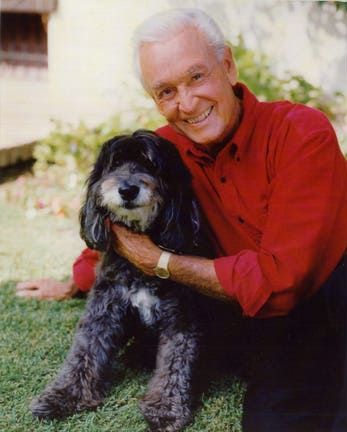
“This is Bob Barker reminding you to help control the pet population — have your pets spayed or neutered.”

– Bob Barker, long-time host of The Price is Right, in his trademark sign-off used from 1982 until his retirement in 2007

Mr Barker passed away at the age of 99 on 26 August 2023. He hosted The Price is Right from 1972 to 2007 and was a passionate animal rights activist.

I packed a grab bag today (and I hope you will, too)

For the last 20 years, I have always tried to have emergency supplies on hand. First it was because of the ‘millennium bug’ which threatened to shut down utilities and other essential services. Then it was the warnings of New Zealand officials about being ready for earthquakes. I accessed and used many of my supplies during our 2010 and 2011 earthquakes and was pleased to have been prepared.

Since then, I have reviewed my supplies and attempted to keep them re-stocked. A busy life means that I haven’t always been as diligent as I should in doing this (my water purifying tablets expired 3 years ago, for example).

Earlier this year, regions of our North Island were hit by Cyclone Gabrielle and severe flooding. Many people lost their homes. Over the last 10 days, though, I have watched the events in Lahaina, Maui unfold. Climate change has me worried; everyone on this planet is at risk of severe weather events and that includes our pets.

As I write this, there are suggestions that upwards of 3,000 pets on Maui are missing or injured. Many will never be found, which seems to be likely for many human victims, too, because of the heat and destruction of the fires.

The time to prepare is today. Don’t wait.

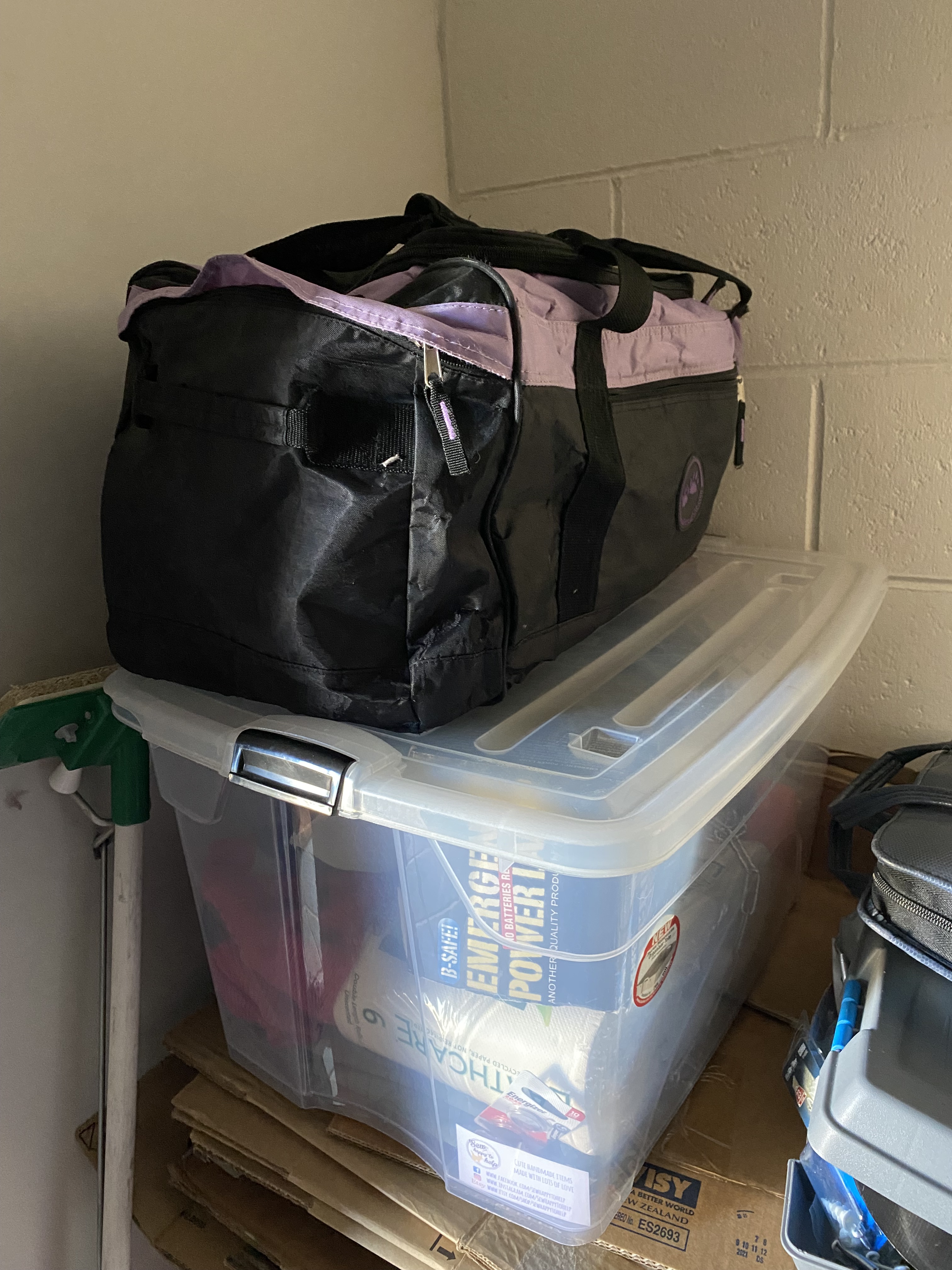
I have re-vamped my grab bag with an updated pair of glasses, masks, clothes for both Sox and I, a harness (because in the hurry to get him into the car, I may not have time to saddle him up as I usually do), pain medication, an asthma inhaler, a charging cord for my mobile phone, heavy work gloves, and other items.

The bag will be the first thing taken if we have to evacuate in a hurry. The box contains dog treats, batteries, an emergency torch, toilet paper, liquid soap and other hygiene items. I keep a bag of dog food nearby, too, to grab on the way out.

From what has been reported, it seems that many in Lahaina had no idea that they were under threat and that evacuation orders were haphazard. There will be lessons learned from this disaster.

In Canterbury, we get very dry in summer with strong winds. Climate change is supposed to exacerbate this. We live with the ever-present threat of earthquakes. Storms will be more severe in the years to come. Please give some thought to the hazards where you live and plan accordingly.

It’s my hope that I never need these supplies, but it gives me comfort to know that I have them on hand and ready to go if we have to leave our home quickly. I plan to do better at reviewing the supplies; much like the batteries in smoke alarms, they should be reviewed each year when we change clocks to/from daylight savings time.

Kathleen Crisley, Fear-Free certified professional and specialist in dog massage, rehabilitation and canine fitness,  The Balanced Dog, Christchurch, New Zealand

Dogs can age healthier by socializing with humans and pets, study says

Social interaction is good for human health, and a new study suggests it might be good for your dog, too.

“Where we live and who we interact with has a really strong effect on our health and well-being,” said Noah Snyder-Mackler, who is lead author of the study and an associate professor at Arizona State University’s school of life sciences and its center for evolution and medicine. “This link between our social environments and our health extends to many social animals. Animals with stronger social relationships live longer, healthier lives.”

Social companionship helps with healthy aging for dogs, a study says. (Katherine Frey/The Washington Post)

The research, published in Evolution, Medicine & Public Health, surveyed the human parents of more than 21,000 dogs and found that social companionship — with both people and other animals — had the largest influence on healthier aging among dogs. The effect was five times greater than anything else they looked at, such as family finances, household children or the pet parent’s age.

Improving dog and human health

The study is part of the Dog Aging Project, a large community-science research effort started in 2018 and funded by the National Institute on Aging and private donations. It’s led by the University of Washington and Texas A&M schools of medicine and includes more than a dozen institutions, including Arizona State University.

Its goal is to learn how genes, lifestyle and the environment influence aging and disease among dogs. Researchers also hope the insights can help human health.

“Dogs are often considered our closest animal companions and share many aspects of our daily lives,” said Brianah McCoy, an ASU doctoral student and a co-author of the paper. “By studying how the social environment affects dog health, we can gain insights that may also be relevant to human health.”

More than 45,000 dogs overall are enrolled in the aging project. A subset, about 1,000 dogs, are part of a more focused cohort from whom Snyder-Mackler and his collaborators are collecting blood and other biological samples over many years to uncover additional clues.

Having furry friends is linked to better health

The researchers used statistical tools to analyze factors in the dogs’ social environments obtained from surveys completed by dog parents. The questionnaires asked about, among other things, physical activity, environment, dog behavior, diet, medications and preventive medications, health status and owner demographics.

The scientists narrowed their analysis to five key factors — neighborhood stability, total household income, social time with children, social time with animals and owner age — that together might explain how the social environment could affect a dog’s well-being.

They found poorer health among dogs who lived in households with financial difficulties and other stressors, and better health among dogs who experienced more social companionship, such as living with other dogs.

The researchers, however, did not quantify life span, although they plan to do so in the future. “While we can’t say ‘having another dog in the house adds X years to your dog’s life,’ we were able to compare the strengths of the effect of different environmental factors on health,” Snyder-Mackler said.

The researchers cautioned that the results don’t mean that pet parents need to add more dogs to the family or rush their pets to dog parks or doggy day-care.

“We don’t know if the environmental factors we measured caused the health outcomes, so we don’t want to make any strong statements about what owners should or shouldn’t do,” Snyder-Mackler said. “The study just looked at whether you had other animal companions in the house. But it does suggest that having more furry friends is linked to better health outcomes.”

Some dogs may not benefit from social interactions

Scientists not involved in the study pointed out that not all dogs respond similarly.

“Some dogs may find social interactions stressful,” said Clara Wilson, a postdoctoral researcher in the Penn Vet Working Dog Center at the University of Pennsylvania School of Veterinary Medicine, “and it may not be in the dog’s best interests to force these interactions.”

Courtney Sexton, postdoctoral researcher at Virginia-Maryland College of Vet Med — and who contributes other research to the Dog Aging Project — said her dog would rather play with a ball than with other dogs, and it’s the pet parents’ “job to pay attention to the signals dogs give us.”

Surprising findings

Several findings were surprising, the study authors said.

  • Having children in the household had a negative impact on a dog’s health.
  • Dogs in wealthier households were diagnosed with more diseases than those in less affluent homes.
  • Dogs seemed to be healthier when they lived with older humans, and this effect was stronger in younger dogs.

Children may be detrimental to the health of dogs because of resource allocation, the researchers suggested. “It’s not that kids hurt the dogs or directly affect their health,” said Layla Brassington, a doctoral student at Vanderbilt University, who worked on the study as a master’s student at Arizona State University. “The more children or time that owners dedicate to their children likely leads to less time and effort they can dedicate to their furry children.”

The authors theorize that wealthier households have better access to medical care, and pet parents might seek veterinary services more frequently, which leads to identifying more diseases.

The ages of the dogs also affected the findings, with younger dogs seeming to be “more tuned into the age of their owner and how it impacts their well-being,” McCoy said.

Could dogs benefit from a cat companion?

The researchers did not specifically look at the effect of breeds — they did not have enough detail on individual breeds — or exercise, Snyder-Mackler said. (The Dog Aging Project recently released a study that found physical activity is associated with a better cognitive outcome in dogs.) “What we did see was that the strength of the relationship between the environment and health was similar when we looked separately at mixed-breed versus purebred dogs,” he said.

They also acknowledged one study limitation — the sample consisted of mostly high-income dog parents. A more diverse set could help “unravel the true magnitude of certain variables’ influence on canine well-being,” McCoy said. “It is possible that the effects we found in this study would be even stronger if we had a more varied and inclusive population.”

Most of the pets in the multi-animal households were dogs, and the scientists said there was insufficient data to distinguish between the effects of having additional dogs vs. other species.

“It could be that having other pets — even cats — provides health benefits through companionship,” Snyder-Mackler said.

Source: Washington Post

Reflections on Pet Central’s liquidation

Earlier this week, the liquidators were called in to oversee the final days of Pet Central, a South Island-based pet retail chain.

I hate to hear when retail staff lose their jobs; they don’t get paid much as it is and they work longer hours at the times of year when most of us wouldn’t (think pre- and post-Christmas). In the pet care business, staff are also predominantly female and so a loss like this one is also an issue for women.

New Zealand’s economy isn’t that great right now and businesses are failing. The good news is that good staff are hard to find and so I wish the best for the retail workers, the groomers and those who staffed the day care. I hope they find work quickly.

And now I put my business hat on. Here’s why I am not particularly surprised at Pet Central’s demise:

  1. It seemed to be growing too fast. Since launching the Pet Central brand, the business decided to compete with other large retail chains – namely Animates and Petstock. From what I could see, though, it had few points of difference. It spent a lot on advertising with bus wraps and billboards. It seemed to want to market strongly on being NZ-owned and then, when it opened its Papanui flagship store in 2020, it included a day care and cafe. The cafe didn’t make it and was closed for quite a while before undergoing a ‘relaunch.’ If a cafe failed the first time around, it was unlikely to suddenly thrive particularly when the Papanui store is located literally across the road from the Northlands Mall food court and hospitality precinct. Hospitality is a mean business.
  2. In big retail, I’m not convinced being NZ owned and operated means that much. A good example is Mitre 10 (NZ owned) vs Bunnings (Australian owned). If you want your big retail hardware fix, most people have a preference but seems to be based on prices, products and location rather than country of ownership. Countdown is Australian owned, Pak N Save is Kiwi owned. Do supermarket shoppers really care that much when time and convenience are at stake?
  3. Pet Central was easily the highest priced chain of all the big pet retail chains. Kiwi consumers are a price-driven lot. We are widely known as a low wage economy. When times are good, people are willing to pay more. With a cost of living crisis, they become more discerning.
  4. Combine this with the fact that there are only two major wholesalers in the pet industry in this country which means all the stores buy from the same place for a large range of products. You can’t mark up a product significantly from your competitors and retain loyalty amongst a large portion of customers; smaller retailers excel at growing customer loyalty and providing service which enables them to survive.
  5. Pet Central was sold about a year ago to a new owner. What has already been reported to the media is that under the new owner, staff were seeing signs of mismanagement. When I spoke to the liquidator earlier this week, he said that suppliers were in the shops re-possessing stock for which they had not been paid. Whatever remains (and it didn’t sound like much) will be sold.
  6. This is not the first pet business that has gone bust in recent years – and that’s just in Christchurch. In 2021, there was Kuri which closed leaving debts of almost $1 million when it collapsed. This business remains trading at only one location in Christchurch, with different ownership. In 2022, there was The Barkery which opened in April and was closed by October. Promoted as a social enterprise, it was still a business that needed to make money before it could return profits to its nominated charities. Now, in 2023, it is Pet Central.
  7. It takes a lot of resource and time to run a successful retail business and that is before you consider the resources you need to expand. Commercial leases are expensive and the more staff you employ, the higher your wage bill and associated costs like Kiwisaver contributions and ACC levies. Cash flow needs to be carefully managed and suppliers must be paid.

But here is the good news, pet owners probably won’t miss Pet Central for long because you can find products elsewhere. As I said, every pet store has to buy from the same distributors in New Zealand for a lot of the product lines. It’s one reason why customers who reported no stock at Pet Central in recent weeks could easily go and find what they needed somewhere else.

For services like grooming and day care, there are other businesses where these services are core business and not an add-on to retail.

And here’s the gem: there are a lot of niche and great products that you can buy from smaller retailers and online. Christchurch and Canterbury are well-served, for example, for raw pet food suppliers. Take the time to research and you will find what you need.

A lot of very good products are not sold to large retailers because they want unrealistically low wholesale prices which they can mark up. A niche product/producer can’t survive at the margins that big retail expects. Smaller businesses are often more agile at sourcing new products for consumers, too.

If you want to support Made in New Zealand, get shopping online and find the many products available to you. You don’t need big retail for this.

There will always be a place in a modern economy for big retailers; you’ve still got choice. In another year, Pet Central will be a distant memory for many, a fond memory for some, and a sour one for those who have not been paid.

Kathleen Crisley, Fear-Free certified professional and specialist in dog massage, rehabilitation and canine fitness,  The Balanced Dog, Christchurch, New Zealand

Image

Doggy quote of the month for August

About half of U.S. pet owners say their pets are as much a part of their family as a human member

Families come in all shapes and sizes. And for a majority of Americans, family includes their pets.

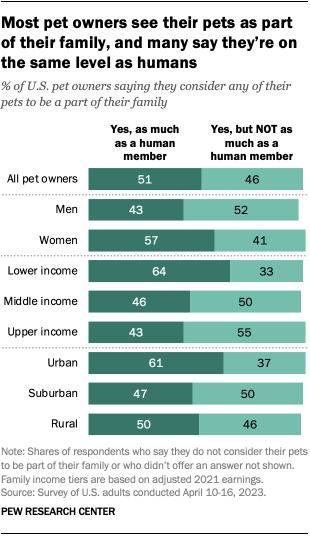
A bar chart that shows most pet owners see their pets as part of their family, and many say they’re on the same level as humans.

Most Americans (62%) own a pet, including about a third (35%) who have more than one. And nearly all U.S. pet owners (97%) say their pets are part of their family, according to a new Pew Research Center survey.

About half of pet owners (51%) not only consider their pets to be a part of their family but say they are as much a part of their family as a human member. Groups that are more likely to say this include:

  • Women: 57% of women pet owners say their pets are just as much a part of their family as a human member, compared with 43% of men who own pets.
  • People with lower family incomes: 64% of pet owners in this group consider their pets to be as much a part of their family as a human member, compared with 46% of those with middle incomes and 43% of those with higher incomes.
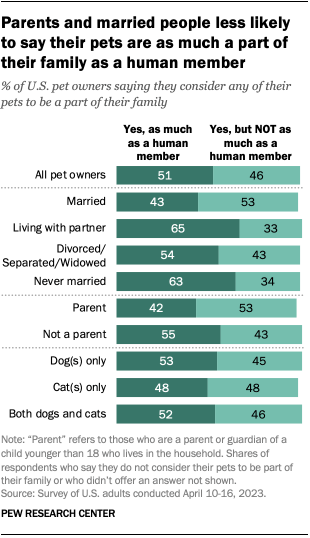
A bar chart showing that parents and married people are less likely to say their pets are as much a part of their family as a human member.
  • People living in urban areas: 61% of pet owners in urban areas say their pets are as much a part of their family as a human member, compared with 50% of those in rural areas and 47% of those in the suburbs.

The share of pet owners who think of their pets as part of their family as much as a human member doesn’t vary notably by age, race or ethnicity.

Pet owners’ family situation is also related to how they think about their pets. Unmarried pet owners and those who do not have children younger than 18 at home are the most likely to consider their pets to be as much a part of their family as a human member.

What about dog owners versus cat owners? The difference is narrow, but those who only have dogs (53%) are more likely than those who only have cats (48%) to think of their pets in the same way they think of a human family member.

Who is most likely to own pets?

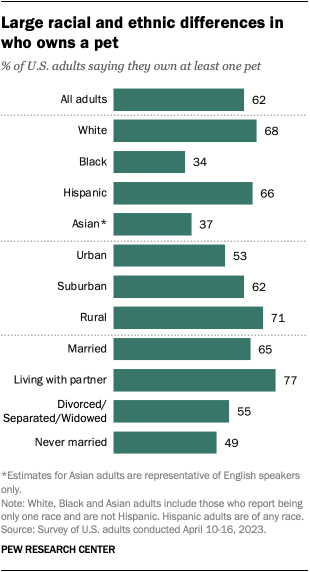
A bar chart that shows large racial and ethnic differences in who owns a pet.

Most Americans own pets, but some groups stand out as being more likely to do so:

  • White and Hispanic adults: 68% of White and 66% of Hispanic adults own a pet. By comparison, just 37% of Asian and 34% of Black adults are pet owners.
  • Rural Americans: 71% of adults living in rural areas have a pet – much higher than the shares in suburban and urban areas. Rural Americans also stand out as the most likely to have multiple pets: 47% of adults in rural areas have more than one pet, compared with 32% in the suburbs and 26% in urban areas.
  • People who are living with a partner or married: 77% of partnered and 65% of married adults have pets. That share drops much lower to 55% among people who are divorced, separated or widowed and to 49% among those who have never been married.

To a lesser extent, women and people in middle-income families are also more likely than others to own pets. People younger than 65 are the age group most likely to have pets.

Dog versus cat ownership

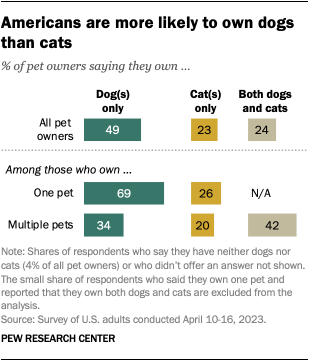
Dog ownership is more common than cat ownership in the United States.

A bar chart that shows Americans are more likely to own dogs than cats.

Among all pet owners:

  • 49% say they have dogs only
  • 23% have cats only
  • 24% have both dogs and cats
  • 4% have neither cats nor dogs

Most pet owners with only one pet say that pet is a dog (69%). Among those with multiple pets:

  • 34% say all their pets are dogs
  • 20% say all their pets are cats
  • 42% say they have both dogs and cats

How Americans think pets are treated

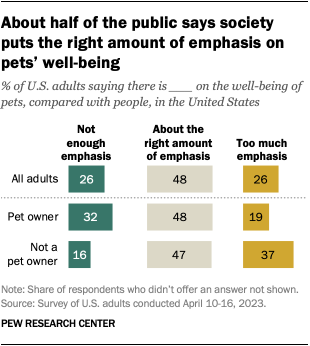
We asked Americans how they think pets are treated compared with people in the U.S.

A bar chart that shows about half of the public says society puts the right amount of emphasis on pets’ well-being.

Some 26% of Americans say there is not enough emphasis on the well-being of pets, and an equal share say there is too much. Roughly half (48%) say there’s about the right amount of emphasis on the well-being of pets.

Pet owners are twice as likely as non-pet owners to say there is not enough emphasis on pets’ well-being. Non-pet owners are about twice as likely as pet owners to say there is too much emphasis.

Among pet owners, 51% of those who say their pet is as much a part of their family as a human member say there isn’t enough emphasis on the well-being of pets. Just 13% of those who say their pet is a part of their family but not as much as a human member say the same.

In turn, 32% of those who say their pets are part of their family but not as much as a human member say there’s too much emphasis on pets’ well-being. Just 6% of those who see their pets the same as a human member of their family say this.

Note: Here are the questions used for this analysis, along with responses, and its methodology.

Source: Pew Research Center