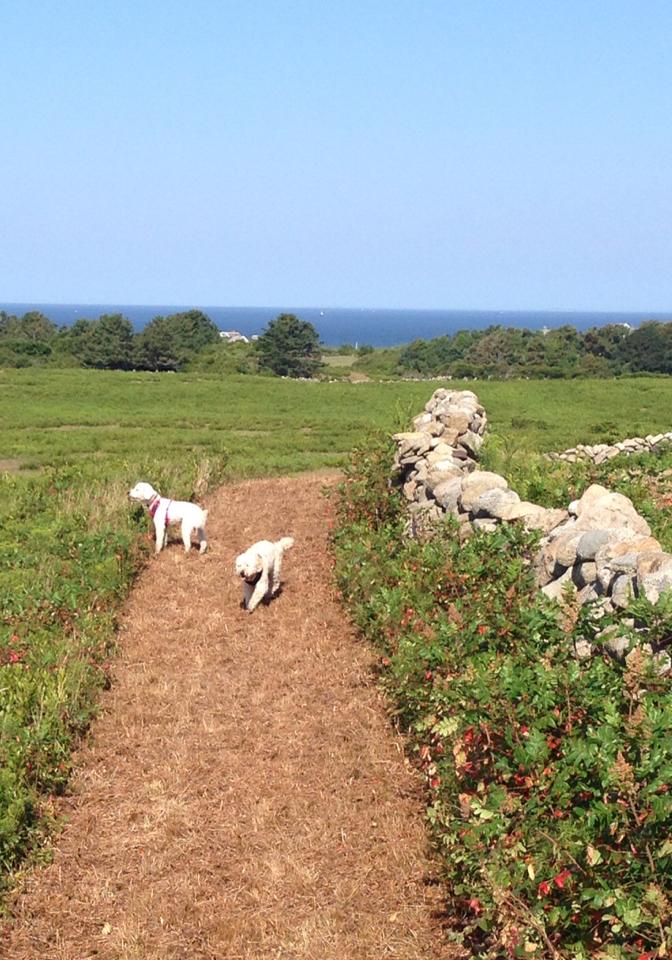
Photo courtesy of Karen Eckstein Han


Photo courtesy of Karen Eckstein Han
The San Francisco SPCA has issued a warning for all dog owners: exercise caution when taking your dog with you on an escalator.
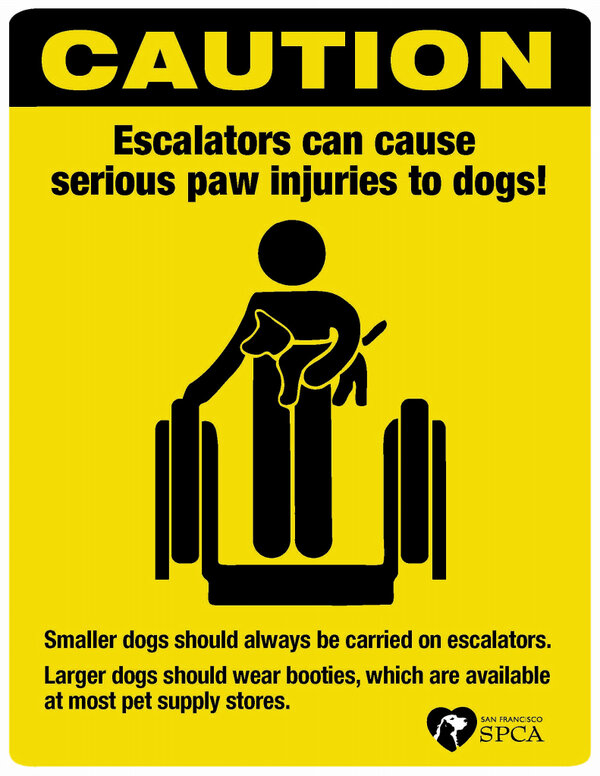 The SPCA’s two hospitals regularly receive emergency visits by dogs injured on escalators. The majority of cases are small breed dogs who are riding on escalators at BART stations (the rapid transit/commuter services in the San Francisco area) or at shopping malls.
However, any size dog can be injured on an escalator.
Injuries are usually to the paws, often requiring toes to be amputated.
Prevention is easy:
Posted in dog care
Tagged BART, booties, elevators, escalators, lifts, San Francisco SPCA, stairs
They say a picture is worth a thousand words and so before next week and another update on Teddy’s progress, here is what Teddy’s elbow fracture looked like.
Compare the x-ray of the right, broken leg with that of the left. It was a dramatic break.


We are not looking back, however. Teddy has had a good week and we are looking forward to even more as we get him comfortable and happy in his new life as a tripod.
Kathleen Crisley, specialist in dog massage, rehabilitation and nutrition/food therapy, Canine Catering Ltd, Christchurch, New Zealand
Posted in Teddy's journey post-amputation
Tagged amputation, beagle, compound fracture, Teddy, x-rays

Dr Andrew King of Swansea University has used GPS technology to understand how sheepdogs do their jobs so well.
He fitted a flock of sheep and a sheepdog with backpacks containing extremely accurate GPS devices designed by colleagues at the Royal Veterinary College, London. Daniel Strömbom of Uppsala University and colleagues then used data from these devices, together with computer simulations, to develop a mathematical shepherding model.
The team found that sheepdogs likely use just two simple rules: to collect the sheep when they’re dispersed and drive them forward when they’re aggregated. In the model, a single shepherd could herd a flock of more than 100 individuals using these two simple rules.
Andrew King explained, “If you watch sheepdogs rounding up sheep, the dog weaves back and forth behind the flock in exactly the way that we see in the model. We had to think about what the dog could see to develop our model. It basically sees white, fluffy things in front of it. If the dog sees gaps between the sheep, or the gaps are getting bigger, the dog needs to bring them together.”
Daniel Strömbom said, “At every time step in the model, the dog decides if the herd is cohesive enough or not. If not cohesive, it will make it cohesive, but if it’s already cohesive the dog will push the herd towards the target.”
King believes that the research team’s model will have many applications for tasks like crowd control, herding of livestock, and keeping animals away from sensitive areas. The algorithm developed could be used to program robots for these tasks.
Animal behaviour specialists at the University of Lincoln (UK) have published a study that supports the use of positive reward-based training methods over the use of electronic shock collars.

The immediate effects of training pet dogs with an electronic collar cause behavioural signs of distress, particularly when used at high settings.
The study involved 63 pet dogs referred for poor recall and related problems, including livestock worrying, which are the main reasons for collar use in the UK. The dogs were split into three groups – one using e-collars and two as control groups.
The trainers in the study were industry approved and fully familiar with the guidelines for use of e-collars which are published by collar manufacturers.
Trainers used lower settings with a pre-warning function and behavioural responses were less marked than during a preliminary study (the results of which have since been discounted because the trainers did not follow collar protocols). Despite this, dogs trained with e-collars showed behavioural changes that were consistent with a negative response. These included showing more signs of tension, more yawning and less time engaged in environmental interaction than the control dogs.
Following training most owners reported improvements in their dog’s problem behaviour. Owners of dogs trained using e-collars were, however, less confident of applying the training approach demonstrated.
These findings indicate that there is no consistent benefit to be gained from e-collar training, but greater welfare concerns compared with positive reward-based training.
Lead author Jonathan Cooper, Professor of Animal Behaviour and Welfare at the University of Lincoln’s School of Life Sciences, said: “e-collar training did not result in a substantially superior response to training in comparison to similarly experienced trainers who do not use e-collars to improve recall and control chasing behaviour.
Accordingly, it seems that the routine use of e-collars even in accordance with best practice, as suggested by collar manufacturers, presents a risk to the well-being of pet dogs. The scale of this risk would be expected to be increased when practice falls outside of this ideal.”
The peer-reviewed journal article for this research is:
Jonathan J Cooper, Nina Cracknell, Jessica Hardiman, Hannah Wright, Daniel Mills ‘The welfare consequences and efficacy of training pet dogs with remote electronic training collars in comparison to reward based training’ PLOSone http://dx.plos.org/10.1371/journal.pone.0102722
Moxie was a 3-year old urban search and rescue dog when she and her handler were called to the World Trade Center in September 2001. Now, she’s a a retired senior dog who is still playing at the park.

Moxie with her owner Mark Aliberti in Coughlin Park, Winthrop, Massachusetts (photo by Kathleen McNerney/WBUR)
Her handler, Mark Aliberti, recalls their experience at the World Trade Center site in this WBUR radio news story:
 Teddy, bright and alert, met me at the door this week. He’s looking and feeling much better now that his pain is under control. It is great to see him up on his feet again. The mood in the entire household has lifted, too.
Teddy’s medication regime has been changed from Previcox to Rimadyl as the preferred NSAID (non-steroidal anti-inflammatory drug) with Tramadol for added pain relief. He’s also had a second acupuncture treatment which is clearly helping to improve his energy and pain levels.
Since last week’s osteopathic adjustment, the compression in Teddy’s back has been relieved and I have been able to use more massage and acupressure techniques on him because he is no longer in pain. I’m still using laser on Teddy, but the ability to manipulate his muscles and limbs is essential to help with the movement of blood and lymphatic fluids.
Yesterday, I gave Teddy a full body massage with emphasis on lengthening and stretching important muscles. I did a lot of work on the latissimus dorsi – one of the major muscles that supports the back. All of Teddy’s remaining legs have good range of motion, although some of the muscles in them need a little help to be warmed and stretched.
Teddy slept through most of his massage – another great sign that he is able to tolerate rehabilitation and that his body is able relax, which will support recovery.
The right hind leg, which has arthritis and is affected by hip dysplasia, is causing us some concern. Teddy is noticeable wobbling on this leg and so we’re focusing on giving this leg extra attention with lasering and acupressure points.
Jill says, “To hear Teddy’s cries and whimpers was distressing for all of us. I’m so happy that Teddy’s condition has improved. I feel like we have turned a corner.”
The floor layout in the main living area has been improved, too. Baby gates still restrict Teddy to a small area. Jill has installed rugs with a foam underlay in the areas where Teddy walks. These will help with shock absorption.
A couch with a very low seat is now Teddy’s preferred sleeping place – he can watch the garden from this position. A foam mattress crash pad is below the sofa to ensure Teddy doesn’t do any damage to his remaining foreleg when he decides gets down.
Kathleen Crisley, specialist in dog massage, rehabilitation and nutrition/food therapy, Canine Catering Ltd, Christchurch, New Zealand
Posted in Teddy's journey post-amputation
Tagged acupuncture, amputation, amputee, beagle, previcox, Rimadyl, Teddy, Tram, tramadol, tripawd, tripod
The past week has been a tough one for Teddy and for Jill.
When Teddy first came home from the hospital, he seemed to be adjusting quickly. He’s always been an independent boy and so he has rejected any support such as a strap or harness when taken out for toileting.
However, this week, Teddy became noticeably withdrawn. For much of the time, he was restless and would whimper frequently. We were sure he was in pain. Because he was so out of sorts, we also felt that he was suffering from anxiety.
When I saw Teddy on Monday, Jill was stressed and Teddy was clearly not himself. We introduced a hot water bottle (or ‘hottie’ as they are known here) on his back which seemed to provide relief and comfort. I also gave Jill a CD from the Through a Dog’s Ear range. This music is designed specifically for dogs to help calm and treat anxiety. These seemed to assist Teddy in the short term to relax and rest.
But Teddy needed better pain management…
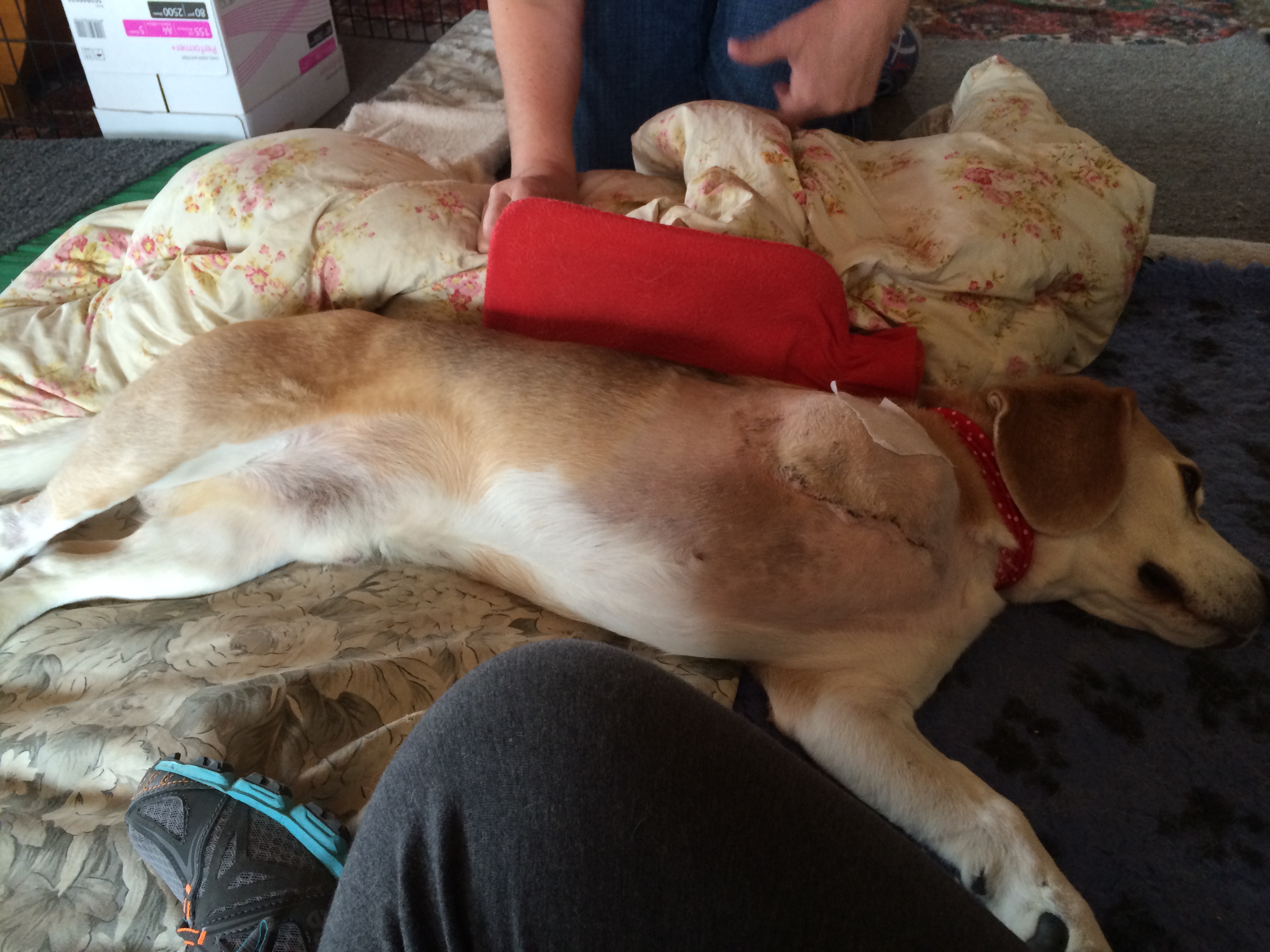
Teddy and his ‘hottie’
Jill took Teddy back to his vet several times this week to discuss pain relief. She freely admits, “I didn’t feel that I was being listened to as the owner. I knew Teddy better than anyone. Persistence, in my case, finally paid off.”
We seemed to agree on Monday that he was taken off his pain medication too quickly – he was taking only Previcox at the time – and his body had been left vulnerable. A Fentanyl patch was re-introduced on Monday and replaced again on Thursday. Jill also started Teddy on Tramadol on Thursday and Teddy received a ketamine injection, too.
Meanwhile, I could tell that Teddy’s back muscles were stiff; his top line did not seem normal, and he was clearly distressed at being handled along the withers and the back. Thankfully, since Teddy was too uncomfortable for deep massage, I was able to use the low level laser along his spine and muscles to help with blood flow and pain relief. I know I want to passively stretch Teddy’s spine but we agreed to wait until Teddy was more comfortable before attempting this. I was able to do passive range of motion stretching on Teddy’s legs.
Armed with this information Jill took Teddy for acupuncture on Tuesday and an osteopathic adjustment on Friday. Both his acupuncture vet and his osteopath agreed that Teddy was in pain and that support with traditional veterinary medicines were needed. The osteopath used gentle traction on Teddy’s back since she found his spine has become compressed.
With his pain properly managed, we can do more to help Teddy’s muscles, tendons and ligaments to adjust to his new gait. And then true rehabilitation and exercise can begin including a greater focus on core muscle strength.
During this stressful week, Jill took to the Internet for help with Teddy’s condition. She found a wonderful site – Tripawds Blogs – for owners of amputee dogs. Owners soon responded with news that helped to assure Jill she had made the right decision for Teddy and gave her information to help her discuss pain management with her vet.
Owners who have been through similar adjustments with their dogs said:
Jill says, “In hindsight, we really took things too quickly and allowed Teddy to move around the garden area with enthusiasm. I wish I had thought of this sooner and we may have avoided him seizing up so badly. The Tripawds site has been a fabulous resource for me knowing that there are others who have been through this before us.
I do feel that vets should listen to owners when it comes to understanding their animal. And if you are not happy with your vet, you need to find someone who you are more comfortable with. The vet can’t have all the answers when they are not with the dog as often as the owner is. This proves that vets are not the final word in recovery – and I’m grateful that complementary practitioners are part of Teddy’s healthcare team”
It’s a new week – and we are all hopeful that Teddy is back on track to recovery. He’s booked for massage and acupuncture this week.
Kathleen Crisley, specialist in dog massage, rehabilitation and nutrition/food therapy, Canine Catering Ltd, Christchurch, New Zealand
Posted in Teddy's journey post-amputation
Tagged acupuncture, anxiety, fentanyl, hot water bottle, laser, massage, osteopathy, pain, pain management, pain relief, Teddy, tramadol, tripawds, tripaws, tripod
The Lifelines Project, based in Austin, Texas, has a mission: it is to depict the bond between people and their pets by sharing images of the homeless with their animals. This is done through the lens of photographer Norah Levine.
Profits from the project (mainly through sale of prints) go to support 4PAWS (“For People and Animals Without Shelter”), a program run by the Animal Trustees of Austin. The program provides essential veterinary care to the homeless population – things like basic vaccinations, spaying and neutering. If a homeless person’s animal needs urgent surgery, the program aims to fund these needs as well.
The Lifelines Project helps to show that responsible dog owners are not limited to those with employment and a home. Many of the homeless portrayed in the project have a strong understanding of what their pet needs – and they are grateful for the financial support to make it happen.
Kathleen Crisley, specialist in dog massage, rehabilitation and nutrition/food therapy, Canine Catering Ltd, Christchurch, New Zealand
Posted in dog ownership, Dogs
Tagged Austin, homeless, homeless person, homeless population, Lifelines project, Norah Levine., responsible dog ownership, Texas







 DoggyMom.com