Lions Hearing Dogs of Australia

Coming up next month in my column in NZ Dog World and on this blog will be information on Hearing Dogs in New Zealand.  However, I was in Australia last week on business and picked up some useful information about Lions Hearing Dogs in that country.

98% of the hearing dogs in Australia are ex-shelter dogs.  As their name suggests, these dogs alert a hearing impaired owner to important sounds like the fire alarm.  It takes approximately $30,000 to train a single hearing dog.

Access to public places for these assistance dogs is guaranteed by law with penalties of up to $50,000 can be applied if someone refuses access to a hearing dog and its owner.

The organisation has trained over 500 dogs since 1982 and has a very useful website.

Be glad you’re not a dog owner in Jiangmen, China

The City of Jiangmen, China originally banned keeping of all dogs  effective from July 26, 2011.  Nine days later, after public pressure, the ban was lifted but only concerning ownership of dogs.   Dogs are still banned from all public places – which doesn’t bode well for the ongoing socialisation of dogs and puppies in that region, nor the efforts of owners to keep them stimulated and exercised.

This is a sad outcome for dogs and dog owners alike.  City officials say that the move was prompted by escalating rates of dog bites and attacks.  (For example, 4,000 dog-related complaints in the first six months 0f 2011.)

So, be glad you’re not a dog owner in Jiangmen, China.  Or a dog for that matter.

Read more about the ban in this UPI article.

Two cats one dog magazine – read it online for free!

Two cats one dog is the vet magazine for pet lovers and you can read it online for absolutely FREE!

Simply go to this introductory page to register and then you are ready to read issues of the magazine online.

I’m featured in the current issue (Spring 2011) as part of a comprehensive article on pet physiotherapy.   There’s a case study of one of my regular clients, Teddy, a young Beagle with hip dysplasia.  The article starts on page 17;  here’s a link to get you to the right page.

They say the best things in life are free – so get reading today!

Kathleen Crisley, Fear-Free certified professional and specialist in dog massage, rehabilitation and nutrition/food therapy, The Balanced Dog, Christchurch, New Zealand

Dogs as workers – not such a bad idea according to NZ researcher

“Some people think that is cruel to use dogs as workers,” says Dr William “Deak” Helton, “but what these people don’t seem to understand is that from the dog’s perspective it is actually crueller if they are not allowed to work.”  Dr Helton, who is based at the Department of Psychology at the University of Canterbury in Christchurch, New Zealand, is describing for me his experience with working dogs in Alaska.  I wrote about his research in my Canine Corner column this month (NZ Dog World), and here’s some more information about Deak and his research.

This slideshow requires JavaScript.

(Photos copyright Eve Welch, University of Canterbury)

Deak has been studying dogs for over 12 years and, from those early days growing up in Alaska, he observed that sledding and racing dogs wanted to pull immediately when they were placed in harness.  Many people don’t realise, when watching coverage of competitions like the Iditarod, that a large metal snow anchor is used to keep the sled in place as the dogs are secured in their harnesses.  A handler that forgets to do this will quickly find his/her sled taken out for an unguided run!

Deak has a keen interest in seeing working dogs reach top performance.  He described one of his research projects, looking for a way to help screen dogs being considered for a working career:A recent study we did was one in which we measured dogs’ right and left ear temperatures and their ability (based on owners’ reports) to pay attention. The tympanic membrane’s (ear drum’s) temperature is highly correlated with the temperature of the brain on the same side. So differences between the ear’s temperatures may tell you if the dog is more strongly cerebrally lateralized than another. Dogs (like people) have two cerebral hemispheres, one right and one left. Most people are aware that they have a dominate hemisphere (are lateralized). Dogs also differ in their degree of lateralization (how strong one side is compared to the other). Neuroscientists have hypothesized that being strongly lateralized (having a dominate cerebral hemisphere) is actually helpful to the animal in coordinating its behaviour. Imagine having two brain hemispheres both trying to tell your body what to do, without having one as the “leader,” the system may be prone to confusion. Hence, dogs with stronger cerebral lateralization may be better able to pay attention. The less lateralized dogs may be more prone to conflicting cues (distraction). Difference in right and left ear temperature may be an objective measure of cerebral lateralization.

One area where dogs show promise is in the field of medical diagnostics, says Deak.  He goes into some detail about the role of the dog, its accuracy in detecting rates of disease, and his opinion that dogs would be used more widely than they currently are:

There have now been several studies showing that dogs can be used to detect various medical conditions, for example, cancers. When you compare detection capability across tests/technologies you have to look at both the correct detection rate and the false alarm rate of the different tests.

Dogs have been trained to detect the presence of breast cancer by smelling the patient’s exhaled breath. The principle is essentially the same as breath analysis to detect alcohol consumption. The patient breathes into a tube that traps the chemicals exhaled in their breath. The dog then is presented with these breath samples and has been trained to signal when one of them has cancer related chemical compounds (it might not be that the dog is smelling cancer per se, but some related chemical excreted by the body as a reaction to cancer). McCulloch and colleagues (2006) have trained dogs to do this task (detect breast cancer via breath samples), and the dogs after training demonstrated a correct detection rate around 88.0% and a false alarm rate around 2.3%. This is not perfect, but for comparative purposes, in the medical literature, mammography screening by professional radiologists for breast cancer typically has a correct detection rate around 86.6% and a false alarm rate around 3.2% (Banks et al., 2004).

A higher correct detection rate and lower false alarm rate means an overall better detector.

The dog definitely looks promising. Keep in mind mammography is also considered by many to be uncomfortable and some people are concerned that the procedure itself may have side effects. This may put off people from doing the test. The key with cancer is probably early detection. If people are afraid of the test, they aren’t going to do it until they feel so bad they have to and by that time it might be too late. Dog detection (since the dog doesn’t have to even be in contact with the patient) is generally non-invasive.

For detecting intestinal cancer the difference in screening may be between a stool sample and having a colonoscopy. The latter is much more uncomfortable than the former. Considering the preliminary evidence and the long track-record of dogs being used in other detection contexts (explosives, narcotics, invasive pests, etc.), I think the lack of using dogs in medical diagnostic work is mysterious. While dogs will not be a perfect system, people have to realize there are no tests that are perfect. Dogs (or other biological detectors) could be used in conjunction with other tests. There are companies trying to figure out what the dogs are detecting so that they can make technological tests for detecting cancer based on the dog’s ability to detect it, but that is not helping anyone now.

Dogs can probably do the job and if the track record in other contexts is informative (for example, explosives) then dogs will probably be able to do the job better than technology for the foreseeable future.  Of course we should develop other technologies, but if we want to save lives now, dogs could be used more in this context.

The Editor of Canine Ergonomics:  The Science of Working Dogs, a compilation of research from disciplines ranging from biology and veterinary medicine, to psychology and forensic medicine, Deak says “For me, this book filled a gap when you consider how extensive dogs are employed.”  The book, published in 2009 has had great reviews.

The cover of Deak's book

Deak describes his research as the field of engineering psychology, more popularly known as ergonomics.  His work in the field of human factors psychology has earned him the 2011 Earl Alluisi Award for Early Career Achievement by the American Psychological Association (APA).

Warning – chicken jerky treats from China

The AVMA and the Canadian Veterinary Medical Association have issued a warning about a possible link between consumption of chicken jerky treats made in China and the incidence of kidney problems in dogs. A pattern started to develop in July when dogs in Canada presented with kidney problems resembling Fanconi syndome.

This syndrome is hereditary in some breeds of dogs such as Basenjis resulting in abnormal levels of sodium, glucose, calcium, phosphate and amino acids.  It can be fatal.  The symptoms of the disorder also present when toxins have been ingested.

This is yet another example of needing good supply chain management and ensuring you are buying foods with quality ingredients.  China is a country with a checkered reputation of managing supply chains and quality of ingredients.

In 2007, melamine was found to contaminate a wide range of pet foods resulting in major recalls and many deaths.  In 2008, the melamine contamination problem escalated to humans when the poison was found in milk powder fed to infants.  Many Chinese babies were affected and some died.

Doggy quote of the month for September

I guess you don’t really own a dog, you rent them.  And you have to be thankful that you had a long lease.

– Joe Garagiola

The Hero Dogs of 9/11

This year marks the 10th anniversary of the September 11, 2001 terrorist attacks.   The date of 9/11 is one that most of us will remember, recalling exactly where we were and what we were doing when the news of the attacks came through.

In my case, it was first thing in the morning New Zealand time and I had turned on the radio for news (something I do every morning) – as it was September 12th in New Zealand.  It was also the morning to get dressed up, as I was being sworn in as a New Zealand citizen.  The ceremony was very memorable, with the Mayor of Christchurch making special reference to the day’s events and what the US citizens in the room must be feeling.

I hope you are as moved by this video as much as I am.  It is about the 300 urban search and rescue dogs who worked at the World Trade Center site.  And it also tells you about Sirius, the bomb detection dog who died in the collapse.

Never forget.

New puppy for Charles and Camilla

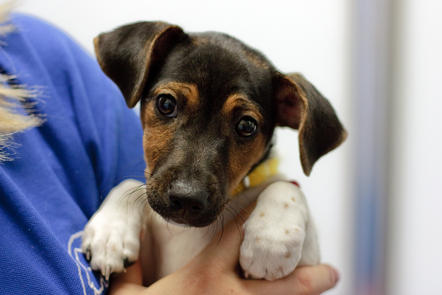
Camilla, the Duchess of Cornwall, adopted a Jack Russell from the Battersea Dogs and Cats  Home earlier this week.

According to the media statement released by Battersea, the puppy is named Beth and she is a tri-colour Jack Russell Terrier who is 3 months old.  She was one of more than 100 stray dogs that the Home took in during the month of July.

Beth, the latest edition to The Royal Family (photo courtesy of Battersea Dogs and Cats Home)

The Duchess is familiar with the breed; she owned a much-loved Jack Russell named Freddy.

Minding the lumps and bumps

This week, I had the pleasure of working with a dog whose owner is very attentive and diligent.  She was the first owner in a long time to provide me with her dog’s ‘lump and bump’ chart.

Many dogs, particularly as they get older, develop lumps and bumps under the skin.  Noticing when a new lump appears, and getting your vet’s opinion about it, are very important.  Many lumps are not sinister and require no attention because they are benign.    Others aren’t.

Whenever I take on a new dog/client for massage and rehab therapy, I start keeping records of the dog’s muscle condition, problems areas, and lumps/bumps.   Since I see dogs on regular basis (the length between visits varies according to the dog’s condition), I can sometimes pick up changes that their owner misses.  This is yet another benefit of massage therapy!

But, for the most part, an owner should be familiar with their dog’s condition.  Through regular grooming, you will notice where your dog has lumps and bumps and know which ones have already been tested by your vet for ‘nasty’ cells.  So start with an outline of your dog’s body and record where they are.

Refer back to your chart periodically when you are bathing and grooming your dog.  If you find something that wasn’t there before, record its size and location on your chart and take your chart with you to the vet.

If you are local to the Canterbury area, we also discuss lump and bump charts and how to compile them in my dog massage workshops for owners.

Kathleen Crisley, Fear-Free certified professional and specialist in dog massage, rehabilitation and nutrition/food therapy, The Balanced Dog, Christchurch, New Zealand

CSI – dog style?

Pooprints, based in Tennessee (USA), is offering DNA testing of a different kind.  It is not about testing your mixed breed dog to find out their lineage, it’s about DNA testing of dog poo!

The number of subdivisions, condominium-style accommodation developments, and apartment complexes is on the rise in the US.  This is a result of a ‘downsizing’ of accommodation because of the economic recession as well as growth in population centres where work is available, but cost of living and commuting times are also an issue.  In these types of developments, there are dog owners living alongside non-dog owners.  And poop is  a problem.

(For my New Zealand readers, read my Last Word column in the March 2011 issue of NZ Dog World magazine.  In that column, I discussed the looming liability of infill housing, population growth,  and the growing problem of dog owners who do not clean up after their dog.)

The company’s service is rather straightforward.  First, a residential community decides to start a dog DNA testing programme.  Usually, this test is mandatory as part of signing up to live there. A mouth swab is taken of your dog and sent for  DNA testing and the results are entered into that site’s database.

Then, a site manager is probably responsible for poop patrol in your community.  They take samples of poop that has not been cleaned up and send the samples for DNA testing (because epithelial cells in the wall of the intestine are excreted every time a dog defecates).   The site manager will be given a report about the dog/owner match in order for followup to occur.

Communities will have rules about the number of infringements required for that person to be fined, or worse, kicked out of their residence.

It may sound ‘over the top’ but it is a symptom of how strongly some people feel about poop that is not cleaned up.

CNN covered the story of one residential development in New Hampshire that has signed up to use the Pooprints system.  Read about it here.