Would you risk your life for your fur baby? A new survey reveals that three in five Americans would willingly run into a burning building to save their pet.
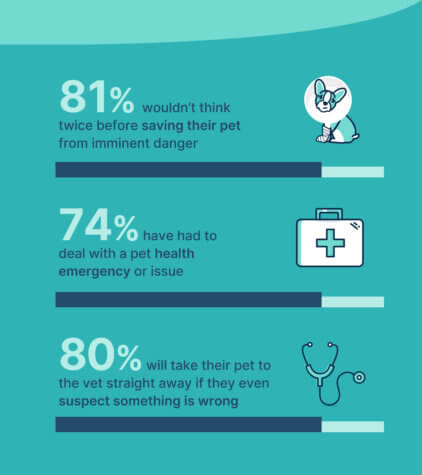
The poll of 2,000 cat and dog owners also shows that 81 percent wouldn’t think twice before saving their pet from immediate danger. Six in 10 (59%) would willingly fight another person to save their four-legged friend.
Say hello to my little friend
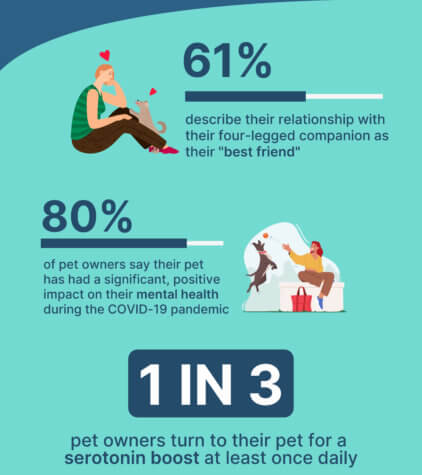
Sixty-two percent would even describe their pet as their “best friend,” while three in five agree that their pet is their “soulmate.”
Conducted by OnePoll on behalf of Figo Pet Insurance, the survey also reveals that pet owners often search for similar affirmations of love from their pets as they do from their partners. That includes their pet “following them around” (63%), “giving them kisses” (59%) and sleeping in their bed (53%) as the top signs of endearment.
Research also showed that 84 percent of Gen Z (ages 18-24) are likely to include their pet in their wedding or a milestone event. More than three-fourths of Gen Zers are likely to get a tattoo inspired by them as well. Of those who own multiple species of pets, 48 percent admit they’ve bonded to one in particular — including 80 percent who feel more tied to their dog than their cat.
Regardless of which pet they bond more with, two-thirds (67%) believe that because they are so connected, they can read each other’s minds. Four in five pet owners believe that their pet significantly impacts their mental health in a positive way.
Furthermore, more than one-third of the survey admit turning to their pet for a boost of serotonin at least once every single day of the week.
“The connection we have with our pets goes much further than just owner and companion. Our pets comfort us when we’re sad, stick by us through ups and downs and provide unconditional love like no other relationship can. Our pets are family, and while they may not be able to verbalize their affection for us, any pet parent can attest to the strength and depth of their devotion,” says Lizbeth Bastidas, claim supervisor and certified vet technician in a statement.
No hesitation in pet health
Because of being the most loyal companion, more than two-thirds of pet owners feel obligated in some way to repay their pet for all they do for them. Eight in 10 say it is likely that they will take their pet to the vet straight away if they even suspect something is wrong.
Almost one in five add they would pay more than $7,000 to save their pet’s life, and 53 percent would willingly go into debt or spend any amount necessary to save them from immediate danger. Although only one-third have pet insurance, 54 percent of pet owners agree that it is a good way to repay their pet.
Of those who have pet insurance, one in three say it has come in handy three to four times. Of those who don’t, two in five believe it is too expensive.
“With the growing cost of vet care in the U.S., the sad reality is that many pet parents will at some point face an expensive vet bill that could put them in a terrible position – having to choose between their beloved companion and their financial health. Our pets are there for us through thick and thin, and many pet parents would do anything to return the favor. This is especially true today, when pet medical care has advanced so drastically; sophisticated cancer treatments, alternative therapies, pain management and the list goes on. Pet insurance lightens the financial, mental and emotional load for pet owners, ensuring that cost does not dictate their pet’s care,” Bastidas adds.
A study involving some 11,000 dogs carried out at the University of Helsinki demonstrated that the gender, age and breed of the dog, as well as any behavioural problems and certain environmental factors, are connected to hyperactive and impulsive behaviour and inattention (ADHD).
(Image: Mostphotos)
“Our findings can help to better identify, understand and treat canine hyperactivity, impulsivity and inattention. Moreover, they indicated similarity with human ADHD, consolidating the role of dogs in ADHD-related research,” says Professor Hannes Lohi, head of a canine gene research group at the University of Helsinki.
“Dogs share many similarities with humans, including physiological traits and the same environment. In addition, ADHD-like behaviour naturally occurs in dogs. This makes dogs an interesting model for investigating ADHD in humans,” says doctoral researcher Sini Sulkama.
Professor Lohi’s research group collected data on more than 11,000 dogs by conducting an extensive behavioural survey. Hyperactivity, impulsivity and inattention were examined using questions based on a survey utilised in human ADHD research. The goal of the study was to identify environmental factors underlying canine ADHD-like behaviour and potential links to other behavioural traits.
The dog’s age and gender as well as the owner’s experience of dogs make a difference
“We found that hyperactivity, impulsivity and inattention were more common in young dogs and male dogs. Corresponding observations relating to age and gender in connection with ADHD have been made in humans too,” says Jenni Puurunen, PhD.
Dogs who spent more time alone at home daily were more hyperactive, impulsive and inattentive than dogs who spent less time on their own.
“As social animals, dogs can get frustrated and stressed when they are alone, which can be released as hyperactivity, impulsivity and inattention. It may be that dogs who spend longer periods in solitude also get less exercise and attention from their owners,” Sulkama muses.
The researchers discovered a new link between hyperactivity and impulsivity, and the owner’s experience with dogs, as the two traits were more common in dogs who were not their owners’ first dogs. The causality of this phenomenon remains unclear.
“People may pick as their first dog a less active individual that better matches the idea of a pet dog, whereas more active and challenging dogs can be chosen after gaining more experience with dogs,” explains Sulkama.
Significant differences between breeds
Breeding has had a significant effect on the breed-specific behaviour of different dog breeds. Differences between breeds can also indicate genes underlying the relevant traits.
“Hyperactivity and impulsivity on the one hand, and good concentration on the other, are common in breeds bred for work, such as the German Shepherd and Border Collie. In contrast, a more calm disposition is considered a benefit in breeds that are popular as pets or show dogs, such as the Chihuahua, Long-Haired Collie and Poodle, making them easier companions in everyday life. Then again, the ability to concentrate has not been considered as important a trait in these breeds as in working breeds, which is why inattention can be more common among pet dogs,” Professor Lohi says.
Link to other behavioural problems
The study confirmed previously observed interesting links between hyperactivity, impulsivity and inattention, and obsessive-compulsive behaviour, aggressiveness and fearfulness. ADHD is also often associated with other mental disorders and illnesses. For example, obsessive-compulsive disorder (OCD) often occurs in conjunction with ADHD. In dogs, OCD-like obsessive-compulsive behaviour can appear as, among other things, tail chasing, continuous licking of surfaces or themselves, or staring at ‘nothing’.
“The findings suggest that the same brain regions and neurobiological pathways regulate activity, impulsivity and concentration in both humans and dogs. This strengthens the promise that dogs show as a model species in the study of ADHD. In other words, the results can both make it easier to identify and treat canine impulsivity and inattention as well as promote ADHD research,” Sulkama sums up.
Funding
This study was part of the Academy of Finland project investigating the epidemiology of canine behaviour and related environmental and genetic factors and metabolic changes. This study was also supported by the European Research Council (Starting Grant), the ERA-NET NEURON funding platform and the Jane and Aatos Erkko Foundation.
Original article
Sulkama S, Puurunen J, Salonen M, Mikkola S, Hakanen E, Araujo C, Lohi H. Canine hyperactivity, impulsivity, and inattention share similar demographic risk factors and behavioural comorbidities with human ADHD. Transl Psychiatry. 2021 Oct 1;11(1):501. doi: 10.1038/s41398-021-01626-x.
It’s hard to heal in your hospital bed if you’re concerned about your pets at home.
Credit: Bryan McCullough
Tiffany Braley, M.D., M.S., an associate professor of neurology at University of Michigan Health, was surprised when a patient she was caring for explained why they needed to go home from the hospital as soon as possible: their pets.
After she heard several more patients voice concern for their cats, dogs and other animals at home as they sat in the hospital, she soon realized that this occurrence was not uncommon. In many cases, it involved patients who were the sole caregivers for their pets.
“I’ve had patients with acute strokes explain to me that they needed to get home to their pets, even though it was in their best medical interest to be admitted or remain in the hospital,” Braley said. “Through these interactions, it became evident to me that we needed to learn more about the scope of this problem and how we could find better ways to address it.”
Braley, who also loves animals, then reached out to fellow animal lover colleagues in neurology, social work, nursing, and U-M’s Office of Patient Experience to investigate this question. The first step: learning about pet owner experiences from Michigan Medicine’s own patient advisors.
Study results
In partnership with U-M’s Office of Patient Experience, Braley and colleagues sent a survey to patient and family advisors who previously offered to help share their experiences to improve the patient experience. The purpose of the survey was to understand how a need to care for animals at home might affect how hospitalized patients follow their doctors’ recommendations.
More than half of the 113 people who responded to the survey (63%) reported difficulty figuring out pet care during their own hospitalization and/or that of a loved one.
Nearly a third reported that pet care needs impacted their decision, the decision of someone they knew, or both, about whether to stay at the hospital when the medical team recommended it.
And 16% of respondents said they know someone who has left the hospital against medical advice to go care for their pets.
“These patients are stressed already; how do you heal or accept staying in the hospital for treatment when you’re also worried about the welfare of your beloved pets?” said first author Carri Polick, R.N., a doctoral student at the U-M School of Nursing. “It can be hard if a patient doesn’t have a lot of social contacts or family members.” “I’ve had patients with acute strokes explain to me that they needed to get home to their pets, even though it was in their best medical interest to be admitted or remain in the hospital.” Tiffany Braley, M.D., M.S.
Although social work is typically brought in to help patients come up with care plans for their pets, they may not be notified until several days into the hospitalization, typically when the situation is urgent, and are usually forced to turn to the patient’s social circle for help. Unfortunately, some patients do not have available social support, and there are limitations in what is available for assistance.
“We see a rising need for a formalized services to identify patients early in their course who need assistance with pet care, and a need to provide better resources, before it becomes a crisis and impacts their care or the welfare of their pets,” said Braley, the senior author and principal investigator.
The study team notes that, while this study is an important first step, the survey was small and included mostly women and white participants who live in nearby Washtenaw, Wayne and Oakland counties, which could indicate low estimations of the issue at large. To learn more about the overall scope and impact of pet care needs in a larger, more diverse group, the team is now studying people currently hospitalized or in the Emergency Department at Michigan Medicine to explore how pet care needs affect their hospital outcomes.
They’ve also started talking with potential local partners, including the Michigan Humane Society, to brainstorm what a future foster care collaboration could look like.
“This research is further evidence that pets are truly a part of the family and an important part of how and why we make decisions,” said Matt Pepper, the organization’s president and CEO. “Here at Michigan Humane, our work has taught us that people will forego their own health and safety for that of their pet. This study reinforces the need for communities to support families inclusive of the pet.”
Braley said a pilot program might start by focusing on a specific unit or patient population first – perhaps people needing inpatient rehabilitation, or parents of a child in the hospital who have an animal back at home. That way, the team could start helping people and their pets while they continue learning about the needs.
“Given the importance of pets to human health, follow-on studies are needed to explore how pet ownership impacts patients’ healthcare decision-making and outcomes,” Braley said. “If there is a link between pet ownership and adherence to medical treatments, I hope that early assessment of pet care needs and implementation of patient-centered methods to meet these needs will become standard of care for hospitalized patients.”
Additional authors include Jennifer W. Applebaum, M.S., Caitlin Hanna, Darnysus Jackson, II, M.S., Sophia Tsaras-Schumacher, LMSW, Rachel Hawkins, LMSW, Alan Conceicao, Louise M. O’Brien, Ph.D., M.S. and Ronald D. Chervin, M.D., M.S.
Paper cited: “The impact of pet care needs on medical decision-making among hospitalized patients: A cross-sectional analysis of patient experience,” Journal of Patient Experience. DOI: 10.1177/23743735211046089.
A textile-based implant containing cartilage derived from stem cells reduced pain and restored hip joint function to baseline levels in a study of dogs with symptoms of moderate osteoarthritis. The study, led by researchers at North Carolina State University, Washington University in St. Louis and Cytex Therapeutics Inc., could be a significant first step toward preventative, less invasive joint resurfacing in dogs and humans.
In humans – and in dogs – a single, millimeter-thick layer of cartilage can mean the difference between an active lifestyle or painful osteoarthritis. That tiny cap of cartilage is what protects joint surfaces and allows the bones to glide over one another smoothly. Age or joint injury can cause the cartilage to degrade, leading to osteoarthritis and progressive joint pain.
“One of the holy grails of orthopedics is to replace cartilage, but there hasn’t been an effective way to do it,” says Duncan Lascelles, professor of surgery and translational pain research and management at NC State and co-corresponding author of the research. “Most of the focus is on replacing or restoring the cartilage surface with artificial materials, but regenerating cartilage isn’t possible right now. And many of the artificial products in use don’t integrate with the body.”
Farshid Guilak, the Mildred B. Simon Professor of Orthopedic Surgery at Washington University and Shriners Hospitals for Children, along with Bradley Estes and Frank Moutos, founded Cytex Therapeutics to develop an implant that could replace damaged or missing cartilage. The implant is made using a unique combination of manufacturing techniques that result in a part textile, part 3D-printed structure, which can be seeded with the patient’s own stem cells.
“Combining 3D printing with advanced textiles enabled us to engineer an implant that mimics the function of native, healthy tissues in the joint from day one after implantation,” Estes says. “We also designed it to dissolve over time so that, ultimately, joint function is transferred back to the patient’s own tissues during the healing process.”
The researchers designed a study to test the implant for resurfacing joints in dogs, a critical step in translating this technology into use for both canine and human patients.
In the study, cartilage was allowed to grow on the implant for several weeks before surgery. Then the implant was placed into the damaged area of the hip’s ball joint. Over time, the implant dissolved, ultimately leaving only the patient’s own natural tissue in the repaired hip joint.
The dogs in the study were divided into two groups – one which received the implant, and a control group which did not. Lascelles, NC State research associate Masataka Enomoto and their NC State colleagues performed the surgeries and measured subsequent joint pain and function in both groups.
Four months post-surgery, the group that received the cartilage implant had returned to baseline levels for both function and pain, while the control group never improved. The researchers also saw evidence that the implant had successfully integrated into the hip joints, effectively resurfacing them.
“What we saw is that with the implant these dogs were doing as well as or better than they would be after a total joint replacement,” Lascelles says.
“We were thrilled that the implant was so effective at restoring the activity levels of the animals,” Estes says. “After all, this is why patients go see their physicians – they want to be able to play tennis, play with their kids, and, in general, re-engage in a pain-free active lifestyle that had been taken away by arthritis.”
Lascelles hopes that the implant will address some of the issues involved with total joint replacements in young and active patients.
“There are significant drawbacks to total joint replacements in the young patient,” Lascelles says. “The surgery is more complicated, and the artificial joints are only good for a particular number of years until they must be replaced, often with poorer results each time.
“This procedure is less invasive, and the implant uses the body’s own cells and integrates into the damaged area with little danger of rejection. We believe that it is an early intervention that could be a major advance in postponing joint replacements for dogs and hopefully one day for humans.”
The work appears in Science Advances and was supported by Shriners Hospitals for Children, the Arthritis Foundation, the Nancy Taylor Foundation for Chronic Diseases, and the National Institutes of Health under grant numbers AR055042, AG46927, AG15768, AR74240, AR073752, and AR074992. Cytex Therapeutics has licensed the implant technology. Enomoto and Estes are co-first authors of the paper. Researchers from the Medical College of Wisconsin and Purdue University also contributed to the work.
I have been in professional practice since 2009 and one of the more consistent battles I have fought over the years is to ensure that dog massage is recognized for the professional skills and training it requires. Consequently, I have never turned down an opportunity to promote my practice and the benefits to customers – both human and canine.
So when accounting software company Xerosent me its October newsletter last year with a little item – if you’d like to feature in one of our Customer Stories, please tell us about your business and how you use Xero – I replied and didn’t think much else about it after receiving an acknowledgement of receipt.
Then suddenly it was early 2021 and I received a request for a Skype interview with a copywriter from Xero. It was a lengthy interview- and very detailed – and I was totally comfortable telling Roz about my business and passion for dogs. And then I was invited to another meeting, with an Executive Producer and another when I was told that the Xero team had considered many businesses – and The Balanced Dog kept popping up to the top of the team’s list.
It was a little like going down the proverbial rabbit hole.
I had clients to contact to ask if they would lend their dogs and homes to be filmed. My lovely clients all said yes (only two were chosen once the logistics of filming were worked out). I then wrote a brief biography of each dog and information on address, logistics, etc. Special massage table coverings were ordered using my company logo, and lots of questions were asked and answered in email exchanges as we prepared for the shoot.
The date was set. The weekend of 1st and 2nd of May with an initial meeting at my home on the Friday afternoon. It turned out to be an entourage of four people who turned up that afternoon: the Director, the Social Media Director, the Producer and the Director of Photography. Little did I realize there would be more…
Saturday dawned. My hair and make-up artist arrived at 6:30 am and then I dropped Izzy with a friend and drove across town.
….to meet a crew of 13!
A Stills Photographer would be taking photos throughout the two days, I was told. We’d be filming a Customer Story that would be edited into several versions. There would be other filming for social media and stories. The Set Dresser would take care of props and arranging furniture and everything would be put back in its place.
They’ll tell me what to do. Just relax.
Thankfully, Canterbury turned on exceptional weather on both days – frosty and chilly for one day, warming up nicely the next.
Our first hill location above Halswell Quarry was perfect in the light of the morning, shame about the rounds of gunfire going off in the background at times. 1st May was the start of duck shooting season, you see.
Timings were monitored carefully by the Producer; everyone got down to work including wiring me for sound and checking lighting. Furniture was moved, my massage table and gear were set up.
I was told that Bryce, the Director, was ready to film. And we do it over and over again. I soon learned that ”one more time” wasn’t to be taken literally. He seemed trustworthy enough on other issues – just don’t believe him about the one more time… Walking up a flight of stairs with my massage table in hand was also becoming serious aerobic exercise.
Then while the film crew set up for another segment, I was needed outside for other filming for social media. There was another director, Cat, for those segments and yet another Director of Photography, Mike, for those.
Stephen, the Stills Photographer, kept asking me to smile. He was always there. I hate having my photo taken, but if anyone was going to be able to make me look good, I figured it would be a professional.
Then a carefully timed lunch break followed by wiring my car for sound. Don’t use the visor for the sunshine, I was told, because there’s a microphone hidden in there. Drive to our second filming location with Arlo and Neisha and their parents while being interviewed behind the wheel at the same time. This was live action filming!
Day 1 was soon over. Pick up Izzy and re-heat leftovers for dinner. Get some sleep.
Day 2 transformed my home into a film studio and we would also walk in our neighbourhood so that Izzy could show off her pram-riding skills and stellar personality. Another carefully timed lunch break in between.
Here’s what my lounge looked like from the other side of the lens during my filmed interview:
Two film cameras and one still – all pointing at me. Izzy was resting in the bedroom at this point (smart dog).
Then everyone rushed to pack up my house to take a drive across town to set up at sunset on Waimairi Beach.
Izzy and I were filmed using a long lens and also a drone.
And just like that, a whirlwind two days came to an end. It was hard to wind down after all the excitement.
I had plenty of time to wind down, as it turned out. This was probably the hardest time of all – wanting to share the experience with friends and clients but keeping quiet about it until the final product was ready for release.
Production takes time. A lot of patient waiting for the professionals to do their jobs editing, followed by scheduling of social media releases. A second Covid-19 lockdown in New Zealand postponed things a bit further.
It was worth the wait. Versions of my story are now making their way into regular posts onto Facebook and other social media.
Here it is – The Business of Dog Massage – HERO story version.
With thanks to everyone at Xero for choosing to profile my business and to the professional crew. I have a new appreciation for the long line of credits that are shown after a full length feature film!
Left to right: Set Dresser Chris Reddington; Production Assistant Harriette Logan; Hair and Makeup Artist Simone Thurlow; Copywriter and Director Roz Sanderson; Xero Producer & Director for Social Stories Cat Montford, Director of Photography & Hero film Ado Greshoff; Kathleen Crisley & Izzy from The Balanced Dog (also known as ‘Talent’); Bryce McNamara Creative Lead and Director of Hero film; Alix Wilson Workparty Producer; Kelly Chen 1st AC/Focus Puller; Director of Photography Social Stories and Drone Mike Sherrell; Best Boy Zac Beckett-Knight; and Sound Recordist Joseph Veale. Stephen Tilley, the Stills Photographer managed to stay behind the camera for this photo.
Kathleen Crisley, Fear-Free certified professional and specialist in dog massage, rehabilitation and nutrition/food therapy, The Balanced Dog, Christchurch, New Zealand
A study published in Scientific Reports compared dogs’ spontaneous reactions to intentional and unintentional human behavior and found that dogs reacted differently depending on the condition.
Over our long shared history, dogs have developed a range of skills for bonding with human beings. Their ability to make sense of human actions, demonstrated by every “sit,” “lay down,” and “roll over,” is just one such skill. But whether dogs understand human intentions, or merely respond to outcomes, remains unclear. The ability to recognize another’s intentions – or at least conceive of them – is a basic component of Theory of Mind, the ability to attribute mental states to oneself and others, long regarded as uniquely human. Do dogs have this basic component of Theory of Mind, the ability to tell the difference between something done on purpose and something done by accident?
To answer this question, a team of researchers in Germany conducted an experiment that examined how dogs reacted when food rewards were withheld, both intentionally and unintentionally. They found that dogs respond differently depending on whether the actions of the experimenter were intentional or unintentional. This, the researchers say, shows that dogs can distinguish between actions that were done on purpose or accidentally.
To reach their conclusions, the researchers conducted an experiment using the “unable vs. unwilling” paradigm. This works by examining whether test subjects react differently towards a human experimenter who either intentionally (the unwilling condition) or unintentionally (the unable condition) withholds rewards from them. Despite being an established paradigm in studies of human and animal cognition, the unable vs. unwilling paradigm had never been previously used to investigate dogs.
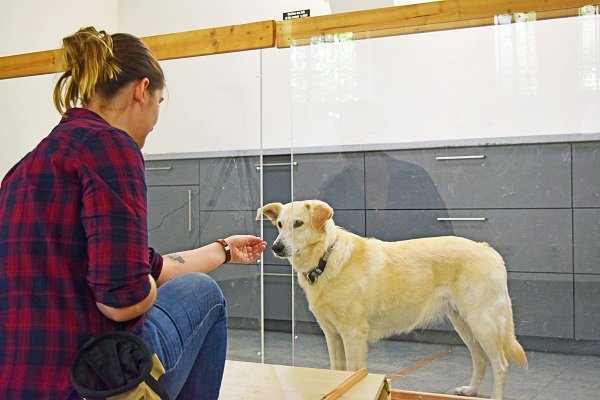
The experiment was conducted with 51 dogs, each of which was tested under three conditions. In each condition, the dog was separated from the human tester by a transparent barrier. The basic situation was that the experimenter fed the dog pieces of dog food through a gap in the barrier. In the “unwilling” condition, the experimenter suddenly withdrew the reward through the gap in the barrier and placed it in front of herself. In the “unable-clumsy” condition, the experimenter brought the reward to the gap in the barrier and “tried” to pass it through the gap but then “accidentally” dropped it. In the “unable-blocked” condition, the experimenter again tried to give the dog a reward, but was unable to because the gap in the barrier was blocked. In all conditions, the reward remained on the tester’s side of the barrier.
“If dogs are indeed able to ascribe intention-in-action to humans,” says Dr. Juliane Bräuer, “we would expect them to show different reactions in the unwilling condition compared to the two unable conditions. As it turns out, this is exactly what we observed.”
The primary behaviour measured by the researchers was the time dogs waited before approaching the reward they were denied. The researchers predicted that, if dogs are able to identify human intentions, they would wait longer before approaching the reward in the unwilling condition, where they were not supposed to have the reward, than in the two unable conditions in which the reward was, in fact, meant for them.
Not only did the dogs wait longer in the unwilling condition than in the unable conditions, they were also more likely to sit or lie down – actions often interpreted as appeasing behaviours – and stop wagging their tails.
“The dogs in our study clearly behaved differently depending on whether the actions of a human experimenter were intentional or unintentional,” says Britta Schünemann, the first author of the study. “This suggests that dogs may indeed be able to identify humans’ intention-in-action,” adds Hannes Rakoczy from the University of Göttingen.
The team acknowledges that their findings may be met with scepticism and that further study is needed to address alternative explanations, such as behavioural cues on the part of experimenters or knowledge transfer from prior dog training.
“Nevertheless,” the paper concludes, “the findings present important initial evidence that dogs may have at least one aspect of Theory of Mind: The capacity to recognize intention-in-action.”
Last week, a new review report into the greyhound racing industry in New Zealand was released. As most of you know, greyhound welfare is a topic near and dear to my heart because Izzy is an ex-racer.
This review, by the Hon Sir Bruce Robertson, is not the first review of the industry. It’s not even the second (but the second, known as the Hansen report was a whopping 93 pages. I discussed that earlier report in my blog post How many hounds needing a home?). The 2021 review is the third review of greyhound racing in this country.
So the report made some headlines last week in the news because the Minister of Racing, Grant Robertson, says he’s putting the industry ‘on notice.’ Frustratingly, none of the mainstream news sources provided a link to a copy of the actual report. Being the information geek that I am, I tracked down the report and read it thoroughly over the weekend – with highlighter pen in hand.
Before I go into some of the key findings, you should be aware that a major reason why this review was undertaken is that Greyhound Racing NZ (GRNZ) wrote to the Minister for Racing in June 2020 stating that all 20 recommendations stated in the Hansen review had been successfully implemented and so they would no longer be providing progress reports. The National Animal Welfare Advisory Committee felt that the information provided was insufficient and, with more deaths and injuries of greyhounds on the track, this review was commissioned.
I like this review, for one reason because it is PITHY. 19 pages including the appendices, it gets straight to the heart of the matter.
Key points:
Kennel audits were supposed to have been undertaken regularly; GRNZ reported that audits were done annually. This review says that comprehensive information on both the regularity of the audits and their outcomes is not available.
The database on greyhounds was to have been updated to ensure it is easily accessible, and contains accurate information on every greyhound born in NZ or imported into New Zealand until it is de-registered. This review found that not only are the data difficult to access but even the National Animal Welfare Advisory Committee cannot obtain even the simplest of information. “There does not appear to be any reason why information regarding the welfare of greyhounds should be outweighed by reasons of privacy, commercial confidentiality, or otherwise.”
The first review of racing recommended that dogs privately re-homed (as in, not through an adoption agency), should be audited to verify their whereabouts. Yet, through submissions to this review, it was found that there is not sufficient information to give any true assurance about the welfare of these dogs.
GRNZ has expanded re-homing efforts BUT it has not established any form of public reduction targets, population projections, or estimated the number of dogs needed for the industry each year. In other words, there is nothing to stop the unchecked breeding of greyhounds for the industry which expects others to take care of their dogs for their lifetimes once they are no longer deemed suitable for racing. The Hansen report clearly said that re-homing alone was not going to solve the industry’s problems.
The negative impacts of racing on overall health often do not present until a dog is settled into a new home.
“No reason given” is still the most common reason for euthanising a greyhound – and by a significant margin.
It is unclear what education and experience standards are in place for individuals employed to assist with breeding and managing kennels.
Conclusions
It has become clear that no matter the outcome of this report, or any reports henceforth, the social license of the industry will continue to be challenged for the foreseeable future. If GRNZ wishes to secure a future for the industry it governs, then it must set out to demonstrate the decency of the greyhound racing industry at every possible opportunity.
GRNZ has made its job harder by unnecessarily obfuscating information and pushing back against those with an interest. All information should be recorded, and it should be available. Arguably GRNZ has data to support its stances on the issues raisedin this report but is seen as unwillingto share this.
For those of you who have an interest, I encourage you to read the report in its entirety and share it with others. The current NZ Government says the industry is on notice and must report by the end of 2022 on its actions in response.
My view is that greyhound racing has been banned in many countries because of the animal welfare considerations. New Zealanders must ask themselves why those animal welfare issues don’t exist here. Because clearly this review has found that they do.
Kathleen Crisley, Fear-Free certified professional and specialist in dog massage, rehabilitation and nutrition/food therapy, The Balanced Dog, Christchurch, New Zealand
Note from DoggyMom: Not all statistics are created equal. This study relied upon comments in pet forums and other social media. It fails to recognise, for example, that the Labrador Retriever consistently ranks as #1 as the top family dog in the UK and the USA. If there are more of them, then they will feature more highly in statistics.
Home is where your dog is – and with good training, consistency and a bit of luck, you won’t experience major damage requiring an insurance claim
They bring us comfort, company and thousands of cute photo opportunities, but pets can also cause their fair share of utter chaos. From knocking over fragile decorations, through to leaving mud (and worse) all over our floors, rarely does a day go by where pet owners don’t find something a little surprising.
But for some animals, the chaos goes way beyond occasional accidents. We’ve scoured pet forums to work out the most destructive breeds of all. The damaging dogs who leave our homes in ruins, through to the catastrophic cats leaving us frantically checking our home insurance policies.
Dogs are more destructive than cats
Based on the number of people on pet forums lamenting their dog’s behavior, we’ve ranked the most calamity-causing canines.
Sorry, dog lovers, but your four-legged best friend has caused more damage than any feline. Despite the tendency of cats to climb into what they should keep out of, and occasionally knock things over out of spite, the chaos they cause pales in comparison to that of dogs.
The energy and excitability of dogs means they occasionally forget how big they are, crashing into things as they rush to show you how happy they are to see you. Cats, on the other hand, are like tiny gymnasts, and are far more laid back about expressions of emotion.
The top 10 most destructive dog breeds
We delved deeper into the pet forums to decipher which dog breeds are the most destructive, causing all kinds of chaos throughout their owners’ homes.
Loveable labs are the biggest home destroyers
One of the most-loved breeds around the world, the labrador has come out top of our naughty list for wreaking havoc in their owner’s home. With 6% of all mentions of various destruction centered around the breed on pet forums, it’s safe to say that their ‘butter wouldn’t melt’ faces have deceived us all!
In second place, and well known for their antics, is the beagle. Their amazing strength and huge amounts of energy have gotten them into a lot of trouble according to our research, with 5% of all mentions of household carnage including this breed.
Though some prangs may be a fact of life for pet owners, the costs don’t have to be. Finding the best home insurance policy for you could save you money and give you the peace of mind to let your perfect pooch have the free rein they deserve.
The things pets love to break
From looking all adorable curled up on your lap, to suddenly ripping up your brand new carpet, pets can decide to ruin your home at the flick of a switch. While they’re probably just doing it because they’re bored, and not because they’ve got some master plan to ruin the no claims discount on your home insurance, the things pets destroy can still end up costing a lot of money.
Here are the things most likely to meet their maker at the paws of your pets.
Item % of all mentions of damage
1
Cable/cables
26%
2
Door
24%
3
Carpet
14%
4
Wire/wires
12%
5
Sofa
8%
But don’t fret – there are ways to keep your home (relatively) pet friendly. Cats in particular love playing with anything dangly, making cables an obvious target. By using cable tidies and hiding them behind furniture, you’ll limit the temptation for cats to bat at them.
Doors are often a victim of excitable scratching. By putting vertical scratching pads on them, you can give your pets a place to vent their feelings without ruining your decorations. A good selection of scratching posts will also keep cats’ claws busy.
Carpets, meanwhile, can fall victim to many animal habits. For the messier ones, we’d recommend a good carpet cleaner to mop up any stains. If sharp claws are more of a concern, both cats and dogs can be trained to leave your carpets alone, so long as they have other options to play with.
Generally, lots of playing and exercise with your pets will stop them playing havoc with your house, and save you having to make a claim on your home insurance. Remember, they’re only doing it because they love you.
Destructive dog breeds and what they love to wreck
We took a look at what the most common form of destruction is for each breed, by matching their mentions on pet forums with each type of damage.
Keep your fragile ornaments away from blundering bull terriers
Staffordshire bull terriers are the clumsiest breakers of the breeds, with 1 in 20 mentions of broken phones, plant pots, glasses and more involving them. They’re a powerful breed with incredible muscles, meaning any excited indoor play could easily result in broken possessions. They love outdoor exercise though, and the more of that they get, the more tired they’ll be when you get them home.
Labradors, however, prefer to destroy things in a much wetter way. They’re the most likely dog to confuse your furniture and carpet for their toilet, so consistent training is essential if you want to keep your home stain free.
Coming home to a chewed skirting board or nibbled sofa is a common occurrence for collie owners, with the breed being mentioned the most for this type of damage. They also received the top mentions for the total destruction of property and the snapping of small household objects, like dustpans, dog bowls and mops. If you have a collie in your home, expect chaos!
In the garden, it’s the shih tzu that will dig up your favourite flower bed to bury that bone, so gardeners beware! For food-lovers, it’s the beagle that you need to watch out for. This breed will steal the food off your plate, tip over the bin for a rummage and ransack any cupboard in reach, with 1 in 15 mentions of food theft including their name.
If you compare home insurance, you can make sure your policy covers your pet’s particular habits – from secret scavenging to amateur gardening.
The cat breeds most likely to destroy things at home
Bengal cats might be beautiful, but their wee certainly isn’t. This breed tops the charts of destructive cats, mainly for their love of urinating in their owners’ homes. Cat pee has a smell that really sticks with you, especially when it’s in the middle of your floor. With 1 in 3 mentions of cats behaving badly linked to the Bengal, this is one sassy cat to look out for.
Ragdolls also enjoy their turn at wrecking things. They’re a very needy breed, and if you leave them alone for too long they may well take that neediness out on your belongings.
Tabby cats come in third place. These cats crave exercise, and keeping them inside for too long could see your furniture fall victim to their pent-up aggression. By letting them roam and explore their surroundings, you can prevent the destruction of your home.
The most loved pets on the internet
It’s not all bad news for pet lovers. While they might occasionally scratch/chew/eat/wee on something important, they’ll more than make up for it in the love they show you.
We analysed social media sentiment to see which pets were receiving the most heart eyes and laughing faces from posts about pets online.
Golden retrievers are the most loved pet on the internet
The popular and adorable golden retriever is officially the most loved pet online, with an average of 222 ‘love’ reactions per online post around the breed, far ahead of the cocker spaniel in second place with 84 loves for every post. The golden retriever also received the most posts online, with 4.4 million in the last year alone.
The sass and mischievous behaviour of the Bengal cat received the second-highest number of posts, with 2.4 million in the last year. Bengals have also earned the title of the funniest pet on the internet, with 17 laughing emojis per post. The clumsy and comical Great Dane took a close second place for the dogs with 16 reactions a post. Great Danes are also racking up the sad face emojis, with its puppy dog eyes gaining the sympathy vote online.
Labradoodles and their owners are getting into the most trouble with their energetic antics online, with the highest amount of angry reactions at 79 reactions for every post.
BreedTotal online reactions
1
Golden retriever
4,400,000
2
Bengal cat
2,400,000
3
German shepherd
2,300,000
4
Chihuahua
1,300,000
5
Bulldog
1,200,000
6
Labrador
1,000,000
7
Great Dane
754,600
8
Boxer
711,900
9
French bulldog
509,400
10
Dachshund
445,000
The secret price of pet ownership
When buying a pet, there’s much more than the initial cost to think about. When you add the price of food, toys and pet insurance to the list, the price quickly adds up.
On top of that, it’s well worth thinking about the impact they’ll have on your home. If you compare home insurance, you should be able to find a policy that can cover the cost of accidental damage, letting you enjoy all the company your pet brings without having to worry about them wrecking your property.
Methodology
We collected over 20,000 posts from pet owners at petforums.co.uk, analysing each for mentions of specific breeds alongside descriptive words for damage, to figure out which breed was most frequently mentioned, and therefore, the most destructive. We then broke down the mentions of breed into specific types of damage, through mentions of key words like ‘chew’ and ‘wee’ alongside household objects, to reveal the breeds causing each type of damage.
To identify the most loved pets on the internet we used social listening tool Buzzsumo to analyse the number of each type of reaction each breed received on all posts in the last year, and divided this by the number of posts about the breed, to get the average number of each type of reaction per social post.













 DoggyMom.com