What Makes A Good Working Dog? Canine ‘Aptitude Test’ Might Offer Clues

The canine labor market is diverse and expansive. Assistance dogs may be trained to work with the visually or hearing impaired, or with people in wheelchairs. Detection dogs may be trained to sniff out explosives, narcotics or bedbugs. Other pups even learn to jump out of helicopters on daring rescue missions.

Despite the wide variety of working roles available for man’s best friend, those jobs can be tough to fill, since not every dog will qualify. Even among dogs specifically bred to be assistance dogs, for example, only about 50 percent that start a training program will successfully complete it, while the rest go on to be very well-trained family pets.

As a result, the wait list for a trained assistance dog can be up to two years.
Working Dogs

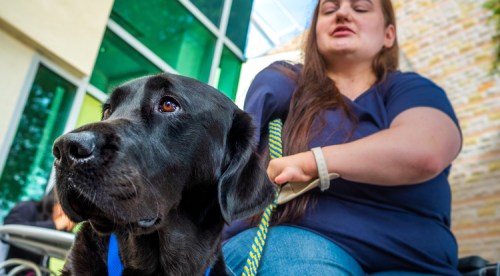
Shelby Smith was matched with her assistance dog Picasso through the nonprofit Canine Companions for Independence. UA researcher Evan MacLean is looking for ways to help organizations like Canine Companions identify promising assistance dogs sooner. (Photo: Bob Demers/UANews)

Evan MacLean, director of the Arizona Canine Cognition Center at the University of Arizona, is exploring ways to identify the best dogs for different jobs – before they start the long and expensive training process — by looking at their cognitive abilities.

He is lead author of a new study in Frontiers in Veterinary Science that looks at whether canines’ cognitive abilities can help predict their success as working dogs.

While a dog’s physical characteristics and temperament are often considered when thinking about which dog will be right for a given job, cognition is an area that’s received far less attention.

“People have really focused on temperament and how reactive a dog is to certain things in the environment,” said MacLean, assistant professor in the UA School of Anthropology. “What we were interested in was the fact that these dogs also face cognitive challenges. They have to learn all these things in the course of their training, and they have to be able to flexibly solve problems when things go wrong.”

MacLean’s study focuses on two types of working dogs: assistance dogs in training, which will go on to be paired with people with disabilities, and explosive detection dogs working for the U.S. Navy.

MacLean and his colleagues looked at the performance of both types of dogs on 25 different cognitive measures by using a battery of game-based tests, like hiding and finding objects and other forms of canine play.

What they found: A different set of skills predict whether a dog will be a good detection dog or a good assistance dog.

In the case of assistance dogs, social skills — including the ability to pay close attention to and maintain eye contact with humans — appear to be especially important. In detection dogs, good short-term memory and sensitivity to human body language, such as pointing gestures, were the best predictors of success.

“Dog jobs are just about as diverse as human jobs are,” MacLean said. “People sometimes think of working dogs as this general category of dogs that have jobs in society, but they actually have to do really, really different things, and because these jobs are so diverse, we didn’t expect that there was going to be one litmus test for what would make a good dog. It’s like if you think about aptitude testing with people – there are certain questions that will tell you something about one job but not another.”

The study involved 164 dogs from the California-based organization Canine Companions for Independence, which trains assistance dogs, and 222 dogs from the Navy.

The researchers tested the assistance dogs at 18 months old, when they first started a full-time, intensive six-month training program. Dogs in the study were considered “successful” based on whether or not they ultimately graduated from the training. Through cognitive testing, MacLean and his colleagues were able to predict the top 25 percent of graduates with 86 percent accuracy.

The success of the Navy dogs, whose training is ongoing and not marked by a single graduation date, was measured based on trainers’ records of the dogs’ performance on training exercises, as well as questionnaires with people who trained or deployed with the dogs.

MacLean’s findings suggest that cognition could be considered alongside temperament and physicality to predict working dog success.

If organizations that train dogs could better predict which dogs are most worth the investment, it could save tens of thousands of dollars in unnecessary training costs and also ensure that people in need get the right dogs faster, MacLean said.

He and his colleagues are now working on determining if cognitive testing could be informative even earlier — when a dog is just 8 weeks old. They also are looking at whether these skills have a genetic basis that could be targeted in breeding programs.

“One of the most exciting parts of all this is that it tells us cognition does something in animals,” MacLean said. “We study these abstract questions about how animals think about the world and how they solve problems, but there aren’t always a lot of situations where you can say, ‘Why does that matter? What does it allow an animal to actually do?’ This is some of the first evidence that suggests that these processes that we measure, which differ between individual dogs, have some real consequences related to something that’s quite worthy in society.”


Source:  University of Arizona media release

Doggy quote of the month for November

“An immaculate house is a wonderful and elegant thing, but it can also be an empty and a cold thing.  I’ll take mine with flying paws and whisking tails and eager loving looks from dark earnest eyes.  When the children go away to school, and get married and move away, there are so many little quiet corners in a house.  A bevy of Cockers and an Irish or two livens things up considerably.  It is hard to be melancholy with somebody playing leapfrog around the room.”

Gladys Taber

Glady Taber, author (1899 – 1980)

Study finds glyphosate in cat and dog food

Got glyphosate?

Your pet’s breakfast might.

glyphosate

A new Cornell study published this month in Environmental Pollution finds that glyphosate, the active herbicidal ingredient in widely used weed killers like Roundup, was present at low levels in a variety of dog and cat foods the researchers purchased at stores. Before you go switching Fido or Fluffy’s favorite brand, however, be aware that the amounts of the herbicide found correspond to levels currently considered safe for humans.

The study grew out of a larger interdisciplinary research project led by Brian Richards, senior research associate in biological and environmental engineering, and supported by the Atkinson Center for a Sustainable Future’s Academic Venture Fund, which sought to reassess glyphosate mobility and impacts in several contexts: movement from crop fields in surface water, impacts on soils and on animals consuming it in their feed.

Richard’s co-investigators Anthony Hay, associate professor of microbiology, and Kenneth Simpson, professor of small-animal medicine, visited a pet store and a retail outlet, where they selected multiple bags of cat and dog foods from major brands. The 18 feeds were all mixtures of vegetable and meat ingredients, and one product was certified GMO-free. Analyses conducted by postdoctoral researcher and lead author Jiang Zhao in Hay’s lab, and research support specialist Steve Pacenka, found that all of the products contained glyphosate at concentrations ranging from approximately 80 to 2,000 micrograms of glyphosate per kilogram.

Since there is not enough data available to determine what effect – if any – low-dose glyphosate exposure has on domestic animals, the researchers used human acceptable daily intake guidelines to put these findings in context, according to Hay. The researchers estimated that the median dog exposure would amount to only 0.7 percent of the U.S. glyphosate limit set for humans.

“While the levels of glyphosate in pet foods surprised us, if a human ate it every day, their glyphosate exposure would still be well below the limits currently deemed safe,” Hay said.

“Even the most contaminated feed they studied had thousands of times less glyphosate than levels that were shown to have no adverse effects on dogs in the U.S. EPA’s Draft Risk Assessment for glyphosate” said Dan Wixted, a pesticide educator with Cornell Cooperative Extension who was not involved in the study.

While unable to pinpoint the exact product or crops that were the source of the glyphosate, Hay’s team did find a correlation with fiber, suggesting a plant-based origin.

“We know that glyphosate is only certified for spraying on crops, and it does not bio-accumulate in animals, so we would not expect it to come from feed animals that are the main protein sources in some of the products,” Hay said. “Our evidence suggests that it’s coming from plant material.”

One surprising finding of the study: Glyphosate was detected in the one GMO-free product the researchers analyzed at levels higher than those of several other processed feeds. This suggests that keeping feed stocks uncontaminated is a challenge even in the GMO-free market.

What is a pet owner to do with this information?

“Glyphosate is out there in our pets’ food, and while there doesn’t appear to be any immediate risk, there is still uncertainty about the chronic impact of low doses like these,” Hay said. “It’s hard to find a product that doesn’t have glyphosate in it, so we included the exposure assessment to provide some context. The old adage ‘dose determines the poison’ is good to keep in mind: While it’s possible that these animals might respond differently than humans, the numbers are still within a range that would be deemed safe for humans.”

Hay, for his part, has stopped feeding chow found to be high in glyphosate to his own dog, a pug beagle mix, but he hasn’t seen any changes in her health.

“She’s more cat than dog to be honest,” he said. “She sits on the bed and won’t go outside when it rains. But I can now confirm that her laziness has nothing to do with her feed.”

Source:  Cornell Chronicle

There’s a technical term for almost everything – the zoomie

The zoomie is something that greyhounds specialize in.  But, of course, other breeds do them too.

Did you know that the technical term for the zoomie is Frenetic Random Activity Period (or FRAP for short)?

Enjoy these videos of greyhound zoomies!

Kathleen Crisley, Fear-Free certified professional and specialist in dog massage, rehabilitation and nutrition/food therapy, The Balanced Dog, Christchurch, New Zealand


Yes, your pet can tell time

Are you taking your time when feeding your pet? Fluffy and Fido are on to you — and they can tell when you are dawdling.

time dog

A new study from Northwestern University has found some of the clearest evidence yet that animals can judge time. By examining the brain’s medial entorhinal cortex, the researchers discovered a previously unknown set of neurons that turn on like a clock when an animal is waiting.

“Does your dog know that it took you twice as long to get its food as it took yesterday? There wasn’t a good answer for that before,” said Daniel Dombeck, who led the study. “This is one of the most convincing experiments to show that animals really do have an explicit representation of time in their brains when they are challenged to measure a time interval.”

The research was published online this week in the journal Nature Neuroscience. Dombeck is an associate professor of neurobiology in Northwestern’s Weinberg College of Arts and Sciences.

When planning the study, Dombeck’s team focused on the medial entorhinal cortex, an area located in the brain’s temporal lobe that is associated with memory and navigation. Because that part of the brain encodes spatial information in episodic memories, Dombeck hypothesized that the area could also be responsible for encoding time.

“Every memory is a bit different,” said James Heys, a postdoctoral fellow in Dombeck’s laboratory. “But there are two central features to all episodic memories: space and time. They always happen in a particular environment and are always structured in time.”

To test their hypothesis, Dombeck and Heys set up an experiment called the virtual “door stop” task. In the experiment, a mouse runs on a physical treadmill in a virtual reality environment. The mouse learns to run down a hallway to a door that is located about halfway down the track. After six seconds, the door opens, allowing the mouse to continue down the hallway to receive its reward.

After running several training sessions, researchers made the door invisible in the virtual reality scene. In the new scenario, the mouse still knew where the now-invisible “door” was located based on the floor’s changing textures. And it still waited six seconds at the “door” before abruptly racing down the track to collect its reward.

“The important point here is that the mouse doesn’t know when the door is open or closed because it’s invisible,” said Heys, the paper’s first author. “The only way he can solve this task efficiently is by using his brain’s internal sense of time.”

By using virtual reality, Dombeck and his team can neatly control potentially influencing factors, such as the sound of the door opening. “We wouldn’t be able to make the door completely invisible in a real environment,” Dombeck said. “The animal could touch it, hear it, smell it or sense it in some way. They wouldn’t have to judge time; they would just sense when the door opened. In virtual reality, we can take away all sensory cues.”

But Dombeck and his team did more than watch the mice complete the door stop task over and over again. They took the experiment one step further by imaging the mice’s brain activity. Using two-photon microscopy, which allows advanced, high-resolution imaging of the brain, Dombeck and Heys watched the mice’s neurons fire.

“As the animals run along the track and get to the invisible door, we see the cells firing that control spatial encoding,” Dombeck said. “Then, when the animal stops at the door, we see those cells turned off and a new set of cells turn on. This was a big surprise and a new discovery.”

Dombeck noted these “timing cells” did not fire during active running — only during rest. “Not only are the cells active during rest,” he said, “but they actually encode how much time the animal has been resting.”

The implication of the work expands well beyond your impatient pooch. Now that researchers have found these new time-encoding neurons, they can study how neurodegenerative diseases might affect this set of cells.

“Patients with Alzheimer’s disease notably forget when things happened in time,” Heys said. “Perhaps this is because they are losing some of the basic functions of the entorhinal cortex, which is one of the first brain regions affected by the disease.”

“So this could lead to new early-detection tests for Alzheimer’s,” Dombeck added. “We could start asking people to judge how much time has elapsed or ask them to navigate a virtual reality environment — essentially having a human do a ‘door stop’ task.”

Source:   Northwestern University media statement

A dog’s colour could impact longevity, increase health problems

New research led by the University of Sydney has revealed the life expectancy of chocolate Labradors is significantly lower than their black and yellow counterparts.
Chocolate Labrador

The study of more than 33,000 United Kingdom-based Labrador retrievers of all colours shows chocolate Labradors also have a higher incidence of ear infections and skin disease. Its findings were published in the open access journal Canine Genetics and Epidemiology.

Part of the University’s VetCompass™ Programme, which collects and analyses electronic patient data on dogs, the research is being replicated in Australia, where Labradors are the most popular breed of dog.

In the UK, the median longevity of non-chocolate Labradors is 12.1 years, more than 10 percent longer than those with chocolate coats. The prevalence of ear inflammation (otitis externa) was twice as high in chocolate Labradors, who were four times more likely to have suffered from pyo-traumatic dermatitis (also known as hot-spot).

Lead author Professor Paul McGreevy, from the University’s Faculty of Science, said the relationship between coat colour and disease came as a surprise to researchers. The UK findings may not hold in Australian Labradors, he said, but warrant investigation.

“The relationships between coat colour and disease may reflect an inadvertent consequence of breeding certain pigmentations,” he said. “Because chocolate colour is recessive in dogs, the gene for this colour must be present in both parents for their puppies to be chocolate. Breeders targeting this colour may therefore be more likely to breed only Labradors carrying the chocolate coat gene. It may be that the resulting reduced gene pool includes a higher proportion of genes conducive to ear and skin conditions.”

Across the entire Labrador population, the most common health conditions found were obesity, ear infections and joint conditions.

“We found that 8.8 percent of UK Labradors are overweight or obese, one of the highest percentages among dog breeds in the VetCompass™ database,” Professor McGreevy said.

The prevalence was higher among male dogs who had been neutered.

Source:  University of Sydney media statement

Scientists chase mystery of how dogs process words

When some dogs hear their owners say “squirrel,” they perk up, become agitated. They may even run to a window and look out of it. But what does the word mean to the dog? Does it mean, “Pay attention, something is happening?” Or does the dog actually picture a small, bushy-tailed rodent in its mind?

scanner_eddie

Eddie, one of the dogs that participated in the study, poses in the fMRI scanner with two of the toys used in the experiments, “Monkey” and “Piggy.” (Photo courtesy Gregory Berns)

Frontiers in Neuroscience published one of the first studies using brain imaging to probe how our canine companions process words they have been taught to associate with objects, conducted by scientists at Emory University. The results suggest that dogs have at least a rudimentary neural representation of meaning for words they have been taught, differentiating words they have heard before from those they have not.

“Many dog owners think that their dogs know what some words mean, but there really isn’t much scientific evidence to support that,” says Ashley Prichard, a PhD candidate in Emory’s Department of Psychology and first author of the study. “We wanted to get data from the dogs themselves — not just owner reports.”

“We know that dogs have the capacity to process at least some aspects of human language since they can learn to follow verbal commands,” adds Emory neuroscientist Gregory Berns, senior author of the study. “Previous research, however, suggests dogs may rely on many other cues to follow a verbal command, such as gaze, gestures and even emotional expressions from their owners.”

The Emory researchers focused on questions surrounding the brain mechanisms dogs use to differentiate between words, or even what constitutes a word to a dog.

Berns is founder of the Dog Project, which is researching evolutionary questions surrounding man’s best, and oldest friend. The project was the first to train dogs to voluntarily enter a functional magnetic resonance imaging (fMRI) scanner and remain motionless during scanning, without restraint or sedation. Studies by the Dog Project have furthered understanding of dogs’ neural response to expected reward, identified specialized areas in the dog brain for processing faces, demonstrated olfactory responses to human and dog odors, and linked prefrontal function to inhibitory control.

For the current study, 12 dogs of varying breeds were trained for months by their owners to retrieve two different objects, based on the objects’ names. Each dog’s pair of objects consisted of one with a soft texture, such as a stuffed animal, and another of a different texture, such as rubber, to facilitate discrimination. Training consisted of instructing the dogs to fetch one of the objects and then rewarding them with food or praise. Training was considered complete when a dog showed that it could discriminate between the two objects by consistently fetching the one requested by the owner when presented with both of the objects.

During one experiment, the trained dog lay in the fMRI scanner while the dog’s owner stood directly in front of the dog at the opening of the machine and said the names of the dog’s toys at set intervals, then showed the dog the corresponding toys.

Eddie, a golden retriever-Labrador mix, for instance, heard his owner say the words “Piggy” or “Monkey,” then his owner held up the matching toy. As a control, the owner then spoke gibberish words, such as “bobbu” and “bodmick,” then held up novel objects like a hat or a doll.

The results showed greater activation in auditory regions of the brain to the novel pseudowords relative to the trained words.

“We expected to see that dogs neurally discriminate between words that they know and words that they don’t,” Prichard says. “What’s surprising is that the result is opposite to that of research on humans — people typically show greater neural activation for known words than novel words.”

The researchers hypothesize that the dogs may show greater neural activation to a novel word because they sense their owners want them to understand what they are saying, and they are trying to do so. “Dogs ultimately want to please their owners, and perhaps also receive praise or food,” Berns says.

Half of the dogs in the experiment showed the increased activation for the novel words in their parietotemporal cortex, an area of the brain that the researchers believe may be analogous to the angular gyrus in humans, where lexical differences are processed.

The other half of the dogs, however, showed heightened activity to novel words in other brain regions, including the other parts of the left temporal cortex and amygdala, caudate nucleus, and the thalamus.

These differences may be related to a limitation of the study — the varying range in breeds and sizes of the dogs, as well as possible variations in their cognitive abilities. A major challenge in mapping the cognitive processes of the canine brain, the researchers acknowledge, is the variety of shapes and sizes of dogs’ brains across breeds.

“Dogs may have varying capacity and motivation for learning and understanding human words,” Berns says, “but they appear to have a neural representation for the meaning of words they have been taught, beyond just a low-level Pavlovian response.”

This conclusion does not mean that spoken words are the most effective way for an owner to communicate with a dog. In fact, other research also led by Prichard and Berns and recently published in Scientific Reports, showed that the neural reward system of dogs is more attuned to visual and to scent cues than to verbal ones.

“When people want to teach their dog a trick, they often use a verbal command because that’s what we humans prefer,” Prichard says. “From the dog’s perspective, however, a visual command might be more effective, helping the dog learn the trick faster.”

Source:  Emory University

Dog intelligence ‘not exceptional’

Note from DoggyMom:

This research hit mainstream media at the beginning of the month.  It’s an important part of the research process to have results peer reviewed and it is also common for reviews of this nature – across multiple pieces of research.

I don’t necessarily think that dogs must be exceptional, however.  And so the results of cognition research that have been published so far shouldn’t be discounted because of this review.  Rather, the cognition research undertaken with dogs helps to prove that they are sentient (very important for animal welfare laws) and more intelligent than many people (and policy makers) believe.

I certainly don’t expect my dogs to be Einstein, but I do see that they have intelligence and emotions – both of which we should respect.


Scientists reviewed evidence that compared the brain power of dogs with other domestic animals, other social hunters and other carnivorous (an order including animals such as dogs, wolves, bears, lions and hyenas).Dog intelligence photo

The researchers, from the University of Exeter and Canterbury Christ Church University, found the cognitive abilities of dogs were at least matched by several species in each of these groups.

The study examined more than 300 papers on the intelligence of dogs and other animals, and found several cases of “over interpretation” in favour of dogs’ abilities.

“During our work it seemed to us that many studies in dog cognition research set out to ‘prove’ how clever dogs are,” said Professor Stephen Lea, of the University of Exeter.

“They are often compared to chimpanzees and whenever dogs ‘win’, this gets added to their reputation as something exceptional.

“Yet in each and every case we found other valid comparison species that do at least as well as dogs do in those tasks.”

The review focussed on sensory cognition, physical cognition, spatial cognition, social cognition and self-awareness.

“Taking all three groups (domestic animals, social hunters and carnivorans) into account, dog cognition does not look exceptional,” said Dr Britta Osthaus, of Canterbury Christ Church University.

“We are doing dogs no favour by expecting too much of them. Dogs are dogs, and we need to take their needs and true abilities into account when considering how we treat them.”

The paper, published in the journal Learning & Behavior, is entitled: “In what sense are dogs special? Canine cognition in comparative context.”

Source:  University of Exeter media release

Have asthma & a pet? Re-homing your cat or dog may not be necessary

Note from Doggy Mom:  I’ve met parents who think that their asthmatic child shouldn’t keep a pet because of the risks of the pet bringing dander and other environmental allergens into the home.    However, this piece of research refutes that belief.  If asthmatic children are managed appropriately with medication, the dog (or cat) can probably stay!

And don’t forget that other research shows that children born into homes with pets have a lower risk of developing the disease (just type ‘asthma’ in the search box to bring up these citations).

boy-and-dog


A study from the Nationwide Children’s Hospital analyzed environmental exposures, like pet and secondhand smoke, to determine if they have a role in asthma control among children whose asthma is managed per NAEPP (EPR-3) guidelines. Researchers found that once asthma guidelines are followed, environmental exposures to pets or secondhand smoke were not significant factors in overall asthma improvement over time.

Children with the diagnosis of uncontrolled asthma and were followed at a pediatric asthma center were provided asthma care as per NAEPP guidelines. At each visit (3-6 months), families completed asthma questionnaires including acute care needs, symptom control and asthma control test (ACT). Asthma control in patients was evaluated at each visit. Results were compared between patients with or without exposure to secondhand smoking and between patients with or without exposure to pets (cats or dogs) at home at baseline and over time.

Three hundred and ninety-five children, ages 2 to 17 years, were included in this study; 25 percent were exposed to secondhand tobacco smoke, and 55 percent were exposed to a cat or dog at home. Clinical outcomes included over time in this cohort, and this improvement was independent of pet exposure. These findings suggest that asthma treatment is more important than certain types of environmental exposures.

Journal citation here.

Source:  American College of Chest Physicians


Why huskies have blue eyes

DNA testing of more than 6,000 dogs has revealed that a duplication on canine chromosome 18 is strongly associated with blue eyes in Siberian Huskies, according to a study published October 4, 2018, in the open-access journal PLOS Genetics by Adam Boyko and Aaron Sams of Embark Veterinary, Inc., and colleagues.

Embark is a dog DNA startup company headquartered in Boston, MA, and Ithaca, NY, and research partner of the Cornell University College of Veterinary Medicine. According to the authors, this represents the first consumer genomics study ever conducted in a non-human model and the largest canine genome-wide association study to date.

Lakota

Embark dog, Lakota, shows off bright blue eyes. Credit: Jamie Leszczak CCAL

Consumer genomics enables genetic discovery on an unprecedented scale by linking very large databases of genomic data with phenotype information voluntarily submitted via web-based surveys. But the promise of consumer genomic data is not limited to human research. Genomic tools for dogs are readily available but the genetic underpinnings of many important traits remain undiscovered. Although two genetic variants are known to underlie blue eye color in some dogs, these do not explain the trait in some other dogs, like Siberian Huskies.

To address this gap in knowledge, Boyko, Sams and colleagues used a diverse panel of 6,070 genetically tested dogs with owners that contributed phenotype data via web-based surveys and photo uploads. They found that a 98.6-kilobase duplication on chromosome 18 near the ALX4 gene, which plays an important role in mammalian eye development, was strongly associated with variation in blue eye color, primarily in Siberian Huskies but also in non-merle Australian Shepherds. One copy of the variant was enough to cause blue eyes or heterochromia (blue and brown eyes), although some dogs with the variant did not have blue eyes, so other genetic or environmental factors are still involved.

Future studies of the functional mechanism underlying this association may lead to the discovery of a novel pathway by which blue eyes develop in mammals. From a broader perspective, the results underscore the power of consumer data-driven discovery in non-human species, especially dogs, where there is intense owner interest in the personal genomic information of their pets, a high level of engagement with web-based surveys, and an underlying genetic architecture ideal for mapping studies.

Aaron J. Sams adds: “Using genetic data from the pets of our customers, combined with eye colors reported by customers for those same animals, we have discovered a genetic duplication that is strongly associated with blue eye color. This study demonstrates the power of the approach that Embark is taking towards improving canine health. In a single year, we collected enough data to conduct the largest canine study of its kind. Embark is currently pursuing similar research projects in a range of morphological and health-related traits and we hope to continue to use our platform to move canine genetics and health forward in a very real way.”

Source:  Science Daily and PLOS Genetics