New sniffer dog research

A team of scientists has provided the first evidence that dogs can learn to categorise odours and apply this to scents they have never encountered before.

The research reveals how the animals process odour information and is likely to have a profound impact on how we train sniffer dogs.

Sniffer dog research
Training a sniffer dog (photo courtesy of University of Lincoln)

The study, led by researchers at the University of Lincoln, UK, and funded by the Office of Naval Research and the Office of Naval Research (ONR) Global in the US,
found that dogs are able to categorise odours on the basis of their common properties. This means that dogs can behave towards new smells from a category in the same way as smells that they already know.

As humans, we do not have to experience the smell of every fish to know that it smells ‘fishy’; instead we use our previous experience of fish and categorise the new smell in the correct way. The new research, published in the journal Scientific Reports, reveals that dogs can do the same.

Researchers separated dogs into two groups and then trained them to respond to 40 different olfactory stimuli – or smells – half of which were accelerant-based. The dogs in the experimental group were trained (through a reward) to offer a behavioural response, for example “sit”, when they were presented with smells which fit a specific category, but to withhold that response for other non-category stimuli. The remaining dogs were trained on the same stimuli but were not rewarded for the categorical variable.

The researchers found that only the dogs in the category group were able to learn the task. Even more significantly, when presented with completely unknown smells, the dogs were able to place them in the correct category and to remember the odours six weeks later.

The researchers concluded that this means that dogs can apply information from previous experience to novel – or new – scents in order to apply an appropriate response.

Dr Anna Wilkinson from the School of Life Sciences at the University of Lincoln said: “As humans, we are very good at assigning different things to different categories; for example, we know something is a chair because there are identifiable aspects such as a flat space to sit on, or four legs. Categorising odours works the same way, and we were keen to discover whether dogs would be able to learn those skills.  

“This was an extremely hard task for the dogs as the odour stimuli varied in strength, so animals were never trained on exactly the same stimulus. As such, it is even more impressive that the experimental group dogs learned and retained the information.

“These findings add substantially to our understanding of how animals process olfactory information and suggest that use of this method may improve performance of working animals.”

The findings have implications in the field of working dog training as it implies that it may be possible to improve the way we train detection dogs.

Source:  University of Lincoln press release

Christmas stress and dogs

It’s that time of year again –  Christmas (followed closely by New Year).  And if the traffic is anything to go by (and I am a mobile practitioner, so I’m on the road fairly often), holiday preparations are in full swing.  The schools have let out for summer, and the shopping intensity is increasing.  So, too, are the rates of pre-Christmas stress.

Holiday plans, parties, travel, new guests coming to stay, and presents and food to buy and prepare should be happy things, but a lot of  people get stressed by them, too.

Have you ever thought about the impact of Christmas on your dog?

Feliz Naughty Dog

Our dogs also suffer stress.   With the changes in routine and surroundings that Christmas brings, we shouldn’t be surprised if our dogs get stressed.

Some will become destructive, such as unwrapping presents under the tree or chewing on ornaments/lights.  (These are also a health hazard, of course.)   Others may show their stress through lip-licking and yawning, backing away, going off their food, pacing, tucking their tail under, etc.

It’s important to know the signs of a stressed dog and to do something to lower your dog’s anxiety.

Ensure your dog has a safe space at home – like a crate or a bedroom – where they can retreat when they have had enough.

Play calming music, spray the room with calming mixtures of essential oils, Bach flower remedies, or Adaptil.

And do your very best to keep your dog on a regular routine.  Meal times and walks are things that your dog has come to count on at certain times of the day. Don’t mess about with these ‘certains’ in their life – it helps to keep stress in check.

Kathleen Crisley, specialist in dog massage, rehabilitation and nutrition/food therapy, The Balanced Dog, Christchurch, New Zealand

Therapy dog vs service dog

There are differences between a therapy dog and a service dog, but the two are often confused.

That’s why I really liked this graphic, produced by the Las Vegas Sun:

Therapy vs Service Dog

The difference between a therapy pet and a service animal (courtesy of the Las Vegas Sun)

The newspaper interviewed Sue Grundfest, Lead Animal Therapist at Southern Hills Hospital and Medical Center, for its article.

Kathleen Crisley, specialist in dog massage, rehabilitation and nutrition/food therapy, The Balanced Dog, Christchurch, New Zealand

A dog’s life in families with children

Note from DoggyMom:

This research reinforces my advice to families with young children and dogs:  understand your dog’s non-verbal and verbal cues so you can pick up when they are stressed, going over threshold, and need time away from the children.

I have several clients on my books currently who are expecting their first child in 2018; this is a subject that we discuss on a regular basis.


Millions of families know how rewarding and enjoyable dog ownership can be – but now a new study has for the first time examined the quality of life for a pet dog owned by a family with children.

happy dog

Photo courtesy of University of Lincoln

There is now extensive scientific research showing the many benefits that pet dogs bring to families, including improved family functioning and wellbeing for those with children with neuro-developmental disorders such as Autism Spectrum Disorder (ASD) and ADHD. For all children, dogs can provide valuable companionship, encourage exercise and family activities, and teach them about responsibilities.

Until now, little attention has been paid to how living with children affects quality of life for pet dogs (those not trained as assistance dogs). Funded by Dogs Trust – the UK’s largest dog welfare charity – a team of animal behaviour and welfare specialists from the University of Lincoln’s School of Life Sciences are examining this question.

Published in the scientific journal PLOS ONE, their latest research involved interviewing parents who own a dog – half with typically developing children and half with children with Autism or ADHD, with all children aged between four and 10 years old.

The research revealed that the child-dog relationship has a number of beneficial aspects for the dog, including a sense of routine, more time for fun and play, and companionship.

Dr Sophie Hall, a Research Fellow specialising in human-animal interactions at the University of Lincoln’s School of Life Sciences, said: “Our study involved 36 dog-owning families, who all highlighted some key benefits that their pet dogs receive from living with young children.

“For example children provide close companionship for pets as well as imposing a sense of predictable and consistent routine in the home, in terms of feed and walk times, which we know is extremely important for a dog’s wellbeing. Of course, children also play regularly with their pet dogs and activities such as throwing a ball and doing assault courses represent really valuable opportunities for exercise and positive mental stimulation.

“The study also highlighted some potentially negative impacts on the pet, which it is important for parents to be aware of when bringing a dog into a home with children.”

The negative impact could be brought on by children having tantrums, with parents observing their dogs running away, shaking or hiding on some of these occasions. Parents also observed a change in their dog’s behaviour if it became ‘over stimulated’ – such as barking, becoming agitated, or seeking a place to escape – when their children were very noisy.

Other events that could cause potential distress for dogs in homes with children could include rough play or accidents such as collisions with toys or pulling the dog’s tail.

The study suggests that in a home with small children, it is important for dogs to have a ‘safe haven’ to escape to if needed, and for parents to understand both the obvious and more subtle signs of distress in their pets and to teach their family about these signs. For example, pet dogs often have wide eyes or lick their lips when they are mildly stressed.

Dr Hall added: “The positive and negative aspects of the child-dog relationship were similar in families with typically developing children and in those with children with a neuro-developmental disorder.

“As such, providing they are aware of key risk events and how to cope with these, and ensuring adequate supervision, parents should not necessarily be dissuaded from acquiring a pet dog because of their child’s developmental issues. As we know, pet dogs can really enrich family life and support child development and wellbeing.”

The results of this initial study are now being developed further by the team at the University of Lincoln with support from Dogs Trust.

The paper is freely available to view online at PLOS ONE.

Source:  University of Lincoln media release

Favorite Video Friday-Clean sheet craziness

That freshly made bed feeling…

Mel's avatarNo Dog About It Blog

You know that feeling when you slide into bed after putting on a fresh set of clean sheets? Yeah. That. 🙂

Happy Friday everyone!

View original post

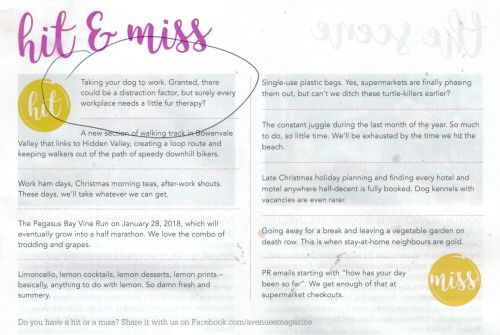
Hits and misses

Christchurch-based monthly magazine, Avenues, has a regular ‘hit & miss’ column to recognise things they like and don’t like which are happening around the city.

I’m pleased that dog-friendly workplaces have made the “Hit” list.

Hits and Misses

Of course, fur therapy is just one of the benefits of a dog-friendly workplaces.

Other benefits include:

  • studies show that people in a dog-friendly workplace will stay at work longer when they are not worried about getting home to their dog
  • with health & safety employer obligations, having dogs in the office to walk encourages staff to have proper breaks and exercise
  • staff have reduced dog care costs – no more costly day care payments which can add up quickly over time
  • because dogs act as a social lubricant, co-workers tend to interact more in a dog-friendly workplace

Kathleen Crisley, specialist in dog massage, rehabilitation and nutrition/food therapy, The Balanced Dog, Christchurch, New Zealand


Dogs get the Hollywood treatment to make animal animations more realistic

Researchers are creating a library of movement data from different dog breeds, to make animal animations in films and video games more realistic.

Hollywood greyhound

Motion data from the dogs will help create more realistic animal animations for games and films

Films such as the Planet of the Apes used motion capture techniques extensively to transform their human actors into apes, however this process doesn’t work well for true four-legged animals.

Now computer scientists from the Centre for Analysis of Motion, Entertainment Research & Applications (CAMERA), at the University of Bath, are looking to automate this process.

Two legs to four

They are developing a new technique that will be able to use the movements of a two-legged human actor to drive a four-legged animal character, to make it move in a more realistic way.

The team has invited canine residents from local neighbours Bath Cats and Dogs Home to their studio to help collect the motion capture data.

Head of Studio at CAMERA, Martin Parsons, said: “At the moment, actors have to walk around on all fours, and the computer software changes them into an animal.

“What we want to do is to look at the movements of the human actor and then use a kind of translator to look at a library of real animal data to make the character on the screen move in a realistic way.

“It works a bit like a puppeteer, with the actor using their whole body to drive the animal avatar.

“We’re really grateful to the Bath Cats and Dogs Home for letting us work with their dogs.

“It is fantastic to be working with an important local charity just down the road from the University and we’re delighted to be making a donation to contribute towards the valuable work they do.”

Hollywood treatment

Cameras on the greyhound

Cameras in the studio detect light reflected from markers worn by the dogs, so researchers can capture the movement accurately

The dogs will be wearing coats with reflective markers fixed onto them. Infrared light hitting the reflective markers is sensed by special cameras that are placed around the edge of the studio, which can then record the 3D position of the marker. This information can be used to reconstruct the movement of the dogs on the computer screen.

The dogs will play on an agility course set up in the studio with their Animal Carers from the Home and an animal behavioural assistant on hand to help them interact, overcome any camera shyness and of course have fun.

Simon Lynn, Head of Animal Operations at Bath Cats and Dogs Home, said: “This is such an innovative project for our dogs and team to be a part of. It will be so beneficial for the dogs taking part as it is great socialisation for them – meeting new people and seeing different sights and sounds.

“Kennel life can become repetitive so we’re always looking at ways to add enrichment to our dog’s lives whilst they’re waiting to be adopted and a trip to the CAMERA team at the University of Bath definitely fits the bill.

“Their carers are with them at all times so we can check they’re relaxed and happy but we’re sure they are going to love it. Not only that but the donation towards Bath Cats and Dogs Home’s work will help these dogs find new homes and help us to save many other unwanted animals in our area.”

They will be using lots of different breeds to study the different gaits of the animals, and hope to expand the project to use cats next year.

As well as informing the research at CAMERA, the data collected during the shoots will be used as part of collaborative research and developments projects with industrial partners to drive the next generation of tools and processes across the visual effects and games industries.

CAMERA is a £5 million research centre funded by the Engineering and Physical Sciences Research Council (EPSRC) and the Arts and Humanities Research Council (AHRC) at the University of Bath. CAMERA will create advanced motion tracking technologies for use in the entertainment industry, to enhance training and athlete performance, and to help develop assistive technologies.

Source:  University of Bath press release

Low stress handling and the use of food diversions

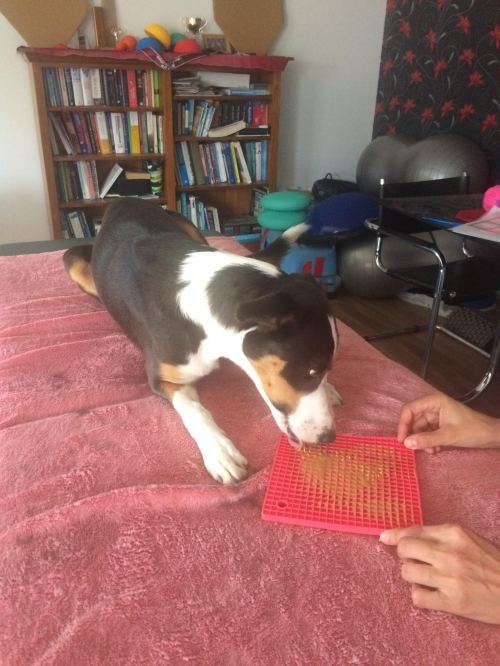
Heading dog with food diversion for dog massage

This is Bee, a young heading dog.  Yesterday, she had her third massage and, with each session, she’s getting better.

There’s nothing physically wrong with Bee; her Mum is training her for competitive agility and wants to keep her in top condition.  Since Bee is high-energy, the massage sessions are also to help her with focus and mindfulness.

During her first massage, Bee took a long time to settle.  At her second massage, I suggested that we introduce a toy and we used a braided rope tug toy.  Then I decided to try pushing some treats into the braids and we got almost instant results.  Bee became more relaxed and allowed more touch.  When I left, her Mum and I promised each other that next time, we’d use a food toy for the entire session.

So yesterday, her Mum was ready.  And how clever is she???  She purchased a silicone pot holder for only $2 from Kmart and spread it with peanut butter.  We had our best massage yet.

Low stress handling techniques are all about keeping the dog below threshold – no stress or anxiety.  Food diversion toys can help with this – and they don’t have to be fancy or expensive.

Kathleen Crisley, specialist in dog massage, rehabilitation and nutrition/food therapy, The Balanced Dog, Christchurch, New Zealand

Doggy quote of the month for December

“Thorns may hurt you, men desert you, sunlight turn to fog; but you’re never friendless ever, if you have a dog.”

– Douglas Malloch, poet

Izzy of The Balanced Dog

The dog on the editorial board

Read through my blog categories and you’ll notice that the research category is one of the largest.  What can I say?  I’m a bit of a science geek.  I trained and worked in environmental science for over 20 years and so I understand the value of research – it creates new knowledge and underpins new developments that can help us and our dogs.

But research comes at a price – and that’s not just the cost of doing the research.  Research quality is often judged on the basis of whether or not the research has been peer-reviewed.  And like any system, the peer review  and publishing system has become a money-maker for some journals.  Academic staff are judged on their production of papers which show not only their name, but also the name of their employing institution.  When I worked at the University of Canterbury in Christchurch, this system was commonly referred to as ‘publish or perish.’

There are journals that scam researchers into paying to be published when there is no real peer behind the peer review and the journal is one that may look reputable, but isn’t.

peer reviewer

Professor Mike Daube of Curtin University in Australia thought it would be a good idea to challenge the system in a tongue-in-cheek way.  He offered the services of his Staffordshire terrier, Olivia Doll, as a peer reviewer with expertise in subjects like “avian propinquity to canines in metropolitan suburbs” and “the benefits of abdominal massage for medium-sized canines.”

Olivia was approached to peer review at least one article.    The Global Journal of Addiction & Rehabilitation Medicine appointed her as an Associate Editor (no job interview required) and a journal called Psychiatry and Mental Disorders listed her as a member of its editorial board.  At last count, Olivia served on the editorial board of seven journals.

I hope I’m a bit more discerning in selecting the dog-related research that I share on this blog; and wherever possible I include a link to the original source to respect copyright.

Source:  Science Magazine

Kathleen Crisley, specialist in dog massage, rehabilitation and nutrition/food therapy, The Balanced Dog, Christchurch, New Zealand