Tag Archives: animals

International Homeless Animals’ Day

Today (18th August) is International Homeless Animals’ Day.

On the third Saturday of August each year, organisations band together to raise awareness about pet overpopulation.  This year is the 21st year of the initiative!

If you are thinking of adding a dog to your household (or another dog), please adopt from a shelter or rescue organisation.  And spay/neuter your pet to avoid adding to the pet population in your area.

Dog dreaming

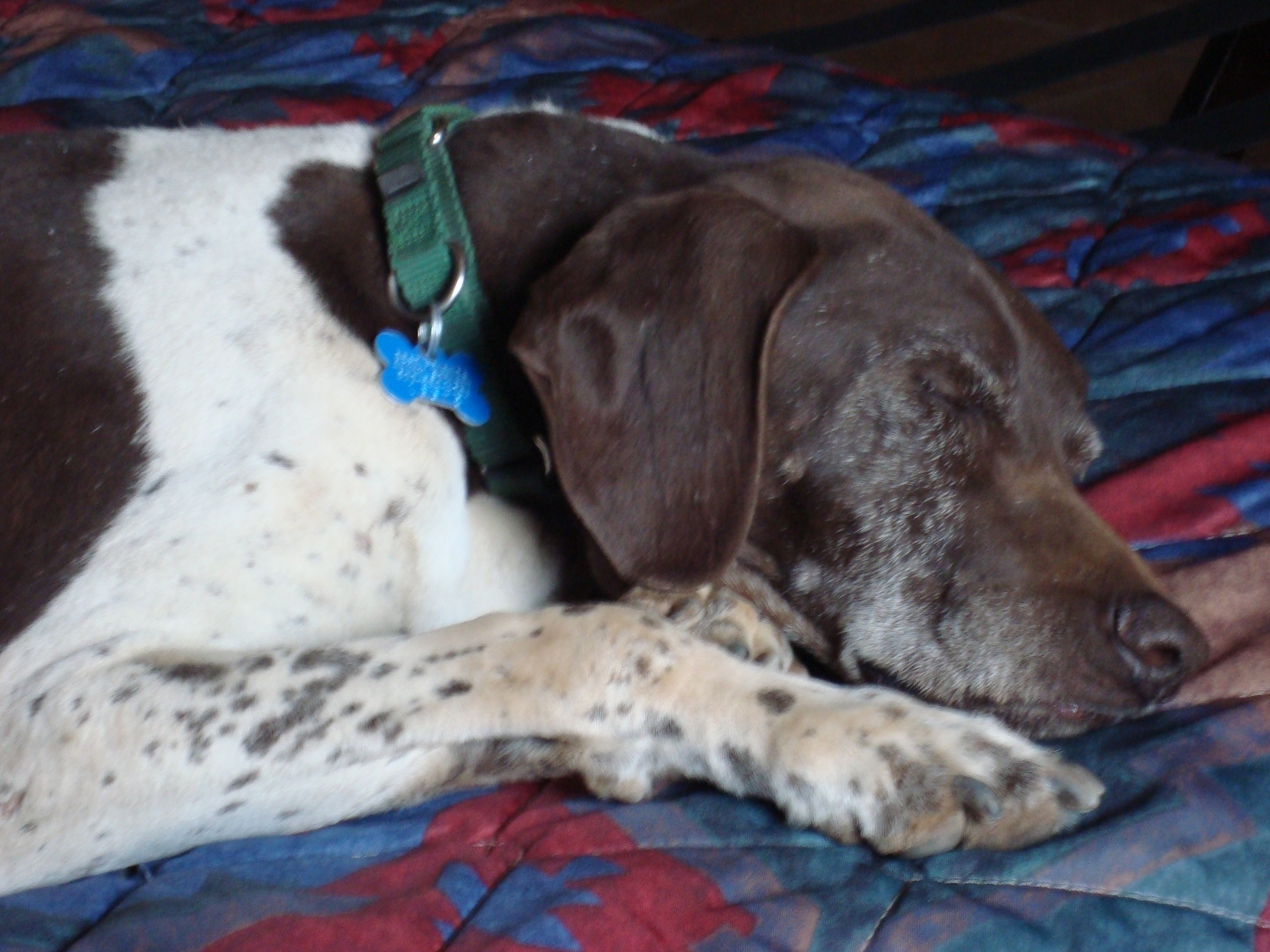
We’ve all seen our dogs deeply asleep, with paws and legs twitching.  There have even been times when my dog puts her head up while sleeping and howls like a wolf.  (She usually wakes herself up, too).

Do our dogs dream?

All evidence points to an answer of ‘yes’.

Researchers know, for example, that the EEGs (electroencephalograms) of sleeping dogs show brain wave activity similar to humans during sleep.  There is a period of sleep known as REM sleep (REM means rapid eye movement) when breathing becomes irregular and the eyes twitch.  Sound familiar?

When humans have been wakened during REM sleep, they report that they have been dreaming and so there is no reason to think that our dogs aren’t dreaming. 

Matthew Wilson, Associate Professor of Brain and Cognitive Sciences at the Massachusetts Institute of Technology says that animals have complex dreams and are able to retain and recall long sequences of events while they are asleep. 

His work involved rats and monitoring their brain wave activity when they were asleep and awake.  He also tracked the effect of sleep on learning of repetitive tasks.

Professor Wilson has said of his work “dreams are the ultimate off-line experience. This work demonstrates that animals are capable of re-evaluating their experiences when they are not in the midst of them.”

By the way, dogs, cats and rabbits are crepuscular which means that they naturally tend to be more active at dawn and at dusk.  Humans are diurnal which means they are most active during the day (which explains why night shifts are so hard on people).  Dogs seem to adjust their own sleep habits to match those of their owners.

Doggy quote of the month for June

“Until one has loved an animal, a part of one’s soul remains unawakened”

– Anatole France

Here we go again – pet food recalls in USA

This time, the cause of concern is salmonella contamination.   Salmonella is a zoonotic infection, meaning it can be transferred to humans too.

Salmonella infection in dogs causes gastroenteritis, septicemia, and spontaneous abortions.  Humans usually experience vomiting, diarrhea and fevers.  It’s not pleasant.

The best prevention is to wash surfaces in the kitchen after feeding your dog and to ensure you wash your hands after handling pet foods.

The brands currently under recall are:

Solid Gold Health Products for Pets, Inc.

  • Solid Gold WolfCub Large Breed Puppy Food
  • Solid Gold WolfKing Large Breed Adult Dog Food

Wellpet LLC

  • Wellness Complete Health Super5mix Large Breed Puppy

Canidae Pet Foods

  • Canidae Dog, All Life Stages
  • Canidae Dog, Chicken Meal & Rice
  • Canidae Dog, Lamb Meal & Rice
  • Canidae Dog, Platinum

Apex Pet Foods

  • Apex Chicken and Rice Dog, 20lb and 40lb bags

Natural Balance Pet Foods

  • Natural Balance Sweet Potato & Venison Dog
  • Natural Balance Lamb Meal & Brown Rice Dog
  • Natural Balance Sweet Potato & Bison Dog
  • Natural Balance Vegetarian Dog
  • Natural Balance Lamb Meal & Brown Rice Dog Large Breed Bites
  • Natural Balance Lamb Meal & Brown Rice Dog Small Breed Bites
  • Chicken Soup for the Pet Lover’s Soul
  • Country Value
  • Diamond
  • Diamond Naturals
  • Premium Edge
  • Professional
  • 4Health
  • Taste of the Wild

The Kirkland Signature products included in the recall are:

  • Kirkland Signature Super Premium Adult Dog Lamb, Rice & Vegetable Formula
  • Kirkland Signature Super Premium Adult Dog Chicken, Rice & Vegetable Formula
  • Kirkland Signature Super Premium Mature Dog Chicken, Rice & Egg Formula
  • Kirkland Signature Super Premium Healthy Weight Dog Formulated with Chicken & Vegetables
  • Kirkland Signature Super Premium Maintenance Cat Chicken & Rice Formula
  • Kirkland Signature Super Premium Healthy Weight Cat Formula
  • Kirkland Signature Nature’s Domain Salmon Meal & Sweet Potato Formula for Dogs

It’s hard to know if some of these foods are available in New Zealand (Canidae definitely is) because some foods are imported in smaller quantities.  If you are feeding one of these foods, stop immediately and check with your supplier for more details on the recall.

This website from the FDA gives all the latest information on pet food recalls.

What is your dog thinking? Researchers are on the case!

Researchers at Emory University have published new research into canine cognition.  Entitled Functional MRI in Awake Unrestrained Dogs, the paper outlines findings of research that required two dogs to remain motionless in an MRI machine.

Yes – that’s right. Motionless.  The two dogs were outfitted with special ear muffs to protect them from the noise of the MRI and trained to rest their heads on a chin rest inside the machine.   As the MRI took scans of the dog’s brain activity,  hand signals were used to show the dogs whether there was or wasn’t a food reward.

This is a first-ever study on awake dogs, rather than those that have been sedated.  Importantly, part of the animal ethics of the study was to ensure the dogs were willing participants.

The findings show a definite brain activity response when the hand signals indicated a food reward.  Those dogs are paying attention!

The lead researcher, Professor Gregory Berns, says “We hope this opens up a whole new door for understanding canine cognition and inter-species communication. We want to understand the dog-human relationship, from the dog’s perspective.”

Professor Bern’s dog Callie in training in a mock-up of the MRI scanner (copyright Emory University)

Listen to Professor Berns talk about this project in the Emory University YouTube video:

Source:  Emory University press release 4 May 2012

Dog friendly shopping in Colorado

****This is a re-print of my column that appeared in the December 2010 issue of NZ Dog World magazine.  Since that magazine is currently available to NZ Kennel Club members only, I’m re-publishing it here because it is a topic I’m passionate about.****

_________________________________________________________

I thought I’d share my experience of dog-friendly shopping in the state of Colorado, where I recently traveled for my business.

Colorado is a state that clearly values the companionship of dogs.  They were everywhere:  in trucks, cars and – unlike New Zealand – they were welcomed in many shops and public shopping areas.   On my flight from San Francisco to Denver, there was even a passenger who had a small dog in a carrier.  (Many U.S. airlines now allow small dogs into the cabin as carry-on luggage.)[1]

I wished my Daisy could have traveled with me to enjoy the sites (but she wouldn’t have appreciated the long flight or the required three-month quarantine on our return to New Zealand).

Dogs welcome

Dog owners could easily identify shops where their dog would be allowed to enter.  These shops displayed a Dogs Welcome logo in their window.  Interestingly, these shops sold clothing and footwear for people and were not just pet stores.  An outdoor mall in Castle Rock went a step further by providing grassed park areas and dispensers of plastic bags for dogs to have a ‘comfort stop.’
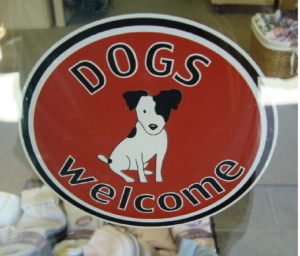
Other shops made up their own signs, such as one retailer whose sign proclaimed, “Four Legged Friends Welcome.”

I asked a shop attendant if they get many shoppers accompanied by their dogs.  She replied, “Yes.  Lots.  Particularly on weekends when people who work all week want to be out with their pet.”

Dog rest stops

I noticed that many communities welcomed dogs in their shopping areas by providing bowls of water for passing dogs to drink from.  I quickly became accustomed to seeing these ‘dog rest stops’ in virtually every town that we visited.

Rest stops varied in style and offerings.  Some were simply a single water bowl or raised water bowls.   Pet shops would often include extras, such as a bench for owners to sit in.  In Manitou Springs, a popular tourist destination at the foot of Pike’s Peak (elevation 4,800 m), a sweet shop provided vending machines with dog treats.  For 25 cents, a passing dog owner could purchase a handful of treats.

Good behaviour required

In all of the communities I visited, dogs and owners acted responsibly.  There was never a pile of poo left on the footpath and dogs didn’t jump on passers-by.  Responsible dog ownership is clearly essential for communities to embrace dog-friendly shopping.

And so, I leave you with good wishes for the summer holiday season and encourage you to think:  Is dog-friendly shopping appropriate for New Zealand and, if so, what will it take to get dog-friendly shopping established here?


[1] The dog carrier is considered the single piece of carry-on luggage for the owner; the dog must have current vaccinations and is not allowed out of the carrier during the flight.

Additional photos of my trip can be found in this blog post.

Kathleen Crisley, specialist in dog massage, rehabilitation and nutrition/food therapy, The Balanced Dog, Christchurch, New Zealand

Fukushima – the animal tragedy continues

This week marks the first anniversary of the  earthquake and tsunami that triggered the nuclear disaster at the nearby Daiichi power plant in Fukushima, Japan.  Animals are victims of this disaster and the effects on these animals’ lives continues even now…

A rescue group called Save Fukushima Animals, based in Vancouver and Tokyo, is working to rescue animals still alive but has to do so in secrecy since people are not allowed into the area.   The group is petitioning the Japanese government to take action to evacuate and save animals that have been left behind, although rescuers caught in the exclusion zone have been threatened with arrest.  This video tells the story of the animal rescue efforts:

When the region was evacuated, people left their pets behind and were unable to return to the area.  Those that haven’t died are fending for themselves – an estimated 3,000 animals are still in the exclusion zone.

Animals saved are taken to vets to be checked for radiation and then reunited with their owners, if possible.  Otherwise, a good home is found for them.

There is no law in Japan requiring pets to be saved during disasters and the group is lobbying the government to change that so this never happens again.  Donations go towards funding rescue efforts.

As for farm animals, many were left to die.  This week, Euro news carried this story about a farmer who has stayed to feed and take care of animals.

And The Telegraph (UK) has carried this story about Elizabeth Oliver and the charity Animal Rescue Kansai (ARK) which is also working to save animals.  Although some 5,900 dogs were registered, ARK estimates that three times that number were in the area because the Japanese have a reputation for not registering their dogs.  Dogs that survived are going feral and breeding; many are shy of humans.

Ms Oliver is outspoken saying, “The whole situation for pets and farm animals after the disaster has been a shambles, with many dying of dehydration or starvation, while there is also cannibalism.   The government has done nothing for them.”

One year on and the tragedy continues.  It’s up to us never to let such widespread neglect happen again.