Tag Archives: beagle

The Beagle

Since I have Beagles in my massage practice, I thought it would be useful to profile this medium-sized breed.

Teddy

Beagles regularly feature on the most popular breed list in the United States.    Using American Kennel Club registrations from 2011, the Beagle is the third most popular dog.

The Beagle originated in the United Kingdom where they were used as hunting dogs for rabbits and other prey animals because of their keen sense of smell and ability to track.  As a pet, owners have to watch their Beagle because he/she will easily follow its nose to track interesting smells – potentially wandering far from home.

Beagles are classified as being tri-colour (black, white and tan) or lemon (yellow) and sometimes even red or white.  An average life span is 15 years.

This breed is prone to hip dysplasia, intervertebral disc disease, and allergies.  Some develop seizure disorders and hypothyroidism.  Regular ear cleaning is recommended because their long, floppy ears (which are very appealing) help to create an ideal environment to hold moisture and bacteria in the ear canal.

The Beagle is a hound and can be extremely vocal, so good training is needed.  Beagles are also known for their appetites and so to keep the weight off, a balanced and healthy diet is needed with careful attention paid to how much the dog is eating during the day (treats, ‘finds’ on walks, etc.)  Plenty of exercise is also needed.

Owners of Beagles tell me that since they were bred as pack dogs (for hunting), they don’t do well as a solo dog in a household.  They need companionship and can become depressed if left alone for long periods of time.  (This depression can lead to problem barking problems, too.)

Beagles are often spotted at airports, cruise ship terminals and postal depots because they are widely used as agriculture and drug detector dogs.  That’s because they can be trained to put their keen noses to good use!  I even came across this YouTube clip from the television show The Doctors where Beagles and Dachshunds are being used as detector dogs for bed bug infestations:

Sadly, because of their size and temperament, they are often used in laboratories for animal testing.  In November 2011, I covered a story about 40 laboratory Beagles who had been rescued.

Perhaps the most famous Beagle is Snoopy (the cartoon by Charles Schulz).  Snoopy was obviously a white Beagle.

If you are looking for a lively pet with minimal grooming requirements and generally a good temperament, then the Beagle may be right for you!

Daniel’s story

Daniel looks like an ordinary beagle.  But he isn’t.  He’s a survivor – quite literally.

In October 2011, Daniel was placed in a gas chamber in Alabama to die with three other unwanted/unclaimed dogs.   The miracle is that Daniel survived the gassing (by carbon monoxide).  The folks at Eleventh Hour Rescue, a rescue organisation that aims to save dogs from high-kill shelters, heard about Daniel and took him to New Jersey to find a forever home.

After fostering, Daniel was re-homed with Joe and Geralynn Dwyer.  Mr Dwyer now is a guest speaker around the country to encourage the banning of gas chambers in the United States and Mr Dwyer is happy to promote Daniel as the face of the anti-gassing law.   The law has been called “Daniel’s Law” in honor of Daniel.    Pennsylvania is the most recent state to enact it.

Only 19 states in the USA have banned the use of gassing as a means of euthanising unwanted dogs and over 4 million animals are euthanised each year in the country.

Here are a couple of video clips of Daniel’s story, starting with his original fostering arrangement:

And on Anderson Cooper:

Spinal cord research benefits dogs

Last week, the University of California San Francisco issued a press release about the promising research of Dr Linda J Noble-Haeusslein and her collaborators at Texas A&M  University.

The US Department of Defense has granted $750,000 over three years to develop a drug that helps to mitigate the secondary damage associated with spinal cord injury.  When an injury occurs, there is a cascading chemical reaction that damages nearby cells and that means – essentially – that more damage happens than that caused by the immediate injury.

It is thought that the drug, a protein-blocking agent, will successfully interfere with that cascading process and preserve sensitive neurological pathways.

Other neurological researchers have shown that movement in the spine can be preserved if as little as 18-20 percent of nerve fibre tracts remain intact.

Dogs such as Dachshunds, Corgis and Beagles (dogs with a long torso) are known to be susceptible to disc ruptures.   When a dog presents with a disc rupture at the Small Animal Hospital at Texas A&M University, their owner will be asked to consent to the experimental treatment.

And why is the funding coming from the Department of Defence?  Well, sadly, there are many wounded soldiers returning from overseas war zones with spinal injuries.

Source:  University of California, San Francisco (UCSF) (2012, January 18). Saving dogs with spinal cord injuries. ScienceDaily. Retrieved January 25, 2012, from http://www.sciencedaily.com­ /releases/2012/01/120118155338.htm

We Bought a Zoo – look for the beagle!

Over the holidays, my mother and I went to see We Bought A Zoo starring Matt Damon and Scarlett Johansson.  The movie is based on the true story (and book by) Benjamin Mee, who purchased the rundown Dartmoor Wildlife  Park (now known as Dartmoor Zoo) and re-opened it in 2007.

I’m an animal lover and so movies like this appeal to me.  Even better, the family in the story owns a beagle named Leon.  He’s not a main character but as with all beagles – he’s adorable.  Behind the scenes, it sounds like the beagle playing Leon was being a true beagle – with a mind of his own despite his training.    According to Cameron Crowe, the Director of the film, “it was really the beagle who was hard to work with (laughs).”  (Interview on azcentral.com)

My advice:  go to the film and enjoy it and look for the beagle!

Top 5 detection jobs for dogs

The American Kennel Club has marked the importance of working dogs by naming the top 5 detection jobs which are performed by dogs.  These jobs are:

  1. Bed bug sniffing  (best performed by breeds such as Beagles, Labrador Retrievers and Belgian Malinois)
  2. Search and rescue  – tracking missing persons, disaster rescue, etc.  (many mixed breeds perform well in this category – just ask the NZ USAR team!)  Also performed by Bloodhounds, Labrador and Golden Retrievers and German Shepherds
  3. Explosives detection (the AKC says that Belgian Malinois, German Shepherds and Vizsla do well in this category)
  4. Cancer detection (Labrador Retrievers – again!)
  5. Allergy alert dogs (Poodles, Portuguese Water Dog and Golden Retrievers seem suited to this work)

Wouldn’t it be nice to see more of these working dogs in use in New Zealand?  (See my previous article on Deak Helton’s research – September 2011)

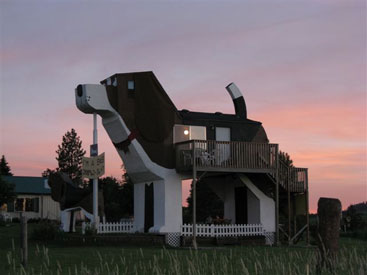
The Dog Bark Park Inn – home to world’s largest beagles

In Cottonwood, Idaho, lies the Dog Bark Park Inn.  Built by chainsaw artists Dennis Sullivan and Frances Conklin, this bed & breakfast is housed within a large beagle!

The structure is named Sweet Willy and he is accompanied by a 12-foot structure named Toby.

In 1995, the Dennis’ and Frances’ work was featured on shopping channel QVC.  They received so many orders, that it took them 18 months to fill them all.  And, with the proceeds, they created the Dog Bark Park Inn.

This accommodation is truly unique and a must for beagle lovers and dog lovers of all kinds.  There is an on-site gift shop, too, where you can buy the folk style wooden art of the proprietors.

Rescuing beagles from the lab

The Foundation for Biomedical Research, located in Washington DC, estimates that there are 60,000 dogs in research facilities in the United States.  (The Foundation advocates for ethical treatment of animals used in research.)

The beagle is commonly chosen as a research subject because of its size and temperament.

Unfortunately for the dogs involved in research, most facilities do not re-home the dogs after their ‘useful’ period has passed.  Most are euthanised.  One reason for this is that the facilities who conduct research involving dogs do not wish to be identified, for fear that they are targeted by activists who publicise their use of the dogs.  In extreme cases, activists have been known to break into the facilities to release the dogs.

Some animal welfare agencies work behind the scenes to find ways to receive these dogs and find them new homes, also protecting the anonymity of the laboratories so they are encouraged to re-home more dogs in the future.   The San Francisco Chronicle ran a story last week of one such re-homing effort involving nine beagles.

Re-homing an ex-laboratory dog is not always easy.  Most of these dogs have never been outside and have never been housebroken because they spend their lives in a crate or cage.  In the cases of these beagles, they were also de-barked (vocal chords were intentionally cut) to reduce noise in the laboratory.

The June re-homing exercise was the second for the Beagle Freedom Project, which mounted this wonderful video on YouTube of the rescue:

In future blog postings, I will provide some more information about dogs used in research and the points of view about whether or not the experimentation on them is essential.  This is a major animal welfare issue and one that will not go away quickly as the world seeks to develop new treatments for human diseases and disorders.

Kathleen Crisley, Fear-Free certified professional and specialist in dog massage, rehabilitation and nutrition/food therapy, The Balanced DogChristchurch, New Zealand