Tag Archives: Dog

What’s its name?

Choosing the ‘right’ name for your dog and puppy is just as important as naming your children.   People will make assumptions based on your dog’s name and act accordingly.  Just ask a Bozo about being treated like a clown… Or wonder why people aren’t interested in petting Killer…

And let’s face it – most books of names out there are focused on naming of babies – so you’ve got the added problem when your partner/parents/friends think you might be expecting when really you are only after the perfect puppy name.

Here’s the solution:  What’s Its Name by John Gordon is a naming guide specifically for dogs.  The book contains ‘1000 ways to dub your dog’ and it was written in 1999.  You can still buy copies of it on Amazon.com and other outlets including used booksellers.

Forgive the language.  John is a New Zealander and some of his references are related to rugby.  Otherwise, it’s an essential reference book for the dog lover.

This book will make an ideal Christmas gift (it isn’t too soon to start setting aside gifts for the holiday!)

Minding the lumps and bumps

This week, I had the pleasure of working with a dog whose owner is very attentive and diligent.  She was the first owner in a long time to provide me with her dog’s ‘lump and bump’ chart.

Many dogs, particularly as they get older, develop lumps and bumps under the skin.  Noticing when a new lump appears, and getting your vet’s opinion about it, are very important.  Many lumps are not sinister and require no attention because they are benign.    Others aren’t.

Whenever I take on a new dog/client for massage and rehab therapy, I start keeping records of the dog’s muscle condition, problems areas, and lumps/bumps.   Since I see dogs on regular basis (the length between visits varies according to the dog’s condition), I can sometimes pick up changes that their owner misses.  This is yet another benefit of massage therapy!

But, for the most part, an owner should be familiar with their dog’s condition.  Through regular grooming, you will notice where your dog has lumps and bumps and know which ones have already been tested by your vet for ‘nasty’ cells.  So start with an outline of your dog’s body and record where they are.

Refer back to your chart periodically when you are bathing and grooming your dog.  If you find something that wasn’t there before, record its size and location on your chart and take your chart with you to the vet.

If you are local to the Canterbury area, we also discuss lump and bump charts and how to compile them in my dog massage workshops for owners.

Kathleen Crisley, Fear-Free certified professional and specialist in dog massage, rehabilitation and nutrition/food therapy, The Balanced Dog, Christchurch, New Zealand

CSI – dog style?

Pooprints, based in Tennessee (USA), is offering DNA testing of a different kind.  It is not about testing your mixed breed dog to find out their lineage, it’s about DNA testing of dog poo!

The number of subdivisions, condominium-style accommodation developments, and apartment complexes is on the rise in the US.  This is a result of a ‘downsizing’ of accommodation because of the economic recession as well as growth in population centres where work is available, but cost of living and commuting times are also an issue.  In these types of developments, there are dog owners living alongside non-dog owners.  And poop is  a problem.

(For my New Zealand readers, read my Last Word column in the March 2011 issue of NZ Dog World magazine.  In that column, I discussed the looming liability of infill housing, population growth,  and the growing problem of dog owners who do not clean up after their dog.)

The company’s service is rather straightforward.  First, a residential community decides to start a dog DNA testing programme.  Usually, this test is mandatory as part of signing up to live there. A mouth swab is taken of your dog and sent for  DNA testing and the results are entered into that site’s database.

Then, a site manager is probably responsible for poop patrol in your community.  They take samples of poop that has not been cleaned up and send the samples for DNA testing (because epithelial cells in the wall of the intestine are excreted every time a dog defecates).   The site manager will be given a report about the dog/owner match in order for followup to occur.

Communities will have rules about the number of infringements required for that person to be fined, or worse, kicked out of their residence.

It may sound ‘over the top’ but it is a symptom of how strongly some people feel about poop that is not cleaned up.

CNN covered the story of one residential development in New Hampshire that has signed up to use the Pooprints system.  Read about it here.

Sea burials for your pet

New England Burials at Sea offers a special service for pet burials at sea along the US coastline from Maine to Miami.

The most common service is for scattering of cremation ash, although the company also offers organic cotton shrouds for full body burials by enquiry.

The company was founded by Brad White, a self-confessed dog lover and owner of Schipperkes who understands that pets are part of the family.

Ceremonies start at $95.0o.  A poem is usually read after the ashes are scattered, followed by flowers or wreaths that are placed on the water.  Owners can email a photo of their pet to Captain Brad before their charter so a photo of their pet is included on the sea burial certificate.   The burial certificate records the date, time, and latitude and longitude (location) where the ashes were scattered.  Many charters are unattended by the pet’s family, but in one case Captain Brad says that over 40 people attended a pet farewell ceremony on his boat.

Read more about the pet burial service here.

A quick Google search shows that there are several other firms offering pet burials at sea.  They are:

San Diego Burial at Sea

Newport Landing Burial at Sea (Los Angeles area)

A Burial at Sea Maritime Funeral Services (Rhode Island)

Amazing Gracie’s Pet Burials at Sea (San Diego area)

US Postal service launches new dog stamp

July 27th marked the launch of the US Postal Service’s newest stamp bearing the image of a dog.

The Owney stamp features the image of Owney, a mixed breed dog that was drawn to the US mail and followed it onto mail wagons, subsequently traveling across the United States collecting tags from each of his stops.  Owney lived at the Albany, New York, post office but would regularly sleep among empty mail bags and travel with them to locations across the United States.

Workers thought Owney was a good luck charm because, in an age of many train accidents, Owney’s trains were never involved in one.

The dog died in 1897 and his body was sent to a taxidermist for preservation.  Since 1993, Owney has been on display at the Smithsonian Institution’s National Postal Museum in Washington DC, which hosted the launch of the new stamp.  The tags Owney collected have also been preserved.

Read more about the Owney and the launch of the new stamp on this page.

The Neater Feeder

Quite some time ago, Daisy’s breeder mentioned that she fed her older dogs “on the step” – meaning that she placed the dog’s feeding bowl on the step leading into the kennels so they could eat from an elevated surface.

Eating from a raised feeder relieves strain on an aging dog’s neck and back.  A dog also tends to raise its head after taking food or water into its mouth to help with swallowing.  This is the time when spills commonly occur.  Consequently, a raised feeder helps to keep the feeding area cleaner.

The pet market is full of elevated or raised dog feeders and some seem highly impractical.  (Yes – that bowl may look like a Tuscan pillar but it will also be top heavy – so unlikely to help you keep your dog’s feeding area clean) .

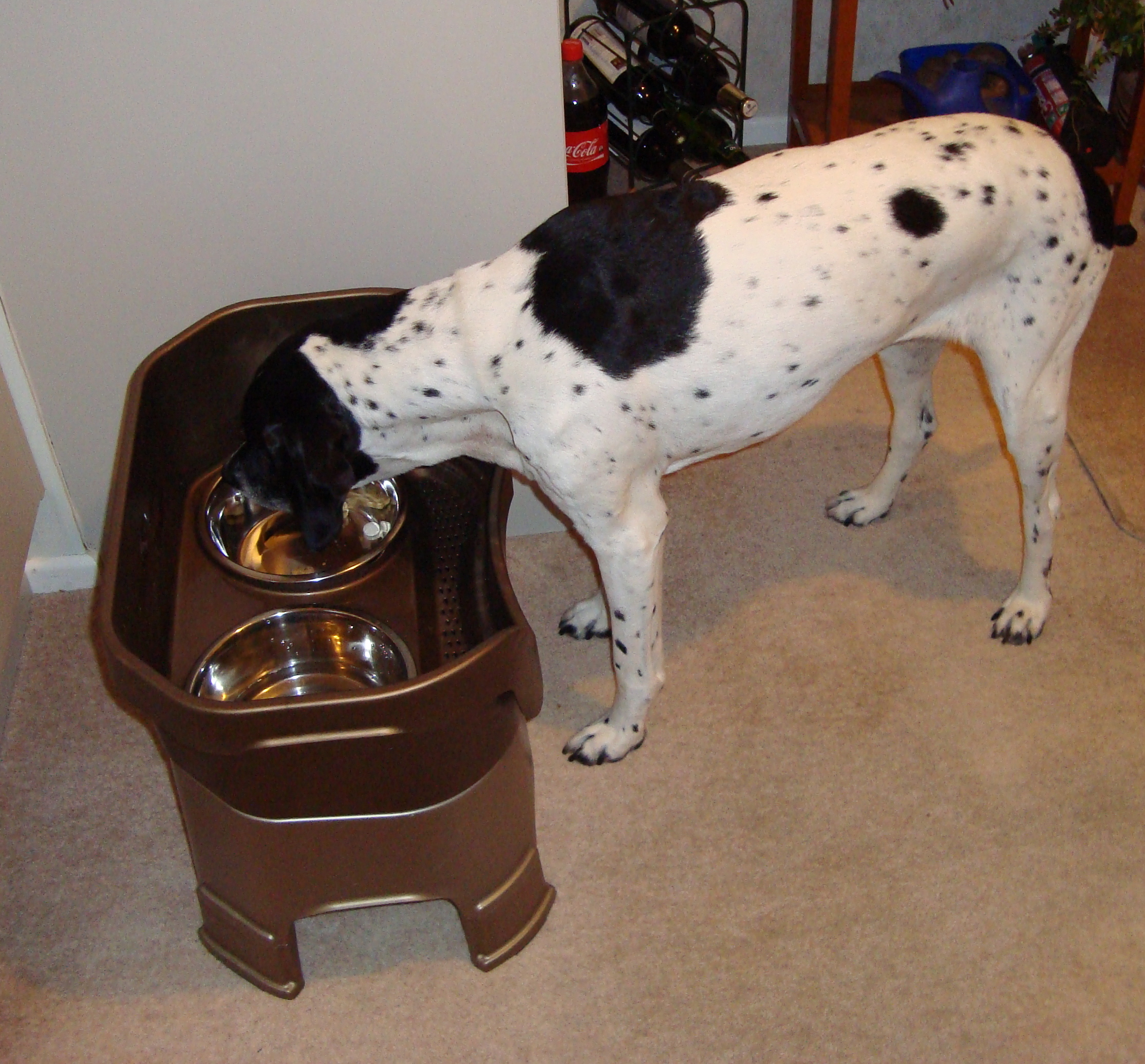
I think the Neater Feeder wins hands down and Daisy agrees.

Daisy enjoys eating from her Neater Feeder

The Neater Feeder comes with removable stainless steel bowls that can be placed in the dishwasher for easy cleaning and sterilising.  It has optional legs to add height to the feeder (we use these on Daisy’s bowl).    Best of all, the feeder comes with a drip tray.    Simply remove the top layer of the feeder and you reveal a tray which catches all the spilled water in it.  This saves time on cleaning but also saves you from messes on the floor.

The Neater Feeder is made in the USA and is available through a wide range of stockists and directly through the company’s website.  The company offers a 30 day money back guarantee on its product.

***I purchased my Neater Feeder; this is not a paid product endorsement***

Kathleen Crisley, specialist in dog massage, rehabilitation and nutrition/food therapy, The Balanced Dog, Christchurch, New Zealand

Love your dog survey results

Australian website PawClub surveyed dog owners from across Australia about their dogs.  Some of the more revealing responses to their How Much Do You Love Your Dog survey are:

  • When asked who they spend more time with and given the choice between their dog, partner, and all relatives including parents – 73% said their dog.
  • When asked who they spend more money on each month – their partner or their dog – 76% said their dog.

78% of respondents take their dog to the vet for a health check (at least once per year) and 51% reported that they walk their dog each day.

Over 80,000 dog owners participated in the survey.

Kathleen Crisley, specialist in dog massage, rehabilitation and nutrition/food therapy, The Balanced Dog, Christchurch, New Zealand

Kandu, the two-legged dog

There are special needs dogs and the special people who take care of them.  Today, I’m sharing the story of Kandu, a Jack Russell who was born without his front legs.

Kandu’s initial owner thought that he should be euthanised but a welfare agency put out the call for owners willing to take on a special needs dog and the rest, as they say, is history.    Kandu is fitted with a special cart that allows him to run and play like all other dogs and he even has a special snowboard for winter play.

Kathleen Crisley, specialist in dog massage, rehabilitation and nutrition/food therapy, The Balanced Dog, Christchurch, New Zealand

Dog food standards

Coverage of dog nutrition and dog food standards is variable in the media  and can often confuse dog owners.  In my nutrition consultations, I get asked about standards all the time.

The industry association for pet food manufacturers and regulators  in the United States is AAFCO, the American Association of Feed Control Officials.   If a dog food label says it meets the AAFCO Animal Testing Requirements, it means that the food has been fed to animals in a controlled feeding trial.

The animals are observed for indications of obvious nutrient deficiencies or imbalances during the feeding trial.    Some nutritional imbalances are minor or subtle and can take time to eventuate.  AAFCO trials are probably not long enough to reveal these imbalances, which is why it is advisable to rotate ‘complete’ dog food products periodically with the aim that one product will include sufficient concentrations of nutrients that the other does not.

If, however, a product says it is ‘formulated to meet AAFCO standards’ a feeding trial has not been done.  Someone in the pet food company has simply sat in front of a computer and formulated a recipe to replicate the concentrations of nutrients of foods that have been the subject of feeding trials.

It is up to you, the dog owner, to decide what foods to feed your dog including choices about BARF (bone and raw food) diets.     Understanding the labeling of commercial foods is important if you want to make educated choices about your dog’s diet.

Kathleen Crisley, specialist in dog massage, rehabilitation and nutrition/food therapy, The Balanced Dog, Christchurch, New Zealand

Routine is very important

Like children, I believe that dogs thrive when they have a routine and daily/weekly schedule that they can count on.  This routine gives them confidence and comfort and caters to their necessities of life.

So what things should you include in your dog’s routine?

Sleep time :  Although sleep requirements differ over the lifetime of your dog and there are also breed differences as far as sleep requirements, the general rule of thumb is that dogs require 16 to 18 hours of sleep per day.  Like you, dogs will benefit from periods where they are left quietly to sleep without disturbance.  In most homes, the dog will have a sleep period that coincides with its family.  However, they will also need time during the day to sleep.  If you work outside of the home, your dog will sleep for a good period of time when you are away.  If you are at home during the day, either by yourself or with children and others in the house, I recommend that you either crate train your dog to give them quiet time or allow your dog the chance to define their special quiet place.  Make an effort during the day to leave your dog undisturbed so they can sleep.

Water:  Your dog should have clean water available at all times during the day.  Keep the water bowl clean and change the water daily.

Food:  “You are what you eat” applies to dogs as well as humans.  Ensure your dog has a good quality diet (some owners choose a raw diet while others prefer a ready-made commercial food).   I prefer a twice daily feeding schedule and larger breeds will need this to help manage against bloat.  Some owners only feed once per day.  Don’t forget to include treats in calculating your dog’s daily ration.

Toilet time:  Most dogs need to urinate or defecate at least every 6-8 hours.  If you leave your dog inside when you are at work, you will need to consider their toileting needs.   When I am going out for the day, for example, Daisy gets a walk before I got out.  I am then more confident that she will be comfortable for when I am away.

Play:  Just like us and our children, dogs need a time to play.  This gives them mental and physical stimulation.  Choose toys appropriate for your dog’s temperament, set up play times with other dogs, go to the dog park to meet other dogs or consider doggie daycare.   Arrange for a pet sitter to walk your dog during the day.  There are many options for creating healthy and happy playtime for your dog.

A safe place:   The den instinct is still there in our domesticated dogs.  Make your home the safe place your dog deserves.    Ensure food, drugs, and household chemicals are kept out of reach of your dog.  Make sure your dog has its own place within the home (bed/crate or both!).

If circumstances change (such as what has occurred in Christchurch with changes to routine because of the earthquake and different work requirements), make a new routine for your dog.  Dogs are able to accommodate short-term changes or interruptions to their schedule, but their behaviour and stress levels will change if you don’t find a new routine for them to follow.

Kathleen Crisley, specialist in dog massage, rehabilitation and nutrition/food therapy, The Balanced Dog, Christchurch, New Zealand