Tag Archives: Dog

Responsible drinking – how Budweiser used a dog to help get the message across

This commercial for “Global Be Responsible Day” was produced by the beer maker, Budweiser.  This ad uses powerful imagery of the human-dog bond to put into context the impact of drunk driving.

Definitely one of my favourite ads!

Kathleen Crisley, specialist in dog massage, rehabilitation and nutrition/food therapy, Canine Catering Ltd, Christchurch, New Zealand


Dogs in strollers: real men do it!

I’m so happy to be able to share these photos.

Kenny is a Blue Heeler/Bull Terrier cross.  Now 12, he’s survived a car accident when a puppy and then a stroke in 2011.

Not surprisingly, Kenny has a few mobility issues.  His back gets sore and his left side is weaker.   He gets regular massage and laser treatments from me which help to keep him more comfortable and mobile.

Like many other senior dogs with a few aches and pains, Kenny still wants to join his family when they go out.  Sometimes he makes it into his favourite park but then struggles on the way back to the car.

The solution, when Kenny gets tired, is to put him in a stroller.

Kenny with dad, Jason (photo by Elesha Ennis)

Kenny with dad, Jason (photo by Elesha Ennis)

Many men seem reluctant to be seen walking their dog in a stroller.  I say “Real men are happy to show that they care and love their dog”.  All credit to Jason, Kenny’s dogfather.

Dogs with mobility issues can live full and active lives with a little help.  Kenny is far better off getting the mental stimulation of family outings than he is being left at home.  Senior dog care requires management techniques; strollers and carts can play their part.

It's a long way back to the car...thanks Dad!  (Photo courtesy of Elesha Ennis)

It’s a long way back to the car…thanks Dad! (Photo courtesy of Elesha Ennis)

Kathleen Crisley, specialist in dog massage, rehabilitation and nutrition/food therapy, Canine Catering Ltd, Christchurch, New Zealand


Nose soccer (football)

Since Izzy is a Greyhound, a breed that likes to ‘nip’ at each other when racing, I put a muzzle on her when she goes to the dog park – just in case she gets too excited or playful with other dogs.

Since Izzy loves to chase the tennis ball, she’s developed a new game – nose soccer.  You can only play this when wearing a muzzle, since you bounce the ball off your muzzle…

Kathleen Crisley, specialist in dog massage, rehabilitation and nutrition/food therapy, Canine Catering Ltd, Christchurch, New Zealand

Arson dog joins the Boston Fire Department

The Boston Fire Department has a new recruit – it’s Keegan, an arson dog.

Click on the lick below to watch Keegan demonstrating his skill with Lieutenant Tom Murray…

Arson dog demo

Just another example of how dogs can be trained to work for our benefit!

Kathleen Crisley, specialist in dog massage, rehabilitation and nutrition/food therapy, Canine Catering Ltd, Christchurch, New Zealand

The Wagington

The Wagington is a new, high-end dog hotel (kennel?) in Singapore catering to the wealthiest residents of the area.

All dogs must be temperament tested before being allowed to stay in one of the 27 suites of the hotel.  Amenities include memory foam mattresses, a bone-shaped swimming pool with supervised swimming, a gym including a treadmill (also supervised), and spa services ranging from ‘pawdicures’ to mud wraps.

A suite at the Wagington (photo courtesy of The Wagington)

A suite at the Wagington (photo courtesy of The Wagington)

Over the top?  Probably – for many of us.  But the opening of this facility, reportedly costing the owner $700,000, shows that the pet market continues its expansion with owners who can afford luxuries for their animals.

Kathleen Crisley, specialist in dog massage, rehabilitation and nutrition/food therapy, Canine Catering Ltd, Christchurch, New Zealand

The human-animal bond using functional MRI

How closely does the relationship between people and their non-human companions mirror the parent-child relationship? Credit: © christingasner / Fotolia

How closely does the relationship between people and their non-human companions mirror the parent-child relationship?
Credit: © christingasner / Fotolia

It has become common for people who have pets to refer to themselves as  “pet parents,” but how closely does the relationship between people and their non-human companions mirror the parent-child relationship?  A small study from a group of Massachusetts General Hospital (MGH) researchers makes a contribution to answering this complex question by investigating differences in how important brain structures are activated when women view images of their children and of their own dogs.  Their report is being published in the open-access journal PLOS ONE.

“Pets hold a special place in many people’s hearts and lives, and there is compelling evidence from clinical and laboratory studies that interacting with pets can be beneficial to the physical, social and emotional wellbeing of humans,” says Lori Palley, DVM, of the MGH Center for Comparative Medicine, co-lead author of the report.  “Several previous studies have found that levels of neurohormones like oxytocin – which is involved in pair-bonding and maternal attachment – rise after interaction with pets, and new brain imaging technologies are helping us begin to understand the neurobiological basis of the relationship, which is exciting.”

In order to compare patterns of brain activation involved with the human-pet bond with those elicited by the maternal-child bond, the study enrolled a group of women with at least one child aged 2 to 10 years old and one pet dog that had been in the household for two years or longer.  Participation consisted of two sessions, the first being a home visit during which participants completed several questionnaires, including ones regarding their relationships with both their child and pet dog. The participants’ dog and child were also photographed in each participants’ home.

The second session took place at the Athinoula A. Martinos Center for Biomedical Imaging at MGH, where functional magnetic resonance imaging (fMRI) – which indicates levels of activation in specific brain structures by detecting changes in blood flow and oxygen levels – was performed as participants lay in a scanner and viewed a series of photographs.  The photos included images of each participant’s own child and own dog alternating with those of an unfamiliar child and dog belonging to another study participant.  After the scanning session, each participant completed additional assessments, including an image recognition test to confirm she had paid close attention to photos presented during scanning, and rated several images from each category shown during the session on factors relating to pleasantness and excitement.

Of 16 women originally enrolled, complete information and MR data was available for 14 participants.  The imaging studies revealed both similarities and differences in the way important brain regions reacted to images of a woman’s own child and own dog.  Areas previously reported as important for functions such as emotion, reward, affiliation, visual processing and social interaction all showed increased activity when participants viewed either their own child or their own dog.  A region known to be important to bond formation – the substantia nigra/ventral tegmental area (SNi/VTA) – was activated only in response to images of a participant’s own child.  The fusiform gyrus, which is involved in facial recognition and other visual processing functions, actually showed greater response to own-dog images than own-child images.

“Although this is a small study that may not apply to other individuals, the results suggest there is a common brain network important for pair-bond formation and maintenance that is activated when mothers viewed images of either their child or their dog,” says Luke Stoeckel, PhD, MGH Department of Psychiatry, co-lead author of the PLOS One report. “We also observed differences in activation of some regions that may reflect variance in the evolutionary course and function of these relationships.  For example, like the SNi/VTA, the nucleus accumbens has been reported to have an important role in pair-bonding in both human and animal studies. But that region showed greater deactivation when mothers viewed their own-dog images instead of greater activation in response to own-child images, as one might expect. We think the greater response of the fusiform gyrus to images of participants’ dogs may reflect the increased reliance on visual than verbal cues in human-animal communications.”

The investigators note that further research is needed to replicate these findings in a larger sample and to see if they are seen in other populations – such as women without children, fathers and parents of adopted children – and in relationships with other animal species.  Combining fMRI studies with additional behavioral and physiological measures could obtain evidence to support a direct relationship between the observed brain activity and the purported functions.

Source:  Massachusetts General Hospital media release

Lucy and Remi: 2 great dog stories in 2 days

From the New Zealand papers this week…Lucy the dog helps save her owner when she falls down a cliff and Remi, a naughty Bull Terrier, alerts his owner to help save a trapped motorist.

Read the links – great stories!

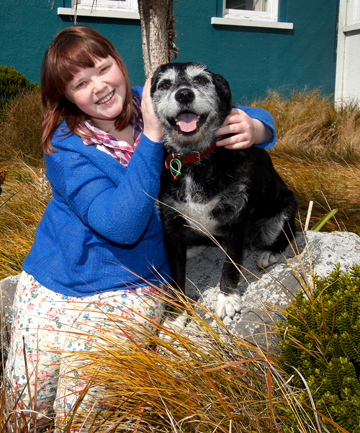
Nikita McMurtrie and her dog, Lucy (Photo by Mytchall Bransgrove)

Nikita McMurtrie and her dog, Lucy (Photo by Mytchall Bransgrove)

Loyal Lucy alerts mum – national | Stuff.co.nz

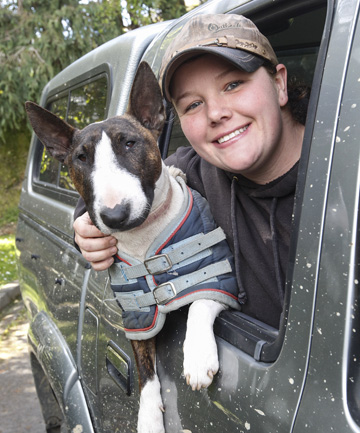
Angel Marsh with Remi; credited with saving a man trapped in a wrecked car (Photo by Fairfax NZ)

Angel Marsh with Remi; credited with saving a man trapped in a wrecked car (Photo by Fairfax NZ)

Dog helps owner to find crash victim – national | Stuff.co.nz

Moxie, the 9/11 search dog

Moxie was a 3-year old urban search and rescue dog when she and her handler were called to the World Trade Center in September 2001.  Now, she’s a a retired senior dog who is still playing at the park.

Moxie with her owner Mark Aliberti in Coughlin Park, Winthrop, Massachusetts (photo by Kathleen McNerney/WBUR)

Moxie with her owner Mark Aliberti in Coughlin Park, Winthrop, Massachusetts (photo by Kathleen McNerney/WBUR)

Her handler, Mark Aliberti, recalls their experience at the World Trade Center site in this WBUR radio news story:

Source:  http://www.wbur.org/2011/09/07/sept-11-search-dogs

Doggy quote of the month for September

“The dog is the perfect beast, companion, friend, shoulder to lean on, and scapegoat when too many cookies are missing.  And a dog won’t hold that against you, either.  I am at peace sitting in silence with a dog.”

– Rick Springfield, musician/actor

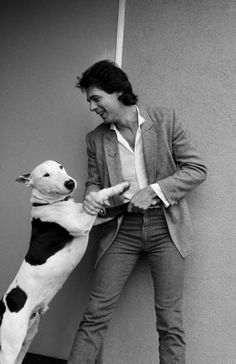
Rick Springfield with Ron

A tribute to Gomer

I have just finished reading musician Rick Springfield’s memoir entitled Late, Late at Night.  I was a fan during my high school years, had his poster on my wall, and I believe I was even a member of his official fan club.  I also remember going to see him in concert (twice).

What I discovered in this book is that Springfield is also a dog person.  Imagine that – even when much younger – I was attracted to people who liked dogs.  There are many comments in Springfield’s memoir about the role of dogs in his early family life and through his career (you might remember that his dog Ron featured on several album covers).

Dogs acted as a source of inspiration and consistency in a life where depression was also a key player.

In January 2010, Springfield’s dog Gomer passed away.  He and his people compiled a bunch of photos of the beloved dog in this tribute on YouTube.  Dog people will ‘get’ this – the need to share and show how great our dog was and how much we miss them.

Having lost Daisy so recently, this tribute really resonated with me.  I hope you enjoy it.

Kathleen Crisley, specialist in dog massage, rehabilitation and nutrition/food therapy, The Balanced Dog Ltd, Christchurch, New Zealand