It’s something every dog owner knows — but now we have the science to prove it: Dogs really can tell when we’re happy or sad.
Scientists have scanned the brains of dogs to reveal how they process various human expressions, including happiness, sadness, anger and fear, according to a study published Monday in the journal iScience.
The scans, carried out by a team from the University of Vienna, show how the animals’ brains respond differently depending on the expression that humans display.
Senior study author Laura Cuaya explained their findings in a press release published on the university’s website. “When we compare humans with primates, we are looking at abilities that may have come from a common ancestor,” she said.
“With dogs, the story is totally different. They followed a very different evolutionary path, yet through domestication, they developed the social abilities needed to understand and cooperate with us.”
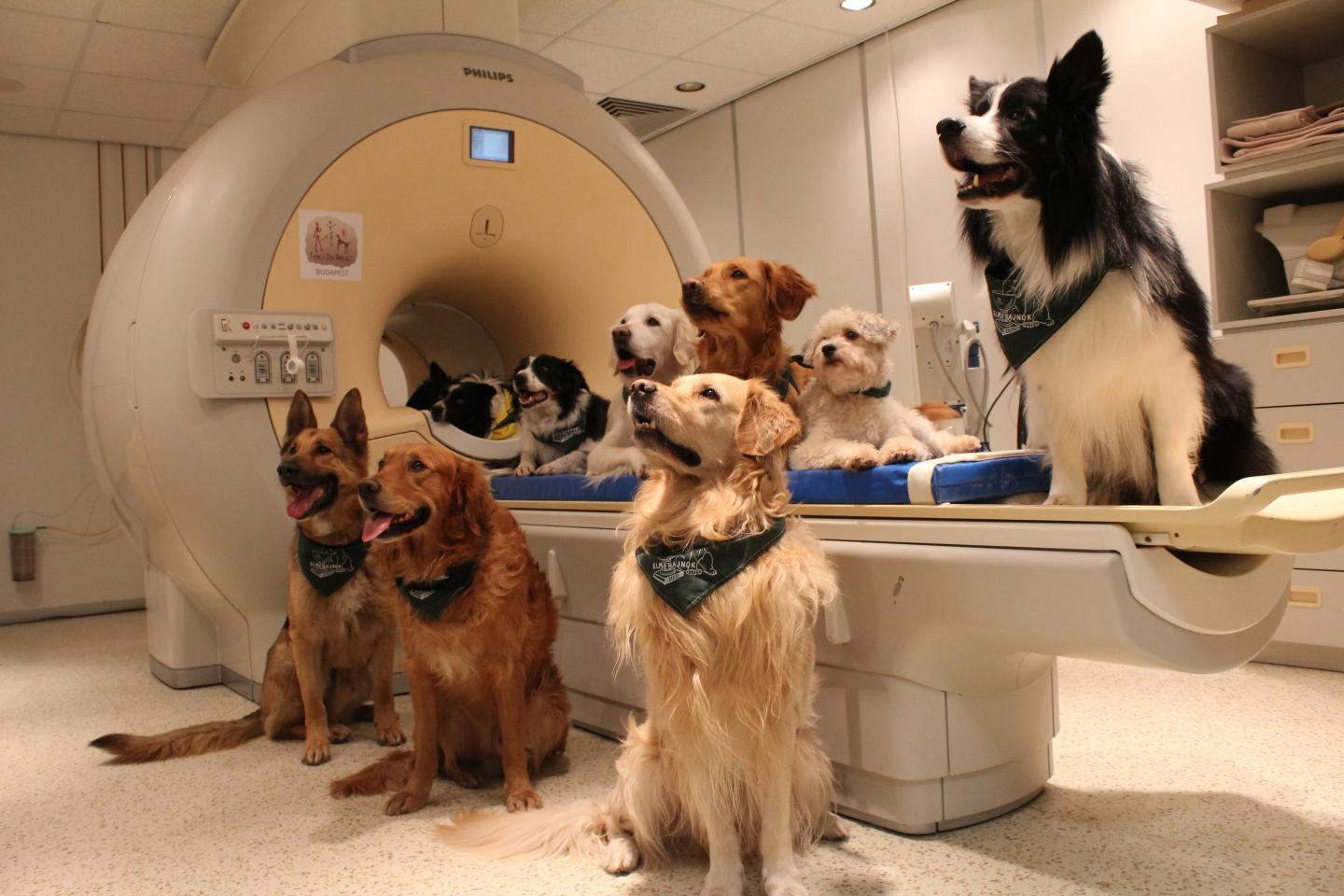
The researchers scanned the brains of eight dogs — six border collies, a labrador and a golden retriever — while showing them images of strangers with either a happy or a neutral expression. The pictures of happy faces increased activity in the parts of the brain associated with higher cognitive and reward processing: the temporal cortex and caudate nucleus.
“It suggests that happy human faces may have emotional significance for dogs,” said Cuaya, who began the research at the National Autonomous University of Mexico and later expanded it through a collaboration at Eötvös Loránd University in Hungary before moving to the Austrian capital.
Next, the researchers wanted to know if the same areas of the dogs’ brains would respond to other emotions. They showed 12 dogs pictures of people feeling happy, angry, fearful or sad and used machine learning to analyse their brain activity.
But the dogs’ brains did not respond in the same way to the angry, fearful or sad expressions as they did to happiness. However, a whole-brain analysis did show distinct patterns of activity when the dogs saw faces showing the negative emotions.
“Humans are really good at picking up small details on the face, so are dogs,” said first author Raúl Hernández-Pérez, also from the University of Vienna. “This makes dogs very interesting. By studying their brains, we can understand what adaptations have developed to support their remarkable social and emotional understanding of humans.”
Cuaya and Hernández-Pérez are partners in their private as well as professional lives and have two dogs, Odin and Kun-kun, who were part of this study.
Hernández-Pérez told CNN that “finding that the caudate nucleus was involved in processing happy faces was a nice surprise,” adding: “Across species, this region has been associated with reward processing. In dogs specifically, caudate activity has been linked to food rewards, but also to social rewards, such as hearing words of praise and perceiving the odor of a familiar person.”
“Although we cannot access dogs’ subjective experience directly, our results suggest that seeing happy faces, even those of strangers, involves positive affective processing.”
The team stressed that there is more to how dogs process emotion than looking at a picture of a still facial expression, as they take other things like the human’s body language, voice and scent into account. They said it is also important to note that the dogs involved in the research were all from loving homes. Those who live on the street may have a completely different way of processing human cues.
Hernández-Pérez told CNN that the dogs had to be specially selected and trained in order to take part. “The dogs needed to be medium-sized, mainly because of the dimensions of the MRI equipment, healthy, and without behavioral problems such as a strong fear of loud sounds,” he said.
“We first teach the dogs that the task is simply to remain still, starting with only one or two seconds and slowly increasing the duration. In fact, one of the most challenging parts is communicating to the dog that ‘doing nothing’ is actually the task. We then gradually introduce the different elements of the MRI environment, including the position, equipment, and scanner sounds. The dogs always participate voluntarily and can leave at any moment.”
The research had several limitations, the authors said. The number of dogs involved in the study was small and most of the dogs were border collies, a smart breed known for its ability to follow social cues.
“It is possible that border collies have a greater ability to interpret human facial expressions, and future studies are needed to determine whether there are behavioral and cerebral differences in the perception of human facial expressions across breeds,” the study said.
The scientists now hope to adopt a “more dogcentric approach” to their research in order to understand how dogs use these signals to make sense of humans.
Hernández-Pérez told CNN: “By reflecting on how remarkably attentive dogs are to our emotions, we can also try to become better at recognizing how they express their own. Emotions are a powerful form of communication that can connect us across species.”
Source: CNN
Journal reference: Dog brain representations of human facial expressions: Encoding happiness and differentiating specific negative expressions