Tag Archives: research

Dog hair blankets in Native America?

Mass spectrometry has been used to resolve a debate about the fibres used to weave Native American blankets.

The blankets have been known as ‘dog hair’ blankets because oral histories passed down by descendents of the Salish weavers, who were indigenous to the Pacific coast of North America, told of the blankets being woven from the hair of dogs who were specially bred for their fur.

copyright University of York Department of Archaeology

Researchers at the University of York‘s Departments of Biology, Archaeology and Chemistry analysed the protein composition of 25 textile samples from 11 different locations.  These textiles were housed in famous collections like the Smithsonian Institution and some came from the expeditions of Lewis and Clark (1803-1806) and Wilkes (1838-1842).

The researchers didn’t find any garments that were made of purely dog hair.

There was evidence of dog hair in a robe of fur and six textile samples, primarily in a blend with goat hair.  The researchers concluded that the dog fur was used to supplement goat hair as a bulking material.

They have published their findings in the journal Antiquity.

Of dogs, house dust and asthma…

This is a tale of how owning a dog can help protect your child from asthma.  Strange, but true.

Researcher Dr Kei Fujimura used mice to test the impact of house dust from homes where a dog lived and from those that didn’t.  She found (and her study was presented at a recent meeting of the American Society for Microbiology) that the dust from households with dogs seemed to have a beneficial effect.

Mice who were fed dust from these households developed an immune response to RSV(respiratory syncytial virus).  Infants who contract this virus have a marked increase in their risk of developing asthma.  RSV affects 90% of children worldwide.  That makes this study significant.

Dr Fujimura says these results support the hypothesis that exposure to animals in early childhood stimulates the immune system to resist the development of asthma and other allergies.

Another reason to introduce your children to the wonders of dog ownership at an early age!

Source:  Discovery News

The importance of pain management

Whenever I take on a new client, I use a health questionnaire that covers current conditions as well as the dog’s health history.  One of the issues I address is any recent changes to the dog’s behaviour or living conditions.

What I am trying to ascertain is if a dog is in pain or having adjustment difficulties. There is a clear link between pain and aggression and this has been supported in a recent study by researchers at the Autonomous University of Barcelona in Spain.

In the Spanish study, which has been published in the Journal of Veterinary Behavior, 12 dogs that were brought in by their owners for ‘aggression problems’ were studied.  All were found to have pain-induced aggression with eight diagnosed as having hip dysplasia.

The breeds in the study were:  a Giant Schnauzer, Irish Setter, Pit Bull, Dalmatian, two German shepherds, Neapolitan Mastiff, Shih-tzu, Bobtail, Catalan Sheepdog, Chow Chow and Doberman.

The researchers concluded “if the pet is handled when in pain, it will quickly act aggressively to avoid more discomfort without the owner being able to prevent it.”

So, when a dog is behaving differently or is “out-of-sorts”, a visit to the vet is recommended.  Behaviour changes can be the first indicator that something is wrong and your vet can help to run appropriate tests to see if there is an underlying health problem.

Dogs have a way of not telling us they are in pain until a problem is more pronounced because their natural instinct is to protect themselves by not exhibiting any noticeable vulnerabilities.  Therapies such as massage and low level laser (which I employ in my canine rehabilitation practice) are useful in helping to manage pain through appropriate stimulation of acupressure points and managing muscle, tendon and ligament condition.  I’m also a strong supporter of acupuncture and refer clients to a local vet who is trained in veterinary acupuncture.

These complementary therapies can be employed alongside traditional pain medications such as NSAIDs to support your dog’s quality of life.  When pain is managed, quality of life improves for everyone in the household.

Source:  Plataforma SINC. “If your dog is aggressive, maybe it is in pain.” ScienceDaily, 13 Jun. 2012. Web. 15 Jun. 2012.

What is your dog thinking? Researchers are on the case!

Researchers at Emory University have published new research into canine cognition.  Entitled Functional MRI in Awake Unrestrained Dogs, the paper outlines findings of research that required two dogs to remain motionless in an MRI machine.

Yes – that’s right. Motionless.  The two dogs were outfitted with special ear muffs to protect them from the noise of the MRI and trained to rest their heads on a chin rest inside the machine.   As the MRI took scans of the dog’s brain activity,  hand signals were used to show the dogs whether there was or wasn’t a food reward.

This is a first-ever study on awake dogs, rather than those that have been sedated.  Importantly, part of the animal ethics of the study was to ensure the dogs were willing participants.

The findings show a definite brain activity response when the hand signals indicated a food reward.  Those dogs are paying attention!

The lead researcher, Professor Gregory Berns, says “We hope this opens up a whole new door for understanding canine cognition and inter-species communication. We want to understand the dog-human relationship, from the dog’s perspective.”

Professor Bern’s dog Callie in training in a mock-up of the MRI scanner (copyright Emory University)

Listen to Professor Berns talk about this project in the Emory University YouTube video:

Source:  Emory University press release 4 May 2012

Would a raised dog feeder help my dog?

A massage client asked me this question earlier this week.   The dog in question is a Boxer (beautiful boy) who happens to be suffering from degeneration in his spine.

Although he is doing well with regular swimming, acupuncture and massage therapy, his owner knows that he is comparatively young (8) and she wants him to have a good quality of life for a long time.  So that’s when we started talking about changes she could make to his physical environment to make things less stressful for him (ramps, steps, etc.)

Would a raised feeder help my dog?

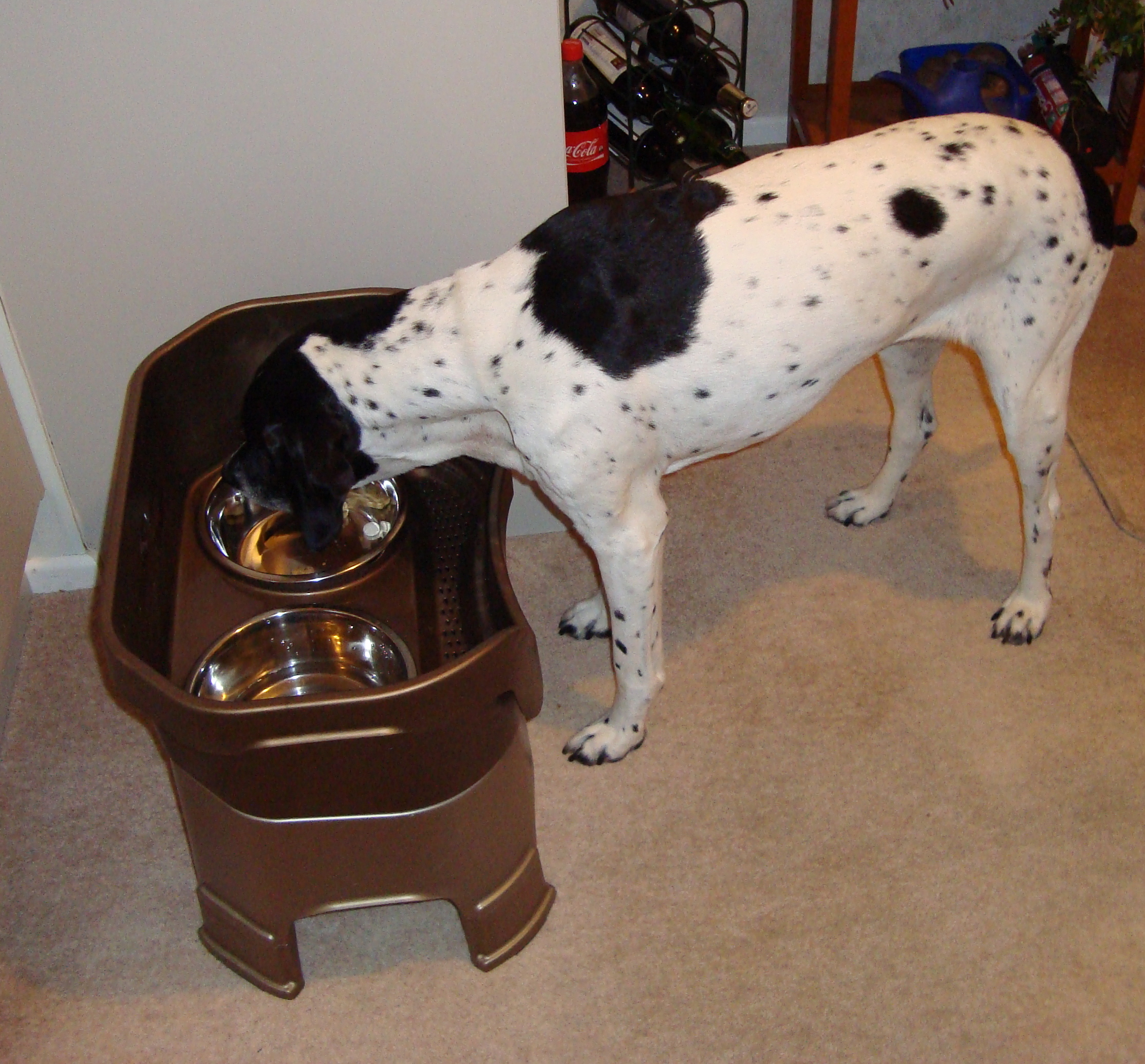
Raised feeders can be a real advantage for a dog with orthopaedic problems or arthritis.  Eating from a raised feeder helps to relieve strain on the neck and back, allowing the dog to eat without dramatically altering their posture and helping them to retain balance.

But – some studies have shown that dogs who are susceptible to bloat have an increased risk from eating from a raised feeder.  The most notable reference for this link is an article by Dr Larry Glickman in Journal of the American Veterinary Medical Association, Vol. 17, No. 10.

Gastric dilation-volvulus (GDV) is known by the common term ‘bloat’  and other terms such as ‘stomach torsion’ or ‘twisted stomach.’  Regardless of what name you use, the condition is life-threatening.  Dogs can die of bloat within several hours.   Even with treatment, as many as 25-33% of dogs who develop bloat will die.

In bloat, the stomach fills up with air and puts pressure on the other organs and the diaphragm. The pressure on the diaphragm makes it difficult for the dog to breathe. The air-filled stomach also compresses large veins in the abdomen, preventing blood from returning to the heart.

Filled with air, the stomach can easily rotate on itself, pinching off its blood supply. This rotation is known as volvulus.  The stomach begins to die and the entire blood supply is disrupted.  A dog with this condition can deteriorate very rapidly – meaning a trip to the vet as an emergency.

Purdue University ranks Boxers as the 16th breed most susceptible to bloat (Great Danes are the highest).  So, in this case, the owner decided not to opt for a raised feeder.  Not only is her Boxer on the higher risk list, but he also is a gobbler – making quick work of his food!

This is just one example where it pays to do a little research.  An idea that seems like a good one may not be so.

Benefits of taking Fido to work may not be far ‘fetched’

The  benefits of dogs in the workplace are the subject of new research published in the March issue of the International Journal of Workplace Health Management.

Researchers at Virginia Commonwealth University  found that the presence of dogs in the workplace may buffer the impact of stress during the work day in both their owners and the people that they come into contact with.

In this YouTube video, principal investigator Dr Randolph T Barker (no pun intended) talks about the costs of stress to employers through lost work time and the benefits of increased productivity.

The researchers conducted their study at Replacements Ltd, the pet-friendly workplace that I featured here in March 2011.

Although Dr Barker is a Professor of Management, he collaborated with specialists in psychiatry and biostatistics for this study.  The researchers emphasise that their results are preliminary and that the next step is to expand the study to a larger sample size in an organisational setting.

I wonder which firm will put their hand up for that study?

Hip dysplasia – it’s not just genetics

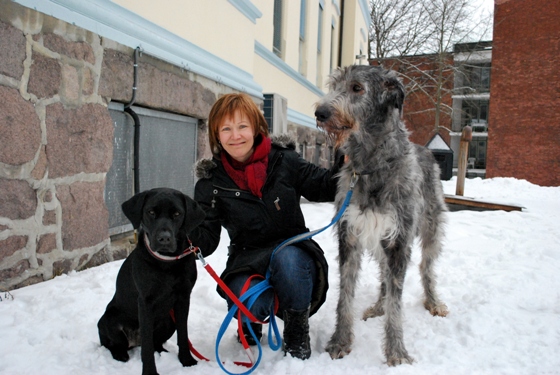
Doctoral research by Randi I. Krontveit at the Norwegian School of Veterinary Science has revealed that environmental factors play a larger role in the development of hip dysplasia than previously thought.

The critical period is from birth to the age of three months.  Activities such as walking up steps on a daily basis during this critical period increased the risk of developing hip dyplasia.

The study group consisted of 500 dogs in four breeds:  the Labrador Retriever, the Newfoundland, the Leonberger and the Irish Wolfhound.

Randi I. Krontveit with two of her study subjects. Photo courtesy of the Norwegian School of Veterinary Medicine

Environmental factors were assessed by questionnaires filled out by breeders and owners alongside examinations by veterinarians.  Dogs were followed for a period of ten years, making the findings of the study particularly robust.

Puppies born in the spring or summer and at breeders’ who lived on a farm or small holding had a lower risk of developing hip dysplasia.  After about eight weeks, the puppies began to live with their new owners. The opportunity to exercise daily in parks up until the age of three months reduced the risk of hip dysplasia.

Overall, it would appear that daily exercise out in gently undulating terrain up until the age of three months has a positive impact when it comes to preventing the disease.

For more information about this research, you can email Dr Krontveit via this page at the Norwegian School of Veterinary Medicine.

New research into virus infection in dogs

Researchers at the University of Pennsylvania School of Veterinary Medicine and the Perelman School of Medicine have published new research into an Epstein Barr-like virus that can infect and may cause lymphomas in dogs.

The findings means that humans and dogs share a similar biology – at least when it comes to the infection by the virus.  (Epstein Barr is the cause of diseases such as mononucleosis and is linked to the development of more serious diseases including non-Hodgkins and Hodgkins lymphomas.)

How does infection occur?

In humans, the Epstein Barr virus infects B cells.  After an acute phase of infection, which passes in many people without them even being aware of it,  the virus goes into a latent phase.  Most people show no symptoms during this phase.  In some, however the virus promotes unnatural growth of B cells and this contributes to the development of lymphoma.

Dogs develop lymphomas that share some characteristics with human lymphomas.  These conditions are relatively common in certain breeds such as the golden retriever.

Researchers think this line of enquiry is promising because they may be able to study the rates of infection and responses to treatment in dogs and this may have spinoffs for human treatment.

You can read the entire University of Pennsylvania media statement here.

Quality of life improves when obese dogs shed excess weight

Researchers at the University of Liverpool have published the results of a study into the quality of life of obese dogs in The Veterinary Journal.

The researchers tracked various quality of life indicators with the owners of 50 dogs who were classified as obese.  These dogs were of various breeds and a mixture of males and females.   The same questionnaire was repeated once the dogs went through a weight loss programme (for the dogs that were successful in losing weight, and those that were not).

Photo courtesy of University of Liverpool

The vitality scores for the dogs that lost weight increased and their scores for emotional disturbance and pain decreased. The more body fat that the dogs lost, the greater their improvement in vitality.

Some people may think ‘these results are a no-brainer’ but in veterinary and other clinical medicine fields, the norm is ‘evidence-based medicine.’  That is, practitioners like veterinarians want results from research that is measurable and defensible when applying or recommending treatments.

Since obesity is linked to problems with the heart, arthritis and other conditions, research likes this helps to underpin the importance of the healthy weight message.

The same basic principles for weight loss in dogs apply to humans:  use portion control, increase exercise and activity, and eat healthy foods.

Dogs as workers – not such a bad idea according to NZ researcher

“Some people think that is cruel to use dogs as workers,” says Dr William “Deak” Helton, “but what these people don’t seem to understand is that from the dog’s perspective it is actually crueller if they are not allowed to work.”  Dr Helton, who is based at the Department of Psychology at the University of Canterbury in Christchurch, New Zealand, is describing for me his experience with working dogs in Alaska.  I wrote about his research in my Canine Corner column this month (NZ Dog World), and here’s some more information about Deak and his research.

This slideshow requires JavaScript.

(Photos copyright Eve Welch, University of Canterbury)

Deak has been studying dogs for over 12 years and, from those early days growing up in Alaska, he observed that sledding and racing dogs wanted to pull immediately when they were placed in harness.  Many people don’t realise, when watching coverage of competitions like the Iditarod, that a large metal snow anchor is used to keep the sled in place as the dogs are secured in their harnesses.  A handler that forgets to do this will quickly find his/her sled taken out for an unguided run!

Deak has a keen interest in seeing working dogs reach top performance.  He described one of his research projects, looking for a way to help screen dogs being considered for a working career:A recent study we did was one in which we measured dogs’ right and left ear temperatures and their ability (based on owners’ reports) to pay attention. The tympanic membrane’s (ear drum’s) temperature is highly correlated with the temperature of the brain on the same side. So differences between the ear’s temperatures may tell you if the dog is more strongly cerebrally lateralized than another. Dogs (like people) have two cerebral hemispheres, one right and one left. Most people are aware that they have a dominate hemisphere (are lateralized). Dogs also differ in their degree of lateralization (how strong one side is compared to the other). Neuroscientists have hypothesized that being strongly lateralized (having a dominate cerebral hemisphere) is actually helpful to the animal in coordinating its behaviour. Imagine having two brain hemispheres both trying to tell your body what to do, without having one as the “leader,” the system may be prone to confusion. Hence, dogs with stronger cerebral lateralization may be better able to pay attention. The less lateralized dogs may be more prone to conflicting cues (distraction). Difference in right and left ear temperature may be an objective measure of cerebral lateralization.

One area where dogs show promise is in the field of medical diagnostics, says Deak.  He goes into some detail about the role of the dog, its accuracy in detecting rates of disease, and his opinion that dogs would be used more widely than they currently are:

There have now been several studies showing that dogs can be used to detect various medical conditions, for example, cancers. When you compare detection capability across tests/technologies you have to look at both the correct detection rate and the false alarm rate of the different tests.

Dogs have been trained to detect the presence of breast cancer by smelling the patient’s exhaled breath. The principle is essentially the same as breath analysis to detect alcohol consumption. The patient breathes into a tube that traps the chemicals exhaled in their breath. The dog then is presented with these breath samples and has been trained to signal when one of them has cancer related chemical compounds (it might not be that the dog is smelling cancer per se, but some related chemical excreted by the body as a reaction to cancer). McCulloch and colleagues (2006) have trained dogs to do this task (detect breast cancer via breath samples), and the dogs after training demonstrated a correct detection rate around 88.0% and a false alarm rate around 2.3%. This is not perfect, but for comparative purposes, in the medical literature, mammography screening by professional radiologists for breast cancer typically has a correct detection rate around 86.6% and a false alarm rate around 3.2% (Banks et al., 2004).

A higher correct detection rate and lower false alarm rate means an overall better detector.

The dog definitely looks promising. Keep in mind mammography is also considered by many to be uncomfortable and some people are concerned that the procedure itself may have side effects. This may put off people from doing the test. The key with cancer is probably early detection. If people are afraid of the test, they aren’t going to do it until they feel so bad they have to and by that time it might be too late. Dog detection (since the dog doesn’t have to even be in contact with the patient) is generally non-invasive.

For detecting intestinal cancer the difference in screening may be between a stool sample and having a colonoscopy. The latter is much more uncomfortable than the former. Considering the preliminary evidence and the long track-record of dogs being used in other detection contexts (explosives, narcotics, invasive pests, etc.), I think the lack of using dogs in medical diagnostic work is mysterious. While dogs will not be a perfect system, people have to realize there are no tests that are perfect. Dogs (or other biological detectors) could be used in conjunction with other tests. There are companies trying to figure out what the dogs are detecting so that they can make technological tests for detecting cancer based on the dog’s ability to detect it, but that is not helping anyone now.

Dogs can probably do the job and if the track record in other contexts is informative (for example, explosives) then dogs will probably be able to do the job better than technology for the foreseeable future.  Of course we should develop other technologies, but if we want to save lives now, dogs could be used more in this context.

The Editor of Canine Ergonomics:  The Science of Working Dogs, a compilation of research from disciplines ranging from biology and veterinary medicine, to psychology and forensic medicine, Deak says “For me, this book filled a gap when you consider how extensive dogs are employed.”  The book, published in 2009 has had great reviews.

The cover of Deak's book

Deak describes his research as the field of engineering psychology, more popularly known as ergonomics.  His work in the field of human factors psychology has earned him the 2011 Earl Alluisi Award for Early Career Achievement by the American Psychological Association (APA).