Monthly Archives: August 2013

Dog fighting: the voiceless victims

Dog fighting is a crime and one where the victims (the dogs) have no voice.  Luckily, animal welfare agencies such as the ASPCA are involved in investigating and prosecuting cases.

Successful prosecution is not easy – it takes a lot of effort to investigate and raid dog fighting rings.   Increasingly, dogs who are rescued are assessed for behaviour and may be directed to welfare agencies for rehabilitation rather than immediate euthanasia.

These photos were taken at the dog fighting temporary exhibit sponsored by the ASPCA at the Crime Museum in Washington DC.  They give a small glimpse into the plight of dogs used for fighting…

The Victims

Scales such as these are used to weigh fighting dogs before they enter the ring

Scales such as these are used to weigh fighting dogs before they enter the ring

Poster

The investigation into Michael Vick's kennels was a turning point in many ways; for the first time there was an offender who had the finances to pay reparation that would support rehabilitation of fighting dogs.

The investigation into Michael Vick’s kennels was a turning point in many ways; for the first time there was an offender who had the finances to pay reparation that would support rehabilitation of fighting dogs.

American Dog Breeders Assoc

WinnerChainingWounds

Image

Senior pets month

Blog paws seniors

Another study about dogs (yawn)

It’s official (again) – dogs yawn more often in response to their owners than to other people.

dog yawning

Last year, researchers in Sweden published research on contagious yawning in dogs.  This year, researchers at the University of Tokyo have published additional research in the open journal PLoS One.

Their research focuses on a ‘familiarity bias’ in contagious yawning by dogs.

Pet dogs in the study watched their owner or a stranger yawn.  They responded more in response to their owners than to the strangers.

The researchers conclude that the dogs have an emotional connection to their owners, which is exhibited through empathy with the yawning movements.

The five freedoms

Let’s go back to basics for a moment and think about our role as caregivers for our dogs.  Every animal owner should understand the Five Freedoms which are an internationally recognised code for animal welfare.

Anyone responsible for looking after animals should aim to meet each of these freedoms.

1.  Freedom from hunger and thirst

This means giving your dog adequate food and water to keep them healthy

2.  Freedom from discomfort

All animals deserve adequate shelter and a place to rest

3.  Freedom from pain, injury and disease

Owners should focus on keeping their animals safe from harm and, when they are sick, they should be taken for appropriate care without delay

4. Freedom to behave normally

This is about ensuring there is enough space for an animal to exhibit its normal behaviour including having opportunities to interact with others of its own kind

5.  Freedom from fear and distress

Treatment should ensure that animals are not distressed or fearful, exhibiting good mental health

The search for quality (a tale of recalls and safety concerns)

Well, it’s happened again.  Another range of pet treats is the subject of a recall.  This time it’s Dogswell treats by Arthur Dogswell LLC.
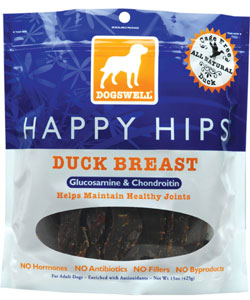
Chicken Breast and Duck Breast jerky under the Breathies, Happy Heart, Happy Hips, Mellow Mut, Shape Up, Veggie Life, Vitality and Vitakitty brands with a best before date of Jan 28, 2015 are affected

Chicken Breast and Duck Breast jerky under the Breathies, Happy Heart, Happy Hips, Mellow Mut, Shape Up, Veggie Life, Vitality and Vitakitty brands with a best before date of Jan 28, 2015 are affected

These treats are being recalled because product testing by the New York State Department of Agriculture and Markets found traces of an antibiotic that is not approved for use in the United States.

The company says that since January of this year, they have new testing procedures in-house to ensure that their chicken and duck ingredients don’t contain antibiotics – so clearly there was a risk identified which motivated them to make a business decision to invest in the new testing!

Because animal feed products are going to ‘just animals’ there’s a real tendency of the markets and businesses involved to buy sub-standard and cheap ingredients.  (Don’t forget the melamine scandal of 2007 and how many brands were involved.)

Supply chain management is so important.  That’s about businesses knowing the source of each and every ingredient in their product – with contractual obligations on those suppliers to meet quality standards.  My advice is if you are considering a food product for your dog, you should enquire with the manufacturer about the source of their ingredients before buying.  If the information isn’t on the label, you need to contact the manufacturer through their website.

If the manufacturer doesn’t have a website or another avenue for customer enquiries – AVOID, AVOID, AVOID their product.  Always get the information on the ingredients of their product in writing (usually via email).

One of the reasons I started Canine Catering was to have greater control over the ingredients in dog treats.  These products tend to remain on shelves for much longer than other foods and their countries of origin often have dubious reputations for supply chain management.  The amount of preservatives is often staggering.

I like to use human grade ingredients in the first instance, as a major step for quality control.   I still read labels even on human grade food.

Accidents happen.  But haven’t we had enough accidents in the pet food industry?  Consumer choice drives change.  Make sure you exercise your power as a consumer by buying quality products for your dog.

Fake service dog products

Non-profit agency Canine Companions for Independence is circulating a petition to the U S Department of Justice to urge them to take action against fake service dog/assistance dog products.

These  products, mostly sold online, fraudulently portray a dog as an assistance dog.   As service animals, they will be permitted inside grocery stores, restaurants and other public places where family pets are otherwise not allowed.

As a result of these acts of fraud, people with disabilities who have a legitimate need for an assistance dog face added discrimination and are being denied access to public places, which is in violation of the Americans with Disabilities Act.

I’m a big supporter of dog-friendly workplaces, hotels, and shopping (as evidenced by the postings on this blog), but I do not support gaining access through fraud.  My biggest concern is that people with disabilities and their dogs may be discriminated against because members of the public will lack confidence in service dog certification systems.  (‘That’s a service dog?  Yeah, right.’)

As an example, check out last month’s publicity when Air New Zealand allowed access to two French bulldogs whose owners carried papers certifying them as psychiatric dogs.  Air New Zealand obeyed the law but the scepticism of the journalists and public who commented on the article was clear.

We simply can’t afford to have the public doubt the authenticity of assistance dog and service dog training programmes.  If you agree with me, please support this cause and sign the Canine Companions petition here.

The State of Pet Health in 2013 – The Banfield Report

As most of my regular readers know, I’m passionate about holistic health for our dogs. It helps, though, when we have statistics like the Banfield State of Pet Health Report 2013 to show us the ailments that are more common. In this report, we see that obesity and dental health are 2 major problems.

So ask yourself honestly – is my dog a bit heavier than he/she should be? Is the dog’s bad breath a sign of something more sinister? Through my practice, I can help dogs with both conditions (plus others, like arthritis).

Get in touch!

Mel's avatarNo Dog About It Blog

Chihuahua Wearing EyeglassesLast year, I shared a summary of Banfield Pet Hospital’s 2012 report on the state of pet health in America. The report was full of interesting information on the common ailments and diseases they see in the cats and dogs who visit their hospitals. It also called out a disturbing trend being seen in both types of pets – an increase in pet obesity.

In their 2013 State of Pet Health Report, Banfield shares even more interesting information on the average lifespan of pets and some frequently occurring themes (also seen in the 2012 report). This year’s report provides pet owners and veterinarians with even greater insight into the health of all our pets and where we should be focusing our attention.

Here is a summary of some of the more interesting findings:

  • Toy or smaller breed dogs live 41% longer than large breed dogs.
  • Large breeds reach their senior…

View original post 223 more words

Testing on animals for a legal high

Across all major cities in New Zealand this week, people and their dogs marched in protest of the Psychoactive Substances Act.  This Act has come into effect to regulate ‘designer drugs’ or ‘legal highs’ to protect the safety of people who choose to take such drugs.

The Act allows for animal testing ‘when there is no alternative’ because the New Zealand MPs who voted for it refused to ban animal testing altogether.

A billboard by SAFE in Wellington

A billboard by SAFE in Wellington

Many New Zealanders signed a petition to Government to oppose animal testing for something as frivolous as ‘getting high.’  The Ministers of Parliament didn’t heed those views when voting on the new law.  Green MP Mojo Mathers has a members bill proposed to remove animal testing as an option – but there are no guarantees that it will be chosen from the ballot to move through the law-making process.

This isn’t about therapeutic drugs – this is about getting your jollies artificially and wanting assurances that you are safe because the products have been tested on animals.

I live in New Zealand, and I’m pretty saddened by the lack of leadership shown by the New Zealand Government.  What do you think?  Would you buy New Zealand made products or plan a trip here knowing that dogs and other animals may die for the legal high industry?

Not a good look, New Zealand.  For shame!

Training dogs for bomb detection

Unfortunately, we live in a world where people still build bombs to kill and maim.  Dogs have traditionally been trained to detect explosive devices by learning to detect specific odours and then to signal their handler.

A detection dog in action

A detection dog in action

The process of training a bomb detection dog is slow because the dog is trained to identify each scent individually.  In countries like Afghanistan and Iraq, homemade devices are made using mixtures of explosives.

With a grant from the Office of Naval Research, researchers at the University of Lincoln (UK) will investigate whether explosive detection dogs are capable of learning by categorisation, a cognitive process that is thought to play a major role in the way humans and animals naturally process new information.

The study will explore whether dogs can be trained to recognise the significance of a group of odours, rather than having to learn each scent individually.

Researcher Helen Zulch says, “In this study we will be testing whether a dog can be taught a general rule for a group of odours and then apply that knowledge to a new situation, involving scents it has never encountered. We know dogs can categorise visual stimuli, so the aim of this study is to find out whether dogs are able to categorise odours in a similar manner.”

If successful, the research will underpin new training approaches that will accelerate the process of training detector dogs.

Source:  University of Lincoln media release

Benefits of having a dog in your life

Daisy portrait

Some of the great benefits of owning a dog are:

  1. Reduction of stress
  2. They make you exercise
  3. They provide unconditional love
  4. And on top of this, they boost self esteem (even after a bad day at work, they love you!)
  5. When life is hard, they teach you the value of play
  6. Because they love you, they provide safety & security
  7. They provide a sense of belonging – you’re packmates!
  8. On top of everything, the act of petting a dog is proven to lower blood pressure and heart rate

Enjoy your weekend.  Have you hugged your dog today?