Today – Friday, 4th April 2014 World Stray Animals Day.
If you want your life to be better with a dog…please visit your local adoption center. (Remember, even Snoopy was adopted!)


Today – Friday, 4th April 2014 World Stray Animals Day.
If you want your life to be better with a dog…please visit your local adoption center. (Remember, even Snoopy was adopted!)
Posted in animal welfare, Dogs
Tagged adoption, Life is Better with a Dog, Peanuts, Snoopy, World Stray Animals Day
The functional MRI research team led by Gregory Berns have done it again. In research published in the journal Behavioural Processes, they show that an area of the canine brain associated with reward responds more strongly to the scents of familiar humans than it does to the scents of other humans, or even to those of familiar dogs.

Kady, a lab involved in the study, shown training for the experiment in a mock-up fMRI scanner. Photo by Helen Berns
“In our experiment, the scent donors were not physically present. That means the canine brain responses were being triggered by something distant in space and time. It shows that dogs’ brains have these mental representations of us that persist when we’re not there.”
When humans smell the perfume or cologne of someone they love, they may have an immediate, emotional reaction that’s not necessarily cognitive, Berns notes. “Our experiment may be showing the same process in dogs. But since dogs are so much more olfactory than humans, their responses would likely be even more powerful than the ones we might have.”
The experiment involved 12 dogs of various breeds. The animals had all undergone training to hold perfectly still while undergoing an fMRI scan. As they were being scanned, the subjects were presented with five different scents that had been collected on sterile gauze pads that morning and sealed in Mylar envelopes. The scent samples came from the subject itself, a dog the subject had never met, a dog that lived in the subject’s household, a human the dog had never met, and a human that lived in the subject’s household.
The familiar human scent samples were taken from someone else from the house other than the handlers during the experiment, so that none of the scent donors were physically present.
The dog scents were swabbed from the rear/genital area and the human scents were taken from armpits.
The results showed that all five scents elicited a similar response in parts of the dogs’ brains involved in detecting smells, the olfactory bulb and peduncle. The caudate responses, however, were significantly stronger for the scents of familiar humans, followed by that of familiar dogs.
“The stronger caudate activation suggested that not only did the dogs discriminate the familiar human scent from the others, they had a positive association with it,” Berns says. “While we might expect that dogs should be highly tuned to the smell of other dogs, it seems that the ‘reward response’ is reserved for their humans. Whether this is based on food, play, innate genetic predisposition or something else remains an area for future investigation.”
An interesting twist: The dogs in the experiment that had received training as service/therapy dogs showed greater caudate activation for the scent of a familiar human compared with the other dogs. It is unclear whether this difference was due to genetics or had simply been fostered through the service/therapy training.
“We plan to do further research to determine whether we can use brain-imaging techniques to better identify dogs that are optimal to serve as companion animals for the disabled,” Berns says.
The training of service dogs is time-consuming and expensive, he says, and only about one-third of the animals that begin the process successfully complete it. Meanwhile, the waiting list for service dogs is long, and includes many wounded veterans.
“In addition to serving as companion animals for wounded veterans, dogs play many important roles in military operations,” Berns says. “By understanding how dogs’ brains work, we hope to find better methods to select and train them for these roles.”
Source: Emory University media release
Read my other blogs about functional MRI research:
“There is no such thing as a stupid dog. Each dog has his own genius and it is up to us as humans to find out what it is.”
– Brian Hare, co-author of The Genius of Dogs
I’ve previously reviewed The Genius of Dogs. Click here to read my review.
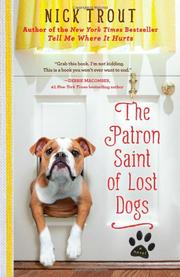
In this first novel by Dr Nick Trout, the main character – Dr Cyrus Mills – returns to his hometown to run the veterinary practice of his late father. Already in financial difficulties himself, Cyrus finds the the practice is also in dire straights and the local banker has given him a week to come up with a good faith payment on debt.
On his first day in the practice, he meets a Golden Retriever named Frieda whose owner wants her to be put down because she is having accidents in the house. Frieda becomes something of a stowaway in Cyrus’ apartment as “Missing Dog” posters start appearing around the town featuring Frieda, whose full name is Frieda Fuzzypaws.
Then there are the other characters that make up the story. The x-ray of a Persian cat with digestive problems reveals that the owner’s fiancee isn’t as doting and devoted as he seems. An elderly female dog named Clint (one in a long line) tests Cyrus’ ability to work with emotional owners and brings him closer to his own love interest, a local waitress.
Clearly Dr Trout has used his own veterinary background to make this story realistic and, hailing from New England himself, he’s used a small Vermont town in winter as the setting for the story.
I enjoyed this novel. I wouldn’t say I loved it – but it’s a good one for taking on vacation with you to the beach.
And you have to find out what happens to Frieda Fuzzypaws!
I’ve also reviewed Tell Me Where It Hurts by Dr Trout. Read my review here.
Kathleen Crisley, specialist in dog massage, rehabilitation and nutrition, Canine Catering Ltd, Christchurch, New Zealand
Posted in dog books
Tagged Dr Cyrus Mills, Dr Nick Trout, Dr Trout, Frieda, Frieda Fuzzypaws, Golden Retriever, Vermont, veterinary practice

Photo courtesy of Indiana University-Purdue University Indianapolis
A research team at Indiana University-Purdue University Indianapolis (IUPUI) has helped determine the science behind how dogs locate explosives such as Composition C-4 (a plastic explosive used by the U.S. military). The study found the dogs react best to the actual explosive, calling into question the use of products designed to mimic the odor of C-4 for training purposes.
These findings are the culmination of a four-year contract funded by the U.S. Department of Defense (DOD).
“Appropriately, dogs that are trained to find real explosives are going to find real explosives and not much else,” said John Goodpaster, Ph.D., associate professor of chemistry and chemical biology and director for the Forensic and Investigative Sciences Program in the School of Science at IUPUI.
The effectiveness of trained detector dogs is well established, but the study sought to determine which chemical compounds cause a dog to recognize a particular explosive and alert to it. Previous studies have suggested that certain non-explosive chemicals emitted by Composition C-4 cause dogs to alert, and that these specific chemicals could be used as mimic substances to train the dogs in place of real explosives.
The research team discovered that the non-explosive chemicals given off by C-4 mimics also are present in a variety of everyday plastic objects. Objects tested included PVC pipes, electrical tape, movie tickets, a plastic grocery bag and plastic food wrapping. Several of the tested items emitted appreciable levels of a mimic compound recommended by some vendors for training dogs.
The second phase exposed 33 trained canines from the DOD, Department of Justice, Amtrak and other agencies to these vapors to see if the dogs would respond. The field trials demonstrated that the dogs failed to respond in any significant way to specific odor compounds found in C-4. The results indicate that if the dogs are trained on the full scent, they will only detect real explosives.
The study findings have been published in the March 2014 edition of the journal Forensic Science International.
Source: IUPUI media release
I’m an absolute advocate for positive reinforcement training. Here’s how Professor Gregory Berns and his research team trained dogs to remain still in a noisy MRI scanner.
You can also read my other blogs about functional MRI research and dogs:
Posted in dog care, Dogs, research
Tagged functional MRI, Gregory Berns, positive reinforcement, Professor Gregory Berns, training, YouTube
It’s raining and blowing a gale in Christchurch today. So I thought I’d share this little video to cheer everyone up!
Researchers have now proven what dog trainers have known for some time: dogs have a sense of quality when it comes to treats and they will seek out the higher value ones.
Kristina Pattison and Thomas Zentall of the University of Kentucky tested the principle by feeding baby carrots and string cheese to ten dogs of various breeds
 The research was conducted on dogs that would willingly eat cheese and baby carrots when offered, but showed a preference for the cheese. However, when given a choice between one slice of cheese, or the cheese together with a piece of carrot, nine of the ten dogs chose the cheese alone. That is, they chose less food over more food.
People, for instance, tend to place greater value on a set of six baseball cards that are in perfect condition, than on the same set of six perfect cards together with three more cards in fair condition.
In cases where rapid decisions must be made, quick solution-driven heuristics such as the “less is more” effect may come in handy. For instance, it is helpful when members of the same species, such as a pack of dogs, feed together. The one that hesitates may lose food to faster-choosing competitors.
But the fact that one in ten dogs did choose the cheese-and-carrot combination suggests that levels of motivation may play a role in this effect. The outlier dog, for instance, had a history of living in shelters and fending for himself.
Source: Springer media release








 DoggyMom.com