“I wonder if other dogs think poodles are members of a weird religious cult.”
– Rita Rudner, comedian


 For the record…I like Poodles. In fact, I like all dogs.

“I wonder if other dogs think poodles are members of a weird religious cult.”
– Rita Rudner, comedian
For the record…I like Poodles. In fact, I like all dogs.
A single injection eased severe, chronic pain caused by late-stage bone cancer in dogs, according to a study in the November issue of Anesthesiology. Dogs with bone cancer that received a neurotoxin injection had significantly more pain relief than those that got standard care without the injection.
“Dogs are part of the family and we do everything we can to relieve them of pain and discomfort when they are sick,” said Dorothy Cimino Brown, D.V.M., School of Veterinary Medicine, University of Pennsylvania, Philadelphia. “In addition to sharing emotional attachments with our dogs, humans share many of the same ailments our pets suffer when fighting cancer. By studying the positive pain relief this treatment afforded dogs, we are hopeful it may also be effective for humans.”

A radiograph of a dog’s leg with a cancerous lesion. (Credit: Image courtesy of American Society of Anesthesiologists (ASA))
The owners of 70 dogs enrolled their pets in this study. Half the dogs received an injection of a neurotoxin, called substance P-saporin (SP-sap), as well as standard care. The other half (i.e., the control group) received standard care without the neurotoxin injection. The average age of the dogs was between 8 and 9 years and their average weight was 90 pounds. Multiple breeds participated in the study, including: Rottweilers, Labrador Retrievers, Golden Retrievers and mixed breeds.
The evolution of bone cancer pain in dogs parallels what occurs in humans, with the frequency and intensity of pain increasing over weeks and months. As the cancer advances, both canine and human patients experience life-altering pain, which greatly affects their daily activities and quality of life. The standard treatment for dogs with late-stage bone cancer can include opioids, steroids, and palliative radiation. All of these treatments can have negative side effects.
Within six weeks of beginning the study, 74 percent (26) of the dogs in the control group needed to be “unblinded” (i.e., their status in the study revealed) and their pain relief regimen adjusted compared to 24 percent of the dogs (eight) in the group that received the injection. This was a statistically significant difference.
Other study results included a 6 percent increase in pain severity scores for dogs in the control group, while the dogs in the SP-sap group had no change in pain severity score. In addition, the dogs in the control group had an 8 percent increase in how pain interferes with their typical activities, while the SP-sap dogs had a 5 percent improvement in this pain impact score. Finally, one dog in the control group responded with improved lameness, while 6 dogs in the SP-sap group became less lame. While these secondary study results were not statistically significant because they were only assessed two weeks after injection, they are promising.
Daisy (my Daisy) is (not surprisingly) a fan of Snoopy because he was born at the Daisy Hill Puppy Farm. (I’ve tried to explain that the Farm was named long before Daisy was born, but she doesn’t quite grasp that concept.)
Mr Schultz, creator of Peanuts, clearly didn’t know about puppy mills when he was creating the story of Snoopy’s adoption – because the Farm looks nothing like the puppy mill operations we see today. Snoopy was able to be raised with his mother and siblings in a ‘free range’ environment which included a healthy buffet for dinner and musical interludes…
This YouTube video shows what the Daisy Hill Puppy Farm looked like:
Wouldn’t it be wonderful if all puppies were raised in these conditions?
I’ve previously written about how to test if your dog is right-pawed or left pawed. Researchers at the University of Adelaide led by Dr Luke Schneider tested a group of 73 dogs using 50 manipulations of an object to determine their paw preference. They then interviewed the dog owners about their dog’s behavior to see if there was a pattern.
“We found that dogs with a preference for left paws were reported by their owners to show high levels of aggression towards strangers. The left pawed dogs scored almost twice as high as ambilateral (ones with no preference) and also higher than dogs with right paws.
“There is research in the human world as well that positive and negative emotions can be located in the left and right hemispheres and it seems to go the same way in humans and other animal species, that the negative emotions are located in the right hemisphere. There are many, many overlaps between human and animal brains.”
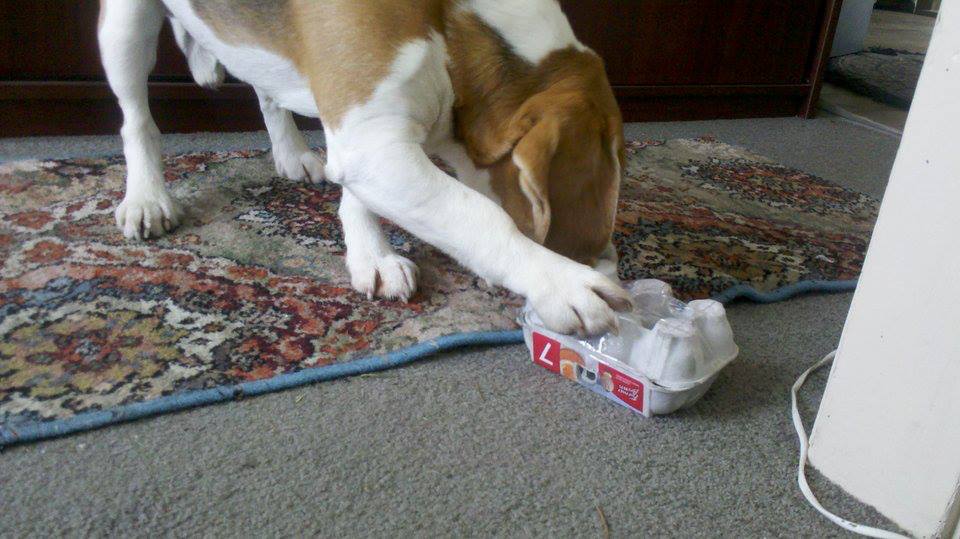
Blake the Beagle shows his preference for the right paw
When testing dogs for paw preference, the research team found a roughly even split between those dogs that had a right paw preference vs those with a left paw preference.
None of the dogs in the study were noted as particularly aggressive, and so the research team wants to do more work with dogs who are noted for aggression-type responses. A larger testing group would also help to validate results. The research team’s study has been published in the Journal of Veterinary Behavior.
This month, Ralph Lauren, has chosen to feature rescue dogs in showing his Fall 2013 Accessories Collection. This collection includes items of dog apparel, such as cashmere sweaters! (October is Adopt a Shelter Dog month, by the way)
If you buy any of the featured items between 15 October and 15 November, 10% of the proceeds will be donated to the ASPCA.
And now…..Ralph Lauren presents The Dog Walk:
Posted in animal welfare, dogs in advertising
Tagged accessories, Accessories Collection, adopt a, ASPCA, cashmere sweaters, collection, Dog Walk, Fall 2013, October, Ralph Lauren, rescue dogs
Dogs have been used in advertising for a long time – it’s not a new trend. Anyone who likes dogs will spot the ads that use a dog and they are more likely to remember the product or service.
Today I spotted this ad on a local website for a car dealership.
Is the Chocolate Labrador a Volkswagen fan?

Posted in dogs in advertising
Tagged advertising, Amarok, Chocolate Labrador, Dog, dogs, labrador, Volkswagen
This is Lily. She was the inspiration behind National Mill Dog Rescue, which is based in Peyton, Colorado. I love to find stories, sad and otherwise, which show how special dog inspire their owners to do new things.
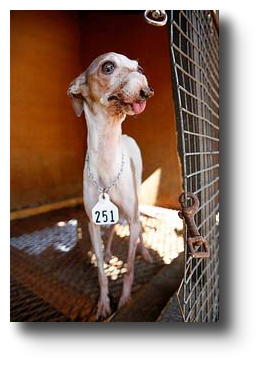 Lily’s story is told eloquently by Rich Strader on the National Mill Dog Rescue website:
Lily was born, raised and perhaps had 13 litters of puppies at the Reedgate Kennels before we were able to buy her at auction. Her time there was spent in a wire cage with a board to sleep on and a rabbit water bottle to drink from. While in the mill she received little or no vet care and because of this she lost all her teeth and her lower jaw rotted off, which is not unusual for the smaller breeds in the puppy mills. Everything that was precious to her was taken away (her puppies). The human hand brought only misery.
When she came to me I took her to work everyday and she slept in the warmth of my Irish Wolfhound’s stomach. She slowly learned to trust and in seven months she would come to me to get on my lap! She now loves all humans as no one will ever hurt her again.
 Lily is my inspiration. She can teach anyone about love, courage and the ability to forgive. Unfortunately the cancer she acquired through years of neglect is now close to ending her life. I have promised her she will never be alone again and I will be with her at the end. To date she is responsible for saving over 7700 dogs as she is the inspiration and founder of MDRN.
Lily died in my arms May 13, 2008. She will be missed.
You can find out more about National Mill Dog Rescue on their website and I encourage you to read Theresa Strader’s Letter to Lily’s Breeder to fully understand the scale of suffering by irresponsible breeders.
And to update the numbers…to date, National Mill Dog Rescue has saved 8,184 dogs … and still counting!
The World’s Ugliest Dog Contest has been held annually in Petaluma, California as part of the Sonoma-Marin Fair for 25 years. This contest has grown in popularity and is now featured on cable television channel Animal Planet.
Although dog moms and dads who enter their dog mainly come from the United States, anyone can enter. The Chinese Crested, a largely hairless breed, has figured prominently amongst the winners.
This year (2013), the title was awarded to Walle, a beagle, boxer, basset hound mix with a large head and a duck-footed walk. He beat 29 other contestants for the title.
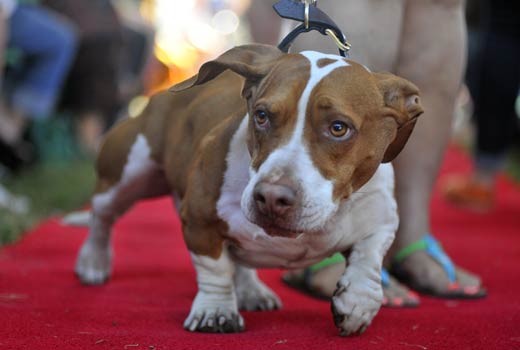
Walle, the World’s Ugliest Dog 2013
Vicki DeArmon has written a book about the contest which profiles winners, other entrants, and their owners. The pictures really do prove that some creatures are so ugly that they’re cute.
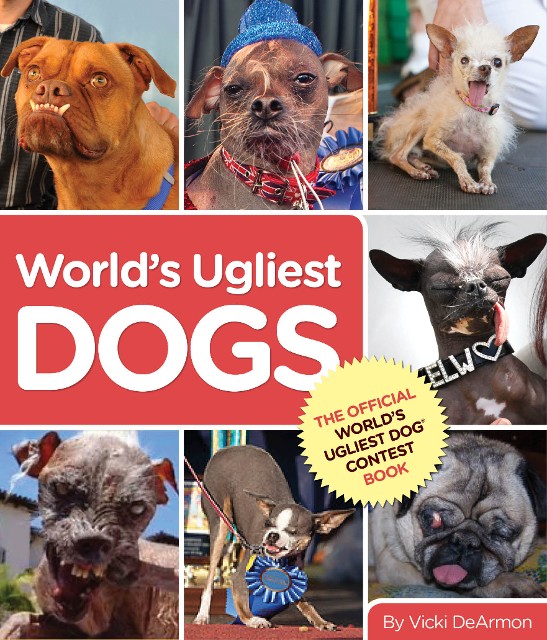
Maybe the dog lover in your pack would like this book for Christmas, or perhaps you should treat yourself?









 DoggyMom.com