This video, courtesy of the University of California San Francisco, shows the gait effects of spinal cord injury and a very good close up of the proprioception test that is used by vets. (See my previous blog about prioprioception here.)

This video, courtesy of the University of California San Francisco, shows the gait effects of spinal cord injury and a very good close up of the proprioception test that is used by vets. (See my previous blog about prioprioception here.)
Posted in dog care
Tagged gait, proprioception, spinal cord, spinal cord injury, University of California San Francisco
Last week, the University of California San Francisco issued a press release about the promising research of Dr Linda J Noble-Haeusslein and her collaborators at Texas A&M University.
The US Department of Defense has granted $750,000 over three years to develop a drug that helps to mitigate the secondary damage associated with spinal cord injury. When an injury occurs, there is a cascading chemical reaction that damages nearby cells and that means – essentially – that more damage happens than that caused by the immediate injury.
It is thought that the drug, a protein-blocking agent, will successfully interfere with that cascading process and preserve sensitive neurological pathways.
Other neurological researchers have shown that movement in the spine can be preserved if as little as 18-20 percent of nerve fibre tracts remain intact.
Dogs such as Dachshunds, Corgis and Beagles (dogs with a long torso) are known to be susceptible to disc ruptures. When a dog presents with a disc rupture at the Small Animal Hospital at Texas A&M University, their owner will be asked to consent to the experimental treatment.
And why is the funding coming from the Department of Defence? Well, sadly, there are many wounded soldiers returning from overseas war zones with spinal injuries.
Source: University of California, San Francisco (UCSF) (2012, January 18). Saving dogs with spinal cord injuries. ScienceDaily. Retrieved January 25, 2012, from http://www.sciencedaily.com /releases/2012/01/120118155338.htm
Posted in research
Tagged beagle, corgi, dachshund, dogs, proprioception, spinal cord injury, Texas A&M, University of California San Francisco
This week, actress Betty White celebrated her 90th birthday. It’s quite a milestone. She’s received a lot of attention over the years and not just for her acting. Ms White has a long history of animal advocacy work and many charities have benefited from her support.
The Seeing Eye, Inc., an organisation founded in 1929, has named a puppy after Betty. Based in Morristown, New Jersey, the Seeing Eye is the oldest existing guide dog school in the world and it has trademarked the term “seeing eye” so that only dogs from its school can be called seeing eye dogs. That’s why guide dog puppies here in New Zealand are called guide dogs whereas folks from the United States often call them seeing eye dogs.

Betty, the Seeing Eye dog named after actress Betty White
Ms White first recorded a radio public service announcement for The Seeing Eye in the 1980s in which she helped remind everyone about the requirement to allow guide dogs access to public transport. You can listen to that announcement here.
In 1987, the American Veterinary Medical Association gave Betty its Humane Award for charity work for animals. Ms White has a bronze plaque at the Los Angeles Zoo (near the gorilla exhibit) which also honours her work for animals. In 2010, she was even granted the title of honorary forest ranger by the US Forest Service!
Happy birthday Betty! And may Betty the Seeing Eye Dog have a long career!
Kathleen Crisley, specialist in dog massage, rehabilitation and nutrition/food therapy, The Balanced Dog, Christchurch, New Zealand
The Wire-haired Fox Terrier is the big winner in The Adventures of Tintin film. New Zealand’s Weta Workshop has worked its magic in creating a digital version of Snowy, Tintin’s loyal dog.
Tintin is a young reporter with a nose for news. He was created by Georges Remi under the pen name of Hergé in 1929, appearing in a series of children’s stories/comic books that particularly appealed to young boys. Investigating crime and finding the culprits were everyday activities for Tintin and Snowy.
It is great to see another dog take center-stage in the film world this year. This official movie trailer, courtesy of YouTube, gives you an introduction to Snowy (and Tintin) and the wonderful work of Weta Workshop.
Posted in dog breeds, Dogs
Tagged georges remi, movie, movie trailer, snowy, Tintin, weta workshop, wire-haired fox terrier, YouTube
I was thinking today about how dog nutrition has changed over the years. Today, there are more dog foods than ever before. There are organic products and even products that aim to attain the values of the raw food diet – but offering a more prepared formulation for busy dog owners.
So now I’m going to show my age and also the power of a good jingle. I still remember this commercial from the 1980s for Kibbles and Bits. This was one of the first commercial dog foods to offer a hard kibble combined with softer texture pieces. But it’s the jingle I remember and I’ve found it for you here on YouTube. Enjoy it.
And now my friends will understand when I tell Daisy that I love her to bits…kibbles and bits and bits and bits!
Posted in dog nutrition and labelling
Tagged bulldog, commercial, dog food, dog foods, jingle, kibbles and bits, raw food, raw food diet, tv
Over the holidays, my mother and I went to see We Bought A Zoo starring Matt Damon and Scarlett Johansson. The movie is based on the true story (and book by) Benjamin Mee, who purchased the rundown Dartmoor Wildlife Park (now known as Dartmoor Zoo) and re-opened it in 2007.
I’m an animal lover and so movies like this appeal to me. Even better, the family in the story owns a beagle named Leon. He’s not a main character but as with all beagles – he’s adorable. Behind the scenes, it sounds like the beagle playing Leon was being a true beagle – with a mind of his own despite his training. According to Cameron Crowe, the Director of the film, “it was really the beagle who was hard to work with (laughs).” (Interview on azcentral.com)
My advice: go to the film and enjoy it and look for the beagle!
Posted in Dogs
Tagged beagle, Cameron Crowe, Matt Damon, movie, Scarlett Johansson, training, We Bought A Zoo
As my readers know, I don’t make product endorsements very often. But, I had to share the great dog photography of Ron Schmidt with my readers.
I discovered Ron’s work last year when I purchased a calendar, Dogma – A Dog’s Guide to Life. I loved the combination of dog photos and dog-inspired proverbs. I have purchased another Dogma calendar for this year!
Ron trained in photography and worked with fashion and celebrity photographers for years before branching out into commercial photography on his own in 1999. A holiday card developed for friends and relatives that featured the family dog carrying a Christmas tree quickly morphed into a career in dog photography. Ron and his wife launched Loose Leashes in 2005 and they donate a portion of the proceeds from sales of prints to animal welfare causes (another reason to like them!)
I won’t break any of Ron’s copyright by attempting to copy his photography on this blog – but check out Loose Leashes today!
When scientists studied captive wolves (and I’m talking about research that dates back to the 1960s), they observed fighting for dominance within the group and extrapolated that information as relevant to domesticated dog behaviour. Unfortunately, by studying captive wolves, the scientists were observing an artificial pack – wolves that were placed together in very unnatural circumstances.
Over the years and ‘informed’ by this research, the theory of being the Alpha Dog developed. The alpha dog is the top dog of the pack, the dog who eats first (as an example).
Trainers who picked up on the alpha dog theory taught their clients to ‘alpha roll’ their dog. That is when you force your dog to roll over on its back to signal your dominance.
It is true that wolves roll over as a submissive behaviour, but nothing in the record suggests that wolves force other wolves to roll over. Wolves will roll over on their backs as a submissive gesture – they do it willingly and not by force.
This YouTube video shows a wolf rolling over as a sign of submission:
There are many trainers today who are adopting reward-based techniques, but others still adhere to a rigid interpretation of dominance theory including alpha rolls. I’m saddened to say that when I first adopted Daisy eight years ago, I went to a local dog training club in Christchurch where the teacher believed in alpha rolls. When Daisy didn’t go ‘down’ on my command, he took both of her legs on the right side and flipped her over. I can still remember the frightened look in her eyes and I was almost in tears myself over the incident.
My advice is to stay away from any dog trainer that doesn’t use reward based techniques. Make sure any trainer you use doesn’t have outdated ideas of what is true canine behaviour.
Posted in dog care, dog ownership
Tagged alpha dog, canine behaviour, Cesar Millan, dog behavior, dog behaviour, dominance, dominance theory, youtube video
Along a stretch of about 15 blocks of Hollywood Boulevard in Hollywood, California is the Hollywood Walk of Fame. Stars are embedded in the pavement to honor achievements in the entertainment industry and are a major tourist attraction for anyone visiting Hollywood.
Three members of the Walk of Fame are canines: Rin Tin Tin, Lassie and Strongheart (a canine star of silent films).
Strongheart was a German Shepherd that was born in 1917 and lived until 1929. He starred in a number of films including White Fang and was sadly injured on a movie set when he was burned by a studio light. The burn became tumorous and was responsible for his death.
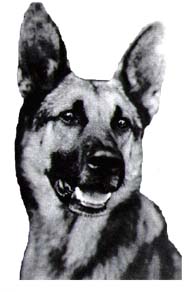
Strongheart, an early canine star in Hollywood
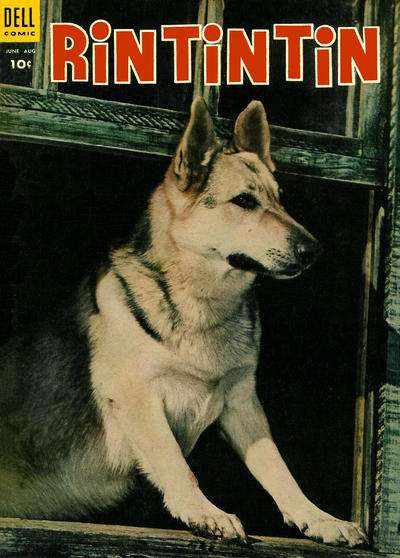
Rin Tin Tin, another German Shepherd, is probably more well known. The first Rin Tin Tin was born in 1918 and featured in 26 films for Warner Brothers studios. There have been many successors to the first Rin Tin Tin and the dog has featured in comic books and other memorabilia. You can learn lots more by visiting his official web site.
Most dog lovers will know about Lassie, a Collie dog who starred in Lassie Come Home in 1943. The film was based on a novel that was published several years earlier. Lassie was played by a dog named Pal. Lassie went on to feature in a television programme, comic books, animated films, radio and other children’s books. Like Rin Tin Tin, there have been a number of Lassies over the years. Lassie also has an official web site.
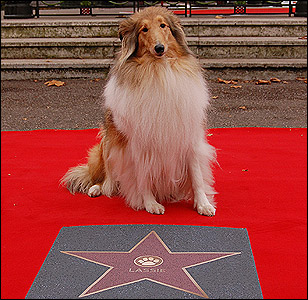
Lassie on the Hollywood Walk of Fame
If you are visiting California, why not honour the dog stars of Hollywood by visiting them on the Walk of Fame?
Posted in Dogs, special dogs and awards
Tagged collie, dogs, german shepherd, Hollywood Walk of Fame, Lassie, Lassie Come Home, Rin Tin Tin, Strongheart, White Fang
There are lots of jokes that circulate at this time of year about a dog’s resolutions for the new year (e.g., kitty-box crunchies are not junk food, etc.). But what about your resolutions for your role as a Doggy Mom or Doggy Dad?
Here are my suggestions for new year resolutions:
1. Resolve to feed your dog the highest quality dog food you can afford. Not sure what to feed or even if you are feeding the right amount? That’s where a nutritional assessment comes in. People like me are trained in reading the labels of your existing dog food and with some information about your dog’s condition and lifestyle, we can tell you a lot about whether you are feeding the right amount and make un-biased suggestions about your core dog food.
In my case, I’m not affiliated with any veterinary practice or brand of dog food (many professionals take their nutrition training from a programme offered by dog food manufacturer – ask about this when selecting a provider for nutritional advice!)
2. Exercise more – for your dog and yourself! Exercise is important mental and physical stimulation for both you and your dog. Discover new walks, link up with walking partners and doggy buddies for more variety, and manage your exercise according to the temperatures of the day (your dog doesn’t have the heat regulation system that you do in the summer; and their paw pads can be irritated by road salt and ice during the winter).
3. Groom your dog – regularly. If you don’t know what to do, then take your dog to a professional groomer and get advice on maintenance that you can do at home. It breaks my heart to hear about veterinary nurses and groomers that have to work on severely matted dogs because their owner has neglected their grooming responsibilities.
4. Make time for your dog. I signed off last month’s newsletter to my Canine Catering customers saying “remember that the best thing you give your dog this holiday season is your time.” It goes for the rest of the year, too. Your dog is a social animal and needs your love and attention throughout the year.
5. Keep a watchful eye on your dog’s health, ensuring they are not overweight (or underweight) and that they receive regular veterinary care. (For a dog to be accepted into my dog massage and rehabilitation practice, the owner must certify for me that their dog is under regular veterinary care.)
6. Have fun together – play time is essential. Dog walks are not the only stimulation for your dog. Choose an activity that suits both you your dog. It could be agility or obedience training, rally-o, fetch, cross-country skiing, hiking/tramping, or the use of interactive dog toys.
I wish you and your dog a wonderful 2012. Contact me through this blog or my website for information on any topic I cover in this blog.







 DoggyMom.com