Author Archives: DoggyMom.com

Before you install these devices, consider your dog

Earlier this week, I was working with one of my in-home massage clients.  I have a sensitive nose, with a keen sense of smell. In fact, years ago I had my nose ‘calibrated’ by the Lincoln University odour lab and they told me that I was in the top 10% of people in terms of picking up scents in the air.

Of course, this is nothing in comparison to dogs.  Depending on which source you believe, dogs have a sense of smell that is at least 10,000 times more powerful than our own; and possibly as high as 100,000 times.

And during this visit, I was picking up on an odour that was slightly chemical and slightly peppery.

I also noticed that the elderly dog I was massaging had a runny nose which is unusual for him.

And then I spotted one of these automatic inspect spray dispensers on the wall (which the owner confirmed was new):

insect dispenser

We had a bit of a chat about the unit and she agreed that she would either remove it or locate it somewhere outside the living area where her dog spends a lot of time.

Before you introduce anything with a scent into your home, you need to consider your dog’s keen sense of smell.

I’m also wary of the automatic air fresheners that look like this for the same reason:

air freshener

These devices introduce chemical substances into your home and I’ve seen many dogs who are sensitive to the smells.

Beyond that, the environmentalist in me is also concerned about the health of everyone in the household.  Is it a good idea to be inhaling these chemicals and also having them settle on your furnishings, clothing and other surfaces?

My advice is to think twice about installing these items in your home and to consider the impact on your dog.

Kathleen Crisley, specialist in dog massage, rehabilitation and nutrition/food therapy, The Balanced Dog, Christchurch, New Zealand

How the opioid crisis is affecting dogs

The USA is the midst of an opioid crisis – large numbers of people are misusing and becoming addicted to opioids, which can include heroin, prescription pain medications and fentanyl (a synthetic).  The Centers for Disease Control and Prevention estimate that an average of 91 Americans die each day due to opioid overdose.

Veterinarians treating companion animals have to be aware of the symptoms of opioid overdose because, unfortunately, there are cases of accidental ingestion.  Sometimes the pet owners are unwilling to admit that their pet may have eaten opioid drugs, which of course is admission that they may be an addict themselves.

Drugs are, of course, big business and it’s up to law enforcement to help catch dealers who are making and selling the drugs.  Police dogs and detection dogs are part of that fight and they are often exposed to opioids in the course of detection work.

This video is for veterinarians and dog handlers to understand how to catch the signs of an opioid overdose in a dog and the treatment with reversal drugs like Narcan which are needed to save them.

and this is some of the news coverage about police dog handlers carrying reversal kits along with other first aid supplies.

Kathleen Crisley, specialist in dog massage, rehabilitation and nutrition/food therapy, The Balanced Dog, Christchurch, New Zealand

Inspirations

Last month, I shared images of the inspiration cards that were given to me when I was working and studying at Best Friends Animal Sanctuary in Utah.

Tonight I share an inspiration of a different kind.

Elesha, who was mum to Kenny who passed away in April 2016, contacted me because she had found these photos on her Instagram page.    She thought I’d like them (I do!).


Kathleen & KennyLooking at these photos, I realise how much time has passed since I worked with Kenny.  My practice has been re-branded from Canine Catering to The Balanced Dog.  I have new shirts with a new logo and even our dog treat labels have changed.  Progress.
But the inspiration is knowing that the work I did with Kenny is still appreciated, and that Elesha stays in touch.

Kenny was a great dog and I’m lucky to have worked with him and his family.

Inspirational!

Kathleen Crisley, specialist in dog massage, rehabilitation and nutrition/food therapy, The Balanced Dog, Christchurch, New Zealand

Ebony’s story

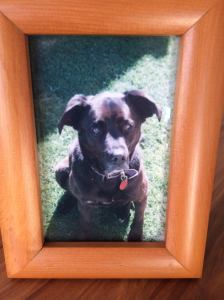
Ebony's photo

This is Ebony; she was a Chocolate Labrador cross – a deep dark chocolate in colour (not milk chocolate like many Labs).  She was my best friend from 1998, when I adopted her via Dogwatch which facilitated a private adoption, to October 2003, when she suddenly succumbed to cancer of the liver and pancreas.

Ebony was highly reactive to sounds and, particularly, fireworks.  So I think of her a lot around Guy Fawkes celebrations each year.

Each year, I’d go to the vet for a prescription for sedatives and then for many nights around the official celebration, I would have to try to dose her before any fireworks started.  This was easier said than done.  As many of us know, people sometimes set off fireworks even before darkness has fallen.  The label recommended intake within 1 hour before any stimulus…

Most of the time, sedatives weren’t enough.  Copious amounts of Rescue Remedy in her water bowl and sprayed around the house didn’t seem to help much, either.  Ebony would run and pace the house, hyperventilating and salivating.  It was heartbreaking to watch.  Sometimes, I would turn the radio on in the car, which was parked in the garage, and I’d put her in the back seat (as usual) with me in the front pretending that any minute we would be going out for a ride.  But in reality, I was just trying to get as many layers of sound-proofing between us and the fireworks that I could.

Ebony wasn’t fooled, although sometimes our car trips to nowhere did help alleviate some of the sounds.

The bottom line was that when Ebony was over-threshold with fear, there wasn’t much that could be done until the fireworks stopped.

One year, we were woken from a sound sleep when someone decided to light off fireworks.  It was late by our standards, past 10 pm when most families and working people would not be up lighting fireworks on a work night.

Ebony was immediately over-threshold, barking and pacing.  And then she lost control of her bowels in our bed.  She was doubly stressed by this, and I had to strip the bed and put everything in the washing machine and re-make the bed with fresh linens.

Another year, Ebony barked so badly that she suffered a rectal prolapse.  She had literally barked herself inside/out; part of her rectum had come out of the anus.   It was incredibly upsetting for the both of us and I knew she was in pain and discomfort, too.  The vet was able to lubricate the tissue and help replace it back inside and I had to feed a low-irritant food to her for a week to ensure that we gave the area a chance to rest.

I clearly remember after this incident how much noise her digestive system made – gurgling – for days.  Looking back, I’m sure that the stress and digestive upsets she endured because of fireworks had something to do with her succumbing to liver and pancreatic cancer – before she even reached aged 10.

So you might wonder why I’m so passionate about the banning of the private sale of fireworks and now you know.  They hurt my dog many times over and when you hurt my dog, I’m unlikely to forget.

Kathleen Crisley, specialist in dog massage, rehabilitation and nutrition/food therapy, The Balanced Dog, Christchurch, New Zealand

Here we go again…a day of sadness

fireworks sign

Today, 2 November 2017, is the day when fireworks legally go on sale in the name of celebrating Guy Fawkes night aka Bonfire Night (5 November each year).

I’m sad because I know that many dogs, including those of my clients and friends, will be in for a stretch of nights filled with fear and anxiety.

Their human owners will be doing everything they can to manage.  Some will have gone to the veterinarian for sedative drugs which they will need to give before the booming starts, others will be playing music, changing routines to ensure nighttime dog walks are finished before the sun sets, wrapping their dogs in Thundershirts, spraying essential oils to help calm…the list goes on…

And like being in a war, you never know when the next barrage will happen.  It’s not just on Guy Fawkes Night.  It could be tonight, tomorrow.  It could be next week.  It may even be in a month or two for the people who stockpile their fireworks for random use.

Where I grew up, the sale of fireworks was illegal.  Only public displays – properly licensed and advertised in advance – were allowed.   It was more manageable and humane.

I fail to see the reason why the sale of these items is still legal in New Zealand and I haven’t seen a political party (or coalition) yet that is prepared to take a stand on this issue.

I have other arguments against fireworks, including the fact that the waste left over just adds to our landfills and that many fireworks users disrespect our parks by leaving their fireworks packaging and other rubbish overflowing from rubbish bins or, worse, strewn across the park for someone else to pick up.

Today I’m sad because, for the animals, the war is about to begin again.

Kathleen Crisley, specialist in dog massage, rehabilitation and nutrition/food therapy, The Balanced Dog, Christchurch, New Zealand

Image

Doggy quote of the month for November

Every dog must have his day

Inspirations – when enough is enough

Another inspiration card to share:

Enough is enough

Kathleen Crisley, specialist in dog massage, rehabilitation and nutrition/food therapy, The Balanced Dog, Christchurch, New Zealand

Dogs May Protect Against Childhood Eczema and Asthma

Two studies presented at the American College of Allergy, Asthma and Immunology (ACAAI) Annual Scientific Meeting show there may be even more reason to love your dog.

The first study shows babies born in a home with a dog during pregnancy receive protection from allergic eczema, though the protective effect goes down by age 10. A second study shows dogs may provide a protective effect against asthma, even in children allergic to dogs.

pregnant woman with dog

“Although eczema is commonly found in infants, many people don’t know there is a progression from eczema to food allergies to nasal allergies and asthma,” says allergist Gagandeep Cheema, MD, ACAAI member and lead author. “We wanted to know if there was a protective effect in having a dog that slowed down that progress.”

The study examined mother-child pairs exposed to a dog. “Exposure” was defined as keeping one or more dogs indoors for at least one hour daily. “We found a mother’s exposure to dogs before the birth of a child is significantly associated with lower risk of eczema by age 2 years, but this protective effect goes down at age 10,” says allergist Edward M. Zoratti, MD, ACAAI member and a study co-author.

In the second study, researchers examined the effects of two different types of dog exposure on children with asthma in Baltimore. The first type was the protein, or allergen, that affects children who are allergic to dogs. The second type were elements, such as bacteria, that a dog might carry. The researchers concluded that exposure to the elements that dogs carry may have a protective effect against asthma symptoms. But exposure to the allergen may result in more asthma symptoms among urban children with dog allergy.

“Among urban children with asthma who were allergic to dogs, spending time with a dog might be associated with two different effects,” says Po-Yang Tsou, MD, MPH, lead author. “There seems to be a protective effect on asthma of non-allergen dog-associated exposures, and a harmful effect of allergen exposure.” The researchers believe that a child’s contact with factors other than dog allergen, such as bacteria or other unknown factors, may provide the protective effect. “However, dog allergen exposure remains a major concern for kids who are allergic to dogs,” says Dr. Tsou.

People with dog allergy should work with their allergist to reduce exposure. ACAAI has additional tips for those with dog allergy who keep a dog in the home:

  • Keep your dog out of your bedroom and restrict it to only a few rooms. But know that keeping the dog in only one room will not limit the allergens to that room.
  • After you pet or hug your dog, wash your hands with soap and water.
  • High-efficiency particulate air (HEPA) cleaners that run continuously in a bedroom or living room can reduce allergen levels over time. Regular use of a high-efficiency vacuum cleaner or a central vacuum can also reduce allergen levels.
  • Giving your dog a bath at least once a week can reduce airborne dog allergen.

Abstract Title: Effect of Prenatal Dog Exposure on Eczema Development in Early and Late Childhood.
Author: Gagandeep Cheema, MD

Abstract Title:  The Effect of Animal Exposures on Asthma Morbidity Independent of Allergen Among Inner-city Asthmatic Children.
Author: Po-Yang Tsou, MD, MPH


Source:  American College of Allergy, Asthma and Immunology media release

Dogs in advertising

You wouldn’t think that a dog would help sell the services of a scaffolding company, would you?

But think again.

Access Solutions certainly got my attention with their billboard – which is in multiple locations around the city.

Access Billboard

Want effective advertising?  Use a dog!

Kathleen Crisley, specialist in dog massage, rehabilitation and nutrition/food therapy, The Balanced Dog, Christchurch, New Zealand

A Ray Profile!

From my experience in Christchurch, I tend to agree with the author of this post. I used to go to the dog park a lot with my Daisy (she’s been gone for over 3 years, and we were together for 10+ years). But I see more and more dogs crowding into the space and more owners who haven’t trained them or show much interest in training them.

What do you think?

colinandray's avatarA New Direction Perhaps?

Below is a good side profile of our beloved Ray.

We had taken him to a large park/conservation area which included a “leash-free” area for dogs. Sadly, and as is typically the case here, you cannot trust other dog owners to be watchful of their dogs which results in some unpleasant interactions. The owners often don’t even notice because they are socializing! From my perspective, it is less of a leash free area for dogs to play in, and more a simple “dumping ground” that is fenced so you cannot loose your dog!

We are not prepared to let Ray loose in there however, there is a small dog area very close by. It is rarely used, so that is where we let Ray off his leash and see if we can coax him into playing fetch etc.

It is unfortunate that our leash free areas are treated more as…

View original post 35 more words