Category Archives: animal welfare

Better paws for Brutus

When Brutus was just a puppy, his breeder left the young Rottweiler outside in freezing temperatures.

The pup suffered frostbite in all four paws, and the breeder tried to salvage the puppy’s paws with an at-home amputation. But Brutus was maimed and couldn’t walk without pain.
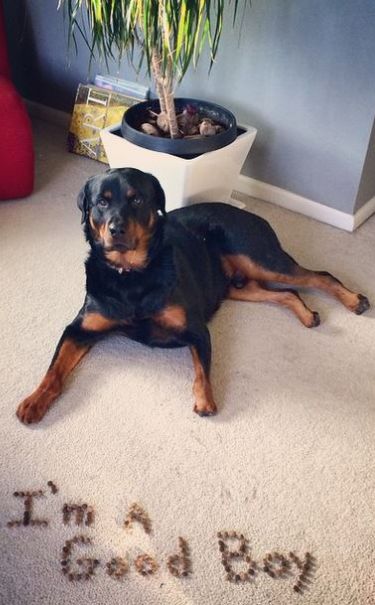
Brutus

Brutus

Now 2 years old, Brutus is living with a new and dedicated owner in Loveland, Colorado, and has become the second dog ever known to receive four prosthetic limbs. He is learning to walk again with help from OrthoPets, an animal prosthetics developer in Denver, and pet orthopedics experts at Colorado State University’s James L. Voss Veterinary Teaching Hospital.

“I believe prosthetics will play a big role in the future of veterinary orthopedics,” said Dr. Felix Duerr, an assistant professor in the Department of Clinical Sciences who practices small animal orthopedics and sports medicine at the university’s Veterinary Teaching Hospital.

“Brutus shows how we can explore new technologies to find solutions, and how our partnerships with companies like OrthoPets really help.”
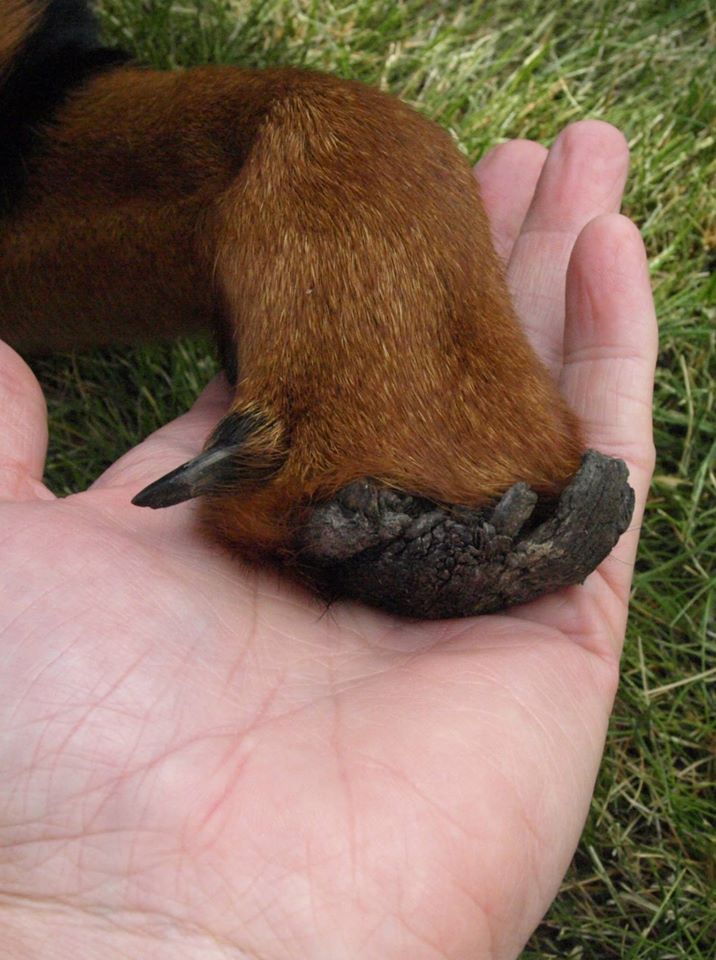
Brutus' paw

Brutus’ paw

Laura Aquilina, the dog’s owner, has provided a caring home for Brutus for seven months in an attempt to find “better paws” for the young rottie. She began fostering Brutus, and more recently adopted him, after he had trouble navigating hardwood floors and stairs in his first foster home, and the family couldn’t meet the disabled dog’s needs.

Aquilina and a pet rescuer in Canon City joined forces to raise nearly $12,500 for Brutus’ prosthetics and physical therapy through Go Fund Me, an online fundraising site. The crowdfunding project was aptly named “Better Paws for Brutus.”
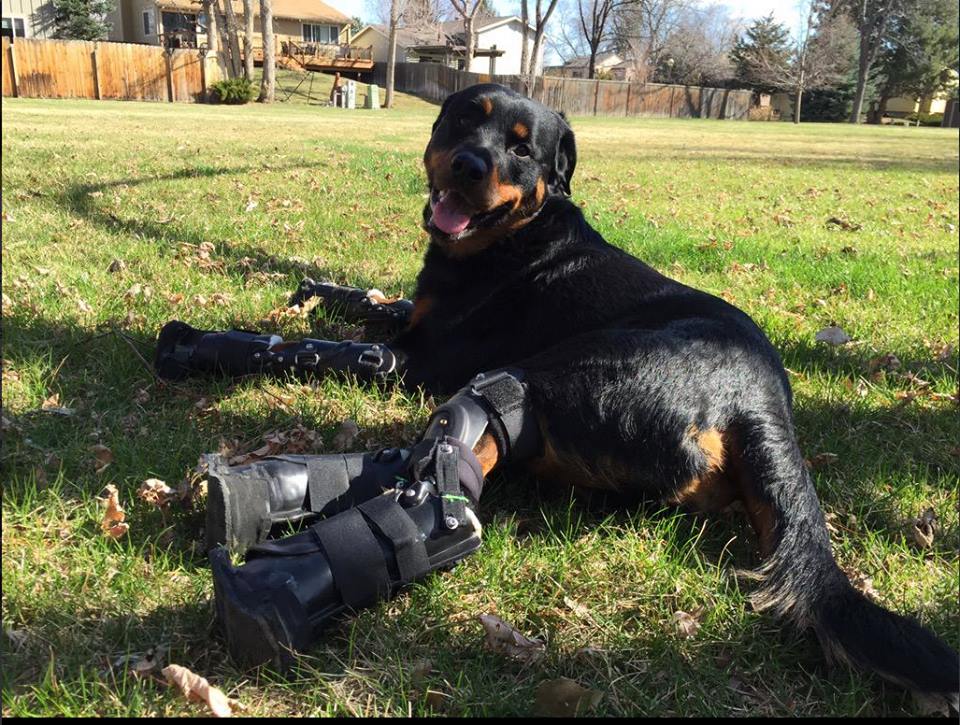
Brutus with his prosthetics

Brutus with his prosthetics

In preparation for prosthetics, Brutus underwent corrective paw surgery with Dr. Trent Gall, a CSU veterinary alumnus working in Longmont. The procedure removed bone fragments, dew claws, and two toes left from the botched amputation.

After recovery from surgery, Brutus and Aquilina worked with Denver-based OrthoPets, the world’s largest veterinary orthotic and prosthetic company, to undergo the process of prosthetics fitting. OrthoPets adapts the same technologies used in the field of human orthotics to care for animal patients.

Martin Kaufmann, company founder, partnered with Colorado State’s Veterinary Teaching Hospital for its research and rehabilitation services.

“I don’t want to be part of a world that settles for ‘fine,’ and neither does CSU,” Kaufmann said. “There’s a common mission between CSU and OrthoPets to return animals’ lives to ‘great.’”

Since the collaboration began, CSU and OrthoPets have successfully developed techniques to treat Achilles tendon injuries in dogs and are investigating how specific injuries correlate with successful orthotic techniques and long-term prosthetic use.

Kaufmann compared the Rottweiler’s story to that of Nakio, the other dog known to live with four prosthetics. “We learned a lot from Nakio’s story and were able to apply that knowledge to Brutus’ case,” he said.

OrthoPets veterinarians learned that both of Brutus’ wrist joints had collapsed. “It’s similar to a human rolling his ankle completely to the side, left grossly unstable,” Kaufmann said, noting that the dog also has a troublesome callus that makes movement difficult.

The unique prosthetics have three purposes: to protect and make Brutus’ limbs more comfortable, to support his front collapsed legs, and to realign each leg to an equal length.

As his devices are refined, Brutus has entered a new phase of rehabilitation with physical therapy guided by Sasha Foster, CSU’s certified canine rehabilitation therapist.

“We’re working with Brutus to help him adjust to wearing his new prosthetics,” Foster said. “He’s learning how to move with them on. Once he’s mastered that, we will help him achieve higher-level functioning activities, like hiking and playing with other dogs.”

In upcoming months, Foster will use underwater treadmill therapy, balance activities, exercise balls and other neuro re-education therapies to help Brutus adjust to his new limbs.

Foster said her work is motivated by helping her patient – and the animal’s family. “When you improve the quality of life for a dog, you improve the quality life for the entire family,” Foster said.

It’s likely Brutus will need physical therapy intermittently for the rest of his life. But Aquilina is hopeful.

“You need a good team behind you, and we found that at CSU,” she said.

Follow Brutus’s recovery on Facebook and Instagram at @BetterPawsForBrutus

Source:  CSU media release

Home’s Best Friend – airing at the Oscars

More on tomorrow’s Oscar awards…

…look out for the new commercial by Coldwell Banker Real Estate.  Entitled “Home’s Best Friend,” the commercial is part of a new project partnership –  Homes for Dogs – with website Adopt-A-Pet.com to find 20,000 animals new homes in 2015.

Of course this commercial is designed to garner customers for Coldwell Banker.  But animals will also benefit…and that’s fine by me!

See also how pets will benefit from this year’s awards at And the Oscar goes to…

Kathleen Crisley, specialist in dog massage, rehabilitation and nutrition/food therapy, Canine Catering Ltd, Christchurch, New Zealand


And the Oscar goes to…

On 22 February 2015, Hollywood celebrities will gather for the 87th annual Academy Awards.   Only a few talented individuals will walk away with the top prize.

But, like last year, those who do not win  in the top 5 Oscar categories (Best Director, Best Actress, Best Actor, Best Supporting Actress and Best Supporting Actor) will still be given a gift – a donation of 10,000 meals to the animal rescue of their choice.  The donation is made possible by Ellen DeGeneres and her dog food company, Halo, Purely for Pets in partnership with Freekibble.com.

Oscars meal donation

The donations are part of a PR campaign called Everyone Wins at the Oscars® which is organized by a Los Angeles marketing firm specializing in product placement.  (The Academy Awards has no affiliation with these gifts – called ‘swag bags.’).

The bag contains many high-end gifts, a value of US$125,000!

Source:  News.com.au


Animals in Emergencies – book review

AnimalsinEmergenciesCover

I have just finished reading Animals in Emergencies:  Learning from the Christchurch earthquakes by Annie Potts and Donelle Gadenne.  This was a must-read book for me.  Why?  I’m in it!

Published in late 2014, this book is largely a compilation of stories about people and animals caught up in the earthquakes of 2010 and 2011.  However, since it is also a text produced by university academics, it aims to serve a purpose as “an introduction to the specialised area of animal welfare management during emergencies.”

I found the first 90% of the book the most enjoyable.  Filled with stories of rescue, sheltering and individual owner’s tales of the earthquakes, the book serves to document – largely in the first person – the historical accounts of the days, weeks and months following the quakes.  And I like the fact that the book doesn’t just focus on companion animal dogs and cats, but also includes stories about horses, fish, hedgehogs and other species.

But the last 10% of the book is rather disappointing (and it hurts me to have to say this).  Since New Zealand is a production-based economy, this book had to focus on the fate of production animals.  But this is also where the book loses its tone and momentum.  Either the authors asked for interviews with farmers and researchers and were rejected, or they simply didn’t ask – we’ll never know.

Perhaps because of the lack of firsthand accounts, the book becomes too formal in its approach to describing the impact on farm animals and animals used in research.  The text uses citations from newspaper articles at this point and becomes ‘preachy’ in terms of animal welfare.  As someone with a personal interest in animal welfare management, the issues raised in the book are not new but the distinct ‘lessons learned from Christchurch’ is very much lost on the reader.

I’m pleased this book has been produced and I’m very honored to have my story told although I know that I’m a very small contributor to the overall efforts to assist animals following the quakes.

Animals in Emergencies has been distributed to booksellers worldwide and a paperback version is available on Amazon.com.

Kathleen Crisley, specialist in dog massage, rehabilitation and nutrition/food therapy, The Balanced Dog Ltd, Christchurch, New Zealand

An update on Kai

Kai, the dog who was abandoned at Ayr Railway Station in Scotland last month, has found a new home.  I wrote about Kai in the post  A new twist on abandonment.

Because of the worldwide coverage of Kai’s story (which reminded a lot of people of the story of Paddington Bear), there were lots of people who applied to adopt him.  Ian Russell, a self-employed hydraulic engineer, is Kai’s new owner.  Kai will get to travel all over Scotland with Russell, just as Russell’s previous dog did for almost 15 years!

Read more about Kai’s new home here:

Dog abandoned at railway station with suitcase of his belongings finds a new owner – Telegraph

Kathleen Crisley, specialist in dog massage, rehabilitation and nutrition/food therapy, Canine Catering Ltd, Christchurch, New Zealand

Dog of the Year

Forget the Golden Globes…

Don’t even think about the Screen Actors Guild awards…

And even pass by the Oscars…

The awards show of early 2015 was the World Dog Awards, broadcast earlier this month on the CW Network in the USA.

Dog of the Year was Hank, the Ballpark Pup. Hank, a suspected Bichon Frise cross, made headlines last year when he wandered into the spring training camp of the Milwaukee Brewers professional baseball team.   A veterinary check revealed that he may have been hit by a car.  Outfitted in Brewers’ official gear, he became the team’s mascot.  A children’s book, beach towel, and other merchandise have also been produced, with 20% of the proceeds going to the Wisconsin Humane Society.

The title “Dog of the Year” was given to honor the dog that made the most impact on popular culture during 2014.   Hank received his Golden Hydrant statue from celebrity Paris Hilton.

While this award show may be seen my some as ‘over the top’ – Hank’s story helped to highlight the plight of homeless pets and the need for people to think ADOPTION first.

Good dog, Hank.  Good Dog.

Kathleen Crisley, specialist in dog massage, rehabilitation and nutrition/food therapy, Canine Catering Ltd, Christchurch, New Zealand

A new twist on abandonment

The Scottish SPCA has reported a dog that was abandoned along with a suitcase of his belongings.

The Shar Pei cross, Kai, along with his suitcase (photo by SPCA/PA)

The Shar Pei cross, Kai, along with his suitcase (photo by SPCA/PA)

The dog named Kai (identification details that were found on his microchip) was discovered tied to a railing outside Ayr station.  His suitcase contained a pillow, food, toy and bowl.

When Scottish SPCA inspector Stewart Taylor checked with the owners, whose details were registered against the microchip, he was told that they had sold Kai on a website in 2013 but they didn’t know to who!

“This case highlights the potential consequences of selling an animal online as it often leads to the impulse buying of pets that people know very little about.  Regardless of the fact Kai was left with his belongings, this was still a cruel incident and we are keen to identify the person responsible. If anyone can help we would ask them to get in touch as soon as possible,” said Scottish SPCA inspector Stewart Taylor.

Abandonment is an animal welfare offense that in Scotland and, if convicted, the persons responsible are likely to be banned from keeping animals for a specified period of time.

The bottom line on this case is that abandonment is still abandonment.  And the ‘new’ owners weren’t even responsible enough to have Kai’s microchip updated.  However, the previous owners are also responsible in that they failed to check on the people who were adopting Kai from them, ensuring they had legitimate credentials, viewing their home, etc.

Dogs are not disposable!

Source:  The Telegraph

Swiss chocolates (yes); Swiss roast dinner (no)

I, like many women, love chocolate and the Swiss are known for it.  However, some Swiss nationals, particularly farmers, regularly eat dog and cat as a meat source.

The advocacy group SOS Chats Noiragigue is leading a campaign to ban the consumption of cats and dogs with a petition to parliament.  As of late November 2014, 18,000 signatures had been gathered including that of famous actress and animal rights activist Brigitte Bardot.

Actress Brigitte Bardot is just one signatory on a petition to outlaw the consumption of dog and cat meat in Switzerland

Actress Brigitte Bardot is just one signatory on a petition to outlaw the consumption of dog and cat meat in Switzerland

Dog meat is primarily used in sausages.

In Switzerland, a proposal needs 100,000 signatures out of a total population of around 8 million for a national referendum to be held on the issue.

With the power of the internet, animal lovers from around the globe can sign a petition to help add weight to this cause.  The Force Change petition is here.

Kathleen Crisley, specialist in dog massage, rehabilitation and nutrition/food therapy, Canine Catering Ltd, Christchurch, New Zealand

Now Paw-tucket can live up to its name

The city of Pawtucket, Rhode Island had a 10-year old ordinance banning the ownership of pit bulls until earlier this week.  A judge ruled that a 2013 state law banning breed-specific legislation meant that the city’s law was now illegal.

This is a win for the fight against breed specific laws and restrictions.

Pit bull owners in Pawtucket celebrated on Sunday with a parade.  There was also a free dog training class offered afterwards.  A local group, Pit Bulls for PTSD, also participated in the parade.  The group trains pit bulls to become service dogs for autistic children and veterans suffering from PTSD.

Please remember:  punish the deed and not the breed!

Kathleen Crisley, specialist in dog massage, rehabilitation and nutrition/food therapy, Canine Catering Ltd, Christchurch, New Zealand

Sheltering people and pets from domestic violence

In the late 1990s, Dr Frank Ascione from Utah State University published some scary statistics:  48 percent of domestic violence victims will stay in an abusive situation because they fear leaving their pets behind.

In New York City in 2013, the Urban Resource Institute teamed up with sponsorship from Purina to launch a pilot program:  People and Animals Living Safely (PALS).  PALS is a co-sheltering program that allows pets to escape domestic violence and remain with their owners in pet-friendly apartments.  A first for New York City, it’s been remarkably successful.  The apartments are always full.

So this year, the program was expanded to include a dog park and play area for the sheltered animals.  Aptly called the Purina Play Haven and Dog Park, this park, full of enrichment activities, was designed by a professional architect.

In these videos on YouTube, have a look at the dog park and hear about how this program fills a need for those unfortunate enough to have become the victims of domestic violence.

Sometimes ‘big corporate’ money can be used for a higher purpose!

Kathleen Crisley, specialist in dog massage, rehabilitation and nutrition/food therapy, Canine Catering Ltd, Christchurch, New Zealand


