Category Archives: dog books

Pets’ Letters to God – recommended read

Pets' Letters to God

This little gift book is an ‘oldie but a goodie.’  Published in 1999 for Hallmark Cards, you can easily find this small, hardcover book in good condition in used book shops (a favourite haunt of most of my family and some friends) and of course online through used book sellers.

I think this book is particularly appropriate at this time of year, as the glow of the Christmas holiday period fades into the past fairly quickly and we return to work, with all of the stresses of commitments and demands on our time.

This book will give you heart! 

It looks at the major questions that our pets want have to ask God (in English, so we can understand)

Here are just a few of my favourite doggy letters:

Dear God,

Must I bark, or can you hear my thoughts?  – Flo-jo

—————————–

Dear God,

When I get to Heaven, can I play Frisbee with my halo? – Nicky

——————————

Dear God,

Is it true that in purgatory there are 10 million cashmere sofas with porcupines sleeping on them? – Shannon

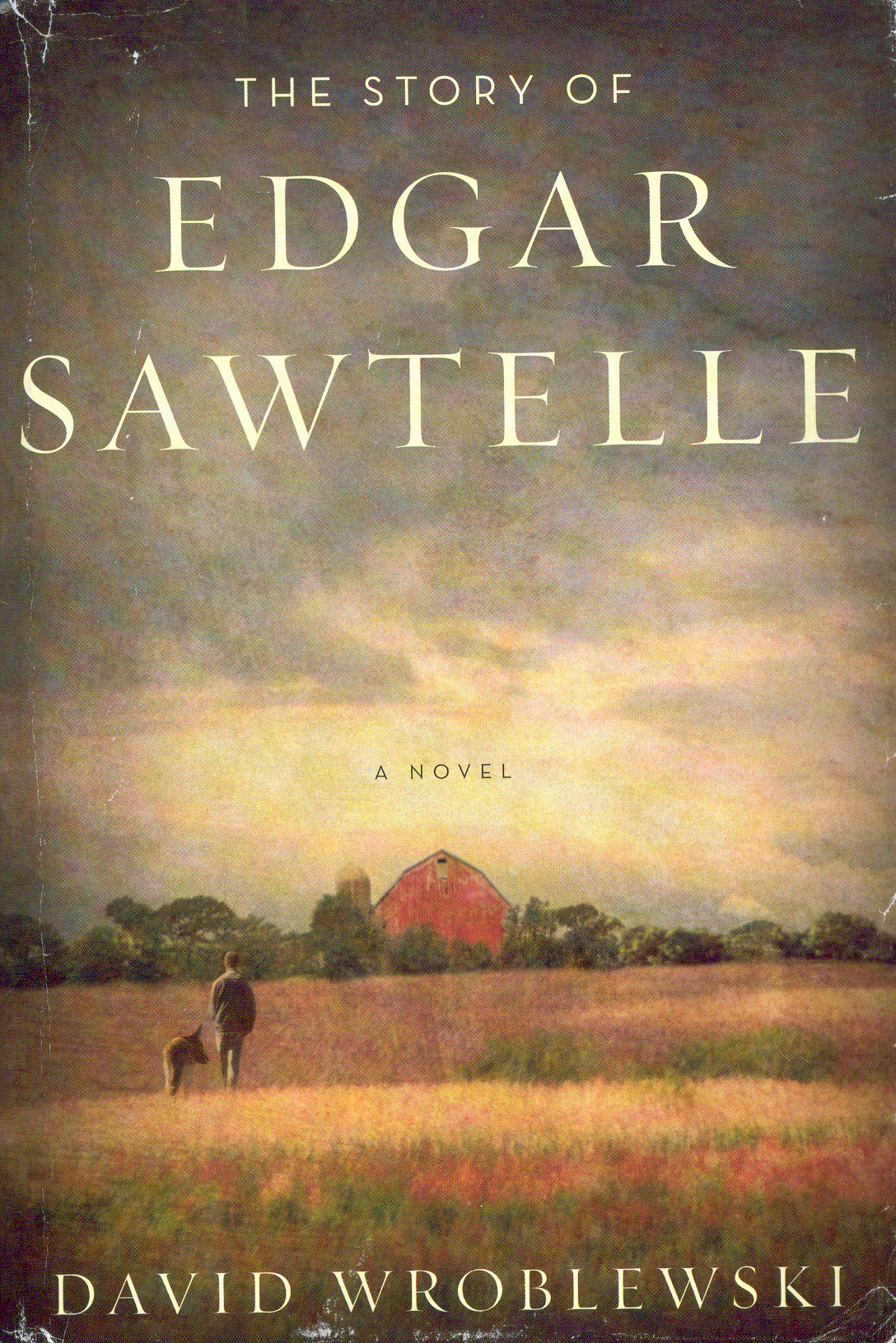
The Story of Edgar Sawtelle

I’ve just finished reading The Story of Edgar Sawtelle by David Wroblewski.  This book was a New York Times bestseller in 2008 and also made Oprah Winfrey’s book club.  With these accolades behind it, and since the novel is set in a breeding kennels (fictitious) in Wisconsin, I had high hopes.

This book is over 560 pages and so it has taken me quite some time to finish it.  The story, at least for the first half, is quite good.  Edgar Sawtelle is a young boy growing up surrounded by dogs and his special canine ompanion, Almondine.  Edgar is mute – he can hear but has never been able to speak.  However, he has developed his own sign language that his parents can easily interpret and use.

The Sawtelles are dog breeders with a difference.  Dogs are whelped and then trained for a year before going to new homes.  “The Sawtelle Dogs” are a reputable breed (although we never quite find out what kind of breed or mixed breed they are).

Edgar’s life changes when his uncle, Claude, enters their lives.   When Edgar’s father dies suddenly, Edgar goes on the run with a handful of the Sawtelle dogs as companions.  During his months on the run, Edgar matures.  It is this part of the book, with Edgar’s adventures, that I enjoyed the most.

Then Edgar returns home and life at the Sawtelle homestead to finish his unfinished business.  It is these final chapters of the book that I found really disappointing and dark.

The story has been labelled a re-telling of Shakespeare’s Hamlet.  Perhaps that’s why I didn’t like it.  I had hoped for an entertaining novel and the story at first was full of promise.  In my opinion, this novel didn’t live up to its reputation and advertising.  I do notice that the most recent rating for the book on Amazon.com is only 3 stars….so perhaps I’m not alone?

Oogy – the dog only a family could love

I’ve just finished reading Oogy:  the dog only a family could love by Larry Levin.  This New York Times bestseller tells the story of Oogy, a puppy that had been used for bait in dog fighting, and the Levin family who adopted him.

In many ways, this is a story about fate.  Fate in how a badly injured Oogy was brought to an animal hospital offering after-hours treatment.  Fate because a woman who worked at the hospital (later called ‘Saint Diane’)  recognised Oogy’s special character and intervened to ensure Oogy got life-saving treatment and care.     Fate because the Levin family met him when they had brought their sick cat to be put to sleep and decided to adopt him.

Oogy lost his left ear and and a good portion of his jaw and face to dog fighting.  It appears that he was used as bait because he wasn’t a good fighter and then left in an abandoned house to die without care or attention.

The Levins named him Oogy because it was a derivation of ‘Ugly.’  Mr Levin is the first to admit that when he first met Oogy, his appearance was grotesque.  (The dog had a lot of scar tissue which was operated on later.)  In fact, Oogy was so disfigured that, because of the connection to dog fighting, everyone assumed Oogy was a pit bull.

As he matured, it was agreed that Oogy was a Dogo Argentino, one of the breeds that is often discriminated against and termed ‘dangerous.’

Read this book and enjoy the Levin’s journey with Oogy.  Read about how his charm wins over residents who were scared of him; read about the care the Levins provided for Oogy, seeing him through corrective surgeries as well as rehabilitation from cruciate ligament ruptures.

Finally, I think one of the best parts of this book is how Levin describes the responsibility of the pet owner:

‘It has always been my belief that a pet owner has a special responsibility to do everything that can be done to make the pet’s life as fulfilling and peaceful as possible.  That responsibility is yours the moment you make the choice to take an animal into your life.’

A Big Little Life


I’ve just finished reading A Big Little Life by Dean Koontz.  This book is the memoir of his Golden Retriever, Trixie.

Trixie was trained by Canine Companions for Independence as an assistance dog but had to be retired after needing elbow surgery.  She came to live with author Dean Koontz and his wife, Gerda, in 1998.  In this book, Koontz relates the stories of Trixie’s (a.k.a. Short Stuff’s)  remarkable life, where she teaches the Koontzes to treasure every moment and live in the present.  Meanwhile she makes lots of friends along the way.

My favourite story is of Trixie, who is suffering from diarrhea.  However, Trixie won’t poop in her own yard and diarrhea won’t stop her from breaking this vow.  She takes Dean for a sprint across their rather large California property in order to reach safe territory.  There, she lets loose with explosive results.  It is stories like this that many dog owners can relate to.  (My Daisy won’t pee in the rain and it doesn’t matter whether she is wearing a raincoat or not – she has to be busting before she’ll go.)

Koontz was inspired by Trixie and this led him to publish a number of books in her name including Life is Good, Bliss to You (Trixie’s Guide to a Happy Life), Christmas is Good, and children’s book I Trixie Who Is Dog.  Proceeds from these books were donated to support the Canine Companions charity.

This slideshow requires JavaScript.

Be prepared as Dean tells us about the awful days in 2007 when Trixie fell ill and was put to sleep in his arms, sitting on her favourite couch.  Koontz was subsequently unable to write for almost a month afterwards.

As Koontz says on Trixie’s dedicated website pages, “She changed us as people, made us better by her example, brought piercing beauty and so much humor into our lives, and left a terrible void when she went to God.”

The Lucky One

I’ve just finished reading The Lucky One by Nicholas Sparks.  What attracted me to the book was the fact that the story is predominantly set at a boarding kennel and that one of the main characters, Zeus, is a German Shepherd.  It helped that the book was previously on the New York Times Bestseller list and so others must have liked it too.

I hadn’t realised that Nicholas Sparks is a the author of novels like The Notebook and Nights in Rodanthe, which were successfully made into movies (I liked both movies).  As it turns out, The Lucky One has just been made into a film starring Zac Efron but it hasn’t shown here in New Zealand yet (more on that later).

This is a story of Logan, a veteran of the conflict in Iraq, who finds a photograph in the desert of a woman.  The photo goes unclaimed at the camp and so Logan keeps it and it becomes his good luck charm.  When he leaves the US Marines and returns to the United States, he goes on a quest to find the woman in the photo – with Zeus his loyal German Shepherd for company.

He finds Elizabeth, a divorced mother, living with her grandmother who runs a boarding  kennel.  He starts working there and through the book we learn about the original owner of the photo and the traumatic experiences that Logan endured during his time in Iraq.  We also learn about his best friend, Victor, who encouraged him to find the woman in the photo…

There’s some suspense at the end of the book (but I found this didn’t really live up to the marketing on the book’s cover).  I won’t tell you whether or not Logan and Elizabeth end up together, either.  I will say that this was a solid story and it’s pleasing to see a dog take up a major role in the book.  It’s worth a read.

And so back to the movie thing.  When I read the book, I definitely didn’t picture Zac Efron as Logan.  He’s too young and fresh-faced and lacks the solid build of a Marine – at least that’s my opinion.  I don’t think I’ll be going to see the film when it shows here – I liked the story but I didn’t love it.  (And I’m sorry if this offends the many Nicholas Sparks fans that are out there).

Lessons from a Freethinking Dog

I have just finished reading Merle’s Door (Lessons from a Freethinking Dog) by Ted Kerasote.  This book was published in 2007 and became a national bestseller.  That’s not a surprise.

Mr Kerasote is an accomplished author.  He has written for publications including National Geographic, the New York Times, and Science.  And he has other books to his name.

Merle’s Door, however, has to be one of Mr Kerasote’s top literary accomplishments and something that will be remembered as a hallmark of his writing career.  Buy it (don’t just download it into your Kindle).

Merle’s Door is a biography of Merle, a dog adopted by Kerasote when they met totally by accident in 1991.  Merle was ‘living rough’ in the Utah desert and Ted was on one of his many trips with friends to enjoy nature.

“You need a dog, and  I’m it” says Merle.  And so begins a lifetime of 13 years together where Ted learns to translate Merle’s thoughts, to give him free reign to learn about life and his surroundings and, in turn, Ted learns many things from Merle.

Using his dog door and the freedom that Ted allowed him, Merle becomes the unofficial mayor of Kelly, Wyoming and makes many friends.  Along the way Ted establishes a ‘dedicated quadruped couch’ in his house and Merle leaves lasting footprints in the varnish of the balcony of the house they built together (and where Kerasote still lives).

Merle’s Door is Merle’s biography.  Lovingly written by Ted, we learn about Merle’s trademark “Ha ha ha” as he would converse with Ted in a language all his own.  He’d go hunting for elk, but was gun-shy when hunting birds  (and we find out why later in the book).  He has his scraps with other dogs and comes out learning valuable life lessons.

Later in life, Merle’s back end starts to deteriorate and Ted employs the use of acupuncture and massage to help his dog recover (no wonder why I like this book!).  With respect, he lets Merle define what will be a good day and a bad day and they enjoy one another’s company to the end.

Mr Kerasote does a wonderful job in depicting the human-dog bond that so many of us dog lovers have appreciated in our lives.  And he does it with the flair of an accomplished writer.

Like all true dog stories, be prepared for the end of Merle’s life in 2004 which is  obviously written by someone who has lived through the last days of their dog’s life.  Have a box of tissues handy – you’ll need it.  (I did)

This is a book I intend on keeping and adding to my dog book collection.  I’m grateful for Mr Kerasote’s writing talent because, not only is this Merle’s story, but it is well referenced with footnotes to key pieces of dog research (15 pages of references in total).

Through Mr Kerasote’s writing, Merle’s story lives on for all of us to share.  A wonderful dog that walked this earth for almost 14 years and left pawprints on many hearts….

Caesar the Anzac Dog

Today around New Zealand, people have stopped their daily activities to commemorate another Anzac Day.

Did you know that New Zealand has its own special dog hero from World War I?  His name was Caesar.

A Bulldog, Caesar led the grand parade down Auckland’s Queen Street as the NZ Rifle Brigade left for the war.  Caesar was trained as a Red Cross dog and worked at the Battle of the Somme in 1916.  Dogs were particularly valuable to rescuers in No Man’s Land, as they helped to locate wounded men at night.

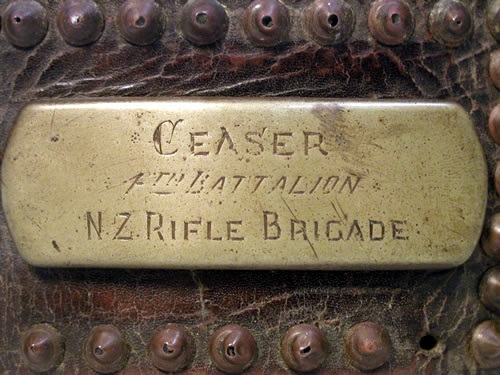
Caesar was killed in action.  His collar (which has his name spelled incorrectly) is on display at the Auckland War Memorial Museum.

Caesar's collar, with his name spelled incorrectly

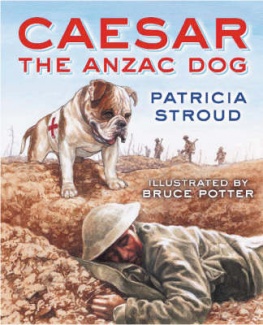
Author Patricia Stroud has written about Caesar in her book, Caesar the Anzac Dog.  Illustrated by Bruce Potter and published by Harper Collins, the book is useful for teaching schoolchildren about the war.  The publisher also offers a study guide for teachers.

A letter to my dog

A letter to my dog is the website collecting stories for photographer Robin Layton’s book project.  Dog owners from across the United States are encouraged to write a letter to their dog, include a photo, and upload both to the site.

This year, Layton will select some of the submissions and visit the dogs and their owners for professional photographs – and the letters and photos will go into his book.    A contribution from the proceeds of the book will be donated to the Humane Society of the United States.

What I like about the site is that people can include the breed of their dog as part of their submission (and there’s a category for mixed breeds, too!).  If you’re partial to the Dalmatian, for example, you can click on the Dalmatian link and read all the stories submitted by Dalmatian owners.

What I really like about the site is that it is a great pick-me-up after a long day.   It’s  dedicated to the bond between dog and owner and gives owners a chance to express their great love for their dog.  Excellent reading!

Some excerpts:

Full of jokes and hugs, you always know how to make me laugh, even in my darkest depression.

The way you look at me, it makes me feel as if I am every thing good in the world, because that is what you see in me.

I am so happy to have you and I hope you live a lot more years.

How could we have known when we walked into the animal control (the pound) the special connection and impact you would have on our lives.

I adopted you 9 years ago, and I still have vivid memories of that day when I came to pick you up.

This might seem a little odd because you can’t read, so I’ll explain it to you over a beer and a few treats very soon.

You instantly won my heart and even managed to win over my mom.

This slideshow requires JavaScript.

Before Cesar and Victoria

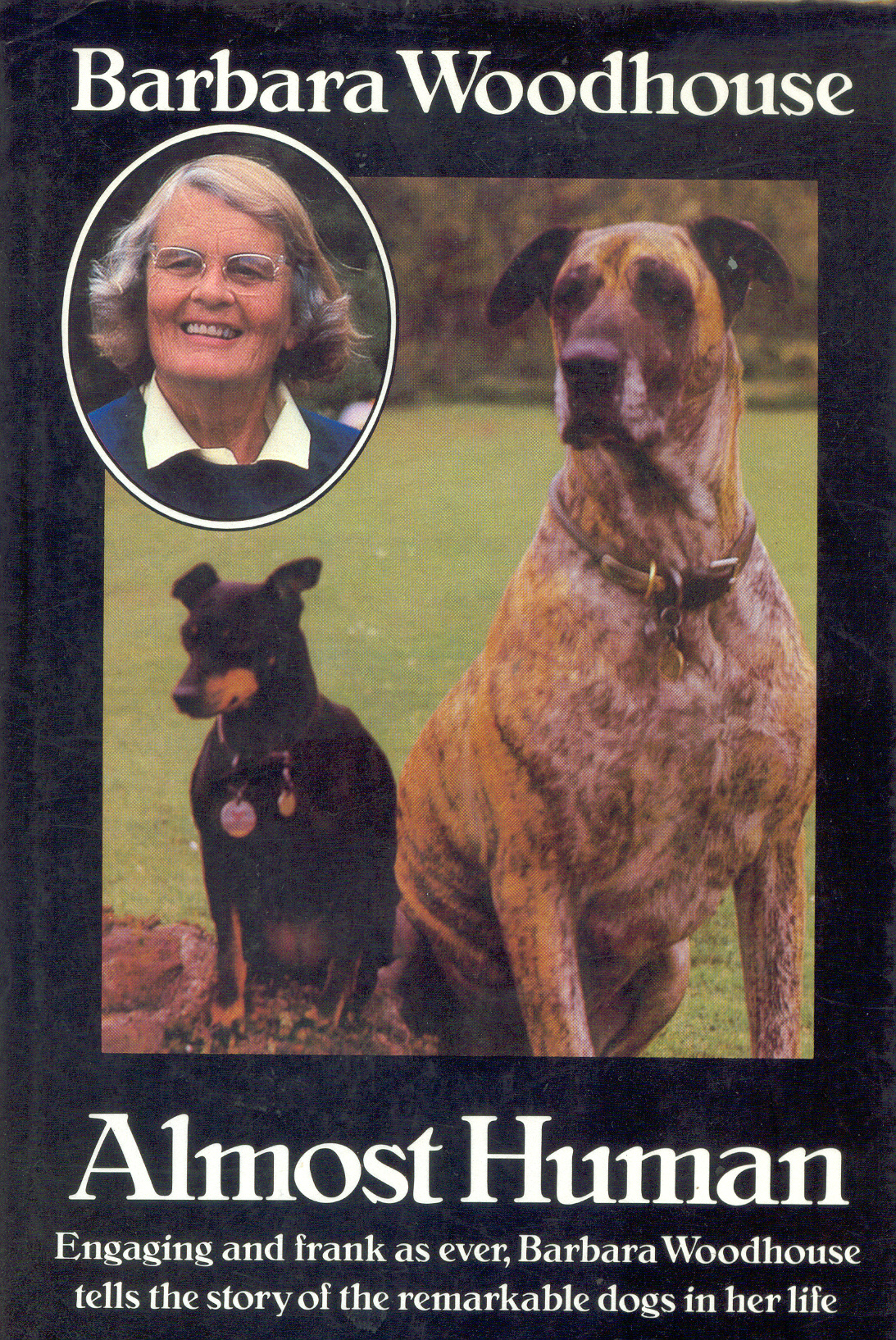
Before Cesar Millan and Victoria Stilwell, there was Barbara Woodhouse.  I have just finished reading one of Barbara’s books, Almost Human.  It made me realise that today’s craze of celebrity ‘dog experts’ isn’t new; we are just repeating a more modern version of what has gone before.


Barbara’s Great Danes, Juno and Junia,  appeared in many British television and films, acting alongside famous actors such as Sir Alec Guinness, Clark Gable and Roger Moore.

In Almost Human, Barbara writes:  My Danes were treated in exactly the same way as our children, and in so doing I learnt an awful lot about how much dogs like to be included in everything the family does…By the end of their lives I am sure they knew at least 250 words and their meaning.

Almost Human was published in 1976 and is a memoir about all her Danes: Jean, Jyntee, Juno and Junia.  There are chapters about owning and caring for a Great Dane.

Her other books included No Bad Dogs, Talking to Animals, Dog Training My Way, and A-Z of Dogs and Puppies.  In the 1980s, Barbara hosted a UK television programme called Training Dogs the Woodhouse Way.  Mrs Woodhouse even recorded an LP (the precursor to DVDs!) entitled Training Dogs Her Way.

Barbara suffered a fatal stroke in July 1988, she was 78.

In Defence of Dogs

John Bradshaw, in his book In Defence of Dogs, explains that most dogs today live in urban environments where they are “expected to be simultaneously better behaved than the average human child and as self-reliant as an adult.”  Yet, many dogs still retain their natural traits such as herding instinct which are viewed as ‘problematic.’

Add on top of this the popularity of dog trainers who insist on the theory of dominance, and Mr Bradshaw says that our dogs are in crisis and need our support.

Mr Bradshaw’s book is about breaking down misconceptions.  He says in his Introduction, “We must strive to better understand their needs and their nature if their niche in human society is not to diminish.”

Mr Bradshaw is a passionate supporter of dogs and his book demonstrates his beliefs clearly.   If you are a dog owner who is concerned about the increasing restrictions on dogs in our modern, living environments or you are simply open-minded enough to explore other ways of looking at canine behaviour,  then this book is for you!