This investigation used an instrument called an autorefractor to measure the dogs’ eyesight in indirect and direct lighting conditions. The study involved nine Beagles ranging in age from 1 to 14 years. Before entering the study, the dogs were examined to confirm that none of them had cataracts.
Measurements were taken on three different days of the week for a period of six weeks.
The researchers found a remarkable difference between the younger and older dogs. The older dogs had a much-reduced ability to see at longer distances (far-sightedness) compared to the younger dogs. Younger dogs were also able to make larger accommodation changes from indirect light to direct light conditions, indicating a more flexible lens.
Humans are the opposite in terms of length of sight. As we age it can become more difficult to read and see things at shorter distances whereas our ability to see at distances is often not affected (although some older people do have difficulties adjusting to night and low-light conditions, just as the dogs in this study did).
So if your dog is getting older and you notice that they can’t pick up on your body language and signals, there’s a physical reason for it.
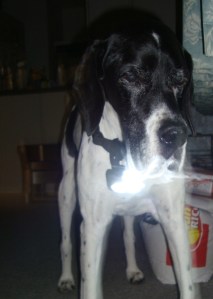
Through my own experience working with older dogs, I recommend using a light that helps your senior dog adjust to low-lighting conditions.See my post on the PupLight, for example.
Kathleen Crisley, specialist in dog massage, rehabilitation and nutrition/food therapy, The Balanced Dog, Christchurch, New Zealand
On Saturday evening in New Zealand, we’ll be changing clocks back to Standard Time. This is often a difficult day for dogs, because suddenly they haven’t been fed at their ‘normal’ time.
An hour is a long time to wait in dog time!
So, for the next few nights, feed your dog 10 to 15 minutes later than the previous evening. You’ll transition them to their new feeding in Standard Time with less trauma.
Kathleen Crisley, specialist in dog massage, rehabilitation and nutrition/food therapy, The Balanced Dog, Christchurch, New Zealand
I like crate training, particularly because it helps ‘future proof’ your dog.
If your dog needs surgery or rest from an injury at any time, having them used to comfortably resting in a crate saves a lot of time and stress (for both dog and owner).
If you need to travel with your dog, whether for a holiday or for relocating, crate training helps you manage your dog’s comfort as well as your own (e.g. limits the risks of accidents in hotel rooms that will charge you an additional cleaning fee).
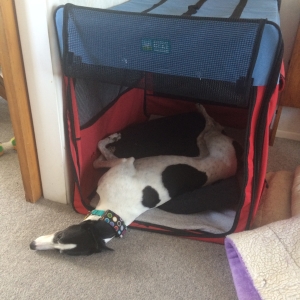
Izzy, mostly in her crate, but enjoying a summer breeze coming from the back door. Izzy’s crate is her safe place (the way it should be)
Crate training can be particularly useful for re-homed dogs because dogs will seek out a place that is safe (den-like if you are thinking of wolves). Giving a re-homed dog a place they can retire to – and not be bothered – is useful for getting them accustomed to life in a domestic home. It’s also a useful boundary for children to learn. If the dog is in its crate, then leave it alone.
Unfortunately, over the last 10 or so years, as crate training became more normalised as a concept, it also has been abused. Owners who are not consistent with their training or not taking the time to truly get their new puppy or dog settled in their home (taking on a dog is a lifetime responsibility, but initially you have to put in the time to get your dog set up for success for life), have begun using crates as a cage. A place to go when the owners are out at work (all day, in most cases) or when the dog has mis-behaved and the owner has had enough.
That’s the wrong use of a crate. There were even stories of dogs locked in their crates during the Christchurch earthquake of 2011 – the dogs were up to their necks in liquefaction by the time they were saved. That’s not a heartening story if you ask me. That’s a story of an irresponsible dog owner.
There are many resources to help owners learn crate training. The Humane Society of the United States, for example, has this useful video:
Kathleen Crisley, specialist in dog massage, rehabilitation and nutrition/food therapy, The Balanced Dog, Christchurch, New Zealand
Izzy is a greyhound, a breed that seems predisposed to a lot of dew claw injuries. Her last one occurred in February, when running after another dog’s tennis ball at the dog park.
I am now better prepared for nail injuries – with the easy addition of some cornflour (corn starch for those of you in the Northern Hemisphere) in my first aid kit.
You don’t need a fancy styptic pencil in your first aid kit to stop the bleeding of a nail injury; this good old fashioned powder will do the job. I’ve placed mine in a recycled prescription pill bottle.
If a nail injury occurs, you want to stop the bleeding which can be profuse. Apply pressure and this powder to stem the bleeding. Once stopped, then you can clean the wound properly with water and antiseptic and wrap the paw to keep it clean. Changing the bandage every day, re-applying antiseptic, is important.
Some nail injuries are worse than others; some will heal without veterinary help. In our last case, the quick was fully exposed (ouch!) and despite my efforts to keep it clean and dry, it became red/irritated and infected. (This is why you have to change the bandage every day and check for signs of infection).
A short course of antibiotics prescribed by our vet took care of the job.
I’m much more confident now that I have my container of cornflour in our first aid kit.
Kathleen Crisley, specialist in dog massage, rehabilitation and nutrition/food therapy, The Balanced Dog, Christchurch, New Zealand
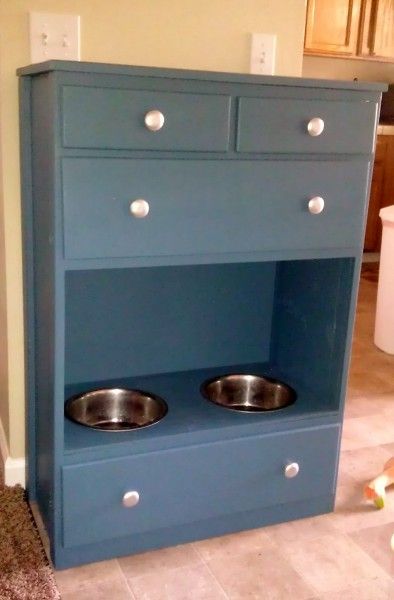
Here’s a design I saved from online a while back. If you have a small apartment or house, this is a great idea. There’s functional storage for your dog’s coats and other gear (or perhaps other things for yourself) and then some of the drawers have been removed to become a raised feeder.
I wish I was better at DIY!
Kathleen Crisley, specialist in dog massage, rehabilitation and nutrition/food therapy, The Balanced Dog, Christchurch, New Zealand
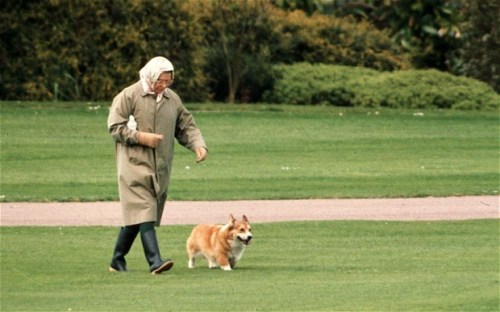
The Telegraph has reported this week that Queen Elizabeth II feeds her dogs in ‘order of seniority’ and that the dogs consume a range of herbal and homeopathic remedies.
The Queen of England couldn’t be more Establishment and yet – there she is – open-minded enough to recognise that herbals and homeopathics may help keep her Corgis in good health, for longer.
I respect her for that.
It’s long been reported and known that the Queen is an animal-lover. Dr Mugford, an animal psychologist who has worked with the Queen’s dogs says “The Queen has definite views about how dogs should be cared for: she doesn’t tolerate unkindness, and I remember she took a very dim view of President Lyndon B Johnson picking his dogs up by their ears.”
Queen Elizabeth has made the decision fairly recently not to replace her Corgis when they pass away, which has been a long-standing tradition in her household. This is surely a sign that the Queen is feeling the pressures of time and old age. She doesn’t want to bring dogs into the household when it’s highly likely they will out-live her.
Kathleen Crisley, specialist in dog massage, rehabilitation and nutrition/food therapy, The Balanced Dog, Christchurch, New Zealand
Vera does her morning yoga (photo by Jenny Hamilton)
I remember watching a yoga video years ago where the instructor described the act of stretching as ‘making space in the joints.’
As a canine massage therapist, I think stretching is essential. It lengthens muscles in a controlled and safe way to ensure good range of motion in the limbs and it helps to maintain blood flow to essential soft tissues.
As our dogs age, or when they are injured, then often need help with stretching (the same is true of people). That’s where professional massage comes in – someone to help warm and stretch the muscles, tendons and ligaments.
Owners can also learn to stretch their dogs; it’s something I include in special massage workshops for greyhound owners. I’ve found that greyhounds, with their sleek builds and racing instinct, often tighten up when in a pet home or when they don’t get regular off-lead exercise.
Kathleen Crisley, specialist in dog massage, rehabilitation and nutrition/food therapy, The Balanced Dog, Christchurch, New Zealand
Some people find it hard to believe that a dog professional like myself has never raised a dog from a puppy. That’s because my family raised me with the idea that you adopt, rather than buy, a dog. And by default that has steered me into a life with re-homed dogs – both mixed breeds and purebreds – who have entered my life at different ages.
My first dog came from a shelter; my second came from a supermarket ‘free to a good home’ ad; my third was a private adoption facilitated by a local rescue group (but she had never lived in their shelter); my fourth was a word-of-mouth adoption of Daisy, a purebred Pointer, who had bounced back to her breeder through no fault of her own. And now, I have Izzy who is a retired racing greyhound.
It’s a myth that ‘rescue’ dogs are all mixed breeds; many pure bred dogs also find themselves in need of re-homing. Responsible breeders will take back a dog for any reason during the lifetime of the dog. So, for example, in cases of divorce or an owner’s death, these dogs come up for adoption – and that’s only a couple of examples. There are also breed specific rescue groups who are passionate supporters of a breed and work to re-home dogs who have fallen on bad times.
What my life of adopting dogs has taught me is patience. It’s great to go out and buy the dog a bed, food and toys and envisage a perfect life together. And it will be good- but there are usually teething problems.
For example, when I adopted Izzy , she was suffering from re-homing stress. She was overwhelmed by her surroundings in my home – it was totally foreign territory. She was off her food and made herself a bed on a blanket by the front door. She remained there for almost 2 weeks (only moving to eat or drink or go out for walks) until she got her confidence to explore more of the house.
It took her 2 months to venture confidently into my bedroom (where large windows looking out onto the garden seemed to overwhelm her). She did not get on my bed for almost 4 months.
We had a few toileting incidents but that was also because she was getting used to new food and was already stressed from her change of circumstances. Whose tummy wouldn’t cause them problems?
But we got there and that takes patience. When I do home-checking for Greyhounds as Pets, I get an idea about how well the family is prepared to be patient with their new dog.
A prospective owner with a very strict timeline for getting their dog settled is unlikely to be successful – the dog doesn’t know about the timeline.
The best advice I can give is – be patient. If anything, give your new dog some space. Let them decide when they are comfortable in trying new things and don’t overwhelm them with affection too soon.
It’s worth the wait.
Kathleen Crisley, specialist in dog massage, rehabilitation and nutrition/food therapy, The Balanced Dog, Christchurch, New Zealand

I see a lot of dogs in my massage practice who have bad breath and/or other noticeable signs of dental disease. Ask most veterinarians and they’ll tell you that they do a lot of ‘dentals’ during the course of any given week. If your dog requires teeth to be extracted because of infection, cracking, or gum disease, your healthcare bill will quickly increase.
The first line of defense in keeping your dog’s teeth healthy is a good diet of wholesome ingredients. That includes chews and bones. Raw diets excel in this because they use bones as a staple part of the diet but I have also seen dogs with excellent teeth who are fed commercial dog foods – typically supplemented with fresh ingredients – and with bones and chews a regular part of the regime.
Some owners feed a combination of raw and commercial diets; I personally like this balanced approach and it is what I feed my own dog.
But, and here’s the but…bones and chews don’t solve the dental disease problem for a good number of dogs. Why?
Some dogs just aren’t naturally strong chewers; they aren’t motivated by chewing for very long – even on a fresh and meaty bone
Dogs who have been rescued or adopted may already have already experienced damage to their teeth or suffered early in life because of a poor diet or starvation
I believe that some dogs, like people, have a mouth chemistry that pre-disposes them to tartar build-up. Dogs are individuals and we simply can’t rule out that nature deals the bad-teeth card to some dogs
Dogs who have been born with defects such as cleft palates usually have something wrong with their teeth from the outset; bones and chews may be difficult for these dogs
So what’s the next step?
My view is definitely teeth-brushing. We train our children to do this daily. Why would it be any different for a domesticated dog?
[And, with hand on heart, most vets will choose teeth brushing over a special ‘dental diet’ any day.] The issue here is having the patience and persistence to brush teeth effectively. Unfortunately, a lot of owners simply give up because of their dog’s protests and vets then become conditioned to ‘water down’ the advice by saying ‘try it a couple of days per week..’ and ‘feed a dental diet.’
I brush my dog’s teeth daily. Izzy is a retired racing greyhound, a breed known for their bad teeth. By the time Izzy was adopted at age 5 1/2, her teeth were noticeably unstable and worn down from what must have been chewing on the bars of a kennel or some other surface equally as unforgiving. She had teeth extracted as part of her adoption medical visit.
I like this very straightforward video from The Whole Dog Journal on the subject of teeth brushing. The only oversight is that the video doesn’t cover the triple-headed toothbrush design which I prefer. My concern with the long-handled toothbrushes is that it is easy to poke a dog in the mouth with them, particularly if they are fussing with you over getting their teeth brushed in the first place…
A triple-headed dog toothbrush – my choice!
There are other natural solutions to dental care which include the use of homeopathics and herbs. All of these are my choice before a dental diet. Why?
Well here’s the ingredient list off the label of a well-known prescription diet product. Does it sound healthy/wholesome to you?