Category Archives: Dogs

A close up look at how our dogs drink…

The field of fluid dynamics explains how our dogs drink and why they splash and slop more than cats…

The drinking mechanism of a dog is videotaped from three different angles (A, B, and C). The curved tongue is rapidly withdrawn and a water column is formed underneath. A physical experiment is designed to understand and characterize the underlying fluid mechanics.  Photo by:  Sean Gart and Sunghwan (Sunny) Jung/Virginia Tech

The drinking mechanism of a dog is videotaped from three different angles (A, B, and C). The curved tongue is rapidly withdrawn and a water column is formed underneath. A physical experiment is designed to understand and characterize the underlying fluid mechanics. Photo by: Sean Gart and Sunghwan (Sunny) Jung/Virginia Tech

By studying the drinking habits of various dog breeds and sizes, a group of researchers at Virginia Tech and Purdue University has recently identified and modeled the fluid dynamics at play when dogs drink water.

“Three years ago, we studied how cats drink,” said Sunny Jung, an assistant professor at Virginia Tech. Jung’s research focuses include biofluid mechanics and the nonlinear interactions between soft bodies and surrounding fluids. His current project is sponsored by the National Science Foundation’s Physics of Living Systems program. “I was curious about how dogs drink, because cats and dogs are everywhere.”

As members of the order Carnivora, cats and dogs have incomplete cheeks, which allow them to open their mouths wide to deliver killing blows. But what makes pack hunting possible also makes suction drinking impossible. Unable to seal their cheeks completely, there is no way for a dog to suck up water. Conversely, humans have “complete” cheeks, and we drink by creating negative pressure, allowing us to suck water into our mouths and down our throats.

Cats, too, lack suction, and they compensate by drinking via a two-part “water entry-and-exit” process. This consists of a plunging and a pulling phase, in which a cat gently places its tongue on the water’s surface and then rapidly withdraws it, creating a column of water underneath the cat’s retracting tongue.

“When we started this project, we thought that dogs drink similarly to cats,” Jung said. “But it turns out that it’s different, because dogs smash their tongues on the water surface — they make lots of splashing — but a cat never does that.”

When dogs withdraw their tongue from water, they create a significant amount of acceleration — roughly five times that of gravity — that creates the water columns, which feed up into their mouths. To model this, Jung placed cameras under the surface of a water trough to map the total surface area of the dogs’ tongues that splashed down when drinking.

The researchers found that heavier dogs drink water with the larger wetted area of the tongue. This indicates that an allometric relationship exists between water contact area of the dog’s tongue and body weight – thus the volume of water a dog’s tongue can move increases exponentially relative to their body size.

In order to better understand how the physiology works, Jung and his colleagues could only go so far by watching dogs drink. They had to have the ability to alter the parameters and see how they affected this ability, and since they could not actually alter a dog in any way, they turned to models of the dog’s tongue and mouth. “We needed to make some kind of physical system,” Jung said.

For their model, Jung and his colleagues used glass tubes to simulate a dog’s tongue. This allowed them to mimic the acceleration and column formation during the exit process. They then measured the volume of water withdrawn. They found that the column of water pinches off and detaches from the water bath primarily due to gravity. Dogs are smart enough to close their mouth just before the water column collapses back to the bath.

Source:  Newswise media release
Dogs pay attention to what we are saying

When people hear another person talking to them, they respond not only to what is being said–those consonants and vowels strung together into words and sentences–but also to other features of that speech–the emotional tone and the speaker’s gender, for instance. Now, a report in the Cell Press journal Current Biology on November 26, 2014 provides some of the first evidence of how dogs also differentiate and process those various components of human speech.

I'm listening...new research proves our dogs are paying attention to what we say and how we say it

I’m listening…new research proves our dogs are paying attention to what we say and how we say it

“Although we cannot say how much or in what way dogs understand information in speech from our study, we can say that dogs react to both verbal and speaker-related information and that these components appear to be processed in different areas of the dog’s brain,” says Victoria Ratcliffe of the School of Psychology at the University of Sussex.

Previous studies showed that dogs have hemispheric biases–left brain versus right–when they process the vocalization sounds of other dogs. Ratcliffe and her supervisor David Reby say it was a logical next step to investigate whether dogs show similar biases in response to the information transmitted in human speech. They played speech from either side of the dog so that the sounds entered each of their ears at the same time and with the same amplitude.

The input from each ear is mainly transmitted to the opposite hemisphere of the brain,” Ratcliffe explains. “If one hemisphere is more specialized in processing certain information in the sound, then that information is perceived as coming from the opposite ear.”

If the dog turned to its left, that showed that the information in the sound being played was heard more prominently by the left ear, suggesting that the right hemisphere is more specialized in processing that kind of information.

When presented with familiar spoken commands in which the meaningful components of words were made more obvious, dogs showed a left-hemisphere processing bias, as indicated by turning to the right. When the intonation or speaker-related vocal cues were exaggerated instead, dogs showed a significant right-hemisphere bias.

“This is particularly interesting because our results suggest that the processing of speech components in the dog’s brain is divided between the two hemispheres in a way that is actually very similar to the way it is separated in the human brain,” Reby says.

Of course, it doesn’t mean that dogs actually understand everything that we humans might say or that they have a human-like ability of language.  But, says Ratcliffe, these results support the idea that our canine companions are paying attention “not only to who we are and how we say things, but also to what we say.”

Source:  EurekAlert! media release

Journal reference:  Ratcliffe et al. Orienting asymmetries in dogs’ responses to different communicatory components of human speech. Current Biology, November 2014

Yes. I tend to go a little overboard for my dogs. Am I alone?

I often recommend activity toys, supportive dog beds, and mobility aids like ramps and stairs…is this going over the top? I don’t think so. This lady does some wonderful things for her dogs – it’s about giving them the best life you can afford.
What have you done for your dog lately?

Kathleen Crisley, specialist in dog massage, rehabilitation and nutrition/food therapy, Canine Catering Ltd, Christchurch, New Zealand


Mel's avatarNo Dog About It Blog

If you ask, I am sure many people would tell you that I tend to go a little overboard where my pets are concerned. (I know for sure my family would!) I tend to buy them things that I think will enrich their lives and make them happy.

I think in the case of my dogs, I wanted to make up for the bad lives they had early on. I also want them to have lives that is enriched by a wide variety of fun experiences. (What’s the fun in having a dog if you can’t enjoy the fun they have with you?)

So while I do have a logic behind what I do for my pets, I also know that I am not the norm.

After all, I …

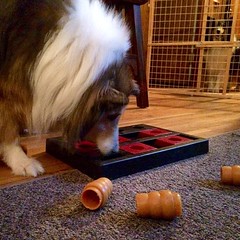
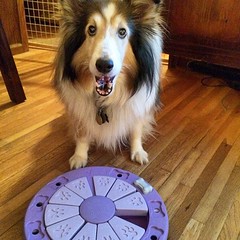
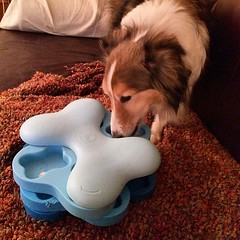
Buy dog games for my dogs, just so they can work their brains on a cold winter’s night.

Waiting his turn

Can you help me mom? This one is hard! #doggames

Game night!

Have at least 20…

View original post 225 more words

Doggy quote of the month for December

“The more I see of men, the more I admire dogs.”

– Madame Roland (also known as Marie-Jeanne “Manon” Philipon), 1754-1793, French political figure during the French Revolution

Arthur chose them…and a new life in Sweden

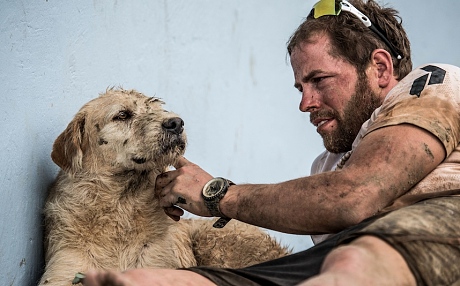
The Swedish members of Team Peak Performance started out as a team of four in a 430-mile adventure race through the Amazon.  By the time they finished the race in Ecuador, they had added a 5th member, a canine named Arthur.

Arthur’s story, including his subsequent relocation to Sweden, has captured the world’s attention.  This is a classic case of a dog choosing its adoptive owner.

It started when Captain Mikael Lindnord threw a stray dog a meatball at a rest break.  A 24-mile rainforest hike, one leg of the race, was about to begin and the stray kept pace with the team.  When the team entered its kayaks for a water part of the race, the stray (now named Arthur) jumped in to swim and stay with them.

“The organisers advised us not to bring Arthur, as it could be unsafe on the water,” explained Mr Lindnord.

“But when we set off in the kayaks, he started swimming after us. It was too heart-breaking and we felt we couldn’t leave him, so we picked him up.  We could hear the people cheer on the shore as we set off.”

Mikael and Arthur during the race Photo: Krister Göransson/Peak Performance

Mikael and Arthur during the race Photo by: Krister Göransson/Peak Performance

Mikael has now adopted Arthur and brought him back to Sweden to become a member of the family.

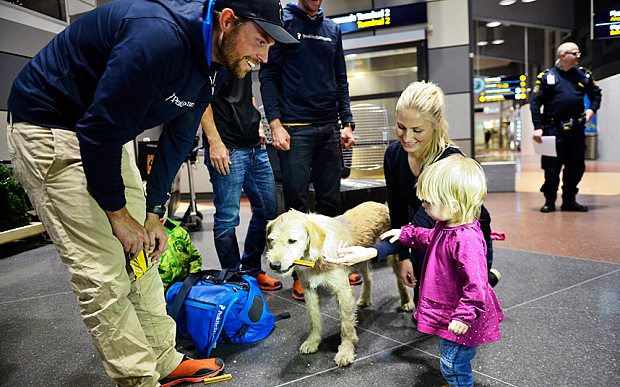
Arthur and his new family at the airport

Arthur and his new family at the airport

Recognizing that Arthur’s story has touched many who want to help other strays, the team has set up the Arthur Foundation to receive donations.

You can follow Arthur’s progress on the Team’s Facebook page.

Kathleen Crisley, specialist in dog massage, rehabilitation and nutrition/food therapy, Canine Catering Ltd, Christchurch, New Zealand

Now Paw-tucket can live up to its name

The city of Pawtucket, Rhode Island had a 10-year old ordinance banning the ownership of pit bulls until earlier this week.  A judge ruled that a 2013 state law banning breed-specific legislation meant that the city’s law was now illegal.

This is a win for the fight against breed specific laws and restrictions.

Pit bull owners in Pawtucket celebrated on Sunday with a parade.  There was also a free dog training class offered afterwards.  A local group, Pit Bulls for PTSD, also participated in the parade.  The group trains pit bulls to become service dogs for autistic children and veterans suffering from PTSD.

Please remember:  punish the deed and not the breed!

Kathleen Crisley, specialist in dog massage, rehabilitation and nutrition/food therapy, Canine Catering Ltd, Christchurch, New Zealand

Freshpet goes public

Earlier this month, Freshpet Inc, the first and only fresh, refrigerated pet food brand distributed across North America, commenced trading on the Nasdaq Stock Market.  It’s trading abbreviation is FRPT.

Freshpet logo

This listing is yet another indication of the growing pet products market in the USA (and worldwide).  Pet owners have incredible purchasing power and this power grows every year.

Freshpet’s operations began in October 2006.  Their food is delivered to Freshpet Fridges in over 13,000 retail outlets.

Freshpet display cabinet

All products are cooked in small batches and then refrigerated immediately and come with a best before date.

I don’t live in the USA and so haven’t experienced Freshpet firsthand.  If you feed their foods, what do you and your dog think about them?

Kathleen Crisley, specialist in dog massage, rehabilitation and nutrition/food therapy, Canine Catering Ltd, Christchurch, New Zealand

Pelorus Jack – remembering World War I

This year marks the 100th anniversary of the start of World War I and commemorations are being held across the Globe.

It’s a fitting time to remember the animals that served during the conflict.

Pelorus Jack, a Bulldog, was the mascot of the HMS New Zealand.  In fact, there were two Pelorus Jacks because the first mascot was killed and subsequently replaced.

A model of Pelorus Jack with his collar and leads (photo courtesy of NZ History)

A model of Pelorus Jack with his collars and leads (photo courtesy of NZ History)

The first dog was a gift to the ship from a New Zealander living in England. He was named after the famous dolphin that accompanied ships traveling in the outer Marlborough Sounds between 1888 and 1912.  He was killed when he fell down the forward funnel of the ship and was officially ‘discharged dead’ from the Navy on 24 April 1916.

In his will he had requested that his successor be a ‘bull pup of honest parentage, clean habits, and moral tendencies’.

The second Pelorus Jack, also a bulldog,  was terrified of the noise of the ship’s guns.  He achieved the rank of leading sea dog before his final discharge in October 1919.   On his return to New Zealand, he was gifted to the City of Auckland along with his silver collar, a brass studded collar and leading reins.

The Auckland War Memorial Museum holds these items in its collection, along with the collar of Caesar the Anzac Dog.  Read my blog about Caesar here.  Another Pelorus Jack collar is kept in the Royal New Zealand Navy Museum in Devonport.

Kathleen Crisley, specialist in dog massage, rehabilitation and nutrition/food therapy, Canine Catering Ltd, Christchurch, New Zealand

Source:  New Zealand History

The dog mayor of San Francisco

On Tuesday (18 November 2014), Frida the Chihuahua was sworn in as Mayor of San Francisco for the day.

Frida, after her swearing in ceremony (photo by NBC News)

Frida, after her swearing in ceremony (photo by NBC News)

Frida earned the honor because her owner had the winning bid of $5,000 at an auction to benefit the Department of Animal Care and Control, which runs the city’s animal shelter.

“We applaud Mayor Frida’s ability to rise above her humble start as a single mom in an animal shelter to Mayor for the Day,” said Miriam Saez, acting director of the Animal Care and Control Department.

Frida

At the end of the day on Tuesday, Frida’s retirement package included a dog bed, toys and a gift basket.

Go Frida!

The dog effect – what’s a dog story worth for newspaper readership?

A new journal article in PS:  Political Science and Politics outlines research done in tracking coverage of news stories in regional newspapers.
The researchers found that by mentioning a dog in the news story, more people are likely to read the news item and increase readership of that issue of the newspaper.
It’s called the ‘dog effect.’
I’ve included the Abstract and the full journal citation below, but you will have to pay to read the entire article if you are not a subscriber to the journal…
Since I love to blog about news involving dogs, this research doesn’t come as a big surprise to me.
There are dog lovers throughout the world and we love to read about dogs!

Kathleen Crisley, specialist in dog massage, rehabilitation and nutrition/food therapy, Canine Catering Ltd, Christchurch, New Zealand

ABSTRACT

Journalists consider the importance of events and the audience’s interest in them when deciding on which events to report. Events most likely to be reported are those that are both important and can capture the audience’s interest. In turn, the public is most likely to become aware of important news when some aspect of the story piques their interest. We suggest an efficacious means of drawing public attention to important news stories: dogs. Examining the national news agenda of 10 regional newspapers relative to that of the New York Times, we evaluated the effect of having a dog in a news event on the likelihood that the event is reported in regional newspapers. The “dog effect” is approximately equivalent to the effect of whether a story warrants front- or back-page national news coverage in the New York Times. Thus, we conclude that dogs are an important factor in news decisions.

 What’s a Dog Story Worth?
Matthew D. Atkinson,Maria Deam and Joseph E. Uscinski (2014).
PS: Political Science & Politics,
“>Volume 47
, Issue04, October 2014 pp 819-823http://journals.cambridge.org/action/displayAbstract?aid=9365716