Category Archives: Dogs

Pain management in dogs with bone cancer

A single injection eased severe, chronic pain caused by late-stage bone cancer in dogs, according to a study in the November issue of Anesthesiology. Dogs with bone cancer that received a neurotoxin injection had significantly more pain relief than those that got standard care without the injection.

“Dogs are part of the family and we do everything we can to relieve them of pain and discomfort when they are sick,” said Dorothy Cimino Brown, D.V.M., School of Veterinary Medicine, University of Pennsylvania, Philadelphia. “In addition to sharing emotional attachments with our dogs, humans share many of the same ailments our pets suffer when fighting cancer. By studying the positive pain relief this treatment afforded dogs, we are hopeful it may also be effective for humans.”
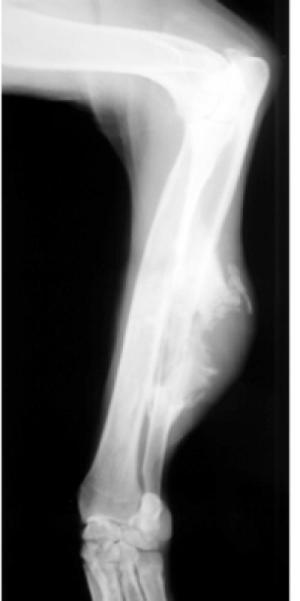
A radiograph of a dog's leg with a cancerous lesion. (Credit: Image courtesy of American Society of Anesthesiologists (ASA))

A radiograph of a dog’s leg with a cancerous lesion. (Credit: Image courtesy of American Society of Anesthesiologists (ASA))

The owners of 70 dogs enrolled their pets in this study. Half the dogs received an injection of a neurotoxin, called substance P-saporin (SP-sap), as well as standard care. The other half (i.e., the control group) received standard care without the neurotoxin injection. The average age of the dogs was between 8 and 9 years and their average weight was 90 pounds.  Multiple breeds participated in the study, including: Rottweilers, Labrador Retrievers, Golden Retrievers and mixed breeds.

The evolution of bone cancer pain in dogs parallels what occurs in humans, with the frequency and intensity of pain increasing over weeks and months. As the cancer advances, both canine and human patients experience life-altering pain, which greatly affects their daily activities and quality of life. The standard treatment for dogs with late-stage bone cancer can include opioids, steroids, and palliative radiation. All of these treatments can have negative side effects.

Within six weeks of beginning the study, 74 percent (26) of the dogs in the control group needed to be “unblinded” (i.e., their status in the study revealed) and their pain relief regimen adjusted compared to 24 percent of the dogs (eight) in the group that received the injection. This was a statistically significant difference.

Other study results included a 6 percent increase in pain severity scores for dogs in the control group, while the dogs in the SP-sap group had no change in pain severity score.  In addition, the dogs in the control group had an 8 percent increase in how pain interferes with their typical activities, while the SP-sap dogs had a 5 percent improvement in this pain impact score. Finally, one dog in the control group responded with improved lameness, while 6 dogs in the SP-sap group became less lame. While these secondary study results were not statistically significant because they were only assessed two weeks after injection, they are promising.

Source:  American Society of Anesthesiologists media release

The Daisy Hill Puppy Farm

Daisy (my Daisy) is (not surprisingly) a fan of Snoopy because he was born at the Daisy Hill Puppy Farm.  (I’ve tried to explain that the Farm was named long before Daisy was born, but she doesn’t quite grasp that concept.)

Mr Schultz, creator of Peanuts, clearly didn’t know about puppy mills when he was creating the story of Snoopy’s adoption – because the Farm looks nothing like the puppy mill operations we see today.  Snoopy was able to be raised with his mother and siblings in a ‘free range’ environment which included a healthy buffet for dinner and musical interludes…

This YouTube video shows what the Daisy Hill Puppy Farm looked like:

Wouldn’t it be wonderful if all puppies were raised in these conditions?

Behaviour in dogs depends on the paw preference

I’ve previously written about how to test if your dog is right-pawed or left pawed.  Researchers at the University of Adelaide led by Dr Luke Schneider tested a group of 73 dogs using 50 manipulations of an object to determine their paw preference.  They then interviewed the dog owners about their dog’s behavior to see if there was a pattern.

“We found that dogs with a preference for left paws were reported by their owners to show high levels of aggression towards strangers. The left pawed dogs scored almost twice as high as ambilateral (ones with no preference) and also higher than dogs with right paws.

“There is research in the human world as well that positive and negative emotions can be located in the left and right hemispheres and it seems to go the same way in humans and other animal species, that the negative emotions are located in the right hemisphere. There are many, many overlaps between human and animal brains.”

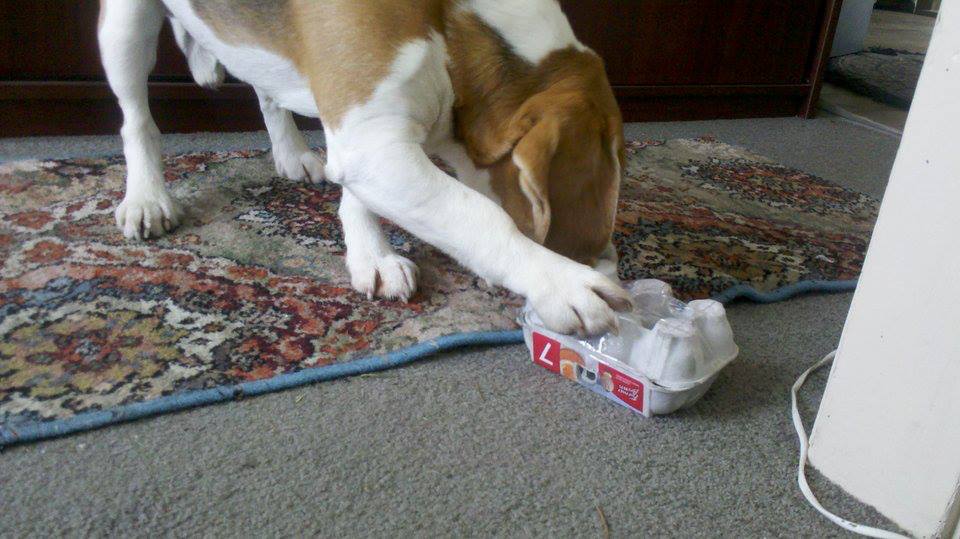
Blake the Beagle shows his preference for the right paw

Blake the Beagle shows his preference for the right paw

When testing dogs for paw preference, the research team found a roughly even split between those dogs that had a right paw preference vs those with a left paw preference.

None of the dogs in the study were noted as particularly aggressive, and so the research team wants to do more work with dogs who are noted for aggression-type responses.  A larger testing group would also help to validate results.  The research team’s study has been published in the Journal of Veterinary Behavior.

Ralph Lauren’s Dog Walk

This month, Ralph Lauren, has chosen to feature rescue dogs in showing his Fall 2013 Accessories Collection.  This collection includes items of dog apparel, such as cashmere sweaters!  (October is Adopt a Shelter Dog month, by the way)

If you buy any of the featured items between 15 October and 15 November, 10% of the proceeds will be donated to the ASPCA.

And now…..Ralph Lauren presents The Dog Walk:

Is the chocolate labrador a Volkswagen fan?

Dogs have been used in advertising for a long time – it’s not a new trend.  Anyone who likes dogs will spot the ads that use a dog and they are more likely to remember the product or service.

Today I spotted this ad on a local website for a car dealership.

Is the Chocolate Labrador a Volkswagen fan?

Miles Continental banner

Image

Wordless Wednesday, part 7

dogue de bordeaux photo

So ugly, they’re cute

The World’s Ugliest Dog Contest has been held annually in Petaluma, California as part of the Sonoma-Marin Fair for 25 years.   This contest has grown in popularity and is now featured on cable television channel Animal Planet.

Although dog moms and dads who enter their dog mainly come from the United States, anyone can enter.  The Chinese Crested, a largely hairless breed, has figured prominently amongst the winners.

This year (2013), the title was awarded to Walle, a beagle, boxer, basset hound mix with a large head and a duck-footed walk.  He beat 29 other contestants for the title.

Walle, the World's Ugliest Dog 2013

Walle, the World’s Ugliest Dog 2013

Vicki DeArmon has written a book about the contest which profiles winners, other entrants, and their owners.  The pictures really do prove that some creatures are so ugly that they’re cute.
World's Ugliest Dog Book

Maybe the dog lover in your pack would like this book for Christmas, or perhaps you should treat yourself?

A dog’s secret life and how it can help elderly owners

Experts at Newcastle University are using movement sensors to track normal dog behaviour while the animals are active outside the home and when they are home alone.

Dog photo for research blog

The sensors show not only when the dog is on the move, but also how much he is barking, sitting, digging and other key canine behaviours.

By mapping the normal behaviour of a healthy, happy dog, Dr Cas Ladha and students Nils Hammerla and Emma Hughes were able to set a benchmark against which the animals could be remotely monitored.  This allowed for any changes in behaviour which might be an indication of illness or boredom to be quickly spotted.

Presenting their findings at the 2013 UbiComp conference in Zurich, project lead Ladha, says the next step is to use the dog’s health and behaviour as an early warning system that an elderly owner may be struggling to cope.

“A dog’s physical and emotional dependence on their owner means that their wellbeing is likely reflect that of their owner and any changes such as the dog being walked less often, perhaps not being fed regularly, or simply demonstrating ‘unhappy’ behaviour could be an early indicator for families that an older relative needs help.” says Hammerla.

The team created a hi-tech, waterproof dog collar complete with accelerometer and collected data for a wide range of dog breeds.

Hammerla adds: “This is the first system of its kind which allows us to remotely monitor a dog’s behaviour in its natural setting” –  ultimately classifying 17 activities such as barking and chewing.

“But beyond this it also presents us with a real opportunity to use man’s best friend as a discreet health barometer.  It’s already well known that pets are good for our health and this new technology means dogs are supporting their older owners to live independently in even more ways than they already do.”

Source:  Newcastle University media statement

Image

Wordless Wednesday, part 6

Testing the beds_Kruize

The SmartPill: helping to understand canine bloat

Gastric dilatation-volvulus (GDV), or bloat, is one of the leading causes of death in dogs.  Second only to cancer in some breeds, it’s the number one killer of Great Danes. Despite its prevalence, the cause of bloat is unknown.

The American Kennel Club Canine Health Foundation has given a research grant to Laura Nelson, assistant professor at Michigan State University College of Veterinary Medicine to change that.

Great Dane photoWhen a dog gets bloat, gas fills the dog’s stomach, the stomach twists completely around, the gas has no way to escape, and blood and air supply to the stomach are cut off. As the stomach swells, it presses against the abdominal wall and pushes against large blood vessels. Shock is usually the cause of death. The whole progression can happen in a matter of minutes or hours, and surgery is required to save the dog’s life.

It’s generally believed that genetics as well as environmental factors play a role in which dog develops bloat.  “We want to know why some dogs get bloat while others don’t,” says Nelson.

Nelson’s team is investigating the relationship of contractions responsible for the digestion of food (motility) with increased GDV risk, and hopes to define the biochemical and genetic alterations that may be associated with hypomotility—abnormally weak contractions. A new diagnostic tool, SmartPill®, makes possible noninvasive assessment of motility. The SmartPill® is an ingestible capsule with an instrument inside that measures acidity and pressure. The team will measure the time it takes the capsule to pass through the dog’s system and the pressure spikes along the way.

In the short term, the research findings may provide clinicians with data that would allow them to make informed decisions about when to use preventative medications or conduct targeted prophylactic surgery—gastropexy—in at-risk dogs. This procedure surgically attaches the stomach to the abdominal wall in order to prevent twisting. It is an effective procedure that is well tolerated, but, Nelson notes, it is an invasive procedure that may not be necessary in some dogs. There currently is not a good way to determine who to recommend it for.

“With bloat, it happens and you treat it. But it would be so much more satisfying if we really understood why some dogs get bloat, and then be able to make more informed treatment decisions and possibly prevent the disease altogether,” says Nelson.

Source:  Michigan State University media statement