Category Archives: Dogs

Guide Dog of the Year 2012 (UK)

Congratulations to John Tovey and his guide dog, Dez, who not only won the Guide Dog of the Year  award but also a Life Changing Award on 19th July at the Specsavers Guide Dog of the Year Awards in London.

John is only 44 and lost his eyesight two years ago to diabetes.  In going blind, John also lost the ability to do his job as a fitter (he’d worked on projects like the Channel Tunnel).    Enter Dez, a Black Labrador…

‘I just fell in love,’ says John.

Now Dez wakes him up every morning at 7:30 wanting to be fed.  And John has quality of life again.

Read more about John’s story in this BBC News article.

A Big Little Life


I’ve just finished reading A Big Little Life by Dean Koontz.  This book is the memoir of his Golden Retriever, Trixie.

Trixie was trained by Canine Companions for Independence as an assistance dog but had to be retired after needing elbow surgery.  She came to live with author Dean Koontz and his wife, Gerda, in 1998.  In this book, Koontz relates the stories of Trixie’s (a.k.a. Short Stuff’s)  remarkable life, where she teaches the Koontzes to treasure every moment and live in the present.  Meanwhile she makes lots of friends along the way.

My favourite story is of Trixie, who is suffering from diarrhea.  However, Trixie won’t poop in her own yard and diarrhea won’t stop her from breaking this vow.  She takes Dean for a sprint across their rather large California property in order to reach safe territory.  There, she lets loose with explosive results.  It is stories like this that many dog owners can relate to.  (My Daisy won’t pee in the rain and it doesn’t matter whether she is wearing a raincoat or not – she has to be busting before she’ll go.)

Koontz was inspired by Trixie and this led him to publish a number of books in her name including Life is Good, Bliss to You (Trixie’s Guide to a Happy Life), Christmas is Good, and children’s book I Trixie Who Is Dog.  Proceeds from these books were donated to support the Canine Companions charity.

This slideshow requires JavaScript.

Be prepared as Dean tells us about the awful days in 2007 when Trixie fell ill and was put to sleep in his arms, sitting on her favourite couch.  Koontz was subsequently unable to write for almost a month afterwards.

As Koontz says on Trixie’s dedicated website pages, “She changed us as people, made us better by her example, brought piercing beauty and so much humor into our lives, and left a terrible void when she went to God.”

Laika the space dog

Sky TV (our cable channel) has been airing the film Apollo 13 for the millionth time and so, as my mind wanders, I started thinking about the first dog in space.

Her name was Laika, which means Barker in the Russian language.  She was found as a stray dog but ultimately was sent into orbit on Sputnik 2 on November 3, 1957.

A photo of Laika in her specially designed space capsule

Her successful launch into space was the subject of a lot of fanfare and heralded as an achievement by the Russian space programme.  Over the years, her launch into space was celebrated in a range of postage stamps from around the world.

This slideshow requires JavaScript.

Back in 1957, people were told that Laika lived almost a week in space before dying a painless death.  In 2002, those facts were disputed at the World Space Congress in Houston, Texas, by Dimitri Malashenkov of the Institute for Biological Problems in Moscow.

He reported that Laika died from overheating and panic just a few hours after the mission started.

Dr Malashenkov  revealed several new details about Laika’s mission at the conference, including that the dog was chained to prevent her turning around and that her food was prepared in a jelly format for space travel.  There was a carbon dioxide absorbing device in the cabin to prevent the accumulation of this toxic gas as well as an oxygen generator (similar to what was used in Apollo 13).

Medical sensors attached to Laika showed that her heart rate increased by to 3 times its resting rate during the launch.   Other sensors showed that temperature and humidity increased as the space ship attained orbit.  Within five to seven hours of flight, mission control in the Soviet Union stopped receiving life signs from Laika.

Laika achieved a place in history for her flight into space, which proved that life forms could survive (with support) in orbit.  Unfortunately for Laika, she lived in a time when animal experimentation was an accepted norm.
Source:  BBC News

The year of the vet plus one

Thirty-five years ago, on the waiting room wall of our family’s first vet, this passage from the actor and cowboy Will Rogers was mounted in a frame:

 The best doctor in the world is the veterinarian. He can’t ask his patients what is the matter- he’s got to just know.

 What Mr Rogers said still holds true today.  Our veterinarians must have enquiring minds, good social skills (with dogs and people), observation capabilities beyond compare, a good network for researching and diagnosing illnesses, and the dedication to continue learning as new drugs and medical techniques are developed.

Did you know that last year (2011),  marked the 250th anniversary of the veterinary profession? French veterinarian and animal pathology researcher Claude Bourgelat established the world’s first veterinary school in Lyon, France in 1761.  Another school was established several years later in Paris.

I get to witness the rapport between client, dog and vet when I’m allowed to sit in on Gumboot Morrall’s post-surgical examination with Dr Tim Nottage of the Merivale Papanui Veterinary Clinic in Christchurch.  Gumboot  –  ‘Boots’ for short – has had a 1.2 kg tumour removed from his abdomen.  His owner, Min Morrall, tells me that Gumboot is a 10-year old Labrador cross and that she takes all her animals to Dr Tim for care and treatment.  She’s obviously comfortable at this practice as she shares the latest news with the receptionist while waiting for her appointment to begin.

Dr Tim Nottage rewards Gumboot after a successful examination

Dr Tim immediately asks for a progress report from Min, who says that Boots is walking again, although slower than normal.  Whilst he works on Boots to examine the surgical scar and drain the wound, Dr Tim asks various questions of Min.  These range from Boots’ appetite and medication to Min’s opinion on how her dog is doing.  Throughout his exam, Dr Tim murmurs encouraging words to Boots.  Afterwards, he gives Boots a treat which Boots happily accepts before heading for the relative safety of the reception area, clearly happy that his uncomfortable visit is over.

Our veterinarians go through years of education and training to become qualified and then their lifelong journey commences as they learn from their patients as new cases are presented.  Today we are reaping the benefits from a profession established over 250 years ago and the lives of our animals are better for it.   When you are next at your vet’s office, consider the words of Will Rogers and watch a true professional in action!

Dogs who help soldiers

When I watched the PBS documentary Shelter Me, I was astounded at the statistics that more returned servicemen are dying by their own hands than are dying in fields of conflict like Afghanistan and Iraq.  These men and women are returning from active duty with difficulties such as post traumatic stress disorder and other anxiety-related problems.  They have difficulty adjusting to life in peacetime.

Dogs are playing a key role in helping these ex-soldiers to recover and re-enter society.  Shelter Me covers the stories of two veterans, for example, who have been paired with service dogs.

Here’s the YouTube trailer for Shelter Me:

The Boston Globe recently covered another story about the value of service dogs.  Patriot Rovers is a charity that trains dogs to be service dogs for returned servicemen and women.  The charity names the dogs after soldiers who have fallen in the line of duty.  The charity’s website is particularly poignant, with photos of the dogs and an explanation of the soldier they are named after.

In the Globe story, Natasha Young-Alicea suffers from migraines and anxiety from the time she served in the Marines and has been paired with Josh who is named after a Navy SEAL, Josh Harris.  Josh helps Young-Alicea in many ways.  One particular heart-wrenching task is to sit behind her in the checkout line at the supermarket, to avoid people approaching her from behind.  This proximity triggers anxiety.

Josh and his handler visit the parents of Josh Harris which also helps in their journey of healing.

These stories reinforce the critical role that service dogs play in our communities.  If you have spare time or dollars, please consider supporting service dog charities in your area.

The Barkin’ Basin of Las Vegas

People who know me well would understand that my first stop on a trip to Las Vegas was a dog park (not a casino).  That’s what happens when you stay with a friend who owns four dogs.

I had never used a GPS before and so the nice man at Hertz programmed the directions to the corner of Alexander and Tenaya – the Barkin’ Basin at Wayne Bunker Park.

The Barkin’ Basin is a large area (7.75 acres according to the City of Las Vegas website) that has been divided into three fenced sections.  At the time I was there, one section was closed to allow the grass to re-grow.  (It’s very hot and dry in Las Vegas and so grass is not a natural phenomenon.)

The park is open from 7 am to 10 pm daily and offers some areas that are covered in shade cloth for owners and dogs to rest.  But, to be honest, it’s so hot in Las Vegas during the summer any caring dog owner would be there early or late.  I arrived after sunset and it was still very warm!

If you are traveling through Las Vegas on a dog friendly holiday, then you shouldn’t miss the Barkin’ Basin.  It comes highly rated by many dog owners.

This slideshow requires JavaScript.

Protecting pets on US flights

The US Department of Transportation has proposed a strengthening of regulations involving the transport of animals on airplanes.

The proposal would require 36 airlines to report companion animal incidents that happen in the cargo holds of their planes.  Currently, only 15 airlines are required to submit annual reports.  Carriers also would have to report the number of animal losses, injuries and deaths and the total number of animals transported each year.

The Humane Society of the United States has endorsed the proposal.  The Society regularly receives complaints about animals who are injured in cargo holds or – worse – die.  Animals transported as cargo are exposed to excessive temperatures (hot and cold) and rough handling.  There have been reports of poor ventilation and lack of oxygen, too.

Another significant change is that the regulations also would apply to dogs and cats being shipped for commercial sale. With an upsurge in online sales, particularly of dogs,  many operators of inhumane commercial breeding facilities (puppy mills) transport dogs to pet stores and to new owners via airplanes.

Inga Fricke, the Director of Sheltering and Pet Care Issues for the Humane Society says  “We applaud the Department of Transportation for proposing to expand this rule because it will keep dogs and cats safer on planesRequiring stronger reporting requirements of airline carriers will force carriers to better handle animals during transport, providing the oversight needed. It would also give consumers clarity when choosing an animal friendly airline, and travelers would be able to compare carriers’ rates of animal deaths and injuries.”

Dog hair blankets in Native America?

Mass spectrometry has been used to resolve a debate about the fibres used to weave Native American blankets.

The blankets have been known as ‘dog hair’ blankets because oral histories passed down by descendents of the Salish weavers, who were indigenous to the Pacific coast of North America, told of the blankets being woven from the hair of dogs who were specially bred for their fur.

copyright University of York Department of Archaeology

Researchers at the University of York‘s Departments of Biology, Archaeology and Chemistry analysed the protein composition of 25 textile samples from 11 different locations.  These textiles were housed in famous collections like the Smithsonian Institution and some came from the expeditions of Lewis and Clark (1803-1806) and Wilkes (1838-1842).

The researchers didn’t find any garments that were made of purely dog hair.

There was evidence of dog hair in a robe of fur and six textile samples, primarily in a blend with goat hair.  The researchers concluded that the dog fur was used to supplement goat hair as a bulking material.

They have published their findings in the journal Antiquity.

The public relations nightmare of unscooped poop

Every sector has an issue that, if not managed, becomes its downfall.  In the dog world, I think this issue is poo.  More specifically, it is poo that is not cleaned up.

A woman complained in our newspaper recently about the amount of dog poo that had not been picked up at a local dog park. I have been at our dog park and watched as dog owners conveniently ‘don’t see’ their dog do a poop.  Even less common (and perhaps something to do with kiwi culture?), are the other dog owners who see it but do not bring it to the dog owner’s attention.   I have found that most dog owners are embarrassed and very willing to clean up when the fact of the dog’s neglected poo is mentioned.

In Poole (UK), the local council has resorted to more overt tactics to get dog owners to recognise the errors of their ways.  They spray paint piles of poo green to highlight the scale of the problem.  It was reported that 200 piles of poo were found in one street alone.[1]  The painting campaign augmented other initiatives such as a crackdown by council officers in issuing fines.

In New Zealand, we have the benefit of a lower population density but that should not make us complacent about this problem.  Cities such as Auckland and Christchurch are actively encouraging infill housing and more urban development to stop urban sprawl.  Over time, people and dogs will be living much closer together.

We need to find ways to peacefully co-exist with one another; and leaving faeces for people to step in is not one of them.  There are also indications that dog waste contributes to water pollution through runoff.

Since August 2009 (when most supermarkets began charging for carry bags) free bags are harder to come by.  Our dog park has posted at least one plea for urgent bag donations.  However, is the lack of a plastic bag an adequate excuse for not cleaning up after your dog? 

There are plenty of other sources of bags and responsible dog owners always have a supply, even in the glove box of the car. Ask your non-dog-owning friends and co-workers to save bags for you.  Bread bags and produce bags work just as well as carry bags.  As a last resort, a roll of freezer bags will set you back a couple of dollars at the supermarket.  The last roll I purchased allowed me to pick up no less than 60 piles of poo!

It is very concerning to see the evidence of dog owners who are not cleaning up after their dog.  It gives all of us a bad name.  If your dog could talk, I wonder if they would say, “I poop.  You pick it up.  Any questions?”[2]


[1] BBC News, August 2010

[2] Puget Sound Starts Here campaign poster (Washington, USA)

Kathleen Crisley, specialist in dog massage, rehabilitation and nutrition/food therapy, The Balanced Dog, Christchurch, New Zealand

Dog intelligence

Most dog owners have an opinion about their dog’s intelligence.  I regularly hear comments like, “He’s so smart, he’s ahead of the rest of his obedience class” or “He’s not very bright, but we love him.”

 When I was working on my management qualification years ago, we were told to go home and ask our partner/flatmate about how they solved problems.  Ebony, my Labrador flatmate at the time, came up with these tips, which I thought were very intelligent:

  1. Remember that chasing your tail does not get you anywhere.  It also makes you dizzy and less able to focus on the task at hand.
  2. Eat regularly and often.  Problem solving is hard work and requires energy.
  3. Don’t underestimate the value of a nap.  A problem looks different after you’ve had a good sleep.
  4. If you stare at a problem long enough, it might move on its own.
  5. Don’t be afraid to ask for help.  Try looking cute.
  6. If looking cute doesn’t work, try whining.
  7. If whining fails, loud retching noises are guaranteed to get the attention of those around you.
  8. Some problems soften over time.  Burying them in the garden hastens this process.
  9. Some problems require more immediate attention.  An immediate problem, if left unattended, is likely to result in a much more smelly mess to be cleaned up later.

There are many published works on the subject of dog intelligence.  Over the years, I’ve read countless research studies into this subject.  There are many institutions involved in the research.  All projects have the goal of understanding how dogs think.

Professor Stanley Coren of the University of British Columbia has authored several books about dog intelligence.  He states that dogs have the intellectual capacity of a two-year old and can understand more than 150 words.[1]

Researchers at the Max Planck Institute for Evolutionary Anthropology have studied the ability of dogs to interpret human gestures.  When researchers hid food beneath one container in a group and pointed to the ‘right’ container, dogs consistently picked up on those cues better than even chimpanzees (a species widely studied because of the evolutionary link between apes and humans).

Earlier this year, a research team at the University of Otago reported on their study that showed that dogs could readily distinguish happy human sounds from sad or angry ones, suggesting an ability to understand human emotions.

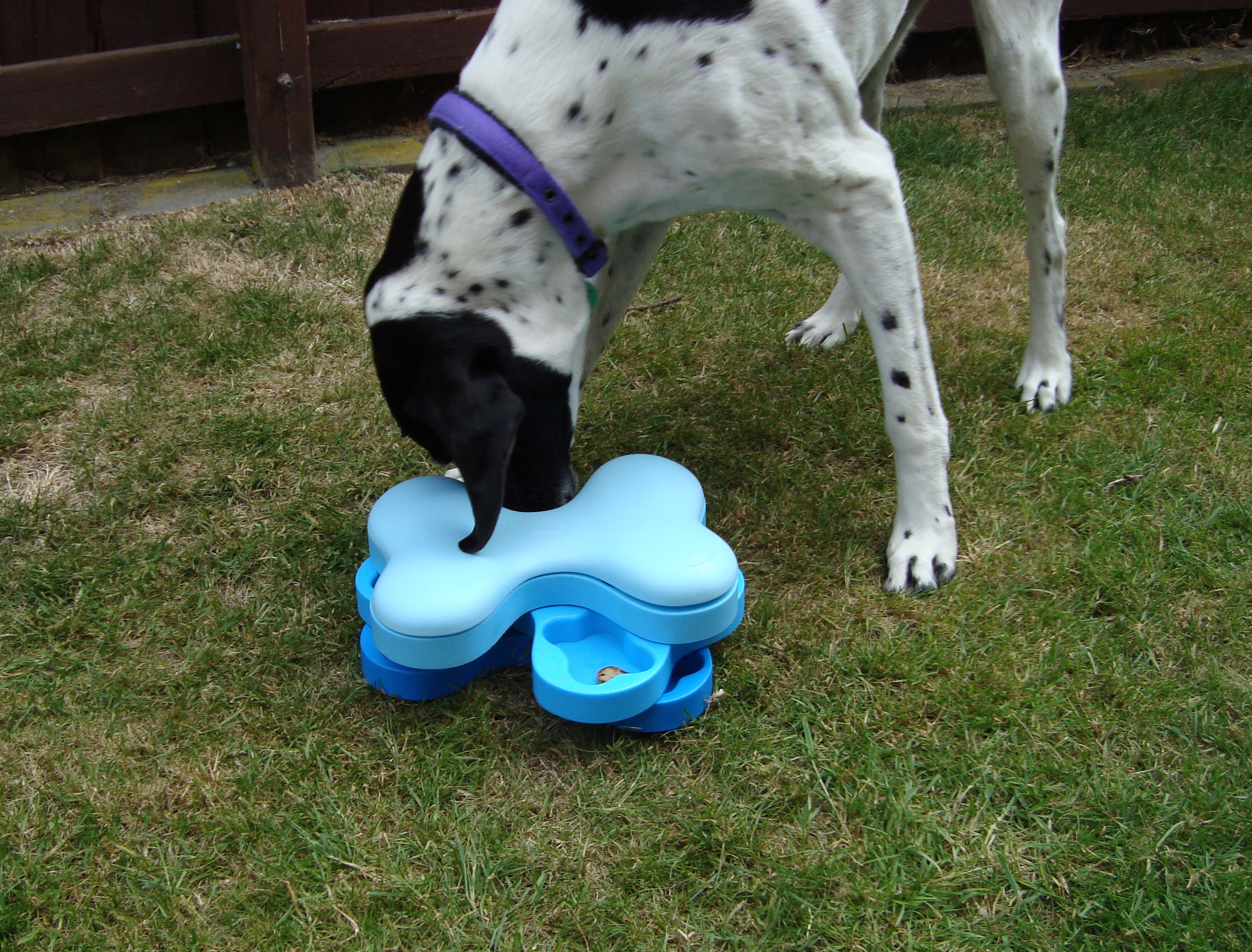
Even the dog toy market has recognised that dogs need mental stimulation.  The Nina Ottosson range, for example, offers a range of skill level toys designed to make your dog think about how to reveal their food reward.

Daisy demonstrates her intelligence with a Nina Ottosson toy

Despite all of this evidence, including videos of my Daisy using her interactive toys, many of the non-dog people in my life remain unconvinced about the intelligence of dogs.  I believe that persistence will pay off.  Over time we will see more and more research about the intellectual capacity of our dogs.  The non-believers will become believers.


[1] Science Daily, 10 August 2009