Category Archives: special dogs and awards

The 13,000 euro rescue operation

Skipper the Jack Russell Photo by Steffen Pletl

Skipper the Jack Russell Photo by Steffen Pletl

Skipper is a special Jack Russell.  After getting incredibly stuck in a badger sett, a complex network of tunnels underground, his owner had to call emergency services to dig him out.

After almost 7 hours of work, they managed to free Skipper.  During this time, they excavated 50 square metres of earth….all because he broke free from his leash when a friend was walking him in November 2012.  He followed his nose and, because he was dragging his leash, he became tangled.

His owner challenged the 13,000 euro bill she received; it’s been discounted to 10,000 in a settlement to end a court dispute.

How much would you spend to rescue your precious pooch?

Source:  The Times

A golden retriever mom for African wild dog puppies

Hot off the press from the Oklahoma City Zoo…a litter of endangered African Wild Dogs, also known as African Painted Dogs, has been born.

The birth mother, Xena, is only three years old and inexperienced.  It became clear to the keepers that the puppies needed a surrogate mother.  Enter Lilly, a special Golden Retriever with maternal skills.

Even though Lilly’s not an African wild dog, she’s still much better suited to surrogate for our pups than humans would be,” said Zoo Veterinarian Dr. Jennifer D’Agostino. “This is a positive for both Lilly’s offspring and the African wild dogs as they will benefit from initial socialization with a canine species.”

This is an example of yet another way to use dogs for work – helping to save an endangered species.

Kathleen Crisley, specialist in dog massage, rehabilitation and nutrition/food therapy, Canine Catering Ltd, Christchurch, New Zealand


Animal therapy’s positive effects on college students

Animal-assisted therapy can reduce symptoms of anxiety and loneliness among college students, according to researchers at Georgia State University, Idaho State University and Savannah College of Art and Design. Their findings are published in the latest issue of the Journal of Creativity in Mental Health.
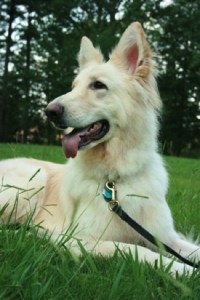
German Shepherd Sophie is a trained assistance dog.  Photo courtesy of Georgia State University

German Shepherd Sophie is a trained assistance dog. Photo courtesy of Georgia State University

The researchers provided animal-assisted therapy to 55 students in a group setting at a small arts college in the southeastern United States.  They found a 60 percent decrease in self-reported anxiety and loneliness symptoms following animal-assisted therapy, in which a registered therapy dog was under the supervision of a licensed mental health practitioner.

Eighty-four percent of the participants reported their interaction with the therapy dog, Sophie, was the most significant part of the program.

The group sessions were held twice monthly during an academic quarter. Students were invited to stop by and interact with the therapy dog as long as they wished, up to two hours. They were allowed to pet, hug, feed, brush, draw, photograph, sit near and play fetch with the therapy dog.

Dr. Leslie Stewart of Idaho State, who led the study, began the research as a Ph.D. student at Georgia State. She collaborated with Drs. Franco Dispenza, Lindy Parker and Catherine Chang of Georgia State and Ms. Taffey Cunnien of Savannah College of Art and Design.

The prevalence of anxiety and loneliness on college campuses has increased, placing extra demands on college counseling centers. Budget strains have made it necessary for these centers to find creative ways to meet the needs of their students.

This study suggests animal-assisted therapy could be an effective way for college counseling centers to meet the growing demands of their students. It is one of the first to apply animal-assisted therapy in a group, college setting and use a systematic form of measurement.

“College counseling centers are also becoming more and more reflective of community mental health agencies,” Dispenza said. “That’s something that’s been noted in the field in probably the last 10 to 15 years. College counseling centers aren’t seeing students struggling with academics, which major to pick or how to study. They’re coming in with post-traumatic stress disorder, anxiety disorders, pervasive mood disorders and considerable contextual strains that are happening out in the world, such as poverty and experiences of homelessness, as well as a history of medical issues and family health issues.”

To become a registered therapy dog, the animal and handler must complete a series of evaluations and courses, which involve their grooming, temperament, previous training and relationship with their handler. Dogs can be ideal therapy animals because they have become so domesticated and the seeming ability to read cues between dogs and humans is probably the most pronounced. For instance, a dog can tell when a human is sad, Dispenza said.

“The presence of a therapy dog facilitates a therapeutic connection between the client and the mental health professional,” Parker said. “When you’re trying to do mental health work with someone, establishing that therapeutic relationship and rapport is so important. Any way to do it faster or more effectively only helps facilitate the therapeutic process.”

Source:  Georgia State University media release

Secret Service guard dogs are in spotlight after latest White House fence jumping

Meet the special dogs guarding The White House in Washington DC…

Secret Service K-9 Hurricane - black Belgian Malinois, left, and Jordan - black/tan Belgian Malinois. (Courtesy of U.S. Secret Service)

Secret Service K-9 Hurricane – black Belgian Malinois, left, and Jordan – black/tan Belgian Malinois. (Courtesy of U.S. Secret Service)

Secret Service guard dogs are in spotlight after latest White House fence jumping

The dogs that conquered space -The Guardian

Space walkies … a postcard of Belka and Strelka in their rocket. Photograph: Fuel Publishing

Space walkies … a postcard of Belka and Strelka in their rocket. Photograph: Fuel Publishing

In the Soviet era, space travel was a major goal and stray dogs collected from the streets were the first explorers in the space program.  This article, by Oliver Wainwright, provides some insight into the propaganda behind the program and how they matched with reality.

It is a rather sad tale of how dogs were exploited in the name of progress, but such exploitation still occurs today in the name of science (arguably, with varying degrees of success, with more standards and controls in place).  Read the story by clicking on this link:  The dogs that conquered space | Art and design | The Guardian.

I have previously blogged about Laika the space dog; so be sure to check out that column for more information on Laika.

Kathleen Crisley, specialist in dog massage, rehabilitation and nutrition/food therapy, Canine Catering Ltd, Christchurch, New Zealand


Lucy and Remi: 2 great dog stories in 2 days

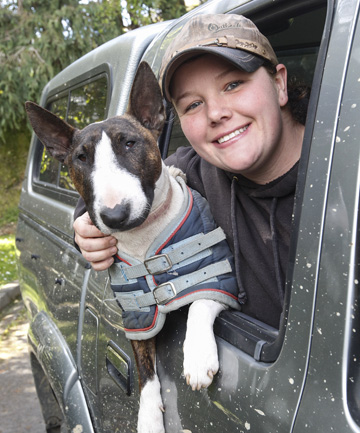
From the New Zealand papers this week…Lucy the dog helps save her owner when she falls down a cliff and Remi, a naughty Bull Terrier, alerts his owner to help save a trapped motorist.

Read the links – great stories!

Nikita McMurtrie and her dog, Lucy (Photo by Mytchall Bransgrove)

Nikita McMurtrie and her dog, Lucy (Photo by Mytchall Bransgrove)

Loyal Lucy alerts mum – national | Stuff.co.nz

Angel Marsh with Remi; credited with saving a man trapped in a wrecked car (Photo by Fairfax NZ)

Angel Marsh with Remi; credited with saving a man trapped in a wrecked car (Photo by Fairfax NZ)

Dog helps owner to find crash victim – national | Stuff.co.nz

Saying goodbye to Faith

Faith the dog 1

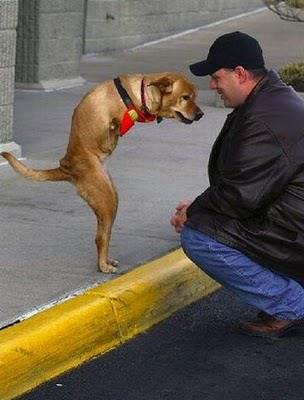
Faith, the biped dog who stole many hearts since being born in 2002, passed away on September 22, 2014.  Her family says that she was increasingly uncomfortable with arthritic pain over the last few months and it was time to let her go.

I first wrote about Faith in 2011 when I was doing some research on special needs dogs.  Faith’s adoptive family taught her to walk on her hind legs, rather than heeding advice from many ‘experts’ that she be put down.  She went on to become a wonderful therapy dog and an ambassador for special needs in general.

Faith with her manager, Mike Maguire

Faith with her manager, Mike Maguire

According to her family, Faith is probably running on all fours on the other side of the Rainbow Bridge.  They are accepting messages of condolence on Faith’s Facebook page.

You can read more about Faith’s inspiring story in the book by Jude Stringfellow, Faith Walks, available through Amazon.

Faith Walks

Kathleen Crisley, specialist in dog massage, rehabilitation and nutrition/food therapy, Canine Catering Ltd, Christchurch, New Zealand

New dog comforts victims

There’s a new staff member at the Suffolk Country District Attorney’s office in Massachusetts.  It’s Indy, a Golden Retriever/Yellow Labrador cross, who is the office’s new comfort dog.

Photo courtesy of Boston.com

Indy at her press conference (photo courtesy of Boston.com)

New Dog Comforts Victims in Suffolk DA’s Office – Massachusetts news – Boston.com.

Moxie, the 9/11 search dog

Moxie was a 3-year old urban search and rescue dog when she and her handler were called to the World Trade Center in September 2001.  Now, she’s a a retired senior dog who is still playing at the park.

Moxie with her owner Mark Aliberti in Coughlin Park, Winthrop, Massachusetts (photo by Kathleen McNerney/WBUR)

Moxie with her owner Mark Aliberti in Coughlin Park, Winthrop, Massachusetts (photo by Kathleen McNerney/WBUR)

Her handler, Mark Aliberti, recalls their experience at the World Trade Center site in this WBUR radio news story:

Source:  http://www.wbur.org/2011/09/07/sept-11-search-dogs

Making cadaver dogs more efficient

A PhD student at the University of Huddersfield (UK) is conducting research to make cadaver and victim recovery (VR) dogs more efficient in their work.

These special dogs are probably not as well known as other working and assistance dogs, because the work they are associated with isn’t pleasant.  They are used to recover dead bodies (victims of suicide or murder), plus to find body parts and fluids that can help police track down the perpetrators of crime.  VR dogs were used to identify body parts from victims of the 7/7 bombings in London, for example.

Kip, a victim recovery dog from the South Yorkshire Police department, has been helping in the research (photo courtesy of University of Huddersfield)

Kip, a victim recovery dog from the South Yorkshire Police Department, has been helping in the research (photo courtesy of University of Huddersfield)

In her experiments using Kip, researcher Lorna Irish set out a sequence of vials containing different odours that she had prepared in the lab.  These chemicals are known to be produced from the body decomposition process.  Alongside these test chemicals were “positive controls” associated with human cadavers, such as human bone – from archaeological sources – and pork at various stages of decomposition.  Pork meat is used for training such dogs due to the ethical and legal problems associated with obtaining human material.  It is thought to be the closest analogue for human flesh for decomposition studies.  There were also “negative controls” – smelly chemicals not associated with decomposition, such as clove oil.

Kip correctly identified the odours derived from decomposition and was not distracted by the “negative control” smells.  It was a successful demonstration. In the field, VR dogs can sometimes be distracted by “false positives”, such as dead animals, or even mushrooms, explained Lorna.  If she can arrive at a greater understanding of the chemistry of odours from human cadavers, then VR dogs can be extra efficient.

“If you train a dog with a chemical that is specific to human decomposition, you can enhance its ability.  It is not about changing the way the dogs do it, but improving it,” she added.

Irish is approximately half-way through the research for her degree; she is traveling widely across the UK to observe dog training methods.

Source: University of Huddersfield media statement